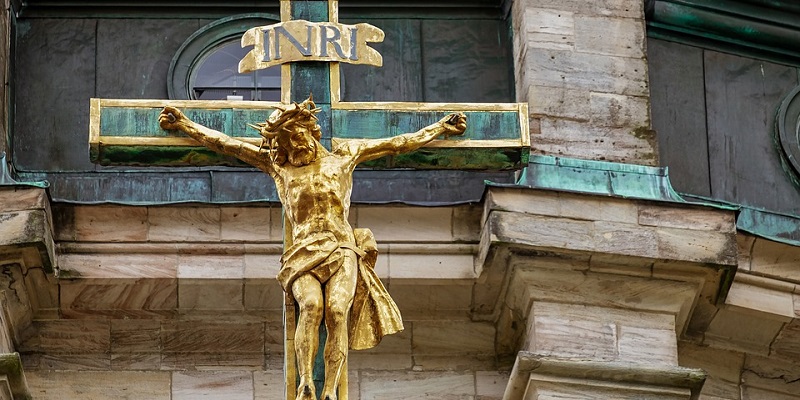
Extra Ecclesiam Nulla Salus is one of the dogmas that tends to present the greatest difficulties of understanding for both Catholics and non-Catholics; some of the latter think the dogma is no longer in force, while others interpret it rigorously, applying the maxim to those who have never heard the Gospel.
I will first treat the basic doctrine as taught by the Catechism of the Catholic Church, then make reference to some of the dogmatic definitions of the Magisterium, and finally briefly summarize the reflections of theologians, popes, and Doctors of the Church.
Because the subject is quite extensive, I will not be able to cover everything I would wish, and I will limit myself to mentioning those contributions I consider most important. Those who wish to explore the topic further are invited to consult the following works, which I have used in preparing this summary:
Francis A. Sullivan, Salvation Outside the Church? Tracing the History of the Catholic Response, Paulist Press, 1992.
Prudencio Damboriena, La salvación en las religiones no cristianas (Salvation in the Non-Christian Religions), Biblioteca de Autores Cristianos, Madrid 1972.
Explanation of the Dogma Extra Ecclesiam Nulla Salus in the Catechism of the Catholic Church
The Church’s teaching regarding this truth of faith is summarized in the Catechism of the Catholic Church as follows:
“Outside the Church there is no salvation”
846 How are we to understand this affirmation, often repeated by the Church Fathers? Re-formulated positively, it means that all salvation comes from Christ the Head through the Church which is his Body:
Basing itself on Scripture and Tradition, the Council teaches that the Church, a pilgrim now on earth, is necessary for salvation: the one Christ is the mediator and the way of salvation; he is present to us in his body which is the Church. He himself explicitly asserted the necessity of faith and Baptism, and thereby affirmed at the same time the necessity of the Church which men enter through Baptism as through a door. Hence they could not be saved who, knowing that the Catholic Church was founded as necessary by God through Christ, would refuse either to enter it or to remain in it (LG 14).
847 This affirmation is not aimed at those who, through no fault of their own, do not know Christ and his Church:
Those who, through no fault of their own, do not know the Gospel of Christ or his Church, but who nevertheless seek God with a sincere heart, and, moved by grace, try in their actions to do his will as they know it through the dictates of their conscience — those too may achieve eternal salvation (LG 16; cf. DS 3866-3872).
848 “Although in ways known to himself God can lead those who, through no fault of their own, are ignorant of the Gospel, to that faith without which it is impossible to please him, the Church still has the obligation and also the sacred right to evangelize all men.” (AG 7).
Definitions of the Dogma by the Magisterium of the Church
Pope Innocent III in the year 1208 imposed on the Waldensians a profession of faith:
“We believe with our hearts and confess with our lips one Church, not of heretics, but the holy, Roman, catholic, and apostolic Church, outside of which we believe that no one is saved.”[1]
The Fourth Lateran Council in the year 1215, directed against the Albigensians, defined:
“There is indeed one universal Church of the faithful, outside of which nobody at all is saved.”[2]
Pope Boniface VIII, in his bull Unam Sanctam in the year 1302, wrote:
“We are compelled in virtue of our faith to believe and maintain that there is only one holy Catholic Church, and that one is apostolic. This we firmly believe and profess without qualification. Outside this Church there is no salvation and no remission of sins.”[3]
“Furthermore, we declare, we proclaim, we define that it is absolutely necessary for salvation that every human creature be subject to the Roman Pontiff.”[4]
The Council of Florence in the year 1442, in its decree for the Jacobites (a profession of faith for the reconciliation of various Monophysite groups), reiterated:
“(The holy Roman Church) firmly believes, professes, and proclaims that those not living within the Catholic Church, not only pagans, but also Jews and heretics and schismatics cannot become participants in eternal life, but will depart into everlasting fire which was prepared for the devil and his angels, unless before the end of life the same have been added to the flock… and that no one, whatever almsgiving he has practiced, even if he has shed blood for the name of Christ, can be saved, unless he has remained in the bosom and unity of the Catholic Church.”[5]
Pope Pius IV, in his bull Iniunctum nobis — known as the Profession of Faith of the Council of Trent (1564) — again repeated:
“…this true Catholic faith, outside of which no one can be saved.”[6]
Pope Pius IX, in his allocution Singulari quadam of the year 1854:
“It must be held by faith that outside the Apostolic Roman Church, no one can be saved; that this is the only ark of salvation; that he who shall not have entered therein will perish in the flood.”[7]
The same Pope Pius IX in his encyclical Quanto conficiamur moerore of the year 1863:
“The Catholic dogma is also well known, namely, that no one can be saved outside the Catholic Church.”[8]
The Controversy Surrounding the Dogma
On the Protestant side, this dogma is attacked from several directions.
Some use it to attack papal infallibility, claiming that Catholic doctrine on this point has changed substantially and is therefore self-contradictory. They object that at first it was maintained that no one could be saved outside the Church, and now the opposite is asserted.
Others, more perceptive than the foregoing, understand that the dogma has undergone no substantial change and therefore remains unshaken. They reject it as an arrogant claim on the part of the Church to monopolize salvation, which for them is achieved through “Faith Alone” in Christ.
On the traditionalist side, there are tendencies that, clinging to a rigorist interpretation of the dogma, understand it in a literal and absolute sense, excluding from salvation those who through invincible ignorance never had the opportunity to hear the Gospel. Some, falling into sedevacantism, go so far as to brand the Second Vatican Council and the popes who followed it as heretical.
On the progressive side, the dogma is rejected as an obsolete definition, and, falling into religious indifferentism, such persons hold that all religions are valid paths to salvation.
Development or Evolution of the Dogma?
Faced with attacks from both Protestantism and certain traditionalists, one might be tempted to think that the Catholic Church has indeed substantially changed its doctrine on this point, since some dogmatic definitions appear to leave no room for exceptions when they flatly state that no one is saved outside the Church, while others seem to indicate the contrary.
One cannot speak here of the dogma having “evolved,” for the very concept of evolution implies the transformation or change of something into something altogether different. To apply this term to Christian doctrine would mean falling into the relativism of asserting that what is true today may cease to be true tomorrow — a notion that has been rejected by the Magisterium.[9] What Catholic doctrine recognizes as legitimate is the development of Christian doctrine, defined as growth in depth and clarity of understanding of the truths of Divine Revelation, while the substance at the core of each doctrine remains immutable.
In this sense the term development differs from evolution in that when something or someone develops, it does not substantially change nor cease to be what it is. Consider, for example, a dinosaur that evolves into a present-day animal — once evolved, it no longer belongs to the same species and is no longer what it was; but a child who develops and becomes a man, though different, remains the same human being. The same example can be applied to a seed that grows into a leafy tree: though different, it remains the same living thing and retains its own nature.[10]
In this regard, the First Vatican Council declares:
“The meaning of the sacred dogmas which has once been declared by holy mother Church must be perpetually retained, and there must never be any deviation from that meaning on the specious grounds of a more profound understanding. Therefore, let the understanding, the knowledge, and the wisdom of individuals as well as of all, of one person as well as of the whole Church, grow and progress strongly with the passage of the ages and the centuries; but this only in its proper kind, that is to say, in the same doctrine, the same sense, and the same understanding.”[11]
It is necessary to affirm that there has been no substantial change regarding the dogma “outside the Church there is no salvation.” But before entering fully into the subject, it is opportune to cite the declaration Mysterium Ecclesiae of 1973, in which the Congregation for the Doctrine of the Faith clarifies the distinction between the substance of a truth of faith and its historical expression:
“Difficulties (in the transmission of Divine Revelation by the Church) also arise from the historical condition that affects the expression of Revelation. In relation to this historical condition, it must first be observed that the meaning of the pronouncements of faith depends partly on the expressive power of the language used at a certain point in time and in particular circumstances. Moreover, it sometimes happens that some dogmatic truth is expressed first in an incomplete manner (but not a false one), and at a later date, when considered in a broader context of faith or human knowledge, it receives a fuller and more perfect expression.”[12]
The Church Regarding Salvation in the Times Before the Coming of Christ
If we review what the early Fathers held on this point, we find that they all agreed that God had provided means of salvation for all people in the pre-Christian era, including those who did not belong to the chosen people. Though explained in various ways, they maintained that those who were saved were saved through Christ. Here are some relevant excerpts:
Justin Martyr (100–165 A.D.)
“I stated that each one will be saved by his own justice. I also said that those who lived according to the law of Moses would likewise be saved. For in the law of Moses there are commanded things that are by nature good and holy and just, for those who believe to do; while other things written with a view to the hardness of heart of the people were practiced by those under the law. Thus, those who fulfilled what is universally, naturally, and eternally good were pleasing to God and will be saved through Christ in the resurrection, just as the righteous men who preceded them — Noah, Enoch, Jacob, and as many as there were — together with those who acknowledge this Christ as the Son of God.”[13]
“Some, without reason, in order to refute our teaching, might object to us that, since we say Christ was born only one hundred and fifty years ago under Quirinius, and subsequently taught during the time of Pontius Pilate, those who lived before Him are not responsible for their deeds. Let us resolve this difficulty in advance. We have been taught that Christ is the first-born of God, and we have indicated above that He is the Word of whom every race of men have been partakers. Those who lived according to the Word are Christians, even though they were called godless — such as, among the Greeks, Socrates and Heraclitus and those like them; and among the barbarians, Abraham, Ananias, Azarias, Misael, and many others.”[14]
Clement of Alexandria (150–215 A.D.)
“God cares for all, since He is Lord of all, and is the Saviour of all; it cannot be said that He is the Saviour of some and not of others. As each was disposed to receive it, He distributed His blessing both to the Greeks and to the barbarians, and in their own time were called those who were predestined to be among the faithful elect.”[15]
Origen (185–254 A.D.)
“Can it then be said that God took no account of human life until He began to be concerned about it now, after so many ages? Our answer to this is that God never ceased to take account of human life, but has always provided occasions for the practice of virtue for the correction of the rational soul. And so it is that in every generation the wisdom of God descends to souls which it finds holy, and makes them friends of God and prophets.”[16]
John Chrysostom (347–407 A.D.)
“Therefore, when the pagans raise this objection against us: What was Christ doing when He took no care of the human race? Why, after having forgotten us for so long a time, did He come to procure our salvation only at the end of the ages? — we shall answer them that He was already in the world before His coming among men, that from all eternity He thought upon the works He was to accomplish, and that He was known by all those who were worthy to know Him.
And if you then say that He was not known, since He was not known by all but only by the upright and virtuous, by the same reasoning you ought to say that He is not adored by men even now, since many of them have no knowledge of Him.”[17]
Augustine of Hippo (354–430 A.D.)
“Therefore, from the very beginning of the human race, all those who believed in Him, who in any way understood Him and lived justly and piously according to His precepts, were without doubt saved through Him, wherever and however they lived… In this way the salvation of this religion, by which alone true salvation is truly and truthfully promised, was not lacking to anyone who was worthy of it. And if it was lacking to anyone, that person was not worthy to receive it.”[18]
Regarding the Salvation of Non-Christians in the First Three Centuries
In the Christian era, however, we find a different situation, in which the instituted Church obeys Jesus’s command to preach the Gospel to all nations:
“Go into all the world and preach the gospel to the whole creation. He who believes and is baptized will be saved; but he who does not believe will be condemned.”[19]
These words of Christ pronounce condemnation upon those who, having received the Gospel message, reject it and turn away from the truth. It is in this context that we find the texts of the early Fathers — St. Ignatius of Antioch, St. Irenaeus of Lyon, Origen, and St. Cyprian — in which they speak of persons excluded from salvation for being outside the Church. But a careful reading of the texts and their context reveals that they were referring to those whom they judged guilty of the separation, specifically for the sins of heresy or schism. No reference whatsoever can be found to those who had never received the message.
Ignatius of Antioch (? – 107 A.D.)
“Do not err, my brethren. If any man follows him that makes a schism in the Church, he shall not inherit the kingdom of God. If any one walks according to a strange opinion, he agrees not with the passion of the Lord.”[20]
Irenaeus of Lyon (130–202 A.D.)
“In the Church, God has placed Apostles, Prophets, teachers, and every other working of the Spirit, of which none of those who do not run to the Church are partakers, but who deprive themselves of life through their perverse minds and still more perverse conduct. For where the Church is, there is the Spirit of God; and where the Spirit of God is, there is the Church, and every kind of grace.”[21]
Origen (185–254 A.D.)
“Let no one therefore persuade himself, let no one deceive himself: outside this house, that is, outside the Church, no one is saved. For if anyone goes out of it, he is himself responsible for his own death.”[22]
Cyprian of Carthage (200–258 A.D.)
“Let them not think that the path of life or salvation exists for them, if they have refused to obey the bishops and priests, since the Lord says in the Book of Deuteronomy: ‘The man who acts presumptuously, by not obeying the priest who stands to minister there before the LORD your God, or the judge, that man shall die.’ And then they were killed with the sword… but now, the proud and insolent are killed with the sword of the Spirit, when they are cast out from the Church. For they cannot live outside it, since there is only one house of God, and there can be no salvation for anyone except in the Church.”[23]
“For the heretic, neither the baptism of public confession nor that of blood can avail unto salvation, because there is no salvation outside the Church.”[24]
“He who abandons the Church of Christ attains not to Christ’s rewards. He is an alien, a worldling, and an enemy. He can no longer have God for his father, who has not the Church for his mother. He who is separated from the Church is joined to an adulteress and cut off from the promises of the Church.”[25]
“While you are still in this world, repentance is never too late. Even at the very gates of death you may seek forgiveness of your sins, appealing to the one true God. For God’s goodness grants absolution to the believer unto salvation, to pass from death to immortality. It is Christ who grants this grace.”[26]
Regarding the Salvation of Non-Christians from the Fourth Century Onward
By the fourth century the situation of the Church began to change. The persecution of Christians ended with the edicts of the emperors Galerius (311) and Constantine (313), and Christianity was declared by Emperor Theodosius I[27] to be the official religion of the empire.
The judgment of culpability applied to Christian schismatics for having voluntarily placed themselves outside the Church was extended also to Jews and pagans, in a context that presupposed the Gospel message had by then been proclaimed throughout the entire known world, giving all people sufficient opportunity to accept it. The negative judgment rested on the assumption that the Christian message had been preached to all with sufficient clarity for them to grasp the truth, so that those who refused to accept it were voluntarily excluding themselves from the kingdom of God.
That some were excluded from salvation was not regarded, in any case, as an arbitrary decree of God. Those who were condemned were not condemned because God willed that they not be saved, but because they had rejected the means God had placed at their disposal for salvation.
Ambrose of Milan (340–397 A.D.)
“If anyone does not believe in Christ, he deprives himself of the universal benefit, as one who shuts his window against the rays of the sun. For the mercy of the Lord has been poured out by the Church upon all nations; faith has been distributed to all peoples.”[28]
John Chrysostom (347–407 A.D.)
“One ought not to believe that ignorance excuses unbelievers… When you are ignorant of what can easily be known, you must suffer punishment… When we do all that is in our power in matters we do not know, God will extend His hand to us; but if we do not do what we can, we will not enjoy God’s help… So do not say: ‘Why has God abandoned that sincere and honest pagan?’ You will realize that he was not truly diligent in seeking the truth, since truth is now clearer than the sun. How will those obtain pardon who, seeing the doctrine of truth laid before them, make no effort to know it? For now the man of God is proclaimed to all… It is impossible for anyone who is attentive in seeking the truth to be overlooked by God.”[29]
The Influence of Augustine of Hippo
Although St. Augustine recognized the possibility of salvation for non-Christians through implicit faith in God in the pre-Christian era, he was rigorous in his view of the impossibility of salvation for such persons in the age of the New Testament.
It is known that St. Augustine was aware of the existence of tribes and peoples in Africa outside the limits of the Roman Empire who had never received the preaching of the Gospel.[30] These people could not be said to have “culpably” placed themselves outside the Church, and one might have expected the saint to apply the same criterion he used for those who lived before the coming of Christ. Nevertheless, he excludes them from the possibility of salvation — first maintaining that if God withheld faith from someone it was because He foresaw that were it offered to that person it would be rejected, and later arguing that the penalty incurred through original sin was sufficient justification for God to condemn not only children who died without baptism but also adults who died in ignorance of the Christian faith.
He was unable to find a solution regarding the possibility of salvation for those who die without baptism and outside the Church, yet one cannot reproach him for what would only be fully clarified by subsequent theological development.
The Disciples of Augustine
Among Augustine’s various disciples, some followed his line of thought and others knew how to depart from it on these problematic points.
One who followed his line was St. Fulgentius, bishop of the city of Ruspe in North Africa, who, by adhering too closely to St. Augustine on these points, went so far as to deny God’s universal salvific will — that God wills all men to be saved:
“If it were true that God willed universally that all be saved and come to the knowledge of the truth, how is it that this Truth has hidden from some men the mystery of His knowledge? Surely, to those to whom He denied such knowledge, He also denies salvation… Therefore, He willed to save those to whom He gave the knowledge of the mystery of salvation, and did not will to save those to whom He denied the knowledge of the saving mystery. If He had willed the salvation of both, He would have granted the knowledge of the truth to both.”[31]
Another of his disciples, however — St. Prosper of Aquitaine — was able to discern between the essential doctrine of Augustine regarding the primacy of grace and some of the consequences Augustine believed followed from this principle. Thus, unlike St. Fulgentius, he affirms that God does indeed will that all men be saved, while at the same time acknowledging that the case of children who die without baptism remains for him an unsolvable mystery, which he leaves to the mercy of God.
Regarding the problem of those who die as unbelievers because they never heard the Gospel, he writes:
“There is no reason to doubt that Jesus Christ Our Lord died for unbelievers and sinners. If there had been any who did not belong to these categories, then Christ would not have died for all. But He died for all men without exception…”[32]
“It may be true that, just as we know that in former times some were not admitted to the dignity of the sons of God, so today, in the remotest parts of the world, there are some nations that have not yet seen the light of the grace of the Savior. But we have no doubt that in the hidden plan of God, a time of calling has been established even for them, in which they will hear and accept the Gospel that now remains unknown to them. Even now they receive that measure of general help which the heavens have always granted to every man.”[33]
“…we believe with total confidence in the goodness of God who ‘desires all men to be saved and to come to the knowledge of the truth.’ We must hold this as His immutable will from all eternity, which is manifested in the various degrees in which He, in His wisdom, chooses to increase His general gifts with special favors.”[34]
Thomas Aquinas
St. Thomas, like the medieval theologians, considered the case of one who had had no opportunity to hear the Gospel to be something altogether exceptional — for him such a case would be like that of a child raised in the jungle or among beasts. For such cases he affirms that God would not leave a person without the necessary means for salvation, provided that person does everything within his power with the grace received, so that before the end of his life he might arrive at an explicit faith:
“If we speak of what man is able to do without the aid of healing grace: he is bound to many things which without such aid he cannot do — for example, to love God and neighbor, and likewise to believe the articles of faith. But all of these things he is able to do with the aid of grace. This aid of grace, to those to whom it is divinely given, is given through mercy; but to those to whom it is denied, it is denied through justice, in punishment of some preceding sin, at least of original sin, as Augustine states in De correptione et gratia.”[35]
The Discovery of the New World and the Growth of Theological Reflection on the Dogma
With the discovery of America, theologians began to realize that the cases of those who had not heard the Gospel were neither so few nor so exceptional as they had supposed, for they were confronted with a situation in which countless people had lived without knowing the Gospel — through no fault of their own — for more than fifteen hundred years.
The solution proposed up to that point by St. Thomas proved insufficiently satisfactory, for it was very difficult to reconcile how entire populations of a continent, never having heard any preaching, could arrive at an explicit faith. It is here that Melchor Cano O.P.[36], while following the line of St. Thomas, goes one step further and concludes that for persons of good heart who cooperate with the grace they receive, it is sufficient to make an act of implicit faith as described in Hebrews 11:6. A similar solution was maintained by Domingo de Soto O.P.[37].
Protestantism, foreign to the dogma but professing that no one could be saved without confessing faith in Christ, had resolved the situation of the native Americans who died without hearing the Gospel in a far simpler way: all to hell. For John Calvin, for example, God had predestined to eternal condemnation those who were deprived of the knowledge of the Gospel. If God did not grant them revelation, it was because He had abandoned them to their wickedness, and no one could question this since it was part of God’s “inscrutable decree.” It is in this context that Albert Pigge, opposing Calvinist rigorism, maintains that God’s providence fixes different times for the promulgation of the Gospel to different groups of people, and provides all with the means to be saved:
“This is entirely true: that it is impossible to establish any one time at which it could be said, or could ever be said, that the Gospel was sufficiently promulgated to the whole world. For God has not determined the same time of calling for all nations. Even now, in many regions of the world, there are many nations where the light of the Savior has not yet shone, and an ever-increasing number to whom this light is only beginning to shine through missionaries. There can be no doubt that such persons are in the same condition as Cornelius was before being instructed in the faith by Peter.”[38]
The Contribution of Robert Bellarmine
St. Robert Bellarmine[39] addressed the case of persons who never heard the Gospel, explaining that God’s universal salvific design provides everyone with the possibility of being saved, at least at some moment and in some place.
“We say ‘at some moment or place,’ because we do not determine whether this help is available at every moment of a person’s life… We say that there is no one who does not receive, at some moment, this help. We then say ‘mediately or immediately,’ because we believe that those who have the use of reason receive holy inspirations from God, and thus, without any other mediation, have enabling grace, and if they cooperate with it, can dispose themselves for justification and, finally, attain salvation.”[40]
“People to whom the Gospel has not yet been preached can come to know the existence of God through creatures, and thus can be moved by prevenient grace to believe that God exists and rewards those who seek Him; and from that faith they can then be led by God who guides and helps them to prayers and works of charity, and in this way can obtain, through prayer, a greater light of faith, which God will readily communicate to them, either directly, or through the mediation of men or angels.”[41]
A similar solution was maintained by Francisco Suárez[42].
Development of the Concept of Invincible Ignorance up to the Second Vatican Council
In this way the Church began to develop an awareness that there are many who find themselves in a certain condition in which they cannot be considered culpable for their separation from the Catholic Church.
The Contribution of Juan de Lugo, S.J.
Although De Lugo[43] maintained essentially the same position as Bellarmine and Suárez, he developed the concept of invincible ignorance further, applying it not only to those who had never heard the Gospel, but also to those to whom the Gospel had not been preached effectively enough to move them powerfully toward conversion. He distinguishes between the situation of a heresiarch who separates himself from the Church through stubbornness and that of one who was born within a schism or in some heretical sect and has had no way of realizing he is in error.
“Those who do not believe with the Catholic faith can be divided into various categories. There are some who, although they do not believe all the dogmas of the Catholic religion, acknowledge the one true God; these are the Turks and all Muslims, as well as the Jews. Others acknowledge the Triune God and Christ, as do most heretics… Now, if those persons are excused from the sin of infidelity through invincible ignorance, they can be saved.”[44]
“Someone who is baptized as an infant by heretics, and is raised by them in false doctrine, when he reaches adulthood may not be guilty for a time of sin against the Catholic faith, since it has not been presented to him in a manner sufficient to oblige him to accept it. However, if the Catholic faith were later proposed to him in a manner sufficient to oblige him to accept it, and to abandon the errors contrary to it, and he still persisted in his error, then he would be a heretic.”[45]
Giovanni Perrone, S.J.
The contribution of Giovanni Perrone[46] is similar to those of his predecessors: on the one hand he reaffirms the dogma, while on the other he emphasizes that it applies to those who are culpably in a state of separation from the Church.
“For those who die in a culpable state of heresy, schism, or unbelief, there can be no salvation; in other words, salvation cannot be obtained outside the Catholic Church. Therefore, as follows from the way the proposition is stated, we are speaking only of those who are culpably in a state of heresy, schism, or unbelief.
In other words, we speak only of formal sectarians, not merely material ones. The latter are so by reason of having been raised from infancy in errors and prejudices, and they do not suspect that they are truly in heresy or schism; or if such a suspicion arises in their minds, they seek the truth with all their heart and with a sincere mind. Let us leave such persons to the judgment of God, for He it is who looks within and examines the thoughts and ways of the heart. For the goodness and mercy of God do not permit that anyone who is not guilty of a deliberate fault should suffer eternal torments in hell. To assert the contrary would be contrary to the explicit teaching of the Church.”[47]
“It belongs to divine providence to offer sufficient means for the salvation of all men. By virtue of the fact that God wills that all men be saved, and that no one can be saved without faith, God grants to all who do not place an obstacle — and sometimes even to those who do, because this grace is unmerited — through His mercy and in virtue of the merits of Christ, either an internal supernatural illumination or revelation, or causes them to receive instruction from others on the faith; and in this way they can be justified and saved. Moreover, this mode of action on God’s part is not to be regarded as miraculous, because it belongs to God’s ordinary supernatural providence.”[48]
Pope Pius IX
The testimony of Pope Pius IX is significant. As already cited, in his allocution Singulari quadam of 1854 he had likewise maintained that “no one can be saved outside the Church”; however, in that same allocution he qualifies this and adds that God does not condemn the innocent who never heard the message of the Gospel, so that the expression Extra Ecclesiam Nulla Salus does not apply to them. At the same time he combats religious indifferentism — under which all religions were believed to be paths to salvation — as well as the rigorism that excluded from salvation those who, through no fault of their own, were separated from the Church:
“Not without sorrow have we learned that another error, no less destructive, has taken possession of some parts of the Catholic world and has entered into the minds of many Catholics who think that one may well hope for the eternal salvation of all those who have in no way lived in the true Church of Christ. For this reason they are wont frequently to ask what is to be the fate and condition after death of those who have never given themselves to the Catholic faith and, guided by the most absurd reasons, they expect an answer favorable to their depraved opinion. We do not wish at all to set bounds to the divine mercy which is infinite; far be it from us to penetrate the hidden counsels of God which are an unfathomable abyss. Consistent with our Apostolic duty, we desire to arouse your episcopal solicitude and vigilance to drive from the minds of men, by every effort at your command, that impious and fatal opinion that the path of eternal salvation can be found in any religion. With all the learning and skill at your disposal, you are to demonstrate to the people committed to your charge that the dogmas of the Catholic faith are in no wise opposed to divine mercy and justice. It is indeed necessary to hold as a matter of faith that no one can be saved outside the Apostolic Roman Church, which is the only ark of salvation, and that those who do not enter it will perish in the flood. Yet at the same time, it must likewise be held as certain that those who labor in ignorance of the true faith, if that ignorance is invincible, will not be held guilty of this in the eyes of God. Who would presume to set limits to human ignorance, bearing in mind the infinite variety of peoples, lands, natural gifts, and so many other circumstances?”[49]
Nine years later the same Pope addressed the same topic in an encyclical directed to all the bishops of Italy:
“We must once again mention and reprove a very grave error in which some unfortunate Catholics have unhappily fallen, believing that persons living in error and far from the true faith and Catholic unity can attain eternal life. This is most opposed to Catholic teaching. It is known to us and to you that those who labor in invincible ignorance of our most holy religion, and who, keeping the natural law and its precepts inscribed by God in the hearts of all, and being disposed to obey God, live an honest and upright life, can, by the operating power of divine light and grace, attain eternal life, since God, who clearly sees, searches, and knows the minds, the intentions, the thoughts, and the habits of all, in His supreme goodness and clemency will by no means allow anyone who is not guilty of deliberate sin to suffer eternal punishments. But it is also a perfectly well-known Catholic dogma that no one can be saved outside the Catholic Church, and that those who are obstinate toward the authority and definitions of the same Church, and who pertinaciously remain separated from the unity of that Church and from the successor of Peter, the Roman Pontiff — to whom the Savior entrusted the custody of the vineyard — cannot obtain eternal salvation.”[50]
The Pope is not saying that invincible ignorance is a cause of salvation, but that it is a cause of non-culpability. Nor is he saying that people are saved merely by observing the moral law — which would be Pelagianism — but rather emphasizing that they can be saved “through the operating light and grace of God.”
Pope Pius XII
In his encyclical Mystici Corporis, Pope Pius XII acknowledges the possibility of salvation for those who are inculpably outside the Church:
“We urge each and every one of them to be ready to follow the interior movements of grace, and to seek earnestly to free themselves from a state in which they cannot be sure of their own salvation. For even though by a certain unconscious desire and longing they may be related to the Mystical Body of the Redeemer, they still remain deprived of so many precious gifts and helps from heaven which can only be enjoyed in the Catholic Church.”[51]
In this text the Pope emphasizes that they “cannot be sure” of their salvation — which neither affirms nor denies that they may be saved — while speaking of how they may be related to the Mystical Body of Christ by “an unconscious desire and longing,” in a manner similar to what St. Robert Bellarmine had already maintained in the sixteenth century.
The Case of Leonard Feeney
In the late 1940s a controversy arose when Father Leonard Feeney denounced Archbishop Richard Cushing for heresy for declaring that non-Catholics could be saved. Father Feeney interpreted the dogma in a rigorist sense, and after accusing the bishop, the latter appealed to Rome for an authoritative interpretation. The following are the most relevant excerpts from the response of the Holy Office:
“Among the truths that the Church has always preached and will never cease to preach, is contained that infallible statement which teaches us that ‘outside the Church there is no salvation.’ However, this dogma must be understood in the sense in which the Church herself understands it. For our Savior did not entrust the deposit of faith to be interpreted by private judgment, but to the Magisterium of the Church…
For this reason, no one will be saved who, knowing that the Church was divinely instituted by Christ, nevertheless refuses to submit to the Church or withholds obedience from the Roman Pontiff, the Vicar of Christ on earth…
Since for obtaining eternal salvation it is not always required that a person be incorporated in fact (reapse) as a member of the Church, it is nonetheless required that he belong to it at least in desire and longing (voto et desiderio). But this desire need not always be explicit, as it is in catechumens; on the contrary, when a person is in invincible ignorance, God accepts also an implicit desire, so called because it is contained in that good disposition of soul by which a person wishes his will to be conformed to the will of God.
These things the Supreme Pontiff Pius XII teaches clearly in his dogmatic letter on the Mystical Body of Christ… Towards the end of the encyclical, when with all his heart he invites to unity all those who do not belong to the body of the Catholic Church, he mentions those who “by a certain unconscious desire and longing are directed to the Mystical Body of the Redeemer.” However, he does not exclude such persons from eternal salvation, but on the other hand he observes that they are in a state “in which they cannot be sure of their salvation…
With these prudent words he reproves both those who exclude from eternal salvation all who are united to the Church only by an implicit desire, and those who falsely assert that men can be saved equally well in every religion. Nor should it be thought that any desire whatsoever of entering the Church is sufficient for a person to be saved. It is necessary that the desire by which one is related to the Church be animated by perfect charity; nor can an implicit desire produce its effect unless the person has supernatural faith.[52]
Conclusions
All the foregoing theological development has culminated in the present teaching contained in the Second Vatican Council and summarized in the Catechism. The core of the teaching, though expressed in various ways according to different historical contexts, has always emphasized the necessity of the Church for salvation, together with the universal salvific will of God who desires that all men be saved — while at the same time rejecting both religious indifferentism, for which all religions are paths to salvation, and the rigorism that would definitively exclude from salvation those who, through no fault of their own, do not know Christ or His Church.
Notes
- Denzinger-Schönmetzer, Enchiridion symbolorum, definitionum, declarationum, 34th edition, 1967, 792 ↩
- Ibid., 802 ↩
- Ibid., 870 ↩
- Ibid., 875 ↩
- Ibid., 1351 ↩
- Ibid., 1870 ↩
- Ibid., 2865 ↩
- Ibid., 2867 ↩
- Pope Pius X ordered the clergy to take an anti-modernist oath in which they were required to declare: “I absolutely reject the heretical fiction of the evolution of dogmas, according to which they could pass from one meaning to another, different from the one the Church first professed” (Denzinger-Schönmetzer 3541). ↩
- It is possible to use the term “evolution” specifying that it is an evolution in the same sense, and not a transformist evolution. Highly recommended in this regard is the work of Father Francisco Marín-Sola entitled La evolución homogénea del dogma católico (The Homogeneous Evolution of Catholic Dogma). ↩
- Op. cit. Denzinger-Schönmetzer 3020 ↩
- Acta Apostolicae Sedis 65, 1973, 402-403 ↩
- Justin Martyr, Dialogue with Trypho, 45,3Daniel Ruiz Bueno, Padres Apologetas Griegos, BAC 116, Third Edition, Madrid 1996, p. 375-376 ↩
- Justin Martyr, First Apology, 46,1-3Ibid., p. 232-233 ↩
- Clement of Alexandria, Stromata 7,2New Advent, Fathers of the Church, http://www.newadvent.org/fathers/02107.htm ↩
- Contra Celsum 4,7New Advent, Fathers of the Church, http://www.newadvent.org/fathers/04164.htm ↩
- John Chrysostom, In Ioannem hom. 8; pg 59,67-68New Advent, Fathers of the Church, http://www.newadvent.org/fathers/240108.htm ↩
- Augustine of Hippo, Letter 102,12.15.Complete Works of St. Augustine, Vol. VIII, BAC 69, Madrid 1986, pp. 719 and 722 ↩
- Mk 16:15-16 ↩
- Ignatius of Antioch, Letter to the Philadelphians 3,3Daniel Ruiz Bueno, Padres Apostólicos, BAC 65, Fifth Edition, Madrid 1985, p. 483 ↩
- Irenaeus of Lyon, Against Heresies 3,24,1 ↩
- Origen, Homiliae in Jesu Nave 3,5 pg. 12, 841-842 ↩
- Cyprian of Carthage, Letter 4,4; Corpus scriptorum ecclesiasticorum latinorum 3,2: 476-477 ↩
- Cyprian of Carthage, Letter 73,21; Corpus scriptorum ecclesiasticorum latinorum 3,2; 795 ↩
- Cyprian of Carthage, The Unity of the Church, 6,77. AWC 25,48-49 ↩
- Cited from M. Bévenot, Salus extra ecclesiam non est (St. Cyprian), in Fides Sacramenti, Sacramentum Fidei, ed. H. J. Auf der Maur, Assen 1981, p. 105. ↩
- Theodosius I was emperor of the Roman Empire from the year 379 to 395. ↩
- Ambrose of Milan, In Psalmum 118, Sermon 8, 57; Migne Patrologia Latina 15, 13-18. ↩
- John Chrysostom, In Epist. ad Rom. Hom. 26, 3-4; PG 60, 641-642. ↩
- He writes in this regard: “There are among us, here in Africa itself, innumerable barbarian peoples among whom the Gospel has not yet been preached; we can verify this every day through the prisoners whom the Romans take and reduce to servitude” (Letter 199, 12.46; Corpus scriptorum ecclesiasticorum latinorum 57, 284). ↩
- Fulgentius of Ruspe, De veritate praedestinationis 3, 16-18; Migne Patrologia Latina 65, 660-661. ↩
- Prosper of Aquitaine, De vocatione 2, 16. Migne Patrologia Latina 51, 702-703. ↩
- Prosper of Aquitaine, De vocatione 2,17. Ibid., 51, 704 ↩
- Prosper of Aquitaine, De vocatione 2,18. Ibid.,51, 706 ↩
- Thomas Aquinas, Summa Theologiae II-IIae, q.2, a.5, ad 1 ↩
- Melchor Cano O.P. (1509 – 1560), was a Dominican friar, theologian and bishop of the Canary Islands. ↩
- Domingo de Soto O.P. (1494-1570) was a Spanish Dominican theologian. ↩
- Albert Pigge, De Libero hominis arbitrio, lib. X. fol 180 v-181r. ↩
- Robert Bellarmine was Archbishop, Cardinal and Jesuit inquisitor. ↩
- Robert Bellarmine, De Gratia et libero arbitrio, lib. 2. Cap 5; ed.Giuliano, vol. 4, 301 ↩
- Ibid., vol. 4, 308 ↩
- Francisco Suárez (1548-1619) was a renowned Jesuit theologian. ↩
- Juan de Lugo (1583-1660) was a cardinal and theologian. ↩
- Juan de Lugo S.J., De virtute fidei divinae, disp. 12, n.50-51 ↩
- Ibid., disp. 20, n. 149. ↩
- Giovanni Perrone (1794-1876) was an Italian theologian. ↩
- Giovanni Perrone, S.J., De vera religione, pars II. Prop. XI. n.265, in Praelectiones theologicae, vol. I, ed. 34, Torino: Marietti, 1900. p. 214 ↩
- Giovanni Perrone, De virtutibus fidei spei et caritatis; De fide, n. 321, p. 115 ↩
- Pius IX, Singulari quadam, Acta Pii IX, I/I, p. 626. ↩
- Pius IX, Quanto conficiamur moerore, Acta Pii IX I/3, p. 613 ↩
- Pius XII, Mystici Corporis, n. 100. ↩
- Letter of the Holy Office to Archbishop Cushing, 1949. ↩
