
Dear Protestant friend:
You ask me why Catholics continually re-sacrifice Jesus Christ in the Mass. I am going to answer this question, but not in two or three lines. If you are truly interested in what the Catholic Church teaches, and I believe you are, I will treat you as a beloved brother in Christ and will attempt a deeper explanation. The question will be answered in due course, once I have given you an overview of some more fundamental matters. From the very first moment I will use Scripture and history. Before anything else, I would like to define some terms and sources of authority in this field before we begin.
When we reach the moment of the answer, even though you may perhaps not agree with me, you will nevertheless be able to see that Catholics have a mountain of biblical evidence to speak of the Mass. The Catholic position is certainly one that can be held not only with biblical evidence but also with historical evidence, and it fits very well within the overall vision of salvation as God has revealed it. And if we do not come to agree on everything, then it will be clear that in the biblical texts not everything is clear and evident, and people who approach the Bible honestly can have disagreements. We read the Bible – you and I – through the lens of tradition: I through a tradition that goes back two thousand years, you through one that goes back five hundred.
As I understand it, your question can be summed up like this: How can the Mass, that is, the unbloody offering of Christ, be a true sacrifice, while at the same time Catholics deny that it is a re-sacrificing of Jesus Christ? If it truly is a sacrifice, is that not to deny and directly contradict the Scriptures, which teach us that Jesus Christ sacrificed himself once and for all? Is that sacrifice of Christ not sufficient? Why must we resort to other repeated sacrifices? How can we call the sacrifice of Christ an “offering,” and at the same time call the Mass an “offering”? Do Catholics not do injury to Christ by celebrating “sacrifices”?
Necessary presuppositions before entering the subject
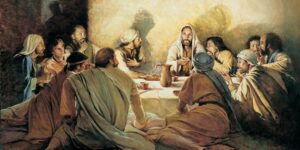
Before we go deeper into the sacrifice of the Mass, we must ask ourselves by what authority, that is, from which authoritative sources, we know what the Eucharist is, what it represents, and how we are to celebrate it. As the good Protestant I once was, I always regarded the Lord’s Supper or Communion as a rite we celebrated once a month in order to mentally recall what the Lord had done for us. As simple as that. However, the Catholic Church today, and the Church of the first centuries, understood the Eucharist as much more than that. So, is the Eucharist something more than a mere remembrance? How can we know? And first of all, does the New Testament teach everything that the Eucharist is and means? In fact, in the Scriptures we have few details of that celebration[1]. The details were given to believers by Paul and the Apostles in person, while they lived and established their traditions in the Churches (2 Thess 2:15; 3:6; 1 Cor 11:2). The writings of the New Testament were not intended to be manuals on “How to celebrate the Lord’s Supper.” Rather, that information had already been handed on to the churches and entrusted to the “overseers” (bishops). The subsequent letters were corrective instruments, meant to set right abuses in what had already been taught beforehand.
The point of these lines, before we go on to explain what the Eucharist is, is to show you that one cannot go to the Bible presupposing that all the details and explanations about everything will be there clearly expressed, as if it were a “divine manual” on how to celebrate the Lord’s Supper, a sort of “guide to the celebration.” Things are not like that[2]. The fact that the Reformers, gathered at Marburg (Germany) in 1529, did not come even remotely to an agreement on the subject of the Lord’s Supper is, I believe, something very significant. When I visited Marburg in 1983, seeking out my Protestant roots, I looked with interest at the mural that depicts them, seated, debating down to the smallest details, yet unable to reach a unanimous conclusion about the meaning of the Scriptures on the subject. If the biblical evidence is so clear, as some say, I do not understand why even those great “reformers” of the Church, and all their 28,000 Protestant groups that are heirs to that way of thinking, have so many differences on the matter, some going so far as to deny that the Eucharist (and also Baptism) has any value in the present plan of salvation (by “present plan of salvation” we here translate what English speakers call “dispensation”; in Catholic theology this is called the “economy of salvation”). Do you realize that there was a single doctrine on the Eucharist for a thousand five hundred years, from the first century of the Church’s history? When the “reformers” opened the floodgates of confusion, caused by free interpretation and private judgment, it took the form of different dogmatic schools. Not even fifty years had passed since Luther’s “95 theses” when a book was published in German bearing the title: “Two Hundred Definitions of the Words ‘This Is My Body’.”
From Luther’s own perspective, disheartened by the factions that were already beginning to form, he wrote: “There are almost as many sects and beliefs as there are heads; this one will not admit Baptism; that one rejects the Sacrament of the altar; a third asserts that there is a world between the present one and the day of judgment; there is no lack of those who teach that Jesus Christ is not God. There is not one of them, however great a buffoon he may be, who does not claim to be inspired by the Holy Spirit, and who does not put forth his dreams and fancies as prophecies” (quoted in Leslie Rumble, Bible Quizzes to a Street Preacher [Rockford, IL: TAN Books, 1976], 22).
 From the perspective of the early Church, the celebration of the Eucharist was handed down as an inheritance to the Church by the Apostles themselves, and not by means of “manuals,” nor even by apostolic letters, which would come later. The Church was the depositary of this information and of this practice, the depositary of the apostolic teaching. It was she who handed on to future generations the teaching and the practice she had received. It is in this sense that the Church speaks of the “Sacred Tradition” that is preserved in her. That is why I consider the Apostolic Fathers and the other Fathers of the Church to be very important, for they are authentic witnesses of the Apostolic Tradition “deposited in the Church, in the way a rich man deposits his money in a bank” (St. Irenaeus). This was, in fact, the first and primary source of instruction during the first centuries. The principle of Sola Scriptura simply did not exist; indeed, the Fathers refuted those who proposed supposedly biblical doctrines that lacked the support of the constant apostolic teaching and Tradition. It was the Church that transmitted the truth. She was “the pillar and ground of the truth” (1 Tim 3:15). Martin Luther writes: “We are obliged to concede to them (the Catholics) that they have the Word of God, that we received it from them, and that without them we should have no knowledge of it at all. That the Papacy has the Word of God and the office of the Apostles, and that we have received the Holy Scriptures, Baptism, the Sacrament, and the pulpit from them. What would we know of these things if it were not for them?” (Sermons on the Gospel of John, Chap. 14–16, 1537, in volume 24 of Luther’s Works, St. Louis, Missouri: Concordia Publ. House, 1961, 304).
And so I will not answer your question by resorting to the Bible alone, although I will certainly do that as well; I will also consult the Fathers of the Church, because I respect the way in which they interpreted the texts and the teachings. Irenaeus says of Clement that he “had seen the blessed Apostles and had conversed with them, and had yet ringing in his ears the preaching of the Apostles, and had their traditions before his eyes. And not he alone; for there were many still remaining who had been instructed by the Apostles… In the same order and by the same succession the authentic tradition received from the Apostles and handed down by the Church, and the preaching of the truth, have come down to us” (Adversus Haereses, 3.3.2f). I respect their teachings – I must admit – more than today’s evangelicals do, who have thrown overboard and contradicted fifteen centuries of the presence and guidance of the Holy Spirit in his Church. I find it particularly curious how much many evangelicals esteem their present-day professors and teachers, and at the same time how much ignorance they have of those first teachers, teachers who were certainly extraordinary.
What is the Mass?
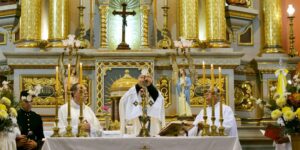 With this brief background, let us go a little further. You ask what the word “Mass” means. In itself the word is insignificant. It comes from the Latin conclusion of the celebration, when the priest dismisses the assembly with the words: Ite, Missa est, which literally means: “Go, it is now the end.” The prolonged use of this final greeting caused the word “Mass” to come to mean the whole celebration.
The Mass is a very broad and profound liturgy or service, one that contains mystery and typology. It incorporates the beauty and the power of the Passion of Christ, re-presenting it before our eyes. It is symbolic and it is real, of simple language and at the same time typological. It is paradoxical and at the same time simple. It contains all the dignity, depth, symbolism, profundity, and spiritual reality that one would expect of the central act of worship of the Church founded by Jesus Christ and the Apostles. It incorporates all the typology of the Old Testament, which was its shadow. The Mass was prophesied by Malachi (Mal 1:11), as the early Church understood it (we will see this later on). “Mass” is simply another title for the divine service, for the liturgy, for the sharing of the Body of Christ in the Lord’s Supper.
The Mass as sacrifice: the Altar
Does the Mass mean a true sacrifice? Yes, in several ways. I will describe the simplest one first. In the Old Testament, a sacrifice began with an offering, something that was solemnly brought into the presence of God, and there offered to Him. This is the first sense of “offering” or “sacrifice” in the Mass. The people of God gather around the table of the Lord (that is, the altar, the place of sacrifice; Mal 1; 1 Cor 10:21). God commands the Israelites to bring the first fruits of the land to be placed upon the altar and thus offer their worship. “‘And now, behold I have brought the first fruits of the land which the Lord gave me.’ And thou shalt leave them in the sight of the Lord thy God, adoring the Lord thy God” (Deut 26:10).
The Church has always regarded this, in the Mass, as profoundly significant. When we gather, each one from his own place, to worship God, we bring our gifts to offer to Him. In a certain sense, these are laid upon the altar as an offering. What do we offer to God? Many things: ourselves (Rom 12:1), our praises (Heb 13:15), and our gifts (1 Cor 16:2), etc. The offertory, during the celebration, is the way of offering these things to God in a manner that is both real and symbolic. Incidentally, “symbol” is not a bad word… I have a friend who says that the Gospel no longer contains any symbolism. He is right: now it is revealed by means of symbols. The strangest thing is that this friend of mine celebrates “the Lord’s Supper” and says that it is only… a symbol! To my mind, this is a contradiction of his own principles. Symbols, in fact, are necessary, and they correspond perfectly to the human way our mind has of understanding. We use symbols for everything. For Protestants too, Baptism and Communion are “symbols,” just like the crosses in churches, wooden altars, Christian banners, wedding rings, bowing our heads or making gestures with our hands, kneeling, closing our eyes to pray, holding “the Word of God up high” when we preach from the pulpit, the laying on of hands, etc. All these things are symbols. (For more on this subject, see the excellent book by Thomas Howard, Evangelical Is Not Enough, published by Ignatius Press.)
During the offertory, we bring two things to lay upon the altar. But first of all, is the “altar” a New Testament concept, or an outdated remnant of the Old? The Catholic Church has an altar (Heb 13:10; 1 Cor 10:21; etc.). Ignatius of Antioch (35–107 A.D.) and the first Christian believers agree: “Take care, therefore, to use one Eucharist, so that whatever you do, you do according to God: for there is one flesh of our Lord Jesus Christ, and one cup in the union of his Blood; one altar, as there is one bishop, together with the presbytery and the deacons, my fellow servants” (Letter to the Philadelphians 4, written around 106 A.D.). Note the four key words that constantly appear: body, blood, altar, and sacrifice. The Protestant scholar J. N. D. Kelly comments on this last quotation: “Ignatius’s reference to ‘one altar, as there is one bishop’ reveals to us that he too was thinking [of the Eucharist] in terms of sacrifice.”
There is also an altar in Heaven, of gold (Isa 6:6; Rev 6:9; 8:3, 5; 9:13; 11:1; 14:18; 16:7). It gives the impression that we cannot escape altars…, beginning with the sacrificial offerings of the sons of Adam, passing through Abraham, and coming to the Cross and the Table of the Lord, the altar to which the author of the Letter to the Hebrews referred; and even at the very end of the inspired text we see that God did not dispense us from altars in this new “spiritual age” in the heavens, but rather we see that He has a “golden” altar before his throne, and the Lamb of sacrifice eternally before his eyes. Impressive. Catholics have altars that represent both the Cross of the Lord and his Last Supper (in reality one and the same thing); Protestants have a table set before them in their churches that is not at all an altar. Even so, they still keep the so-called “altar calls,” that is, the calls to the altar, when they invite people to come forward and receive Christ. It is very ironic to see how they use all the symbols of the Catholics but emptied of their authentic and original content. We will take up this subject again later on.
 In the Church, after the Liturgy of the Word and the Prayer of the Faithful, we have what we call the “Offertory.” Here we present our gifts to the Lord. We also give something of our money to God and to the Church, for whatever may be needed. This would correspond to the offerings and tithes of the Old Testament. It is an offering in the biblical sense, that is, something freely given, offered to the Lord.
These gifts, real and symbolic, are brought before the presence of the throne of God; they represent the believers – us – who offer upon the altar not only gifts, but also – and above all – ourselves, our families, all that we are and have. When I see a family, at the Sunday celebration, carrying to the altar the gifts of bread and wine, I see myself and all that I possess being received by the priest and laid upon the altar. I give myself to the Cross, I renew my self-giving to God, I hand over my life as He handed over his, I surrender myself to the will of God, I am once again offered to God as a living and holy sacrifice. He takes the little I can offer Him, and turns it into Christ himself. All that I am is consumed by the Father, no longer in the flames of immolation as happened in the Old Testament, but rather as an offering and a blessing of thanksgiving and acceptance. It seems to me that Catholics often do not realize the beauty of the Mass, as you probably did not when you were a young Catholic; this happens because we do not read enough, we do not study, we do not pray, we do not practice these tremendous mysteries enough. It is a real pity when these richest of mysteries are before our eyes and we do not notice them. Jesus rebuked his followers, as he still does today, saying to them, “Having eyes, see you not?…” (Mark 8:18).
We bring to the altar the wine and the bread, fruits of the earth, gifts of God, made by the hands of man. We take something He gave us, we turn it into bread and wine, and we give back to Him part of his gifts. We give thanks to God for his gifts, for life, for the fruits of the earth. “Blessed be you forever, O Lord!”
Real or symbolic Presence?
Now then, the bread and the wine are upon the altar. What happens next? We know that Jesus did not say that the bread and the wine “represented” his Body and his Blood (even though in Aramaic there do exist words for “to represent,” which He could well have used had that been his intention), but rather He said that the bread and the wine are his Body and his Blood. In fact, some scholars think that the word “body” in Greek would be translating the word “flesh” in Aramaic (the language Jesus used), since there is no more exact word to signify “body” in Aramaic than the word “flesh.” So Jesus would be saying, “This is my flesh.” Sounds rather Catholic, doesn’t it?
The Real Presence of Jesus in the Eucharist was never denied in the early Church, except by the Gnostics. Why would the Gnostics deny the Real Presence? Because they regard Jesus as merely a man, and Christ, according to this doctrine, would be a spirit that came upon Jesus, that is, Jesus and Christ would be two distinct entities. Christ did not have, according to this doctrine, a real body, and therefore there can be no such thing as a Real Presence of the Body and Blood of Christ in the Eucharist. The Fathers of the Church, curiously, argued in the opposite direction: since there is a Real Presence in the Eucharist, then Jesus must have had a real body when He lived on earth. A most interesting argument, isn’t it? Do you not find it striking that Protestants now follow the reasoning of Gnosticism, instead of agreeing with the teachings and practices of the first Christians? There was no other way of thinking in the Church of the first centuries until well into the ninth century; and only in the fourteenth century did teachings arise that denied the Real Presence of the Lord in the Eucharist, interpreting the words of the Lord in a symbolic way instead of a literal one. (And to think that it is the Protestants who are supposed to interpret everything more literally!)
Imagine for a moment Jesus being interrupted by James or by John, as He says “This is my Body”… John hastens to correct him: “No, it is not your body, it only symbolizes your body.” And Jesus looks at him attentively and says: “What did you say?” As we shall see, it was this that made Judas lose his faith; it was precisely at that moment concerning faith in the Eucharist that Satan entered into him.
We will set aside, for the moment, the question of the Real Presence, although in my book I will write on the subject in abundant detail, studying both the Old and the New Testament, the early Church, the Reformation, and modern times. I also included in my book Crossing the Tiber a “Brief History of the Resistance”; of this resistance – as you know – you are (and I was) a descendant.
Returning to the question of the Sacrifice: the words of Jesus at the institution of the Lord’s Supper are laden with sacrificial meaning. In fact He takes what was a sacrifice (the Passover) and transforms it with new symbolism and with a new reality. That which the Jews ate each year – and they had to eat the sacrificial lamb, otherwise it would have had no effect – symbolized the Lamb who was to come. But now that the true Lamb had offered himself, they were also to eat the Lamb, not in a symbolic way, but really. Temporal lambs – Eternal Lamb. The first were symbols, the second – Reality. The Jews previously ate the symbol, whereas the new People of God eats the Reality. “This is my Body, which shall be delivered for you.” Strange words indeed! When we look at these passages in the original Greek, and in the light of Jewish culture – something we will do shortly – we discover that there is an extensive use of sacrificial terminology.
Reading the Bible in its living context
 But before we go on to examine the sacrificial nature of the Eucharist, let us recall some important passages of Scripture: “Now the pasch, the festival day of the Jews, was near at hand… Jesus therefore said: Make the men sit down. Now there was much grass in the place. The men therefore sat down, in number about five thousand. And Jesus took the loaves; and when he had given thanks, he distributed to them that were set down… And when they were filled, he said to his disciples: Gather up the fragments that remain… Now those men, when they had seen what a miracle Jesus had done, said: This is of a truth the prophet that is to come into the world” (John 6:4, 10–14).
The Greek word for “thanks” is “eucharisteo,” from which comes our use of the word “Eucharist.” John intentionally repeats this word in verse 23, where it must be seen as an allusion to the eucharistic intention of the passage. This conclusion is all the more justified if we consider that the Gospel was written at the end of the first century, when the Lord’s Supper was technically called the Eucharist, as is clear from the letters of St. Ignatius of Antioch, a disciple of John (see, for example, his letter to the Ephesians 13, to the Philadelphians 4, to the Smyrnaeans 7), and so many others. The Protestant scholar Oscar Cullmann writes: “The long discourse of Jesus in John’s Gospel… has from ancient times been regarded by the majority of exegetes as a discourse on the Eucharist… Here the author makes Jesus himself establish the distinction between the miracle of the material multiplication of the material bread and the miracle of the Sacrament” (Early Christian Worship, translated by A. Stewart Todd and James B. Torrance, Philadelphia, Westminster Press, 1953, p. 93).
This is the only miracle worked by Jesus in his earthly ministry that has been recorded by all four evangelists, thus demonstrating the importance of the event. Jesus sets the stage for the discourse on the “Bread of Life,” which “came down from heaven.” With the multiplication of the loaves Jesus demonstrates his power to provide bread for all, preparing a table in the “desert,” which is a veiled way of speaking of the world. We will soon see that Jesus explains that the bread He offers, in the Eucharist, is his flesh, which “is meat indeed” and will be supplied through his Church to all men, in all places, of all times.
The sacrificial tone used by the evangelists in the Synoptic Gospels suggests that the early Christians already associated, from ancient times, the miracle of the loaves with the Eucharist, bearing in mind that the Gospels were written in the second half of the first century. The Protestant and anti-Catholic historian Philip Schaff writes: “Here the deepest mystery of Christianity takes shape again and again, and the history of the Cross is reproduced before our eyes. Here the miraculous feeding of the five thousand is spiritually perpetuated… Here Christ… gives his own body and blood, sacrificed for us… as spiritual food, as the true bread that comes down from heaven” (History of the Church, Grand Rapids, MI, Eerdmans, 1980, 1:473).
In this narrative, John gives us a beautiful description of the Church: “all the people,” who made up five thousand persons (not counting women and children), represent the universal Church, gathered in “little groups” of fifty and of a hundred, which represent the local churches, all fed by Christ, the great High Priest, who distributes “the bread” to all, through the hands of his priests, the Apostles. Later, in the same chapter, Jesus explains that the bread is his flesh, which must be eaten, just as the flesh of the Paschal Lamb had to be eaten. In this way He lays the foundation for the future apostolic teaching and for the sacraments of the Church.
After the multiplication of the loaves, Jesus says: “I am the living bread which came down from heaven. If any man eat of this bread, he shall live for ever; and the bread that I will give is my flesh, for the life of the world. The Jews therefore strove among themselves, saying: How can this man give us his flesh to eat? Then Jesus said to them: Amen, amen, I say unto you: except you eat the flesh of the Son of man, and drink his blood, you shall not have life in you. He that eateth my flesh and drinketh my blood hath everlasting life: and I will raise him up in the last day. For my flesh is meat indeed: and my blood is drink indeed… After this many of his disciples went back; and walked no more with him. Then Jesus said to the twelve: Will you also go away? And Simon Peter answered him: Lord, to whom shall we go? Thou hast the words of eternal life” (John 6:51–55, 66–68).
How would the first recipients of John’s Gospel have taken it? Let us not forget that this Gospel was written between 90 and 100 A.D. According to George Beasley-Murray, perhaps the most important Baptist exegete of these times, “it is not necessary to interpret the text exclusively in the sense of the body and blood of the Lord’s Last Supper; nevertheless, it is evident that neither the evangelist nor his Christian readers could have written or read these sayings of Jesus without a conscious reference to the Eucharist; at the very least it must be said that they recognized the event of the Lord’s Supper as the most perfect fulfillment (of what is said in the discourse on the Bread of Life)” (see George Beasley-Murray, John, vol. 36 of the Word Biblical Commentary, Waco, TX, Word Books, 1987, p. 95).
In this discourse it would seem as if Jesus decides to speak in a particularly difficult way, wishing to frighten his disciples unnecessarily… He spoke to them words hard to understand, apparently inviting them to be cannibals; as a result, many were scandalized and turned away from him for good. The Greek word John uses for “to eat” is not the one ordinarily used to describe a refined meal: it is the Greek expression that means “to bite,” “to eat noisily,” and could be translated as “to chew” his flesh (see Raymond Brown, The Gospel according to John I-XII [New York, NY: Doubleday, 1966], 283). “This scandal – says Cullmann – belongs now to the Sacrament, just as the scandal against the human body belongs to the divine Logos” (Oscar Cullmann, Early Christian Worship, 100). And Protestants of the Anabaptist and Zwinglian tradition are indeed scandalized by the Eucharist. This is the only case (in the Gospel), at least that has been recorded, of disciples turning away from Jesus over a doctrinal question. As a Protestant, I too had been scandalized and had turned away from the real meaning of these words. Why did Jesus not stop the stampede of the disciples? He could easily have said to them: “Wait, do you not see that I am speaking in a symbolic way? Come back, for I was speaking to you figuratively.” Since He did not do so, many of his disciples turned away from him. But the Twelve remained with him: they realized that his words were words of eternal life.
This passage was understood, from the earliest days of the Church, as an explanation that anticipates the Eucharist. St. Basil the Great (330–379 A.D.) wrote in his epistle To the Patrician Caesaria, on Communion: “It is good and beneficial to communicate every day, and to partake of the holy body and blood of Christ. For he says quite plainly: He that eateth my flesh and drinketh my blood hath eternal life” (The Nicene and Post-Nicene Fathers, 2nd series, 8:179). According to Raymond Brown, “there are two great indications that lead us to think that here (in John 6) the Eucharist is being spoken of. The first indication is the insistence of Jesus on the necessity of eating and feeding on his body and his blood: we cannot take these words as a simple metaphor that would speak to us of ‘accepting his revelation’… So if we wish to attribute to the words of Jesus in John 6:53 a positive sense, we must refer them to the Eucharist: ‘Take, eat: this is my body;… drink… this is my blood.’ The second indication that refers to the Eucharist is the formula we find in John 6:51, where John speaks to us of ‘flesh,’ while the Synoptic Gospels, recounting the Lord’s Last Supper, speak to us of his ‘body.’ However, one must know that there is no Hebrew or Aramaic word for ‘body,’ as we understand this word; for this reason, many scholars maintain that at the Last Supper what Jesus truly said was the Aramaic equivalent of ‘This is my flesh’” (The Gospel According to John I-XII, 284–285). We must recall once more that John wrote his Gospel between 90 and 100 A.D.; from this period documents are preserved that demonstrate that the Eucharist was clearly celebrated by the Catholic Church, throughout the Roman Empire, as the partaking of the body and blood of Christ literally. If the Eucharist was to be taken in a symbolic sense, and any other practice would have been seen as idolatry, John could easily have clarified the doctrine, as in fact he liked to clarify things in his Gospel (see John 1:42; 21:19). He could have made clear to his readers that it was a symbolic way of speaking, and did not mean what the first Christians thought it meant. But John wrote a sacramental Gospel, and he knew exactly what he was writing, and why.
The setting of the discourse: the Passover and the traitor
Next we read the words of Jesus to Judas in the same context of John 6: “Jesus answered them: Have not I chosen you twelve; and one of you is a devil? Now he meant Judas Iscariot, the son of Simon: for this same was about to betray him, whereas he was one of the twelve” (John 6:70–71).
The context of a passage is always important for its interpretation. While reading the Bible, one must always ask oneself such things as: why does the author place this event in this spot, and not in that other one? Or indeed, what conclusion does the author expect of us by placing these words in this context? In our passage, it seems to us contextually significant that John mentions the betrayal of Judas at this point in his narrative. Where do we again find, in the Gospels, the event of the betrayal of Judas? In each of the Gospels the mention of Satan entering into Judas is made in the context of the Last Supper. Each Gospel begins the account with the notice that it was the Passover, and ends with the assertion that Satan entered into Judas – exactly as in John 6. And this is explained by the fact that John frames his eucharistic discourse in chapter 6 in such a way that the reader may see the clear parallel with the Synoptic accounts of the Lord’s Supper. The first verse of John 6 says that Jesus gave his discourse on the necessity of “eating his flesh” during the Passover. The mention he then makes of Judas would seem totally out of place here, except when it is understood within the “eucharistic” framework of the whole chapter. How marvelous the Bible is!
The institution of the Eucharist
Let us now turn to the institution of the Eucharist, as the Gospel of Mark presents it (written in the latter part of the first century). Mark wrote: “And whilst they were eating, Jesus took bread; and blessing, broke, and gave to them, and said: Take ye, this is my body. And having taken the chalice, giving thanks, he gave it to them. And they all drank of it. And he said to them: This is my blood of the new testament, which shall be shed for many” (Mark 14:22–24). It seems that Jesus intentionally uses the terminology of Exodus 24:8: “This is the blood of the covenant which the Lord hath made with you concerning all these words.” It is here, as you will note, that Jesus fulfilled what He had promised in John 6: “This is my body… this is my blood.” What words could be clearer than these? At that moment Jesus and the Apostles were eating the Passover supper, the sacrificial lamb, which was the prefiguration of the body of the Lord, and now, seated at that very table, Jesus lifts up a piece of bread and says: “This is my body.”
It is interesting to note that in the Greek text, the noun “body” carries a definite article which, according to Greek grammar, makes the expression appear with particular force, something lost in translation. Literally we might render it as “this here is my body”; it is being declared that this (the bread) is my body. Jesus said these words in Aramaic, the language spoken by him and his Apostles. Some scholars think that the words of Jesus here were “This is my flesh,” since there is no Aramaic word to designate “body,” but only “flesh.” This would fit very well with that saying of John 6, when Jesus says: “you must eat my flesh and drink my blood.”
Now let us see what Luke tells us in his Gospel: “And when the hour was come, he sat down, and the twelve apostles with him. And he said to them: With desire I have desired to eat this pasch with you, before I suffer. For I say to you, that from this time I will not eat it, till it be fulfilled in the kingdom of God. And having taken the chalice, he gave thanks, and said: Take, and divide it among you. For I say to you, that I will not drink of the fruit of the vine, till the kingdom of God come. And taking bread, he gave thanks, and brake; and gave to them, saying: This is my body, which is given for you. Do this for a commemoration of me. In like manner the chalice also, after he had supped, saying: This is the chalice, the new testament in my blood, which shall be shed for you” (Luke 22:14ff).
Paul and Luke add the elements of “memory,” “remembrance” (Greek “anamnesis”), which Mark and the other Gospels do not include. There are indications of liturgical development even within the New Testament itself (see The Study of Liturgy, ed. by Cheslyn Jones, Geoffrey Wainwright, Edward Yarnold, and Paul Bradshaw [New York, NY: Oxford Univ. Press; 1978, 1992], 204). The word “memory” is a sacrificial term, and it is used in the Greek Septuagint version (the “Septuagint” is the name given to the Greek version of the Old Testament, which was widely used in the times of Jesus). “In Lev. 24:7 the word anamnesis translates the Hebrew ‘azkarah,’ which was a memorial sacrifice… This particular sacrifice (azkarah) was understood as a perpetual remembrance of the covenant” (Dictionary of New Testament Theology, ed. by Colin Brown [Grand Rapids, MI: Zondervan Publ., 1979], 3:239). Anamnesis is used in Numbers 10:10, where again it makes mention of sacrifice, for which reason the expression of Jesus at the Last Supper undoubtedly had a sacrificial character for his hearers. We cannot think that it escaped Jesus, at that crucial moment of the Last Supper, that the word anamnesis (or its Aramaic equivalent) had that sacrificial meaning… Rather we must think that what Jesus is doing is precisely to give a sacrificial context to that Eucharist which He institutes during the Jewish celebration of the Passover; Paul, in 1 Corinthians, seems to have grasped this aspect very well.
They recognized him…
Finally, with respect to Luke, I would like to comment on one of the most interesting moments of the New Testament. It seems evident that reference is being made in this passage to the Eucharist, whether by the use of the same terminology, by the setting of the story, or by the date on which the Gospel was written. We read in Luke: “And behold, two of them went, the same day, to a town which was sixty furlongs from Jerusalem, named Emmaus. And they talked together of all these things which had happened. And it came to pass, that while they talked and reasoned with themselves, Jesus himself also drawing near, went with them. But their eyes were held, that they should not know him. And he said to them: What are these discourses that you hold one with another as you walk, and are sad?… Then he said to them: O foolish, and slow of heart to believe in all things which the prophets have spoken. Ought not Christ to have suffered these things, and so to enter into his glory? And beginning at Moses and all the prophets, he expounded to them in all the scriptures, the things that were concerning him. And they drew nigh to the town, whither they were going: and he made as though he would go farther. But they constrained him, saying: Stay with us, because it is towards evening, and the day is now far spent. And he went in with them. And it came to pass, whilst he was at table with them, he took bread, and blessed, and brake, and gave to them. And their eyes were opened, and they knew him: and he vanished out of their sight. And they said one to the other: Was not our heart burning within us, whilst he spoke in the way, and opened to us the scriptures? And rising up, the same hour, they went back to Jerusalem: and they found the eleven gathered together, and those that were with them… And they told what things were done in the way; and how they knew him in the breaking of the bread” (Luke 24:13–17, 25–33, 35).
What a truly strange way these travelers have of recounting how and when they recognized that it was Jesus! And what a strange way to conclude the Gospel narrative! After his resurrection, Jesus was explaining the Scriptures to them, as they walked together. “And beginning at Moses and all the prophets, he expounded to them in all the scriptures, the things that were concerning him.” This must have been one of the most beautiful expository sermons of all time, preached by Jesus himself! And yet, even though it was Jesus himself who was explaining the Scriptures to them, they did not understand who He was. But when Jesus took the bread, broke it, blessed it, and gave it to them, “their eyes were opened, and they knew him.” This is a most interesting step: the disciples do not present the “discovery of Jesus” as a consequence of “biblical preaching,” but rather they declare that they “knew him in the breaking of the bread” (Luke 24:35). It is worth noting that Luke here employs the same words that Jesus used a few chapters earlier, when He instituted the Eucharist (he took, blessed, broke, and gave). The only times the New Testament employs these words in this way are when the evangelist speaks of the Eucharist and… here in Luke 24. Was Luke trying to say something, by closing his Gospel with this historical account? Raymond Brown writes: “The insistence that Luke shows in explaining that the disciples recognized Jesus in the breaking of the bread has commonly been taken as a eucharistic teaching, so as to be able to convince the community that they too could encounter the risen Jesus in the breaking of the eucharistic bread” (The Gospel according to John I-XII, 1100).
The Eucharist in the teaching of Paul
In any case, let us now turn to the words of Paul in 1 Corinthians, without losing sight of Malachi 1:11. Paul writes: “For I have received of the Lord that which also I delivered unto you, that the Lord Jesus, the same night in which he was betrayed, took bread, and giving thanks, broke, and said: Take ye, and eat: this is my body, which shall be delivered for you: this do for the commemoration of me. In like manner also the chalice, after he had supped, saying: This chalice is the new testament in my blood: this do ye, as often as you shall drink, for the commemoration of me. For as often as you shall eat this bread, and drink the chalice, you shall shew the death of the Lord, until he come. Therefore whosoever shall eat this bread, or drink the chalice of the Lord unworthily, shall be guilty of the body and of the blood of the Lord” (1 Cor 11:23–27).
Paul here confirms the words of Jesus and the oral tradition of the Church, since these things had not yet been written down in the Gospels. In fact, if we take a look at the chronology, 1 Corinthians is probably the first written evidence of the words of Jesus at the Last Supper. Let us say a couple of things about this passage before going on.
The words “receive” and “deliver” are technical words used for the transmission of the apostolic tradition (see also 1 Cor 15:3). The Corinthians did not learn about the Lord’s Supper by reading the New Testament. They learned it by the tradition delivered or transmitted by Paul through oral teaching and examples (2 Cor 11:2; 2 Thess 2:15; 3:6), a tradition that Paul, in turn, received directly from the Lord, or perhaps directly from the Twelve Apostles (Gal 1:18, etc.). The letters of the New Testament were never intended to replace the tradition taught by the Apostles, the Living Word of God delivered in person (1 Thess 2:13). Paul’s letters were neither sent nor seen as “church manuals” with complete instructions on the Lord’s Supper, since the Corinthians had already been suitably instructed by Paul himself, in person. His letters were meant to correct abuses and defective practices that had crept into the religious practice of the faithful of Corinth. The faith had been delivered orally, by the instruction given by the apostles to the saints (Jude 3), that is, to the Church. The letters were sent much later to encourage and exhort the churches in what they already knew by tradition (1 Cor 4:17; 2 Pet 3:1–2).
With respect to the word “memory,” I must make some comments. According to Thomas Howard, in his book Evangelical Is Not Enough (San Francisco, Ignatius Press, 1984), the word “memory” does not express the ultimate content of the Greek word “anamnesis,” which is used at the moment of the institution of the Eucharist. “The word suggests a memory that, at the same time, means a ‘making present’” (106). The Theological Dictionary of the New Testament uses the word re-presentation and “the making present, on the part of the community, of the Lord who instituted the Supper” (1:348). “This re-calling or re-presenting means that something ‘past’ is made ‘present,’ something that, here and now, affects us vitally and profoundly. In other words, the Eucharist is the making present of the true Paschal Lamb, who is Christ… In this way, from the earliest days, the Church understood the Eucharist as the ‘re-presenting’ of the sacrifice of Christ, with its present saving power. All the ancient liturgies make clear that in eucharistic worship the Church experiences the power of the present Savior” (Olive Wyon, The Altar Fire, London, SCM Press, 1956, 35–36). The Protestant author Max Thurian wrote: “This memorial is not a simple act of subjective recollection; it is a liturgical action… that makes the Lord present… that calls before the heavenly Father, as a memorial, the one sacrifice of the Son, and this makes the Son present in his memorial” (The Eucharistic Memorial, II, The New Testament, Ecumenical Studies in Worship, as cited in the Dictionary of the New Testament, edited by Colin Brown, Grand Rapids, MI, Zondervan Publ. 1979, 3:244).
Jesus says that the Chalice is the Blood of the New Covenant, making clear reference to the words of Moses. This way of speaking and using the terms is certainly drawn from the sacrificial language of the Old Testament, and Ex 24:8 in particular: “And he took the blood and sprinkled it upon the people, and he said: This is the blood of the covenant which the Lord hath made with you concerning all these words.” Jesus is speaking to us of real blood, not of a symbolic wine that represents blood. Making reference to the words of the blood covenant of Moses, Jesus says: “This is my blood of the covenant,” as He hands the chalice to his disciples, commanding them to drink his blood, of which He had spoken to them and explained at length in his discourse of John 6.
Finally, a word with respect to profaning the Body of the Lord: to be guilty “of the body and the blood” of someone had at that time the meaning of “being guilty of homicide.” How could anyone be guilty of homicide if the body (bread) is only a symbol? The real presence of the Body of Christ is necessary for an offense against it to be possible. How can anyone be guilty “of the body and blood of Christ” by eating a piece of bread or drinking a sip of wine? “No one is guilty of homicide if he commits violence against the image or the statue of a person without touching that person physically. Paul’s words make no sense without the dogma of the Real Presence” (Leslie Rumble and Charles M. Carty, Eucharist Quizzes to a Street Preacher [Rockford, IL.: TAN Books, 1976], 7–8).
I would like to comment on one last passage of Paul before considering in more detail the heart of the question, that is, the Eucharistic Sacrifice, and the fact that there is a single sacrifice that occurred in time, and that the daily sacrifice of the Mass is a re-presentation of that one and singular sacrifice, and not a re-crucifixion of Jesus. Bear with me a little…
Paul continues: “I speak as to wise men: judge ye yourselves what I say. The chalice of benediction, which we bless, is it not the communion of the blood of Christ? And the bread, which we break, is it not the partaking of the body of the Lord? For we, being many, are one bread, one body, all that partake of one bread. Behold Israel according to the flesh: are not they, that eat of the sacrifices, partakers of the altar?… But the things which the heathens sacrifice, they sacrifice to devils, and not to God. And I would not that you should be made partakers with devils. You cannot drink the chalice of the Lord, and the chalice of devils: you cannot be partakers of the table of the Lord, and of the table of devils” (1 Cor 10:15–18, 20–21).
What does the word “communion” (Greek koinonia) mean in this passage? Is it symbolic language? No, it means a real participation. St. Augustine, wishing to describe what happens in the Eucharist, puts the following words into the mouth of Jesus: “You will not change me into yourself, as happens with bodily food, but rather you will be changed into me” (Confessions, 7,10,16). Even the Theological Dictionary of the New Testament by Gerhard Kittel teaches that “koinonia denotes participation, communion, with the sense of profound closeness. It expresses a relationship that is mutual. It means participation, communication, communion.”
St. John Chrysostom says: “For what is the bread? The Body of Christ. And what do those who partake of it become? The Body of Christ: not many bodies, but one single body” (Homily on 1 Corinthians). We do not merely participate by a symbolic gesture, but rather, as Paul clearly says, we truly partake of the body and blood of Christ. How could that be so, if the participation were merely symbolic? Fundamentalist evangelicals claim for themselves the quality of being those who take the Bible in its most literal sense: the Bible says what it means, and means what it says. And yet, as the good fundamentalist I once was, I did not hesitate to set aside the literal sense of these passages, as well as the interpretation of the early Church, in order to keep the Bible according to the fundamentalist tradition in which I had been instructed and which I had accepted.
The Eucharist also represents the unity of the Body of Christ, which the Protestants have broken. There is no stronger example of the unity of the Body of Christ than the example of the bread and the wine. Bread is made of many separate grains, which are gathered and crushed to obtain the flour, from which a single loaf is kneaded and baked. Grapes, originally separate, are harvested and crushed to obtain the fruit of the vine, the wine. Just as the many grains form a single loaf, so too we, when we eat that one bread, the Body of Christ, are transformed into a single body. We become his body in a very real way, by partaking of and eating his Flesh and drinking his Blood. Remember that Paul teaches that we eat of one single bread, which indicates the real body of Christ, since if we hold to the external symbol, we eat separate, distinct loaves. Catholics eat of one single bread, the risen Christ, the Bread of Life.
The Eucharist is the summit and the source of unity, as the Catechism of the Catholic Church clearly teaches: “The Eucharist is our daily bread. The power belonging to this divine food makes it a bond of union. Its effect is then understood as unity, so that, gathered into his Body and made members of him, we may become what we receive” (2837, citing St. Augustine, Sermon 57, 7).
But we may ask ourselves: Does Paul think in sacrificial terms? Let us take a look at the words he uses, and the examples he gives. Let us remember that 1 Corinthians is not a “manual” or “catechism” of Christian doctrines. That doctrine had already been transmitted to the Corinthians through oral tradition (1 Cor 11:2), by Paul personally. The letter was intended to be a missive of a corrective character, to remind them and deepen the eucharistic knowledge and practice they already possessed and practiced. “The sacramental meaning of the bread and the wine is not only presupposed in this letter, but they are the basis of the whole present argument… The spiritual drink and food now appear, with greater clarity, as the Body and Blood of Christ; and although the ultimate basis of this definition will be given only later (1 Cor 11:23–26), Paul here already supposes it as something commonly shared with his readers, which has sufficient force to ground the argument that follows… What the writings of the New Testament presuppose… is even more important than what they actually say” (The Study of Liturgy, 191).
Let us note something interesting: Paul compares three different sacrifices. For his readers, the meaning was clear. Each sacrifice is offered upon an altar (table of sacrifice): first the sacrifice of the Jews (v. 18), then that of the pagans (vv. 19–21, offered to idols), and finally that of the Christians, the Eucharist. By means of these comparisons, Paul confirms the sacrificial character of the Christian Eucharist. The “table of the Lord” is a common technical term in the Old Testament that refers to the altar of sacrifice (Lev 24:6, 7; Ezek 41:22; 44:15; Mal 1:7, 12), so that the readers of the letter would immediately have grasped the correlation Paul was suggesting. In this sense I am surprised that in my early days as a Catholic I had not noticed this important detail: the “table of the Lord” in the Church, to which Paul refers, and which is rooted in the terminology and practice of the Old Testament, is now the altar of the new sacrifice, of which Malachi speaks (1:11). Let us observe that the “table of the Lord” is mentioned twice in the first chapter of Malachi, before and after God’s promise of a new and universal sacrifice offered by the Gentiles. The “table of the Lord,” that is, the altar of sacrifice, will be the place of this offering, which corresponds to the Eucharist, offered upon the “table of the Lord” of 1 Corinthians 10:21.
Allow me to ask you this question: did you know these things when you left the Catholic Church? Is not the parallel striking and unmistakable? Malachi twice frames the “spotless sacrifice” of the Gentiles with the sacrificial terms of “table of the Lord.”
St. Paul then uses this same terminology to explain the new sacrifice offered upon “the table of the Lord” in the Church. The sacrifice of the Eucharist upon the “table of the Lord” is compared with the other, more than sufficiently well-known sacrifices that are offered upon the tables of both pagan and Jewish altars. Paul, the most brilliant disciple of the most lucid Jewish rabbi, Gamaliel, is not using this Old Testament terminology lightly: he is an outstanding pupil… He knows that his readers interpret this sacrificial terminology by relating it to the Eucharist. Can it be doubted that Paul, the brilliant master of the Torah, understood the Eucharist in sacrificial terms, interpreting the “table of the Lord” as a fulfillment of Malachi 1:11? “The parallel that Paul draws between the participation of Jews and pagans in their sacrifices by means of eating the flesh of the victims and the Christian agape in Christ by means of the Eucharist shows us that he regards the eating of the Eucharist as a sacrificial meal, and that implies that the Eucharist itself is a sacrifice” (Jerome Biblical Commentary, ed. by Raymond E. Brown, Joseph A. Fitzmyer, and Roland E. Murphy [Englewood Cliffs, NJ: Prentice-Hall, 1968], 269).
At times I have been so moved by the Lord and the Church that I have become stuck while writing. The Lord has been so wonderful.
Answering your question
Now we can at last address your specific question: how can the Mass be a real sacrifice and not imply a new sacrifice of Christ? In short – and I believe I made this clarification in my Ankerberg article – there is only one single sacrifice, an eternal sacrifice, and we are participating in it daily in the dimensions of time and space, on the temporal plane. Protestants tend to get tangled up in time (I know, I have been through it) while Catholics tend to see things in terms of time and eternity. The same happens when we discuss the intercession of the saints. We come upon Protestants who argue: Where does the Bible say that we should pray to the deceased saints? The Catholic is surprised and replies: where does the Bible say that the saints are dead? It is simply a question of perspective. Protestants tend to put a tin roof over their heads; they are not able to see beyond the dimension of time – and the temporal sphere – toward eternity. For them the saints have died and the sacrifice of Christ is finished and consummated. For a Catholic, the saints are alive,[3] but in another dimension (heaven), and the sacrifice of Christ was accomplished two thousand years ago, but it is still a real happening and an eternal event in the eyes of a God and a Church not contained in time alone, and without the restricted vision that the Protestants have accepted on account of the tradition they inherited.
To say that Christ died only once and dies no more (Heb 7:27; 9:12; 10:10), and to say at the same time that He is offered at every Mass as a sacrifice, seems contradictory or paradoxical to a Protestant who tends to consider all questions horizontally rather than vertically, but this is not problematic if you change your way of thinking, if you broaden your vision to think biblically. Let me ask you: how can Jesus be a King who is seated at the right hand of the Most High (Heb 1:3) and at the same time be a sacrificial Lamb, a sacrifice upon the altar (Rev 5:6)? How can He be in both places in two conditions so radically different? How can He be seated in heaven at the right hand of the Father and at the same time be in a different place, in our hearts (Col 1:27)? He now has astonishing capacities, prerogatives never exercised while He was on earth, when He renounced for a time the use of some prerogatives of his divinity (Phil 2:5–11).
We now come upon one of those paradoxes that are only apparently so. Do Catholics sacrifice Christ again on the altar at every Mass? NO.
Do Catholics make present and participate in the one single sacrifice of Christ in the Mass? YES.
Let us refer again to Malachi 1:11, which prophesies about the future spotless sacrifice upon the Table of the Lord: “For from the rising of the sun even to the going down, my name is great among the Gentiles, and in every place there is sacrifice, and there is offered to my name a clean oblation: for my name is great among the Gentiles, saith the Lord of hosts.” Let us highlight the plurals and the singulars here. In every place ( = plural, in all places) and a clean oblation (singular). One offering offered in every place. Having already discussed this verse, I do not want to dwell on this point, but it corresponds marvelously to the Mass, as the first Christians already taught at so early a time as the first century, when the apostles were still alive, and from then on the interpretation is so clearly disseminated during the first two centuries that it can be admitted to have been a clear apostolic teaching, which came from the apostles themselves. Let us remember that they thought many things that have not been preserved in the few documents we have collected in the canon. In this way we have a single sacrifice offered in multiple places in the future among the nations throughout the world – an excellent description of the Mass.
We must now underline the ongoing force of the sacrifice of Christ. It is not only a single and definitive sacrifice, although it is certainly referred to time and space, but it is also perpetual in its reality and effects, referred to eternity. It is an unceasing sacrifice and its effects continue. Christ always offers himself to the Father. He always offers himself, even though He died only once (Heb 7:5). This is the singular clean oblation of Malachi. He always offers this immolation, of which the physical fact has already passed but whose value remains. He constantly intercedes for us as High Priest. Christ is, at the same time, priest and sacrificial offering. The passion and death of Christ are things past, but He who suffered his passion and his death remains forever clothed with the merits of his passion and his death. You might very well agree with this, because you too understand the consummation of the work of Christ, offered once, effective forever.
In the apocalyptic scene, Christ stands, before the Father, upon the golden altar, before the throne, with a cut in his neck: “And I saw: and behold in the midst of the throne and of the four living creatures, and in the midst of the ancients, a Lamb standing as it were slain” (Rev 5:6). This has been most beautifully depicted in a painting by Jan van Eyck titled “The Adoration of the Lamb,” which is preserved in Ghent (Belgium). I have had the privilege of standing before this painting, enthralled, for almost an hour, analyzing and appreciating it. It is probably my favorite painting of all those in the History of Art (with the Descent from the Cross, by Rembrandt, in second place, which I saw in Munich). The Lamb stands majestically upon the altar with its slit throat open in the manner of the Old Testament sacrifices. The Holy Spirit hovers above it, pouring its light over everything. The blood flows from the Lamb into a chalice. People from the four cardinal points of the globe (from the place where the sun rises and where it sets, for Malachi) come to the Lamb to share one same cup and one same flesh and to adore in the eternal sacrifice re-presented in all times.
Christ does not cease to offer his sacrifice. He is eternally interceding for his people. When the age of redemption has concluded and the Second Coming has been brought to completion, only then will the sacrifice of Christ have been completed. A sacrifice is completed when those for whom it is offered taste its fruits and receive all the benefits of its efficacy. Christ then will no longer have to offer himself henceforth as a propitiatory and expiatory “victim” upon the altar. Christ offers himself as a victim precisely for all humanity on earth, for the men who still live in time, in the process of being justified and redeemed. This permanent offering of the sacrifice of the Cross will end when the end of time arrives. The offering that Christ presents to the Father is for this world and is directed toward the consummation of the last day.
There have been many speculations by theologians, Catholic and Protestant alike, on the nature of the Lord’s Supper. Catholic theologians have discussed and speculated on the nature and effects of the Eucharist in an attempt to sound the depths of this mystery of mysteries, so simple and so profound at the same time. So temporal and so eternal simultaneously. Theology approaches ever more closely a complete understanding of its fullness, but that fullness will be reserved for the last day, when what is seen dimly in a mirror will be seen and understood fully. The consecrated bread and wine signify not only the body and blood of Christ but also his sacrifice. The consecration of the two species is a symbolic immolation, but the symbolism is sacramental and thus contains what it signifies. The Mass is a sacrifice, because it signifies and at the same time contains the complete reality of the sacrifice of the Cross.
In what follows, and for a few paragraphs, I want to draw on the excellent book by Marie-Joseph Nicolas, What Is the Eucharist?, since it is profound and easy to understand. I have some seventy books on my shelf that deal exclusively with the Mass and the Eucharist, but I do not have time to quote them all, which I am sure you will take into account.
The Mass: a new sacrifice?
What do the words “the complete reality of the sacrifice of the Cross” mean? If we wish to understand them, there are two extreme opinions we must eliminate. One goes too far, the other falls short. The first might argue thus: time and space have been abolished in the mystery of the Eucharist; what I make present in the Mass is the passion, the death, and moreover the resurrection of Christ. This explanation is absolutely impossible. Time is not like space. What has passed does not exist in any very prolonged way in the time-governed form that the historical facts of the passion and death encompass. The coexistence of yesterday and today is not possible. On the contrary, the glorified body of Christ is absent FROM and yet coexists WITH us. We exist at the same time, the same moment in duration. To make him present is not to give him back the being he no longer has; it is to place his being where it can come into contact with us. In no way, then, is Christ present on the altar as bleeding and dead, but rather according to his present state as triumphant over death.
Others say that what is most important in the sacrifice of the Cross is the interior sacrifice, the completely spiritual and immanent state of oblation into which his soul was plunged. The interior oblation of Jesus has not ceased to exist; it continues in heaven, and this is expressed in a particularly striking and visible way by the gift of himself in the Eucharist. But this explanation of the facts does not see with sufficient clarity that the sacrifice of the Eucharist is the sacrifice of the Cross. It might appear that there are, according to this point of view, two “moments” of the one sacrifice, the eucharistic “moment” as a mere sign and commemoration of the historical “moment,” and at the same time as a new externalization and embodiment of the interior disposition of Jesus.
We must go still further and defend this idea of permanence that is in the first explanation and absent from the second. We need only recall the idea of the permanence of the sacrifice of the Cross in itself. It is not only the state of the soul of Christ in oblation that remains; it is also what He offers, his human nature immolated but victorious over suffering and death, clothed with the merits it possesses as the permanent fruit of its sacrifice. What has passed serves what remains: the suffering of Christ and his death, which are facts that have passed, is at the service of that state of victim which is continually pleasing to God. Christ is eternally the one who dies for us and offers himself as such. The priest, when he consecrates the bread and the wine, makes him present for us in this very state, or, more rightly, Christ himself, through the mediation of the priest, makes himself present as such, as the victim, triumphant over death, who is as it were rising from death for our sake.
This is what the Council of Trent means by the words: it is the same sacrifice because it is the same priest, the same victim, offered in another manner. In the Mass, the same sacrifice is offered in a symbolic and sacramental way. The Mass is the sacrament of the sacrifice of the Cross, in all that the sacrifice of the Cross has of the enduring. This is the reason why the Council makes the clarification for us that the Mass possesses all the qualities of the sacrifice of the Cross and applies its fruits to us. As we have said, the force of the sacrifice of the Cross lies in the power with which, in the eyes of God, Christ is clothed. Christ is contained in the Eucharist as exercising this power and applying it here and now to those who share in the Eucharist. There is, therefore, no exaggeration in affirming that the Eucharist is the sacrifice of the Cross made present once more. The idea of renewal that this expression implies is, however, not entirely exact. On this point we are dealing with a presence, actual and active, of the victim who is always sacrificing himself, and this is what Christ is until the end of time. When we say to the believer: “You must attend Mass as if you were witnessing the sacrifice of the Cross,” we would be exaggerating if we meant by that that the believer must feel compassion for Christ as if He were suffering here and now. We do not exaggerate if we say that they must participate in the offering that Christ makes of himself in our name, an offering that, in the past, was painful and bloody and, because it was so, retains all its virtue in the present.
The Mass, consequently, is not a new sacrifice, that is, it adds nothing new to that of the Cross on the sacrificial plane. It does not place before God any new act of propitiation and expiation, and therefore provides Him with no new reason to grant grace to humanity. It is the same victim who is present in that ever-active state, conferred upon her by her immolation followed by the resurrection. This eucharistic state adds no new value in the order of sacrifice. The Mass is a sacrifice only by its relation to the sacrifice of the Cross.
Nevertheless, each Mass is a true sacrifice. Each consecration is a sacrificial act, though in the sacramental order, that is, insofar as it signifies and contains the act of the eternal and invisible sacrifice of which it is the sensible sign. There are, as we know, as many presences of Christ as there are consecrated hosts. But there is only one single Christ present in all of them. This is what St. Paul affirms, even though all of us have separated the individual loaves in each parish, we are all receiving one single bread. Similarly, there are many sacrificial offerings, as many as there are Masses said, but there is only one sacrifice of Christ, which is expressed in all those sacrifices. There are many sacrifices that are referred to one single absolute sacrifice and that each acquire their sacrificial character only in virtue of this relation.
It would help us to understand this if we always kept in mind that there is one principal Author of the multitude of eucharistic consecrations, one single true and invisible priest, represented by the multitude of priests at the Masses: it is Christ in glory, the eternal priest.
And we should not believe that the New Covenant abolished the priesthood. In the Old Testament there were three levels of priesthood: the High Priest (Aaron and his successors), the Levites as ministerial priests, and then the whole people of God as a universal priesthood (Ex 19:6: “And you shall be to me a priestly kingdom, and a holy nation. These are the words thou shalt speak to the children of Israel”). We see three levels of priesthood: High Priest (only one), ministerial priesthood (that of all the Levites), and the universal priesthood (all the people of God). It is the same today! We have three levels: one High Priest (Jesus Christ), ministerial priests (the apostles and their successors, the bishops and priests), and the people of God (a nation of priests). There is a marvelous continuity.
What new thing does the celebration of the Mass contribute?
Let us return to the Mass. What, then, is new in the Mass, different from the one Crucifixion? What does the eucharistic sacrifice add to the sacrifice of the Cross perpetuated in the person of the glorified Christ? To use more technical terminology, what does the “sacrament” add to the “reality” that it makes present?
First and foremost, it adds the fact of making this reality present to us, of inserting the transcendent sacrifice of Christ into our human time, from which He departs by his resurrection. Eternity breaks into our time, or else we are lifted up, transported to heaven to share in the liturgy revealed in the Book of Revelation. Either of the two perspectives is the same; we are introduced into an eternal happening, a heavenly liturgy, a cosmic service of adoration. We must not forget that the salvation of each man is achieved during the time of his earthly life through “contact,” through the encounter with his Savior. This personal encounter, this response of each one of us to God, who takes our flesh and gives us his life, is brought to the fore and essentially so by means of faith, a faith that is also an acceptance. The object of this faith that saves and justifies is Christ in the very act by which He saves us. “And that I live now in the flesh: I live in the faith of the Son of God, who loved me, and delivered himself for me” (Gal 2:20). I must appropriate and make my own that redemptive sacrifice made by Christ in my name. This is the condition I must satisfy if I am truly disposed to receive within myself salvation, the forgiveness of God, his love and his grace. The idea underlying the institution of the sacraments is to carry out this saving act of Christ in a sensible way, concretely and outwardly present. I adhere to this presence by the faith that takes possession of its object, and I submit myself to the almighty act by which I am saved. Each sacrament is an invisible act of Christ in the soul and is grounded in the sacrifice of Christ, just as each profitable reception of a sacrament is grounded in my faith in the sacrifice of Christ who died for me. In the Eucharist, it is the sacrifice itself that is made actual and present for me. All its efficacy is placed at my disposal. I believe and I receive. The efficacy of the sacrifice of Christ is offered to, and placed at the disposal of, each man existing in this sphere of time into which each sacrifice of Christ is grafted.
Only the Eucharist gives Christ this existence in our human time. His death and his resurrection remove him from it. Without the priest, who serves him as his instrument and, in a certain sense, as the prolongation of his humanity (a continuous incarnation, as in a certain way the Body of Christ, the Church, also is), Christ could indeed offer his sacrifice, but not from this earth and in earthly time. Similarly, the Word could not have become man and one of us without the portion of flesh that He took from the Virgin Mary.
We are now in a position to show in more detail what is new in the sacrifice of the Mass in comparison with that of the Cross.
Let us look at them individually.
Each consecration implies a new and real intervention of Christ, since He is the principal and invisible priest of the Mass. It is He who offers himself and not – properly speaking – the priest who offers the host.
This intervention is not a new offering in relation to the offering He perpetually makes of himself and which is the true state of his glorious being. It is an application of His eternal offering, its insertion at a given point in space and in time.
The sacrifice of the Mass, therefore, does not acquire with its sacramental offering any new merit, any new efficacy, any new sacrificial value, but rather a new application of its efficacy. The Mass applies the efficacy of the sacrifice of the Cross to a given moment of time and to the man who lives in time.
The sacrifice of the Cross, by taking this sacramental form, has added this: it is offered through the Church, that is, by means of men. Christ the Priest acts here by means of an instrument to whom the power of his priesthood passes and gives life to the visible human words and gestures. And precisely because of the use of this instrument the sacrifice limits, not its intrinsic value, but its effective reach. It has in view the aims of the Church here present, of the priests and of the faithful of the parish, and goes out to meet their faith. At first sight this would seem to limit the horizon of the sacrifice of Christ, but in fact it perfects it, not in the sense of making it more perfect in itself, but insofar as it broadens its radius of action in the human sphere. That is: the Mass makes it possible for the sacrifice of Christ to be now offered also by men to God in and through their Head and sovereign Priest, Christ the Lord.
Similarly, the victim of the sacrifice of the Mass assumes all our personal offerings. It is one of the essential principles of the Covenant of Redemption (and we may call it the principle of Co-redemption) that men, far from being dispensed by the sacrifice of Christ from offering themselves in sacrifice, are made more capable by it of doing so. The imperfect victims that we are attain value by their union with the perfect victim. Offering himself through the mediation of men, Christ offers the men themselves with him. This is admirably expressed by the liturgy of the offertory. The bread and the wine taken from Creation are the symbol of that which men have received from God, of all their goods, of their true being. The transubstantiation of the bread and the wine into the true being of Jesus Christ perfectly expresses the fact that Jesus Christ takes up completely what we have and what we are. After the Consecration, we no longer offer God our offerings, but Christ in us. Only God who becomes man could bring into existence the perfect victim, but by becoming incarnate He incorporates into himself everything human, and makes the whole Church his body and as an extension of himself.
Finally, the sacrifice of Christ, by becoming eucharistic, realizes more fully the idea of sacrifice, as we have explained. When He dies on the Cross, Christ certainly gathers the whole community of men into himself. He acted as priest and offered his sacrifice. This victim was visible, objective, external. Nor was there lacking a unique symbolism of unequaled efficacy, insofar as the “kind of death” He chose, raising him up as it did with arms outstretched, genuinely signifies the total self-giving of an obedient and submissive victim, his offering to God and his gift to men. However, the very reality of this bloody immolation did not allow it to have a ritual character. On the Cross, Christ was the visible victim, but He was not visibly the priest, since He suffered passively and the authors of his immolation, far from performing a sacred ceremony in the name of all of us, perpetrated a hateful and sacrilegious crime. The sacrifice of Christ became a ceremonial act only in its eucharistic form, allowing the immolation of Christ to be always accomplished, according to the desire of men who live in time and cannot exist except through the repetition of their acts.
The sacrifice of Christ does not cease to be real; it “begins again” in the sacred and liturgical forms, which are symbolic. It was Christ himself who, before the effective moment of his death, created this characteristic of his sacrifice, binding it to our earthly condition. He offered his sacrifice ritually at the Last Supper before offering it effectively on the Cross.
We must never forget that we are speaking of a rite that contains a reality that is twofold: on the one hand the reality of Christ offering himself, a victim immolated and glorified; on the other hand the reality of men offering their real lives and their real being, their everyday existence. Our participation in the sacramental sacrifice would be a hypocrisy if it consisted only of empty forms and signs, if it did not suppose the authentic offering of our own lives in union with Christ, in the real conditions in which we live. The sacramental life is never self-sufficient; it presupposes our real life, both that of Christ and that of Christians. It presupposes real life and the gift of life until the day of our death. It presupposes and demands a great faith.
This will help us to understand how the Mass is the sacrifice of all humanity and how, on the other hand, it is the sacrifice of the Church exclusively, that is, of humanity already effectively redeemed. Only those who believe can participate in it; therefore only through faith and acceptance of it do we participate in it. Only through the offering to God in Christ of our earthly goods do we have a part in the perfect victim who is Christ. It is only the Church, therefore, in her living members, that is united to Christ in the eucharistic sacrifice.
But this sacrifice intercedes for the whole world. It offers salvation to the entire world. This means that the whole world as it is, everything that exists in human nature, is consequently open to receiving the grace of Christ, and is authorized to appropriate and profit for itself from his death and resurrection.
We may sum up by saying that the sacrifice of the Mass adds our part to the sacrifice of the Cross, which does not thereby acquire more value or efficacy, but a more human character. In explaining this it is customary to insist on the fact that each Mass is a new application of the efficacy of the sacrifice of the Cross. But we must not forget that the “efficacy” of the sacrifice of the Cross lies above all in its ascendancy over the Heart of God the Father, its value as perfect worship. The application to men of the “power” of the sacrifice of Christ – and it is then that its efficacy reaches “its consummation” – always implies the offering of its value by means of men. And that is what in fact happens. Each Mass contains in itself, in all its fullness, the adoration of Christ, his thanksgiving, his desire for reparation, but passing through the Church, through us, and thus making his offering and his adoration our own.
Thus, we end where we began: The Sacrifice of the Mass is the sacrifice of Christ re-presented in a sacramental way, providing us with his Body and Blood in fulfillment of his promise. I believe that its nature will now be clearer, as the Catechism teaches it. If not, let the foregoing be read and the attempt made to understand it anew. By way of a reminder, the Catechism declares: “The sacrifice of Christ and the sacrifice of the Eucharist are one single sacrifice: ‘The victim is one and the same: the same now offers through the ministry of priests, who then offered himself on the cross; only the manner of offering is different.’ ‘In this divine sacrifice which is celebrated in the Mass, the same Christ who offered himself once in a bloody manner on the altar of the cross is contained and is offered in an unbloody manner.’”
So then, why do Protestants always allege that the Catholic world has another sacrifice, or say that we sacrifice Christ again over and over without ceasing? One said: “With all the fragments of the body of Christ that Catholics and you eat, I wonder whether anything of Christ will be left in heaven.” What nonsense! I want to think that it is simply a mistake and not an attempt to confuse people or to deceive them. I would not want to consider you one of them. I tend to imagine you honest and sincere in these matters, and I hope I am right.
I also believe that history is on the Catholic side, especially if we consider the quotations I used in this article. Let me quote to you one last time St. Justin, who was beheaded for his faith in 165 A.D.: “According to the words of God through the mouth of Malachi, one of the twelve prophets, as I said before, about the sacrifices at that time presented by you [the Jews]: ‘I have no pleasure in you, saith the Lord, and I will not accept your sacrifices at your hands; for from the rising of the sun to its setting My Name shall be glorified among the Gentiles, and in every place incense shall be offered to My Name, and a pure oblation: for My Name is great among the Gentiles, saith the Lord, but you profane it.’ He then foretold to those Gentiles, that is, to us, that in every place sacrifices would be offered to Him, that is, the bread of the Eucharist as well as the chalice of the Eucharist, affirming both that we glorify His Name and that you profane it.”
Ignatius, the disciple of Paul and Peter, writes in the first century: “But look at those men who have those mistaken notions concerning the grace of Jesus Christ that has come down to us, and observe how what they are is opposed to the mind of God… They even abstain from the Eucharist and from public [liturgical] prayer, because they do not admit that the Eucharist is the very body of our Savior Jesus Christ, whose [flesh] suffered for our sins, and whom the Father in his goodness raised up again. Consequently, since they reject the gifts of God, they are condemned in their very obstinacy. They would have done better to learn charity, if they aspired ever to know the resurrection… Reject sectarianism, for it is the beginning of every evil”[4].
If I have to choose between siding with these our noble predecessors in the faith, who are the first generation after the apostles, or else siding with the present-day Protestants, capriciously clinging to “the Bible alone,” who throw overboard fifteen centuries of the Church, you will understand that the matter is beyond dispute: I stay with the former; it is good company!
I know that this reply was much longer than you probably supposed, or wished, but I wanted to be a little more detailed, in the hope of giving you a good overview. I hope to help you clarify things and make it easier for you to understand the Catholic, historical, and biblical teachings about the Eucharist. For that reason I devoted much time to the passages of the Bible, the quotations of the first Fathers of the Church, and the explanation of how, from a Catholic perspective, what the Mass makes present is understood. Even supposing that you do not agree, I hope that you will at least treat your Catholic brothers with a little more intellectual respect, since this teaching is very defensible from a biblical point of view, and is certainly viable. It is neither unbiblical nor incomprehensible, although there is no doubt that it is a profound mystery.
I will not be able to keep up a great deal of correspondence over the next few months, since I have several lectures to prepare, a course on the Bible that I begin to teach in November (for which we think hundreds of Catholics (and Protestants) will take part), and moreover I am under pressure from the publisher to finish the second book. Besides, my kids are beginning to think that I am married to this blessed computer. I want to take a rest.
God bless you, Paul, and I hope that we can go on being friends as we share these matters so important to us both. If you would like suggestions regarding good reading material on this to deepen your search, I would be delighted to suggest some titles to you, and not least my book, which contributes a multitude of new data. I have also ordered a book for you that I will send you by mail when it arrives here.
May you receive the best blessings of God upon you, your family, and your congregation, as you strive to serve Him in holiness and love.
In Christ,
Steve Ray
* * *
Two Appendices: 1) A passage from John Hardon’s Catholic Catechism, and 2) the original paragraph of my letter to John Ankerberg that gave rise to this conversation.
A brief excerpt from John A. Hardon’s Catholic Catechism (NY: Image Books, 1981)
THE SACRIFICE OF THE MASS
Already at the Last Supper, Christ made clear to the apostles that what He was doing at that moment and what He would complete on Calvary was a sacrifice, one that He desired them to continue in his memory. In Judaism, bread and wine were components that usually formed part of the sacrifice. The words that Jesus used in instituting it, when He spoke of the New Covenant, of his body that was to be delivered, of his blood that was to be shed, of doing it in memory of Him – all of them have profound sacrificial implications.
In apostolic times the Church did not doubt that, while the sacrifice of the cross was certainly adequate for the redemption of the world, Christ intended to perpetuate this sacrifice in a ritual way until the end of time. This was one of the principal themes of the Letter to the Hebrews, which took for granted that Christ had offered himself once to God the Father upon the altar of the cross, but also came to affirm that his redemption was a fact extended in time. The priesthood of Christ “continues for ever,” “since He is always living to make intercession for all who come to God through Him” (Heb. 7:24–25).
It is a renewal of Calvary. The close association of what Christ did at the Last Supper with what He did on Good Friday has been the Church’s norm for intimately relating both phenomena. For this reason, the sacrifice of the altar is not merely an empty commemoration of Calvary, but a true and proper act of sacrifice, by means of which Christ, the High and Eternal Priest, through an unbloody immolation, offers himself as an acceptable victim to the eternal Father, as He did on the Cross. Only the manner of offering is different.”
“The priest is the same, that is, Jesus Christ, whose divine person the human minister represents at the altar. By reason of his ordination, the minister is constituted a high priest and possesses the power to perform the actions ‘in persona Christi,’ in the place of the very person of Christ.”
“The victim is also the same, that is, the Savior in his human nature with his true body and blood.
Hardon stressed that what makes the Mass a sacrifice is that Christ is a living human being with a human will, capable, nonetheless, of offering (therefore priest) and of being offered (therefore victim), no less truly today than when it took place on the cross.
Re-presentation means that on the cross, Jesus offered himself and all his sufferings to God by immolating himself unto his physical death, but an immolation that He offered freely to his heavenly Father. On the altar, by reason of the glorious state of his human nature, “death has no more dominion over Him” (Rom. 6:9).
Consequently, the shedding of his blood is impossible. However, in accordance with the plan of divine providence, the continuous sacrifice of Christ is manifested in the Mass by means of external signs that are symbols of his death. How can that be? “By the transubstantiation of the bread into the body of Christ and of the wine into his blood, his body and his blood are both really present. But that is not all. Their separation in the consecration represents the actual separation of his body and his blood. Thus the commemorative re-presentation of his death, which effectively took place on Calvary, is shown symbolically by means of separate symbols that represent the state of victim.”
“Catholicism, therefore, affirms that because Christ is really present in his humanity in heaven and on the altar, He is now able, and was on Good Friday, to give himself as an offering freely to the Father. He can no longer die from the moment that He is now in a glorified body, but the essence of his oblation remains the same: the continuous submission of his will to the will of the Father.
The Mass is a memorial of the passion of Christ and of his death throughout the whole Eucharistic liturgy, as already appears in a ritual of the second century.
The Apostles in their memoirs, which are called Gospels, have taken for granted that Jesus commanded to do it; that He took bread and, after giving thanks, said: “Do this in memory of me; this is my body.” In like manner, He also took the chalice, giving thanks, and said: “This is my blood.” And He gave it to them one single time.
“Is only the death of Christ commemorated? The Church teaches that it is ‘a memorial of his death and Resurrection,’ though obviously in different ways. When we say that the Mass commemorates the death of Christ, we mean that in a mysterious way Christ really offers himself as eternal priest and that his oblation is not only a psychological remembrance but a mystical reality. When we say that the Mass is a memorial of his resurrection, this also means that it is not simply a mental remembrance. After all, the Christ who is now in heaven and the principal priest at the altar is the glorified Savior. His resurrection is not only a fact that took place once, but a continuing fact in the history of salvation. To call the Mass a memorial of the resurrection may evoke the image of a pleasant memory that gently crosses the mind. It should tell us rather that in the Mass the glorified Lord is present and is our center, and unites all of us, still mortal, with Him, who is our resurrection.
The Holy Sacrifice of the Mass is the means willed by God to apply the merits of Calvary. On this point it would be helpful to clarify a question that is otherwise complicated: How does the Mass apply the merits of the passion and death of Christ? During the period of the Reformation, this was one of the thorniest questions the Church addressed, whose priests some said were mistaken in declaring the Mass to be a source of divine grace. And they were told that either they and the magisterium of the Church were mistaken, or else St. Paul was confused when he wrote that when Christ died, “He, on the other hand, offered one single sacrifice for sins, and then took his place forever, at the right hand of God” (Heb. 10:12). The dilemma seems insoluble: either Christ died once and for all and his death is sufficient for the redemption of humanity, or in spite of his single and sufficient death the Mass would have, in some way, to “make up” for what was “insufficient” in the passion of the Savior.
“The Council of Trent applied itself to the solution in a memorable article that sums up fifteen centuries of Catholic faith in the efficacy of the Mass, but an efficacy that depends entirely on Calvary.
The sacrifice [of the Mass] is truly propitiatory, so that if we approach God with an upright heart and true faith, with fear and reverence, with sorrow and repentance, by means of the Mass we may obtain mercy and find grace to help us in time of need. By means of this oblation the Lord is appeased, He grants grace and the gift of repentance, and forgives our misdeeds and sins, however grave some of them may be.
The benefits of this oblation (that is, the one bloody oblation) are received in abundance through this unbloody oblation. In no way, then, does the sacrifice of the Mass detract from the sacrifice of the cross.
Therefore, the Mass may well be offered, in accordance with apostolic tradition, for the sins, punishments, satisfaction, and other needs of the faithful on earth, as well as for those who have died in Christ and are not yet completely purified.
“What the Church teaches is that, although the benefits of salvation were merited for humanity on the cross, these benefits must still be applied by us, principally by means of the Mass. Between these two realities, merit and application, are located the reality of faith and of human freedom: faith to believe that God asks us to use channels such as the Mass, and freedom to unite ourselves humbly in spirit to the self-immolation of Christ: He on the cross who has suffered, and we on our cross, which He offers us to carry daily if we wish to be his disciples.
* * *
A passage from my letter to John Ankerberg on the Mass, in which I make a critical assessment of his book Protestants and Catholics:
The Mass
Mr. Ankerberg, I refer you directly to page 81 of your book “Protestants and Catholics: Do They Now Agree?”, where I believe you seriously misrepresent the Catholic position regarding the Mass. Catholics would listen to you if you were honest and correctly presented their position. But if you only ridicule the teachings of the Church they will politely dismiss you as an ill-mannered person or one not interested in the truth. You would do better if you presented the honest position of the Catholic Church and acted rightly, instead of setting up straw men that are easily knocked down. The Catholic Church does not teach that Christ is “sacrificed again” on the altar. Why do you try to say that is what they do? The quotation you provide from the Catholic Encyclopedia does not use the word “re-sacrifice,” and yet you paraphrase it in your own words by saying that it professes the idea that Christ is sacrificed anew [on the altar]. Words are important, and they will trouble the Catholics who understand what you are doing – playing loosely with the terminology to suit your own interests. The Catholic Church teaches exactly the opposite, and you, as a learned man, ought to know that Christ was sacrificed once and for all, as the Epistle to the Hebrews clearly tells us, and He does not need to come down and be crucified again every day.
Catholics teach that there was only one sacrifice and that the Mass is a re-presentation of this sacrifice, a sharing and a partaking in common of the one sacrifice – the eating of the Lamb (Ex. 12:11; John 6:52–58). There are not many sacrifices – only one. Catholics teach that the Mass is a participation in the one sacrifice, the sacrifice of Calvary. Let us note, all the same, that we see Christ before the throne of God in Revelation 5:6, always presented as a “Lamb slain” (the perfect tense in the Greek language, which means that He was and continues to be slain). The Apostle John tells us that the Lamb was slain, but is still on the altar before the throne of God[5]. We also observe another anomaly: Christ sits at the right hand of the Father, and Christ, the Lamb of God, remains on the Altar. In the temporal world, He was slain once, but in heaven, the world outside of time, it seems that the sacrifice of Christ is an eternal fact. It is also said that He was crucified before the creation of the world (Revelation 13:8).
Let us ask ourselves a question: When was Christ crucified?
– 1) “Before the creation of the world,” or else
– 2) in the year 30 A.D., or else
– 3) “the Lamb standing as though slain,” presented in the future eternity?
The Catholic simply sees the Mass as a sharing in that eternal happening. It presents to us that eternal happening in its true nature, transports us to heaven to see, experience, and share in the eternal liturgy, placing us before the true throne of God. Catholics are surprised at why Evangelicals get so tangled up over this, since for us it is a very simple, connatural reality.
To be honest, on page 81 you should have quoted the new Catechism of the Catholic Church, and not offered your personal paraphrase and private interpretation of what our books say.[6] In paragraph 1367 the Catechism affirms: “The sacrifice of Christ and the sacrifice of the Eucharist are one single sacrifice: ‘The victim is one and the same: the same now offers through the ministry of priests, who then offered himself on the cross; only the manner of offering is different.’ ‘In this divine sacrifice which is accomplished in the Mass, this same Christ, who offered himself once in a bloody manner upon the altar of the cross, is contained and is immolated in an unbloody manner.’” So there arises a doubt, a legitimate one I think, about the rectitude of intention of the Protestants, who continually affirm that the Catholic Church teaches that the sacrifice of the Mass is a new sacrifice, distinct from that of the Cross, and that we sacrifice Christ “again” on our altars… We do not think that or teach that: for us the Mass is a participation in the one sacrifice. History seems to be on our side, and this is something about which I also want to say a few things to you.
To begin with, one of the early Christians, Justin Martyr, wrote: “Hence God speaks by the mouth of Malachi, one of the twelve prophets, as I said before, about the sacrifices at that time presented by you [the Jews]: ‘I have no pleasure in you, saith the Lord, and I will not accept your sacrifices at your hands; for from the rising of the sun to its setting My Name shall be glorified among the Gentiles, and in every place incense shall be offered to My Name, and a pure offering: for My Name is great among the Gentiles, saith the Lord, but you profane it.’ He then spoke to those Gentiles, that is, to us, who in every place offer sacrifices to Him, that is, the bread of the Eucharist and also the chalice of the Eucharist, affirming at the same time that we glorify His Name and that you profane it.”[7]
When I read Paul’s letter to the Corinthians I seem to see the same language: “I speak as to wise men; judge ye yourselves what I say. The chalice of benediction which we bless, is it not the communion of the blood of Christ? And the bread which we break, is it not the partaking of the body of the Lord? For we, being many, are one bread, one body, all that partake of one bread. Behold Israel according to the flesh; are not they that eat of the sacrifices partakers of the altar? I mean that the things which the heathens sacrifice, they sacrifice to devils and not to God. And I would not that you should be made partakers with devils. You cannot share the table of the Lord and the table of devils.”[8]
Let us observe how sacrificial language is being used. The expression “table of the Lord” is a technical term and in the Old Testament always refers to the table of sacrifice. Why would Paul use such striking terms from the sacrificial terminology if he were trying to deny any association between the Eucharist and sacrifice?
Here is what really troubles me and you do not have the courage to address: Why is the Protestant position on the Lord’s Supper so at odds with the universal teaching of the first Christians, who called the Lord’s Supper the “Eucharist”? I always maintained, in my pre-Catholic days, that the first four centuries of Christianity were essentially evangelical, and then pagan elements infiltrated, and the Catholic Church was the result of that amalgam. After reading the writings of the Fathers (the Didache, first century; Ignatius of Antioch, 106 A.D.; Clement of Rome, 96 A.D.; Justin Martyr, second century; Barnabas, first century, etc.) I had to admit that I could not find my favorite Evangelical doctrines represented in those writers, whereas I DID find precisely Catholic doctrines.[9] This is a real problem that needs to be faced and you do not seem to do so. It was clever of you to keep your readers from coming into contact with the history of the first centuries: when I did so for the first time, believe me, it was like a bucket of cold water! Why would it be precisely those who received the Gospels from the Apostles who lost the trail most quickly, as evangelicals generally maintain? This makes no sense. Why did the Lord wait a thousand five hundred years, until the coming of Luther, to get the train back on its tracks? I suppose the answer is that “a thousand years is like a day to Him,” right?…
* * *
Question from a Protestant brother: “I have read your reply to John Ankerberg… My question is how can you say that Christ is not ‘re-sacrificed’ in the Mass when even the very manner of speaking of the New Catechism that you cite in your defense says that He is immolated in an unbloody way, and then they use the same word ‘immolated’ referring to His real sacrifice on the cross. The two uses of the word ‘immolated’ both denote a sacrifice, which would make John Ankerberg’s use of the word ‘re-sacrifice’ at least acceptable. If it is as you say (and you present the Catholic position in a way I had never heard), then why does the New Catechism not clarify (incidentally, why is there a new catechism? Is there something wrong with the old one?) by saying that He is not being effectively sacrificed (immolated) but that it is a celebration of and a participation in it? Why does He have to be immolated again? And if the second use of the word ‘immolated’ is not the same as the first, then why has this distinction not been made more clearly?”
Reply: First of all, let us admit that your question is not entirely clear, at least to me. I will discuss the word “mystery” a little later, as opposed to the word “murky” that you use further on, but for now it will suffice to say that the mystery of the Eucharist is not something that can be explained in simple terms. The Church has striven to define as clearly as possible many mysteries, and the Eucharist has not been the least of them. It is not strange that you do not understand it, since it is difficult to understand with the human mind. If I recall correctly, however, you used to criticize me for being too “cerebral” while you understood the “deeper” truths. Now I am speaking of mysteries and you expect everything to be explained with mathematical precision. And yet…
Does not the fact that Christ was once and for all crucified and now presented forever as the “Lamb slain” before the Father help you to understand? I think I made clear in the letter that the Lamb with a cut in his neck was eternally present before the Father and that the eternal sacrifice is made present in the Eucharist. The sacrifice or immolation is made real for us on the altar. Did you know that the altar in the Catholic Church simultaneously represents the cross (the place of sacrifice; Mal 1:7, 12; 1 Cor 10:21) and the table at which we eat the Lord’s Supper? Upon this table of the Lord the sacrifice of Christ is made real for us. It is re-presented. This seems simple enough to me. Again the Catechism says, “The Eucharist is thus a sacrifice because it re-presents (makes present) the sacrifice of the cross, because it is its memorial and because it applies its fruit” (CCC 1366).
The Council of Trent said, “[Christ], our Lord and God, was once and for all to offer himself to God the Father by his death on the altar of the cross, to accomplish there the consummation of the redemption. But since his priesthood was not to end with his death, at the Last Supper ‘on the night when he was betrayed,’ [He willed] to leave to his beloved spouse the Church a visible sacrifice (as the nature of man requires) by which the bloody sacrifice which He accomplished once and for all on the cross would be re-presented, its memory perpetuated until the end of the world, and its salutary power applied to the forgiveness of the sins we daily commit.”
Could you not perhaps consider the sacrifice of Christ as perpetual and available today to redeem you from the sins you commit? Do you not apply the finished works of Christ, considering them each day as present and effective?
The Eternal sacrifice of Christ is made present daily by a gracious act of God. Do not deny Him this power, nor should you despise the constant teaching of the Church since the first century. Such a rejection would seem to me arrogant, and I hope it will be considered only superficially.
Protestant: “Are you telling me that if I begin to search the documents of the Catholic Church I will never find any official teaching that posits that the Mass is a ‘re-sacrifice’ of the Lord? The murkiness of such an idea does not deceive Protestants but rather deceives Catholics, who have never managed to clarify what is really happening.”
Reply: If you inquire into the totality of Catholic teaching, you will not find contradictions regarding the Real Presence of Christ in the Eucharist, nor regarding what happens at the consecration. You will find much speculation among theologians, laymen, and skeptics; but the official teaching of the Church will be coherent. This teaching has been developed and deepened as regards the understanding of the mystery, it has been defined (for example, transubstantiation at the Fourth Lateran Council in 1215) and subsequently explained, but none of the texts of Scripture or of the later official documents or councils has been contradicted. Like the definition of the Trinity, which took several centuries to define, every doctrine is addressed, discussed, and defined whenever the people of God have need. Another example: there was no official Canon [of the Scriptures] for several centuries: although you and I agree that the Bible always existed, and always contained the truth, nevertheless it was not yet defined in a dogmatic and clear way.
In the same way you can see a development of the understanding and doctrine of the Eucharist, but you will not find any substantial difference in the teaching of the Church over 2,000 years of development. If you find any aspect that you think is contradictory, let me know it and we will discuss it, but so far I know of none, and if you believe there is one, as is natural in a good discussion, the burden of demonstrating it is yours.
Moreover, you would have to acknowledge that you find nothing in the teaching of the Church that says that Christ is “re-sacrificed,” because that would be strikingly contrary to Scripture (for example, Heb 7:27; 9:12; 10:10). Catholics, like me, can be a little timid at times, but we know the Bible. A teaching that Christ is “re-sacrificed” in the Mass would be in flagrant contradiction with the clear affirmations of Scripture, and that would not be very intelligent. Remember that Catholics have been in agreement with the Bible for 2,000 years, know it well, and would not admit such nonsense.
I know that you know the teaching of Hebrews 6:6: “It is impossible for them to be renewed again unto penance, crucifying again to themselves the Son of God, and making him a mockery.” Interesting, isn’t it?
Now we are in a position to consider your next paragraph: “The murkiness of such a proposition does not depend on the Protestants, but rather on the Catholics, who have never clarified what is really happening during the Mass.” I do not agree with the word murkiness, since it implies a crooked intention. It comes from the Old English “mirce,” equivalent to the Old Norse “myrkr,” which means “darkness.” The Catholic Church as well as the Orthodox, in the Holy Tradition of the Fathers, understands that the sacrifice of the Mass is a “mystery,” which is not the same as saying “darkness” or “murkiness.” I believe we are at a key point.
Let us consider for a moment the two natures of Christ in a single Person, or the Trinity of three persons in a single nature. Is this something easy to explain? Try to attempt it the next time the Jehovah’s Witnesses knock at your door. It is a mystery, not a “darkness,” and we know it is true because it is the constant teaching of the Church and is attested in Scripture (although nowhere is it affirmed as clearly as in a theological manual “three divine Persons in one substance”). Merriam-Webster defines “mystery” as “a religious truth that one can know only by revelation and cannot fully understand,” a definition that seems reasonable to me. A good Catholic Dictionary writes: “a reality that cannot be explained by reason, but that takes its force from supernatural faith.” This should not be difficult for you to accept, for I challenge you to give me a fully scientific explanation of how the Holy Spirit dwells in us or of what happens when one is “slain in the Spirit.” Could you then explain to me perfectly these realities that you accept? Or, to use your own words, “clarify for me what is really happening.” Do you maintain that you can clearly explain everything that is happening in the spiritual life and in our soul? Can you explain what happens when we are born again? Can you explain what happens when a person has been spiritually healed? Can you describe with scientific detail what mechanical or biological process takes place? Can you explain how the Holy Spirit overshadowed Mary with the Eternal Word of God? Would you call these realities “dark” or “murky,” or rather “mysterious”?
The Fathers of the Church had no problem admitting some phenomena that are mysteries! And if you do not agree, I would ask you to show me one of the Fathers of the Church or the Apostolic Fathers who thinks differently. In fact, it would be a good exercise for you to inquire as to who was the first person in the history of Christianity to deny the Real Presence of Christ in the Eucharist or to deny that it was a sacrifice.
In Malachi 1:11 it says: “My Name shall be great among the nations [Gentiles], from the rising of the sun even to the going down, and in every place there shall be offered to my Name a sacrifice of incense and a clean oblation: for my Name is great among the nations.” The Apostolic Fathers and the whole early Church explained this passage on the basis of the Eucharist. A Protestant scholar well acquainted with the Old Testament, Joyce Baldwin, summed up these verses of Malachi as follows:
(1) The name of God will be honored among the nations (Gentiles), and they will come to know God;
(2) this worldwide worship would not be dependent on the Levitical sacrifices offered in Jerusalem; and,
(3) “shall be offered” refers to the imminent future, in which the clean oblation will transcend all previous offerings.
Baldwin stresses that “the adjective ‘clean’ is not used elsewhere to describe the offerings… At best the Levitical sacrifices were never described in these terms” (Haggai, Zechariah, Malachi, vol. 24 in the Tyndale Old Testament Commentaries [Downers Grove, IL: Inter-Varsity Press; 1972], 229–230).
The language of Malachi is clearly sacrificial and gives a clear account of a single oblation, something never seen in the Old Testament.
This sacrifice, offered worldwide, is superior to the Levitical sacrifices of the Jews and could never be conceived on an equal footing with the pagan sacrifices, however sincere those might be. The sacrifice (singular) will be offered worldwide (multiple sacrifices) and will replace and be superior to all preceding sacrifices. This single sacrifice attains its fullness with the singular and definitive sacrifice of Christ, while the best explanation for the multiple sacrifices “from the rising of the sun to its setting” is the celebration of the Eucharist, as it was understood by the Christians who received the Gospel from the lips of the apostles.
This leads us to consider the Church, the covenant open to all nations, Jews and Gentiles, as the setting for this “clean offering” that will be offered in every place on the planet. That this reference to the Eucharist was made with the Church in mind is something that can be perceived at so early a time as in the Didache (also known as the “Teaching of the Twelve Apostles,” probably composed in Syria around 60–80 A.D., which is, after the New Testament, the oldest Christian literary document). I will provide a few examples for the moment: The sacrifice is a singular “clean offering,” and yet “in every place”: the Catholic Mass fits it like a glove. St. Augustine already affirmed: “What do you answer to this? Open your eyes at last, therefore, at any time, and see, from the rising of the sun to its setting, the Sacrifice of the Christians is offered, not in one place only, as was established with the Jews, but everywhere; and not to any god for all, but to the one He foretold, the God of Israel… Not in one single place, as He prescribed for you in the earthly Jerusalem, but everywhere, even in Jerusalem itself. Not according to the Order of Aaron, but according to the Order of Melchizedek” (The Faith of the Early Fathers, 3:168).
Now I will provide you with a few quotations from the early Fathers to substantiate this. I confess to you that, as an evangelical, I was absolutely dismayed when I was able to verify that none of the representatives of the early Church as a whole, and I mean none (except the Gnostics), rejected the idea of the Eucharist as a true sacrifice.
The Didache, or “Teaching of the Apostles” (written even before some of the documents of the New Testament):
Gather together on the Lord’s Day, and break bread and offer the Eucharist, but first confess your sins, so that your sacrifice may be entirely pure. Let no one who is at odds with his neighbor join you until they have been reconciled, so that your sacrifice may not be profaned. This is the offering of which the Lord has said: “In every place and time offer me a sacrifice that is without blemish, for I am a great king, saith the Lord, and my name is the wonder of the nations” [Malachi 1:11].”
Clement of Rome (probably mentioned in Philippians 4:3, knew Paul and Peter)
“Our sins will not be small if we cast out from the episcopate [bishops or the group of those led by the bishops] those who have blamelessly and holily offered their Sacrifices.”
And Clement further affirms: “The High Priest, for example, has his own services assigned to him… There are particular ministries established for the Levites, and the layman is bound by the rules that affect the lay state. In the same way, my brothers, when we offer our own Eucharist to God, each one must keep to his own rank.”
Ignatius of Antioch (c. 35–107 A.D.)
Be convinced, therefore, that you all partake of one common Eucharist; for there is but one Body of our Lord Jesus Christ, one chalice in the union with His Blood, and one altar of sacrifice – even as there is but one bishop, with his clergy and his own accompanying servants, the deacons. This will enable you to make sure that everything you do is in complete accord with the will of God.” J. N. D. Kelly comments on this last quotation that “Ignatius’s reference to one altar, as well as to one bishop, reveals that he too thinks in sacrificial terms.”
And again, “But look at those men who have those perverse notions concerning the grace of Jesus Christ that has come down to us, and see how contrary to the mind of God they are… They even abstain from [participating in] the Eucharist and from public [liturgical] prayer, because they do not admit that the Eucharist is the very body of our Savior Jesus Christ, whose [flesh] was immolated for our sins, and whom the Father in his goodness raised up again. Consequently, since they reject the gifts of God, they are condemned in their disputes. They would do better to learn to be charitable if they wish to know the resurrection… Abjure their dissensions, for they are the beginning of their evils.”
“Obey your bishop and priests with undivided minds… Keep to a common partaking of the one bread – the medicine of immortality, and the sovereign remedy by which we shall escape death and live in Christ Jesus forever.”
These are the words of the men who were led by the apostles themselves. Should I give ear to their teachings, or to those of the Fundamentalists, who are two thousand years distant from the apostles?
And what of the SECOND CENTURY? Let us listen to Justin Martyr, the great Apologist: “And this food is called among us the Eucharist, of which no one is allowed to partake but the man who believes that the things we teach are true, and who has been washed with the washing that is for the remission of sins, unto regeneration, and who is living as Christ has commanded. For we do not receive these as common bread nor common drink; but in like manner as Jesus Christ our Savior, having been made flesh by the Word of God, took upon him flesh and blood for our salvation, so likewise we have been taught that the food which is blessed by the prayer of His word, and by which our blood and flesh by transmutation are nourished, is the flesh and blood of that Jesus who was made flesh.”
Justin adds: “So then God speaks by the lips of Malachi, one of the twelve [prophets], as I said before, about the sacrifices presented at that time by you [the Jews]: ‘I have no pleasure in you, saith the Lord, and I will not accept sacrifices at your hands; for from the rising of the sun to its setting, My name has been glorified among the Gentiles, and in every place incense is offered to My name, and a pure offering: for My name is great among the Gentiles, saith the Lord, but you profane it.’ [Thus] He then addresses the Gentiles, that is, us, who in every place offer sacrifices to Him, that is, the bread of the Eucharist, and also the chalice of the Eucharist, affirming both that we glorify His Name and that you profane it.”
And once more: “Consequently, God, anticipating all the sacrifices that we offer through this name, and that Jesus Christ commanded us to offer, that is, in the Eucharist of the bread and of the chalice, and that are celebrated by the Christians in every place throughout the world, bears witness that these are pleasing to Him, saying: ‘from the rising of the sun to its setting my name is glorified among the Gentiles [Malachi 1:11].’”[10]
These are a few quotations from the first and second centuries, concepts that will multiply in the following centuries. Now then, do you find your concept of the Eucharist anywhere here?
The Protestant historian J. N. D. Kelly says: “Justin speaks of ‘the sacrifices that we offer through this name, and that Jesus Christ commanded us to offer, that is, in the Eucharist of the bread and of the chalice, and that are celebrated by the Christians in every place throughout the world.’ Not only here but also elsewhere, he identifies ‘the bread of the Eucharist and also the chalice of the Eucharist’ with the sacrifice prophesied by Malachi.”
“It was natural for the early Christians to think of the Eucharist as a sacrifice. The fulfillment of prophecy demanded a solemn Christian sacrifice, and the rite itself was wrapped in the sacrificial atmosphere with which our Lord invested the Last Supper. The words of the institution, ‘Do this,’ must have been charged with sacrificial connotations for those who heard them in the second century; Justin at any rate understood them so… If we ask in what this ‘sacrifice’ consisted, the Didache provides no clear answer. Justin, however, makes it quite clear that the ‘clean oblation’ foretold by Malachi was the very bread and wine of Jesus’s offering. Even supposing that he holds that ‘prayers and thanksgivings’ are the only sacrifices pleasing to God, we must remember that he uses the expression ‘thanksgiving’ as technically equivalent to ‘the eucharistic bread and wine.’ The bread and the wine, moreover, are offered ‘as a memorial of the passion,’ a phrase which, taking into account the identification of these with the body and blood of the Lord, implies much more than an act of simple spiritual remembrance. Although it might seem that, even where his language was not fully explicit, Justin is moving toward a conception of the Eucharist as the offering of the Savior’s passion.” Early Christian Doctrines by the famous Protestant scholar J. N. D. Kelly (San Francisco: Harper & Row, 1978).
You write: “I am interested in your reply. It is something purely academic in the sense that I am not really trying to attack you, but I would have to put the same question to you if I were in the Catholic Church, which I am, though not in the Roman one.”
I reply to you: I suppose you can tell yourself whatever you like, but the historical definition of Catholic, with a capital “C,” certainly cannot be applied to you, though I grant it with a lowercase “c.” As you can see, when a word is written with a capital letter it is taken in a very determined sense, as a technical term, or a name. As Cyril of Jerusalem said: “And if ever you are visiting in any city, do not simply ask where the ‘house of the Lord’ is, since the others, the sects of the impious, also try to call their dens ‘the house of the Lord’ – nor ask simply where the Church is, but rather ask where the Catholic Church is. For this is the peculiar name of the holy Church, the mother of us all, who is the Bride of our Lord Jesus Christ, the Only-begotten Son of God.”
Taking refuge in Mercy,
Author: Steve Ray
Source: Apologetica.org
——————————————————————————–
NOTES
- Incidentally, the Bible is not the ultimate arbiter on the question of monogamy, since it presents polygamy as the norm; it is thanks to Catholic tradition that evangelicals believe in monogamy. The same may be said with respect to pro-life issues, the Trinity, the canon of the Scriptures, and many other topics that evangelicals accept one hundred percent because they are Catholic traditions, even though they do not know it. ↩
- It is interesting to note that the Old Testament likewise does not provide a Jewish manual on how to celebrate all the feasts of the Lord. This was known by living tradition, from generation to generation. The Jews understood that Moses, when he came down from Mount Sinai, brought with him written laws and oral traditions; this is seen, for example, in the fact that Moses, in Exodus, sat among the people to judge their causes, according to the commandments of the Lord. This authority passed from generation to generation among the people of Israel, through the priests and other leaders. Jesus himself acknowledged that authority and did not deny or abolish it; on the contrary, He approved it, as is recorded in Mt 23:2, when the “chair of Moses” is spoken of. ↩
- Mt 22:29–32: “And Jesus answering, said to them: You err, not knowing the Scriptures, nor the power of God. For in the resurrection they shall neither marry nor be married; but shall be as the angels of God in heaven. And concerning the resurrection of the dead, have you not read that which was spoken by God, saying to you: I am the God of Abraham, and the God of Isaac, and the God of Jacob? He is not the God of the dead, but of the living.” ↩
- Ignatius of Antioch, The Epistle to the Smyrnaeans, 7, 8, in Early Christian Writings, 102–103, written around 106 A.D. ↩
- As we do, Protestants regard as an altar the table of sacrifice, in heaven before the throne of God (Is. 6:1; Rev. 6:9; 8:3, 5; 9:13; 11:1; 14:18; 16:7). Do altars, then, disappear with the New Covenant or Law? ↩
- If you handle your own documents in such an offhand way, Catholics will distrust the way you read and interpret the Bible. Credibility, in relation to a reader, is difficult to recover once you have lost it. ↩
- Justin Martyr in his dialogue with Trypho the Jew around 135 A.D. [Chapter 41]. Justin regards the Eucharist as a sacrifice, and this was prophesied several centuries earlier by Malachi [1:10]. This was the universal doctrine of the early Church. ↩
- What does the term communion mean? Is it also part of a symbolic language? No, it means a real participation. St. Augustine puts these words on the lips of Jesus to describe what happens in the Eucharist: “I will not change myself into you, as happens with bodily food; rather you will be changed into me.” (Confessions, VII, 10, 16). As Kittel affirms: “koinonia denotes participation, communion.” (TDNT, III, 798). ↩
- For example, the first-century Christian Ignatius of Antioch, of whom history tells us that he knew the apostles, writes: “Observe those who hold erroneous opinions concerning the grace of Jesus Christ that has come to us, and see how they are opposed to the mind of God! They engage in no work of charity, neither in regard to widows nor orphans, nor to the afflicted, nor to those in prison or out of it, nor to the hungry or thirsty. From the Eucharist and prayer they keep themselves away, because they do not confess that the Eucharist is the Flesh of our Savior Jesus Christ, who suffered for our sins, and whom the Father in His superabundant love raised from the dead. And so, those who call the gift of God into question end by falling victim to their partialities. It would be better for them if they cultivated charity, so that they might have a share in the resurrection [of Christ].” (Epistle to the Smyrnaeans, 6, 7). ↩
- Justin Martyr, Dialogue with Trypho the Jew, chapter 117; taken from The Ante-Nicene Fathers, 1:257. Justin affirms very explicitly that the Eucharist is the pure sacrifice that God, through the true Messiah, has substituted for those of the Jewish Temple. He maintains that this is the universal doctrine of the early Church. ↩
