Religious Proselytism in Latin America and the Catholic Response.
An Analysis of the Sectarian Phenomenon and Its Solution.
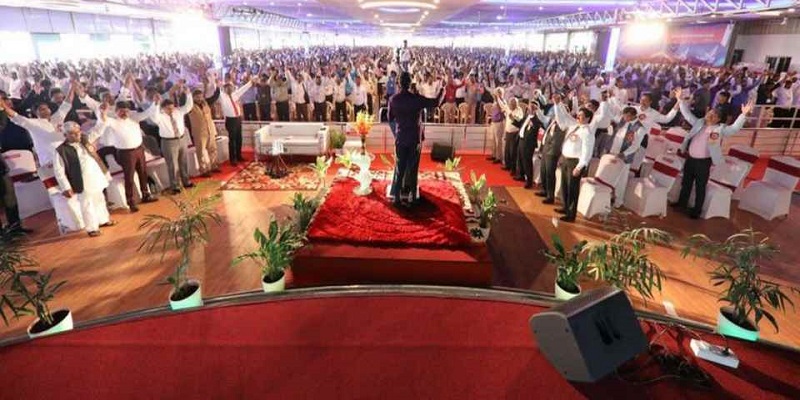
Although the phenomenon of globalization tries to soften things, it is a fact that in Latin America the dominant note is not dialogue or understanding, but the most shameless religious proselytism.
Religious proselytism on the part of the sects, the new religious movements, the New Age followers, the non-Christian religions, and even the historic churches, whose membership is largely composed of former Catholics.
Cultural Displacement
Now then, keeping all of this in mind, where lies the deepest cause of the collapse of the Catholic Church in many parts of Latin America and, at the same time, the deepest reason for the advance of the proselytizing groups? In a certain disorientation or cultural displacement present in the Catholic Church, especially in its hierarchy.
Indeed, there exists an enormous difference between the way of being and acting of the Catholic people and the way of being and acting of the proselytizing groups. While in the Catholic Church being, the mind, and knowledge are privileged, in the proselytizing groups doing (action), the heart, and experience are privileged. While in the Catholic Church the values of truth and fidelity are especially esteemed, in the proselytizing groups the values of efficacy and success are placed in first position. While our style is essentially prophetic, the style of the proselytizing groups is essentially entrepreneurial. While for us the best Catholic is the theologian, the one who knows most deeply the mystery of God and His plan of salvation (almost all bishops come from among the theologians), for the proselytizing groups the authentic disciple of Christ is the apostle, the one who proclaims Christ and wins souls, using every possible means, licit or illicit.
It is enough to compare the documents of the Catholic Church with the documents of the proselytizing groups to realize that we find ourselves before two profoundly different worlds. Indeed, the documents of the Catholic Church are essentially doctrinal and exhortative, while the documents of the proselytizing groups are essentially operative, with concrete plans of action for advancing further. In my way of seeing things, herein lies the secret of their successes and, at the same time, the cause of our retreat. If things continue this way, it will not be difficult to forecast the religious future of Latin America.
Keeping all of this in mind, what is needed in the Catholic Church is a profound cultural change along the line of modernity or post-modernity, seeking a balance between thinking and acting, exhorting and planning, knowing and experiencing. This is what the Ecclesial Movements are trying to do, whose membership is composed essentially of committed laypeople who, by their very human and ecclesial condition, represent a bridge between society, wholly immersed in the present, and the Catholic hierarchy, culturally tied to the past by its very theological-philosophical formation.
Actors and Spectators
When the Mexican Episcopal Conference entrusted to me the Department of the Faith in the Face of Sectarian Proselytism, those in charge of Ecumenism chose to define my role thus: “Your task will be to keep the Episcopate informed about the advance of the sects.” What a lovely task, that of being the official witness to the Catholic defeat! To be a spectator and nothing more, trying not to influence the course of events, as if the advance of the proselytizing groups obeyed some inescapable historical process. This I naturally rejected completely, devoting myself to the arduous task of seeking the most opportune strategies for strengthening the faith of Catholics in the face of the onslaught of the proselytizing groups.
We ask ourselves: “To what is due such a passive and generalized attitude on the part of the Catholic clergy in the face of the phenomenon of sectarian proselytism, with such an organized, capillary, and overwhelming action?” It is simply a logical consequence of the cultural displacement of which we have spoken previously. Having a clear conscience of its own incapacity to react adequately to a phenomenon so deep and global, it opts to ignore it (the ostrich policy) or not to attribute due importance to it, giving proof of an enormous insensitivity to the suffering of the Catholic people, who feel abandoned to themselves in a relentless struggle unleashed by the proselytizing groups.
In reality, in order to confront the phenomenon of religious proselytism with sound realism, profound changes are needed within the Church, changes that lead to a new type of pastoral care, made no longer of personal sympathies, passing moods, or improvisation, but of research, planning, and an adequate management of human and economic resources.
Pretexts
Now then, not feeling capable of nor disposed to such a radical change, and at the same time wanting to give the appearance of an open and progressive attitude, the clergy took refuge in its own terrain, which is theological reflection, trying to justify its decision of non-intervention through pretexts without any foundation in reality:
· Christ does not need anyone to defend Him; He knows how to defend Himself alone.
· The faith is not defended, it is lived.
· If many leave the Catholic Church, it is because their faith no longer satisfies them. Therefore, if they find something better elsewhere, why bother them?
· Apologetics is a thing of other times. Now it is no longer of use.
· Apologetics must be avoided, since it may hinder the ecumenical process.
Evidently, these are pure pretexts. It is to ignore the reality of religious proselytism, which makes use of everything to “conquer” the Catholic: calumny, the handout, false testimony, biblical manipulation, psychological pressure, etc. It is not that someone, not feeling satisfied by the answers his Catholic faith offers him, begins to venture off in another direction, seeking something to give meaning to his life. Rather, it is others who use any means to make him doubt and thus carry him off to their groups.
Moreover, it is not a matter of defending Christ or defending the faith in the abstract. When we speak of defense of the faith, we are referring to the faith of the Catholic of flesh and blood, who finds himself unprotected against the attacks of religious proselytism, wherever they may come from. It is a matter, then, of helping that concrete Catholic to defend his faith in relation to those who wish to disturb it, along the line of the good shepherd who does not flee in the face of danger, as the hireling does (Jn 10:12–13), but is ready to lay down his life for the sheep (Jn 10:15).
Apologetics and Ecumenism
So then, apologetics is not a thing of other times; it is something fundamental for the believer of all times, helping him to remain firm in his faith in the face of any threat. Do you remember that statue Nabuchodonosor saw in his dream? Everything perfect: gold, silver, brass, iron… (Dan 2:31–33). Only one weak point: the feet of clay and iron. A single stone sufficed for the whole thing to collapse.
This is what is now happening with our Catholic people: catechesis at every level and with every imaginable pedagogical resource, various apostolic movements, liturgy, lofty theological flights…, but one thing is lacking: apologetics, which grounds and strengthens the faith of the Catholic in the face of the threats present in the environment surrounding him. Things being so, though everything may seem beautiful and perfect, at the hour of trial it does not hold up and collapses.
One of the great errors committed after the Council has been that of wagering everything on ecumenism and interreligious dialogue while eliminating apologetics, of not having understood that there is no opposition between apologetics and ecumenism. Rather, they are two complementary activities: ecumenism with those who are disposed to dialogue, and apologetics with those who do not accept dialogue and strive to conquer the Catholic. Two sides of the same coin, which is the problem of unity: unity that must be preserved (apologetics) and unity that must be recovered (ecumenism).
Not having understood this has led to the abandonment of the Catholic people in the face of the proselytizing onslaught. Priests, seminarians, religious, and committed laypeople, wholly isolated from the people, boasting of their knowledge on the ecumenical and interreligious plane, but wholly incapable of helping the Catholic in the face of the objections and attacks of the proselytizing groups.
On the operative plane, the greatest error has been that of having placed the matter of the sects, the new religious movements, and alternative religiosity in general into the hands of those in charge of ecumenism. These, instead of seeing what can be done to help the Catholic people in the face of the threat of religious proselytism, devoted themselves to analyzing marginal and deviant aspects: whether it is correct to speak of sects and new religious movements or whether it is preferable to speak of sectarian groups and free cults; whether the Pentecostal and neo-evangelical groups are churches or sects, etc.
And when they saw that the problem of religious proselytism was becoming ever more serious and the goal of unity appeared ever more distant, instead of becoming more realistic and changing strategy, they leapt over the obstacle, affirming that at bottom we all constitute the same Church of Christ “complementarily.” With regard to the matter of interreligious dialogue, to make things easier, they had no scruple in denying the uniqueness of the role of Christ and His Church in the order of salvation, comparing Christ with Buddha or Mohammed and speaking of different paths of salvation, equally valid, thus stripping the mission of all meaning.
The reactions to the document “Dominus Iesus” give an account of how far it was carried, once the wrong path had been taken, turning a deaf ear to the concrete reality of the Catholic people and to the voice of the Scriptures in harmony with the authentic Tradition, present in the Catholic Church and sinking its roots into Christ and the apostles.
Naturally, not everyone reached these excesses. In any case, this invites us to reflect on the gravity of the situation that has gradually been created, by not having known how to confront with due seriousness and caution the matter of religious pluralism, the division among Christians, and proselytism.
A New Apologetics
In what does it consist? Not in trying to convince the proselytizing groups, whose only concern consists in “conquering” others, always trying to speak without ever listening, but in strengthening the faith of Catholics in such a way that they can resist their solicitations and snares. How to achieve this? By clarifying our identity and offering an answer to each of their objections.
Catholic Identity
We are the Church of Christ. Herein lie our deepest pride and our security. Not in long fasts, complete moral integrity, or vast biblical knowledge. For us what matters most is to obey Christ, belonging to the one Church that He founded personally when He lived in this world and which will endure until the end of history. In her resides the fullness of the Gospel and of the means of salvation. Her pastors possess the powers that Christ entrusted to Peter and the apostles for the good of His Church.
All the other ecclesiastical entities possess something, but not everything, nor in the same measure. Insofar as their religious patrimony coincides with the patrimony of the Catholic Church, it possesses the divine guarantee; insofar as it departs from or opposes it, it no longer possesses the same guarantee.
Moreover, they do not possess the note of indefectibility, proper to the Church of Christ, which is the Catholic Church. Therefore, just as they began at a determined moment in the history of the Church, so too they can disappear, without any guarantee of remaining until the return of Christ.
The Bible and the Church
So that salvation might reach the whole world, Jesus did not write the Bible, but rather founded the Church. Moreover, the Bible itself has much to do with the Church founded by Christ, which soon came to be called Catholic.
In reality, Jesus commanded that the Gospel be “preached,” not that it be written. In fact, the apostles and their successors preached the Gospel. Little by little something came to be written for practical reasons; not everything was written. Now then, among everything that was written, the Church declared what is “the Word of God.” Thus arose the New Testament.
As for the Old Testament, the Church chose the edition that was made outside Palestine, with the Greek translation of the edition made in Palestine in Hebrew and adding seven books written originally outside Palestine in Greek. It is the edition that the apostles used when preaching outside Palestine.
Things being so, how can one reasonably accept the Bible and reject the Church, which has so much to do with the very origins of the Bible?
An Answer to the Objections
Each group has its objections in order to confuse the Catholic and carry him off (the baptism of infants, images, the virginity of Mary, confession, the Sabbath, etc.). Now then, once the Catholic is aware of those objections and at the same time knows the answer to each one of them, he feels secure in his faith.
For the moment we are confronting the problem of the proselytizing groups of Christian origin, which are the most active and which are drawing the most people away from the Church. Little by little, we intend to confront the phenomenon of the New Age, Santería, spiritism, satanism, etc., and the proselytism that the non-Christian religions are beginning to exercise.
A Special Ministry
Since the phenomenon of religious proselytism is affecting the life of the Catholic people so deeply, it is necessary that a special ministry be established at every level, devoted to confronting this problem. Its task will be to intervene in catechesis, in the associations and apostolic movements, in order to strengthen the faith of Catholics. So that, at the moment of difficulty, in each community there may always be someone who can lend a hand on behalf of the Church; likewise when someone finds himself on the road of return and needs support.
The Apostles of the Word, already present in every country of the American continent, as well as in Italy, Spain, and Portugal, are devoting ourselves to this task, promoting in every place where we are allowed to work Commissions for the Promotion and Defense of the Faith and distributing support material: books, pamphlets, cassettes, videocassettes, radio programs, etc. Experience demonstrates that, wherever our method of work has been established, religious proselytism is halted and a phenomenon of return toward the Catholic Church begins.
Along this line, we see it as necessary that a chair of apologetics be established, alongside that of ecumenism and interreligious dialogue, in all the centers of formation for pastoral agents (faculties of theology, theological institutes, seminaries, catechetical centers, etc.). At the same time it would be opportune that a theological faculty specialized in apologetics should arise, destined to deepen the problematic of religious proselytism together with all the alternative religious manifestations, such as Santería, the Afro-Brazilian cults, spiritism, esotericism, occultism, satanism, the New Age, etc.
Without doubt, an attentive analysis of that whole vast range of religious beliefs would be of the utmost usefulness, not only for pastoral activity, but also for the formation of the pastoral agents themselves (priests, religious, and committed laypeople), who, being unacquainted with these religious phenomena, find themselves in the greatest uncertainty. For this reason they prefer not to broach these themes in catechesis, homilies, or spiritual counseling and, when they feel challenged in this regard, their answer is generally very superficial, running the risk of harming rather than helping the faithful.
The ideal place to establish this kind of faculty would be the State of California (USA), which represents a veritable breeding ground for the emergence of the most varied religious expressions.
Bible and Catechism: A Radical Change in Pre-Sacramental Catechesis
The Bible represents the greatest lure that the proselytizing groups of Christian origin use to make an impact upon and attract Catholics. Faced with them, Catholics normally feel a complex precisely because they are unacquainted with the Bible.
So I ask myself: “Why do we not confront the problem once and for all?” How? By beginning with the Bible from pre-sacramental catechesis onward, concretely from the preparation for First Communion.
First a general overview of the Bible is presented (History of Salvation), using the Bible and a small aid with all the pedagogical resources possible. This will serve so that the child gradually becomes familiar with the Bible. Afterward one passes to the catechism, verifying all its contents in the Bible. At the end a brief course of apologetics is imparted, grounding his faith in the face of the attacks of the proselytizing groups. In other latitudes it will possibly be better to insist on the aspect of ecumenical or interreligious dialogue, always starting from the awareness of one’s own identity.
The same must be done with the preparation for Confirmation and any other kind of catechesis, retreats, etc. Everything with the Bible and nothing without the Bible. Let the Bible recover in the life of the Catholic the place that belongs to it, as the basic text for nourishing his faith and the obligatory point of reference for any matter related to the faith. In carrying out this project, in a few years the Catholic people will be able to count on a common platform and a common language for the living of the faith, liturgical life, and pastoral action, emerging from the enormous cultural pothole in which it currently finds itself, immersed as it is in so-called “Popular Religiosity.”
In this way, in a simple manner and using the catechetical infrastructure we already have at our disposal, it will be easy to raise the self-esteem of the Catholic, to offer him the basic tool for his Christian maturation, and at the same time to create a bridge in relation to those who find themselves along the ecumenical line and a dike in the face of the threat of the proselytizing groups.
Conclusion
Without doubt, religious proselytism caught us wholly unprepared, preoccupied essentially with ecumenical and interreligious dialogue. For this reason it managed to wreak great havoc among the Catholic people of the American continent. Dealing with a people that still possesses enormous religious reserves, many intend to take advantage of them to swell their ranks.
It is time for the Catholic Church to react. Or soon the Continent of Hope will turn into the Continent of the Nightmare.
Author: Fr. Flaviano Amatulli Valente, fmap
