This Is How a Sect Begins… An Analysis of the Historical Process in Sectarian Movements.
In connection with this contemporary religious problem, several supposed “truths” have been formulated and accepted uncritically by most of us. One of them is the assertion that the sectarian phenomenon is something proper to the realm of religious experience, to such a degree that the term “sect” is today spontaneously and popularly identified with “religious sect”.
This is sociologically, psychologically, and historically incorrect. As we have already explained, the sectarian mentality is a reality proper to the human condition, a phenomenon belonging to the field of psychology and sociology; that is to say, sectarian behavior can manifest itself in any and all spheres of human activity. This is what we have maintained when speaking of the underlying phenomenon of what we have called “sectarian conducts”. We can find sectarian conducts and organizations in every sphere of human coexistence: political parties, community organizations, sport, and so on.
Another of these dogmatically accepted “truths” today is the belief that this is a phenomenon almost exclusive to the twentieth century. This is equally erroneous; not only because it is an easily verifiable historical fact that the most important groups of Christian origin have their beginnings in the last century (Mormons, Jehovah’s Witnesses, etc.); but also because, since it is a reality proper to human nature wounded by original sin, phenomena such as fanaticism and fundamentalism, as well as sectarianism, have permeated not only every sphere of human coexistence but also its entire history. It would be difficult to find any period in the history of civilization in which society was not gripped by organizations such as those with which we are concerned.
For at the bottom of this deforming experience that we today call a “sect” there lies a tendency embedded in the very heart of man that leads him to affirm division more readily than to work for unity and concord; a tendency which we Christians must affirm has its origin in that ill-fated dialogue that Eve held with the Serpent: “For God doth know that in what day soever you shall eat thereof, your eyes shall be opened: and you shall be as Gods, knowing good and evil” (Genesis 3:5).
To be “knowers of good and evil”, to be masters of good and evil, is basically the temptation of self-sufficiency, of being one’s own lord, of setting ourselves up as our own center and point of reference; herein lies the root of division, of confrontation, and of course also the root of our social, cultural, and religious atomization.
We can therefore affirm that the ultimate cause of this phenomenon of the explosion of religious experience that we witness in our own day, of its disintegration and atomization, is in the final analysis the single cause of the presence of evil in the world: original sin.
In short, we could say that the first sect, the original and primordial sect, is the one made up of the worshippers of themselves, those who raise their claim to “be as gods” as their banner and emblem. They are a sect because they have cut themselves off, torn themselves away from the original trunk, because they have followed the teachings of a particular master: the Tempter. And thus they have separated themselves from the communion of the worshippers of the one true God.
They are a sect because they absolutize a partial truth: that man is lord of all creation. And they forget the primary truth: that man is also a creature. All the “sects” that have appeared throughout the centuries are nothing more than forms, variants proper to each place and historical circumstance, of one first and selfsame rupture, the only truly original one.
In this primordial rupture of communion with the Transcendent we can also find the beginning of the answer to all the difficulties that are usually raised. The religious problem, as well as the social, economic, political, and cultural problem posed by the so-called “challenge of the sects”, has one single and fundamental solution: to rebuild, through personal effort and fidelity to the Truth, the unity and harmony of the order willed by God for his creation, accepting the Creative and Redemptive Love of God, and responding with humility and fidelity to his call.
Original sin has separated man from God; this is the foundational rupture of harmony, the loss of the transcendent harmony and unity proper to man, and for which he was created. This dissonance has not been restricted solely to the religious sphere, but has been projected, and continues to be projected, onto every order of human existence, even the social and the cultural. Such is the message we are to read in the account of the Tower of Babel.
But in what concerns us here, we must focus mainly on this primordial estrangement, on this loss of a stable reference to the Love of the Creator God, which is where we can find the foundational reason for the thirst for God (the “desire for God” of which the Catechism speaks) that will lead all men throughout history to undertake the adventure of finding the path that leads them back to the lost union; the path of religion.
But even though man already carries within himself the seed of division, God has not abandoned him, but rather mercifully continues to reveal himself to men so that those who seek him with a sincere heart may find him.
A Brief Historical Survey
With the reservations and precisions that have preceded us up to this point, we must acknowledge that the term “sect” is the one that most broadly identifies the religious phenomenon to which we are referring. Now then, as we have also said when making the considerations concerning the definition, the term “sect” was already present in the New Testament, and it is therefore evident that the appearance of the phenomenon is not a privilege of our century but that, at least throughout the Christian era, there have always been groups that for various reasons set themselves apart from a fully conceived ecclesial life.
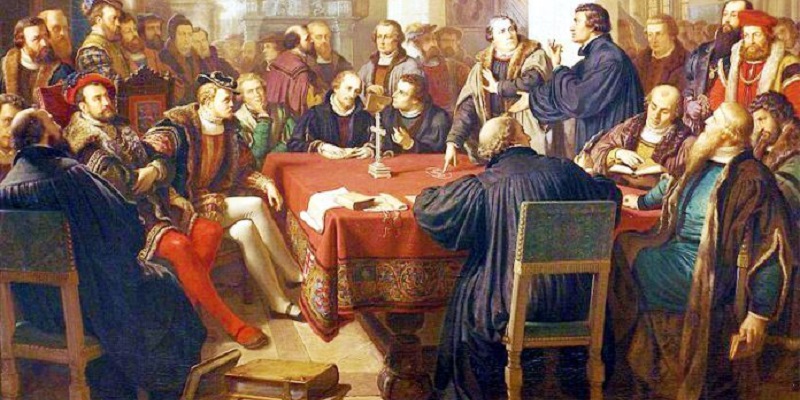
In the modern period, this designation of “sect” began to be applied particularly to the churches derived from the Reformation movement that took place during the sixteenth century; a movement whose declared purpose (at least in the intention of its founders) was to purify the Catholic Church of what they considered to be its most serious errors and weaknesses.
But the reformist movement was an attempt at purification not carried out from within the Church herself, through the search for a greater fidelity to the source of all holiness, which is Christ himself, a purification and revitalization of the Church in the manner of that carried out by Saint Teresa of Jesus or Saint Ignatius of Loyola; rather, it was an attempt at purification applied from without, a purification that did not take into account the marks of transcendence and permanence that the Church has received by her very divine institution, a purification attempted not through a deepening into the divine that is hidden behind the human (as the dynamic of the Incarnation ultimately demands), but attempted from a stepping away, a separating from that old trunk which is considered a priori as totally and irremediably corrupted, in search of a disembodied purity and therefore, in the last analysis, a false one.
In this very thing we may say lay the deepest drama that the reformist movement had to face, since it could not avoid being manipulated by certain rulers (as was the case with Henry VIII of England, or the German princes), who did not hesitate to take advantage of the religious Reformation as an instrument that would allow them to break the unity of the Church, the chief obstacle to the realization of their aims of political absolutism and to their need for funds to finance their military campaigns. These politicians were certainly neither guided nor concerned by the greater or lesser holiness of Christians and their Church, but rather saw in the Reformation a suitable instrument for carrying out their designs of exercising absolute dominion over peoples and territories.
The destruction of the unity of the Church was the indispensable requirement on the road toward absolutism, since the rupture of unity in the faith turned political power into the only unifying factor of the nationalities; in this way, those who wished to eliminate every limit on the exercise of their power found in the Protestant Reformation a convenient spring to undermine the religious structures of their peoples and leave them at the mercy of the mercenaries of their own interests.
Such being the case, the Reformation quickly found in many European princes of the time a notable support, without which it would not have been possible to carry forward the process of dividing the People of God; but for that same reason, the Protestant Reformation had to pay an excessively high price: to submit to the conditions imposed upon it by the civil power.
From our historical perspective, we can affirm today that in general none of the reformers managed to eradicate, in the life of the Christian communities that broke away from the historical trunk of Catholicism, that which they condemned in the Catholic Church.
But the damage caused was not reduced simply to the division of the People of God; rather, a further aggravating element was introduced: the reformist groups, by adopting the Principle of Free Interpretation as their norm of biblical interpretation, definitively and permanently introduced into the religious life of the West a virus that would eat away at its entrails: subjectivism. This subjectivism is the reason why they themselves were unable to keep their own foundational guidelines stable for very long, giving rise within the space of a few years to an incipient process of religious disintegration that has projected itself today into an unfortunately growing process of atomization of religious experience, easily verified through the continuous emergence of new groups, and in the continual wandering of individuals from one group to another, since they cannot find “their place”. This process of atomization of Protestant religious experience has been aggravated above all in recent times by the intrusion of powerful economic and political interests alongside those proper to the preaching of the Gospel.
That subjectivism of free examination proper to the churches that arose from the reformist movement of the sixteenth century, to which we have just referred, joined to a conception of the church that is dissolving in nature (let us recall that in the congregationalist model it is the congregation that sets the doctrinal and organizational norms), is the theological and spiritual substratum out of which the modern phenomenon is engendered whereby each individual builds a religion not upon the mold willed and revealed by the objective and transcendent God, but upon the standards of his own taste, opinion, anxiety, or need; and it is what has provided the appropriate cultural climate for the religious explosion that we behold in our time.
This concise historical analysis leads us to fix our attention on what were the two great poles of this Western “religious explosion” with which we are concerned, in the course of the last century.
I. The Great Religious Awakening
A first religious element proper to the last century, and an antecedent of no small importance, is what some specialists have called “The Great Religious Awakening”.
They give this name to what was a direct consequence of Lutheran pietism, which spread rapidly during the second half of the eighteenth century and the first half of the nineteenth among the religious confessions of Reformed origin, especially in the North of the New World, in the English colonies, where the most anarchic and undisciplined groups of the European Reformed churches, especially of Anglicanism, had been displaced.
This cultural and religious phenomenon is characterized by a marked exacerbation of subjectivism, the emphasis on the obsessive search for a personal holiness believed capable of becoming perfect in the course of the present life, and consequently there is also a morality of a clearly puritanical stamp (a “moral purity” is sought through the observance of a series of moral precepts), and a preaching of a markedly apocalyptic tone (note that already at that time the itinerant preachers went from town to town announcing the imminence of the second coming of Christ).
II. The Social Gospel
On the other hand, what is known by the name of “the Social Gospel” was, by contrast, a movement of religious renewal that arose from the contact of religious groups, principally of Anglican character, with the reality of growing marginalization presented at the beginning and middle of the last century by the proletarian sectors of the great centers of development of the so-called “industrial revolution”, as was the case of London.
This challenge that marginalization poses to Christian charity will instill in the religious communities an effective concern for the recovery of the marginalized of various kinds: alcoholics, the illiterate, the struggle against sexual promiscuity and violence, and so on. Its beginning finds a concrete expression in the Salvation Army, which arose at that time in England.
The immediate fruit of all this renewed fervor, though imbued with pietism and an exacerbated subjectivism, was the appearance of two movements of religious renewal, similar though of differing character, both likewise claiming to be inspired by the Holy Spirit.
While one of these movements placed its emphasis on what they called a “new Pentecost” that renewed all things (these are the so-called Renewal movements), the other was clearly what is called a Restoration movement, which aimed essentially at recovering the way of life proper to the first Christians, as interpreted from a fundamentalist reading of Scripture, especially the Epistles of Saint Paul and the Acts of the Apostles.
It is in this climate of religious effervescence that other groups also found a place, ones not so closely tied to what we call “evangelicalism”, such as Christian Science, Adventism, the Jehovah’s Witnesses, the Mormons…; all of which would be born in this historical period and would begin from here their history of adaptation to the social environment and of expansion.
This is the historical knot of the present host of religious groups that we today so quickly and broadly call “sects”; but this is in reality only a first historical moment in the development of a much more complex process, one that will take on diverse particularities in each nation. In this process, two prominent moments are usually recognized, and a third that is in full evolution:
a) The first moment is the one we have described up to this point, which begins at the start of the nineteenth century, becomes consolidated well into the second half of the last century, and extends to the beginning of this century. In this period there arise, in general, movements that can be characterized as follows:
-almost all originating in the United States
-in general they are of Christian origin, their preaching being centered particularly on the action of the Holy Spirit and on Jesus Christ as Savior (in most cases). Some groups have a clearly apocalyptic or scientistic tinge.
It is in this period that the Jehovah’s Witnesses, the Mormons, Christian Science, the Assemblies of God, and many other evangelical and Pentecostal groups arise and develop.
* A curious element is the fact that no groups are recorded as having arisen during the period between the two wars. In the words of César Vidal Manzanares, “socialism, nationalism, anarchism, and other ‘isms’ absorbed the energies that could have ended up going to other sects”; in fact, in several of these movements mentioned by the Spanish author, we can speak of a quasi-religious belonging on the part of their members, the denial of a properly religious dimension, or the elaboration of a religious outlet or proposal of their own.
b) With the Second World War ended, the West will witness, above all from the decade of the ’50s onward, a new process of religious effervescence that has been growing and continues to our own day. This new moment is basically grounded in a substratum of personal and social uncertainty and insecurity, generating a high content of anguish, and giving rise to new groups that we can characterize by:
-even though they no longer necessarily arise in the United States, in general all these groups use the country of the North as a launching pad in the West
-with various alternatives, all are to a greater or lesser degree products derived from the great Eastern religions, or syncretic products.
It comprises for the most part what in the terminology of the Document of Santo Domingo we call Free Religious Movements, and a great number of them are very well known for their exotic doctrine. Some specialists call many of them “hard” or “destructive” sects on account of the systematic use of techniques of behavioral conditioning or coercive persuasion (commonly called “brainwashing”) with their members. Groups that arose during this period include the Children of God, the Moon Sect, Hare Krishna, Transcendental Meditation, and so many others.
c) It can be affirmed that since the mid-1970s a new stage of this process of religious disintegration has begun to develop; it is a new phenomenon, namely the appearance of groups of national origin (that is, outside the U.S.A.). They are generally groups that claim to seek the authentic faith of the historical churches (Palmar de Troya, Nuevo Amanecer); in many cases their doctrine is strongly marked by gnosticism (CEIS); and, in some particular cases, they are paramilitary groups (Nueva Acrópolis, Edelweiss, La Comunidad).
In summary, the Protestant Reformation introduces into Christianity the Principle of Free Interpretation of the biblical text, and with it religious subjectivism.
The two great poles of this “religious explosion” over the course of the last century:
The Great Religious Awakening: an exacerbation of subjectivism; the emphasis on the search for a perfect personal holiness; a morality of a clearly puritanical stamp; a preaching of an apocalyptic tone.
The Social Gospel: a movement of religious renewal that arose from a reality of growing marginalization
Historical Stages of the Process of Religious Atomization
Nineteenth century up to 1914. Groups arise:
Almost all originating in the United States.
In general they are of Christian origin.
Preaching centered particularly on the Holy Spirit and on Jesus Christ.
Some groups have an apocalyptic or scientistic tinge.
From 1945 onward. Groups arise:
That use the United States as a launching pad in the West.
Products derived from the great Eastern religions, or syncretic products.
From the decade of the ’70s onward
Groups of national origin.
Groups that claim to seek the authentic faith of the historical churches.
In many cases their doctrine is strongly marked by gnosticism.
All these groups of a sectarian character, whether they be fundamentalist sects or free religious movements, follow a relatively similar process of growth that can be systematized into the following stages:
Birth: the group arises at the prompting of a set of cultural, social, and religious circumstances that generate a quantity of anxieties and unsatisfied expectations in a sector of the population. The small community gathers around the figure of a “prophet”, “guru”, or “master” who elaborates not so much the doctrine as concrete directives regarding the group’s action and insertion into society. In this period the sect is basically devoured by its craving for expansion. In general they are identified primarily as “the group of…”, or “the church of…”.
Consolidation: the group, after having probably come into collision not only with other religious confessions but also with various spheres or institutions of the social order in which it develops, begins to seek paths that will allow it to channel the irregularities or eccentricities that the passion of the first phase may have generated, and which may have been the cause of its having lost social acceptance; there is a clear concern not to generate conflicts and to seek the internal stability of the group. This stage generally occurs after the disappearance of the leader or founder, with a simultaneous softening of the most explosive or extravagant aspects of its doctrine and a search for greater conceptual coherence.
Transformation: it is a kind of makeover of the sect, of its public image. Care is carefully taken so that public opinion may forget, and the new adherents may be unaware, that it is truly a sect, and so that it may be accepted as an honorable church, on a par with the historical churches. It is quite possible that the adherents are completely unaware of the origin and early history of the group, which is attempted to be dissolved into some historical depth. As regards the methodology they employ, their fanaticism and intransigence are mitigated, and the presentation of their message is made softer, more polished, and more socially acceptable.
By Oscar Antonio Gerometta
Taken from Apologetica.org
