–What shall we do now? Look at what they are saying in…
–Be calm. I will bless the Lord at all times, his praise shall be always in my mouth. Does that suffice?
In the preceding article I set forth that the Lefebvrist illness had as its principal causes a condemnatory judgment of the postconciliar Church and of her Popes, and a conviction that the Society of Saint Pius X was necessary and indispensable for the continuity of the Church. A historical synthesis came to confirm this diagnosis. And as medicine for that illness, it becomes necessary to reaffirm certain fundamental truths of the faith concerning the Church.
1. There is no Church other than the present and visible Church, presided over by the Pope and by the other successors of the Apostles. Whoever does not believe in “this Church” believes in no Church, because no other exists. A “traditional Church,” an “eternal Rome” –in Archbishop Lefebvre’s words–, if it is understood as distinct from the present Church, is nothing but a nonexistent chimera. Christ has one Body, one alone, the visible Church, palpable and audible, which is unique in its threefold condition: earthly, purgative, and heavenly.
In the sixteenth century, the errors of the deformers Luther and Calvin made it necessary for the Church to reaffirm her social visibility as an essential note of the true Church, for to them it was an accidental note. That is why the Council of Trent, although it did not deal directly with the mystery of the Church, insisted markedly on her institutional character: the objective value of the sacraments, the sanctifying, juridical, and pastoral powers of the apostolic Hierarchy, the specific distinction of the ministerial priesthood. The Catholic faith did not admit that the Church be reduced to an invisible community of grace.
The most ancient and traditional ecclesiology, already from a Saint Ignatius of Antioch, accentuated by post-Tridentine theology, develops amply and in continuous line this vision of the Church, until reaching the First Vatican Council, the encyclicals Satis cognitum of Leo XIII (1896) and Mystici Corporis Christi of Pius XII (1943) and the Second Vatican Council. The Church is one with Christ: his only Bride, his only Body. Saint Thomas explained that the name of Church can have a twofold meaning: “it designates only the Body that is united to Christ, its head… But in another sense, the word Church designates the head and the members united among themselves” (IV Sent. d.49, q.4, a.3 ad4m): the head and the members united among themselves inseparably, forever, like spouses in the conjugal union. It is a central theme of the Second Vatican Council:
“Christ, the one Mediator, established and ceaselessly sustains here on earth his holy Church, the community of faith, hope, and charity, as a visible whole, communicating through her truth and grace to all. And the society furnished with hierarchical organs and the mystical Body of Christ, the visible assembly and the spiritual community, the earthly Church and the Church endowed with heavenly goods, are not to be considered as two distinct things, but rather form one complex reality that is composed of a human and a divine element.
“For this reason, by a remarkable analogy, she is compared to the mystery of the incarnate Word. For just as the assumed nature serves the divine Word as a living instrument of salvation indissolubly united to Him, in a similar way the social articulation of the Church serves the Holy Spirit, who vivifies her, for the increase of his body (cf. Eph 4:16)” (Lumen gentium 8).
Leo XIII had already taught in Satis cognitum that “the Church of Christ is one and perpetual: whoever separates from her departs from the will and the command of Christ our Lord, leaves the way of salvation, and hastens to his ruin” (n.9; it is worth reading the complete development of the doctrine, cf. 3-11). Put in plain words: the only Church that exists is the one you can see, hear, and touch, with all her marvels of grace and holiness, of truth and goodness, and with all her miseries, contradictions, cowardices, filth, and disobediences. There is no other Church distinct from her. You may remain within “this Church” or go outside if you cannot bear her. But know well that there is only one Church. That is why certain words of Archbishop Lefebvre and of his followers, which might make one think otherwise, are false. Those terrible insults, for example, against “the conciliar Church,” the “apostate and adulterous Rome,” etc., are blows struck against the very Body of Christ.
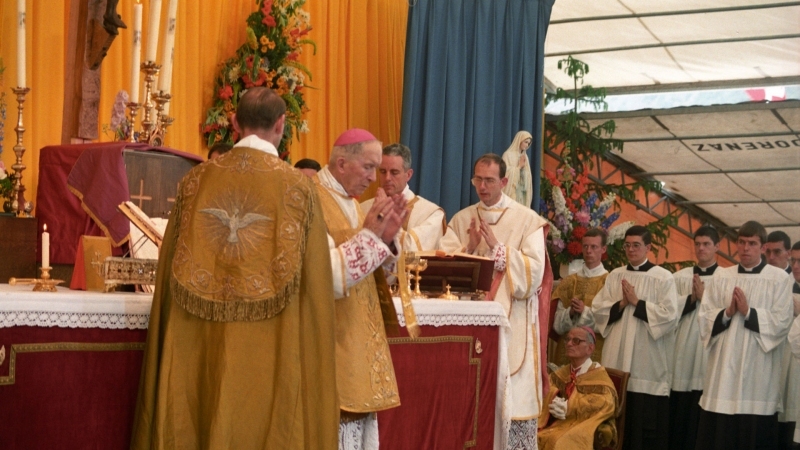
When Archbishop Lefebvre, together with Bishop Castro Mayer, celebrated the schismatic ordination of four Bishops, this dialogue unfolded as the ritual proceeded: – “Do you have the apostolic mandate [to ordain]? –We have it. –Let it be read. –We have it from the Roman Church ever faithful to the holy traditions received from the Apostles”… (Tissier 593). The formula sounds good, but it is worthless: it is purely illusory. They wholly lacked any “apostolic mandate” to consecrate Bishops, because Saint Peter grants that apostolic mandate only through his Successor, the Bishop of Rome, then presided over by John Paul II, who in a personal letter to Archbishop Lefebvre commanded him with the utmost urgency not to ordain.
2. Credo in Ecclesiam. It is “the faith in the Church,” Mater et Magistra, that opens our mind to all “the truths of faith” that she teaches. This reality is clearly manifested in the very rite of Baptism: “What do you ask of the Church? –Faith.” Therefore it is faith in the Church that makes it possible to believe all the truths of the Catholic faith. Why do we believe, for example, that in the Eucharist Christ is present “really, truly, and substantially”: because that is what the Church believes and teaches! John 6, “my flesh is meat indeed,” and other kindred texts, can receive hundreds of diverse interpretations.
Saint Thomas teaches that “the formal object of faith is the First Truth, manifested in the sacred Scriptures and in the doctrine of the Church… Therefore it is evident that whoever gives his adherence to the doctrine of the Church, as to an infallible rule, assents to everything that she teaches. On the contrary, if of the things the Church holds he accepts some and freely rejects others, then he no longer gives his adherence to the doctrine of the Church as to an infallible rule, but to his own will” and judgment (STh II-II,5, 3). I have already treated this subject in two articles: in I Believe in the Holy Catholic Church, in that of yesterday and in the present one, and in They Are Theologians Who Have Lost the Faith (60-2).
Credo ut inteligam could be translated, forcing a little the original Augustinian and Anselmian sense, “I believe in the Church in order to be able to receive her doctrines in my mind.” Therefore: –the true mental order is this: we believe in the truths of the Catholic faith “because the Church teaches them”; and –the false order is the inverse: we believe in the Catholic Church “because we deem her doctrines true”. This second position can be true insofar as not a few converts, for example, have come to believe in the Church convinced by the formidable truths, absolutely coherent among themselves, that she alone affirms and maintains. But it is erroneous when faith in the Church is made conditional upon her holding the doctrine that “I” or that “we” believe to be true. Such an attitude is much closer to Lutheran “private judgment” than it appears at first sight. Faith in the Church is the doorway into the whole world of the truths of the Catholic faith.
Consequently, when Lefebvre declares that “the conciliar Church” has fallen into apostasy and that it has broken with the true Tradition, he is attacking the only Church that exists, he is undermining the Rock upon which the whole edifice of the Christian faith is raised. And in vain will he try to sustain his spiritual house on the foundation of a “Roman Church ever faithful to the traditions of the Apostles,” distinct from the present one, because it does not exist.
3. The personal teaching of the Pope and that of the universal episcopate which remains united to him, whether dispersed throughout the world or gathered in council, is infallible when, in matters of faith and morals, it proposes to the faithful certain truths for them to hold as of faith. Our Lord Jesus Christ said to the whole body of the apostles: “he that heareth you heareth me” (Lk 10:16), and he constituted Peter, him, personally, as the foundational rock of the Church (Mt 16:18), charging him to “confirm his brethren in the faith” (Lk 22:32).
I shall not attempt to summarize here the Catholic doctrine on the infallibility of the apostolic Hierarchy 1st- when it teaches revealed truths or truths annexed to them, proposing them to the faithful as truths of faith, and 2nd- when it governs with pastoral and canonical decisions the people that the Good Shepherd has entrusted to it. In the Second Vatican Council (LG 18, 25) and in the Catechism of the Church (85-88, 891, 2030-2046) we can find this doctrine set forth sufficiently. And it is not the same, of course, the infallible assistance of the Lord when the Church teaches and when the Church governs and pastorally disposes certain means. Therefore, regarding this second aspect of ecclesial infallibility, I think it fitting to recall a classical doctrine expounded by Fr. Faynel:
“In decisions of a general order (the great laws of the Church, permanent dispositions of canon law, impediments to marriage of ecclesiastical law [the promulgation of renewed liturgical Rites concerning the Mass and the Sacraments, I add], the Church enjoys an infallible prudential assistance, meaning by it an assistance [of Christ] that guarantees the prudence of each one of those decisions; not only in the sense that they can contain nothing immoral or contrary to the divine law, but that they will all be positively beneficial. Let us not, however, mistranslate these words, in the sense of ‘they will be perfect decisions’.”
“In decisions of a particular order (the synodal organization of a diocese, processes of nullity of a marriage, etc.), the Church enjoys a relative prudential assistance, meaning by it an assistance that guarantees the value of the ensemble of those decisions, but that does not guarantee it when each one is considered in particular (collective sed non divise)” (L’Église, vol. II, Desclée 1970, 100).
The outrages uttered by Archbishop Lefebvre and his followers about the postconciliar Catholic Liturgy and about the renewed Canon Law, specifically, these being documents promulgated by the Pope and received unanimously by the Bishops of the Church, are absolutely inadmissible.
4. It is contrary to Catholic Tradition to reject publicly the teachings and norms established by the Councils, especially by the Ecumenical Councils, even though these have dealt predominantly with pastoral and disciplinary matters. That is why the Lefebvrist attitude is incompatible with Catholic Tradition.
In the Council of Jerusalem, for example, purely disciplinary agreements are made, but they are obligatory (Acts 15:22-29) and they are received by the Churches as a gift that God grants them through the mediation of the Apostles. Saint Paul, accompanied by his collaborators, “as they passed through the cities, delivered unto them the decrees to keep, that were decreed by the apostles and ancients who were at Jerusalem” (16:4).
Christian antiquity always venerates the sacred canons agreed upon in the sacred Councils, and all the more the Ecumenical ones, even though they be at times exclusively disciplinary and do not enjoy the infallibility proper to doctrinal and dogmatic declarations. In the authority of the Bishops presided over by Peter or his delegate, Catholic Tradition comes to see the authority of Christ and of the Twelve. When the sacred Council of Elvira (306), for example, agrees upon 81 conciliar canons, all disciplinary, it establishes 81 sacred canons that must be respected and fulfilled. And all the more when the lesser Councils are confirmed by the Roman See. The monumental work of Joannes Dominicus Mansi, which gathers in more than 50 enormous volumes all the great and least Councils, bears the significant name of Sacrorum Conciliorum Nova Amplissima Collectio.
Therefore, the truly traditional Catholic attitude today is to respect in the highest degree the agreements and teachings of the sacred Second Vatican Council, the Twenty-first Ecumenical Council, as also all the preceding apostolic Magisterium. To utter against the Council, against “Rome,” words as terrible as those spoken and written by Archbishop Lefebvre and still spread today by the FSSPX –some words perhaps not heard since the times of Luther–, constitutes a grave scandal, a great harm to the Church of Christ.
You can see some of the pro-Lefebvrist comments posted to my previous articles (126), (127), and (129). I cite two examples from among them: One cannot say “that one can be a traditionalist while admitting a bastard mass,” “One of the evils of the Council”… When we hear a good Christian speak thus –an exemplary husband and father, zealous for the Christian education of his children, of daily Mass and rosary, hardworking, compassionate toward the poor–, we do not need to investigate much to discover whence proceeds that attitude so contrary to Catholic Tradition, those ways of speaking that our forebears would never have admitted.
5. Lefebvrism leads to sedevacantism. Tissier de Mallerais affirms that Archbishop Lefebvre never accepted falling into sedevacantism, because, as he said, “that spirit is a schismatic spirit.” To the “theoretical logic” of a Fr. Guérard des Lauriers, for whom Paul VI was Pope “materially, but not formally,” he preferred to hold to “a higher wisdom: the logic of charity and of prudence” (Tissier 534).
Nevertheless, it must be acknowledged that it proves very difficult to affirm at the same time 1.-that “Rome” has fallen into heresy and 2.-that the Pope continues to be the Vicar of Christ. If the Pope is poisoned with modernism –the synthesis of all heresies–, if the See of Peter is under the power of the Antichrist, that means we have no Pope, since “Rome has fallen into heresy.” The Roman Chair is, therefore, sede vacante, for a heretical Pope is not truly the Pope. And indeed, let us note that very soon Archbishop Lefebvre doubted the true identity of Paul VI as Pope:
“How has a successor of Peter been able in so short a time to cause more destruction in the Church than the Revolution of ’89?… Do we truly have a pope or an intruder seated on the see of Peter?” (8-XI-1979; Tissier 533). And the same question continued alive with regard to John Paul II: “How is it possible, the promises of the assistance of Our Lord Jesus Christ having been given to his Vicar, that this same Vicar could at the same time, by himself or through others, corrupt the faith of the faithful?” (Tissier 534).
If indeed Lefebvrism was not and is not sedevacantist, it must nevertheless be acknowledged that it leads straight to sedevacantism, as has been possible to verify over the passing of the years in groups foreign to the FSSPX, and at times harshly opposed to it, because it does not go as far as they would wish.
6. Lefebvrism also approaches, in some questions, “private judgment”, specifically when, subjecting itself to its own ways of understanding Tradition and the Magisterium prior to the Second Vatican Council, it openly confronts, in grave matters, “the conciliar Church”. And also when the decisions of Archbishop Lefebvre prevail over the discernments and mandates of the Holy See. The Roma locuta, causa finita is thus emptied of meaning. Let us recall several concrete cases: the Holy See deems necessary the suppression of the FSSPX and the closure of its Seminary; it suspends Archbishop Lefebvre a divinis; it considers and declares schismatic the episcopal ordinations he carries out; it excommunicates the ordaining Bishop and the ordained… But Archbishop Lefebvre deems that all those discernments, as well as the decisions that accompany them, are false, unjust, and therefore null. He is aware, moreover, that the Holy See is perfectly informed and possesses all the precise data to judge the matter. But he deems that it is not “the conciliar Church” that is to judge him, but rather that it is he who must judge this Church. And thus it is that his judgment prevails over that of the apostolic Authority.
On the other hand, in Archbishop Lefebvre’s estimation, those Catholics –Pope, Bishops, and laity– who have received without reservations the Second Vatican Council and the postconciliar liturgical reforms, have “broken with Tradition and fallen into heresy.” “Le coup de maître de Satan” has been to bring it about that we, through obedience to the Roman Authorities, have been led to perdition, to the corruption of the faith. In short, I prefer not to continue, and I end these considerations by applying them to one of the central questions of the Lefebvrist dispute, the Mass of Paul VI.
–The postconciliar Mass of the Novus Ordo (1970), promulgated by Pope Paul VI and received by all the Catholic Bishops, is true, holy, and sanctifying, “because thus the Holy Mother Church teaches and commands it.” When the Pope gives a solemn approval to renewed liturgical Rites –Mass, Sacraments, Hours–, he is exercising at the same time his teaching authority and his authority of governance , pastoral. And in both aspects he engages the infallibility of the See of Peter.
1.-The liturgy is the supreme mode of the ordinary Magisterium of the Church. The Pope is well aware that, in handing over liturgical books to 4,000 Bishops, hundreds of thousands of priests, and a billion baptized Catholics, so that in keeping to them they may celebrate the Divine Mysteries, he engages the infallibility of his pontifical Magisterium, for lex orandi, lex credendi. He knows perfectly that the liturgy “is the most important organ of the ordinary Magisterium of the Church” (Pius XI, to Abbot Capelle, 12-XII-1935; cf. Mediator Dei 1947, 14). It is understood, therefore, that in the Council of Trent the reaction of the Church was so strong against the terrible impugnations of Luther against the Catholic Mass: “if anyone says that the canon of the Mass contains errors and that for this cause it must be abrogated, let him be anathema” (1562, Dz 1756, canon 6). That on the one hand, but on the other:
2.-The apostolic Authority of the Church enjoys an infallible prudential assistance when it promulgates liturgical Rites, which are always homogeneous evolutions of preceding Rites.
In consequence, for both reasons at once, the Liturgy renewed after the Second Vatican Council must be “believed” –Credo in Ecclesiam– and must be “accepted” as holy and sanctifying, as exempt from all error, and as positively beneficial for the Christian people. It is not perfect, of course, and it admits of further perfectings that, very probably, Divine Providence will grant us in due time.
It is, then, objectively a grave sin and a scandal to reject outright the Mass of the Novus Ordo, publicly calling it a “bastard Mass,” “Luther’s Mass,” “Bugnini’s Mass,” etc. And such an outrage cannot be justified in any way by adducing Masonic infiltrations, meetings with Protestant experts, Bugninis, and truthful accounts by Cardinals Antonelli and Stickler. It is true, however, that Archbishop Lefebvre, despite the gravest epithets he directed at the new Mass, did not consider it properly heretical, but he did deem that it led to heresy –which is no small thing– and that therefore it ought to be avoided as far as possible (Tissier 489). Such was his resistance to the new Mass that, before accepting it, he preferred to see the FSSPX canonically suppressed; a suppression, of course, that he considered null and without any effect.
–The old Mass and the new Mass, lamentably, have found themselves harshly set against each other. Benedict XVI, at the beginning of the Summorum Pontificum, recounts the history of the vicissitudes of the new Mass and of the old Mass, and declares that both forms, ordinary and extraordinary, are the one Roman Rite of the Mass.
On the one hand, one of the principal causes of the prohibitions or limitations of the use of the old Mass lies precisely in the very harsh combat of Archbishop Lefebvre and of others with him against the new Mass. No other way was seen of affirming in practice the validity in force of the new Mass in the Catholic Church of the postconciliar period. There existed and still “there exists the fear that the Authority of the Second Vatican Council be undermined and that one of its essential decisions, the liturgical reform, be called into question. This fear is [today] unfounded.”
And on the other hand, the combat against the renewed Mass came about “above all because in many places it was not celebrated in a manner faithful to the prescriptions of the new Missal, but rather this came to be understood as an authorization and even as an obligation to creativity, which often led to deformations of the Liturgy that reached the limit of what is bearable” (Summorum Pontificum).
The new rite of the Mass, celebrated with fidelity, a sense of the sacred, and the development of all the modalities it offers, is grand and full of majesty and beauty. It faithfully fulfills the norm established by the Second Vatican Council: “the rites should shine (fulgeant) with a noble simplicity” (SC 34). The innumerable abuses that the new Mass has suffered and suffers undoubtedly contribute to its discredit. But let us not deceive ourselves. It would be a mental trap to compare the new Mass badly performed with the old Mass celebrated with all dignity. It is true that in fact those who pass today to the old Missal, escaping from the new Missal badly celebrated, usually celebrate the Mass much better than many of the new Masses are usually celebrated. But this depends much more on the spirit of the priest and of the community than on the very structure of the rites celebrated. Those admirers of the old Mass, among whom I count myself, I would lead to take part in the new Mass celebrated in certain parochial and monastic communities with all its splendor and sacred beauty. Let us see whether they would dare to consider it a Masonic and Protestant Mass, devalued and secularized.
Nor is it altogether certain –though there is something true in it– that the old Missal left less room for bad celebration than the new one. I was ordained a priest in 1963, and I could recall for you some ways, not infrequent, of celebrating the old Mass that were very precarious. I remember Masses during which the Rosary was recited, novenas were made from the pulpit, lines of penitents formed before the confessionals, a priest preached throughout the whole Mass, keeping silence only during the consecration and communion, while the faithful with more formation “followed the Mass” absorbed in their bilingual little missals. Meanwhile, the celebrating priest was over there at the back of a high sanctuary, vested in a relatively modern chasuble, the one that leaves the arms bare, unknown before the sixteenth century, far less traditional than the ancient and medieval chasuble, which covers the priest completely like a little house (casula) or a cloak (casubla)…
–Let us collaborate with Benedict XVI to attain the Pax liturgica. The two forms of the Roman Mass must be accepted by the ones and by the others. In the Summorum Pontificum this intention and hope is clearly manifested. “It is a matter of arriving at an interior reconciliation within the bosom of the Church… There is no contradiction between the one and the other edition of the Missale Romanum. In the history of the Liturgy there is growth and progress, but no rupture.” The priests, then, who celebrate the Mass in its ordinary mode must respect and appreciate the old Mass. And in the same way, “obviously, in order to live full communion, neither can the priests of the Communities that follow the old use, in principle, exclude the celebration according to the new books. For the total exclusion of the new rite would not in fact be consistent with the recognition of its value and holiness.”
Credo in Ecclesiam. In the next article, which I pray to God may be the last of the series, I shall apply these same theological principles to other quæstiones disputatæ of the Lefebvrist world.
Author: Fr. José María Iraburu
