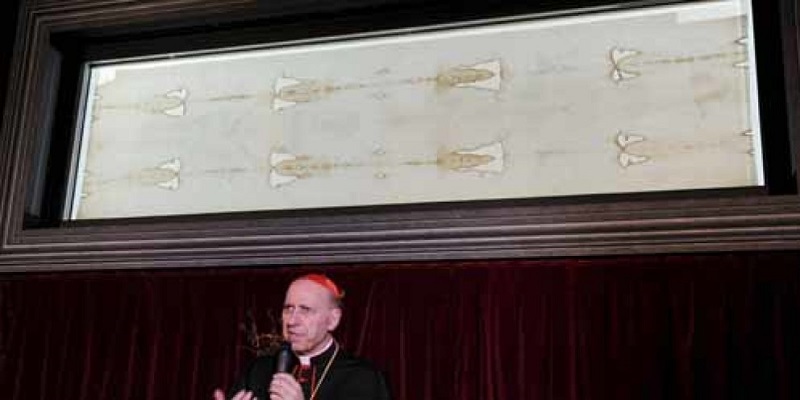
The Italian National Agency for New Technologies, Energy and Sustainable Economic Development (ENEA) has carried out a study over the past five years in an attempt to reproduce the Holy Shroud, which is kept in Turin. In their effort to make a copy, the scientists have confirmed that it is not a forgery, as some claim, but that the shroud is real.
(El Confidencial/InfoCatólica) The researchers only managed to imitate the effect of the cloth by applying high-intensity ultraviolet lasers to the linen and scorching the material. They found that it presents physical and chemical characteristics so peculiar that they currently make it impossible to obtain in the laboratory an identical coloration in all its components. The theory that a medieval forger was the author of the relic is therefore discarded.
The results of the ENEA report indicate that “this inability to repeat (and therefore to falsify) the image of the Holy Shroud makes it impossible to formulate a reliable hypothesis regarding the mechanism by which the impression was formed. In fact, to this day science is still not able to explain how the bodily image on the Holy Shroud was formed. The scientists lament the impossibility of taking direct measurements on the cloth of the Holy Shroud, and this could in part be a justification. In fact, the last experimental in situ analysis of the physical and chemical properties of the bodily image of the Shroud was carried out in 1978 by a group of 31 scientists on behalf of the Shroud of Turin Research Project, Inc. (STURP).”
“The scientists have used cutting-edge instruments, made available to them by various manufacturers, whose commercial value reaches two and a half million dollars.They have carried out numerous non-destructive measurements of infrared, visible and ultraviolet spectroscopy, X-ray fluorescence, thermography and pyrolysis, mass spectrometry, micro-Raman analysis, transmission photography, microscopy, extraction of fibrils and microchemical tests,” the study’s conclusions continue.
The results of the ENEA report also indicate that “the Shroud dates back to the first century, that is, it is not medieval. We have also verified the total absence of pigment; in other words, it is possible to say that it was not made by human hands. All the fragments we have found are of organic origin,” the document says, and it even speaks of “blood.”
“The implications are… that the image was formed by a burst of ultraviolet energy so intense that it can only be supernatural. I do not believe anything like it has ever been done,” Luigi Garlaschelli, professor of chemistry at the University of Pavia, tells The Independent.
For Paolo di Lazzaro, who directed the study, “when one speaks of a flash of light capable of giving color to a piece of linen in the same way as the shroud, the discussion inevitably falls into the realm of miracles.”
Dr. Di Lazzaro states that “whether his results are going to give rise to some kind of philosophical or theological debate is a matter for the experts and for each person’s conscience.”
31/12/11 8:26 AM
Source: Infocatolica
