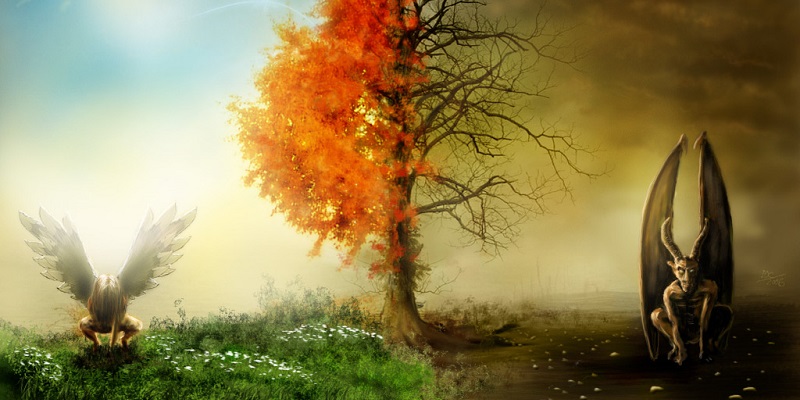
If there is a God, why do evil and suffering exist? The history of humanity is an endless succession of blood, sweat, and tears, of pain, sadness, and fear, of abandonment, despair, and death. In the face of that experience of suffering, it is inevitable that man should have asked himself this question since ancient times. Well known is Epicurus’s skeptical answer: either God wishes to eliminate evil but cannot, and then he is impotent and is not God; or he can and does not wish to, and then he is evil, he is the true demon; or he neither wishes to nor can, which leads to the two previous conclusions; or he wishes to and can, but then, where does evil come from? What are we to say about this?
As a starting point, we must not be scandalized at formulating the question with which we have begun this reflection: it has also been raised on the part of Catholic theology. It is the Catechism of the Catholic Church itself that affirms, in its number 272, that “Faith in God the Father Almighty can be put to the test by the experience of evil and suffering” and that “God can sometimes seem to be absent and incapable of stopping evil,” going so far as to raise, in its number 310, the question “why did God not create a world so perfect that no evil could exist in it?”. The Catholic theologian and bishop Walter Kasper goes so far as to point out that “these experiences of innocent and unjust suffering constitute an existentially much stronger argument against belief in God than all the arguments based on the theory of knowledge, on the sciences, on the critique of religion and ideology, and on any kind of philosophical reasoning.” The theologian Hans Küng affirms that “pain is a continual touchstone of trust in God,” after which he asks, “where does trust in God find a greater challenge than in concrete pain?”. And none other than John Paul II himself, in his catechesis on the creed (general audience of June 4, 1986), indicates that the presence of evil and suffering in the world “constitutes for many the principal difficulty in accepting the truth of Divine Providence,” adding that “in some cases this difficulty assumes a radical form, when God is even accused of the evil and suffering present in the world, going so far as to reject the very truth of God and of his existence,” all of this owing to “the difficulty of reconciling with one another the truth of Divine Providence, of God’s paternal solicitude toward the created world, and the reality of evil and suffering.”
To give an answer to this disquieting question, we must distinguish clearly between evil “in the physical sense” and evil “in the moral sense.” Moral evil is distinguished from physical evil, above all, by involving culpability and by depending on the free will of man; whereas what we are calling physical evil does not depend directly on man’s will, but derives from the very limited, contingent, and finite nature of man and of creation. The calamities caused by earthquakes, floods, and other natural catastrophes, epidemics, illnesses, as well as death, would be examples of this evil that we have called “physical”; the disasters produced by war, terrorism, hatred, violence of every kind that has its origin in man, would be examples of that evil that we have called “moral.” On the basis of this differentiation, the following may be pointed out:
a.- Physical evil is inherent in the condition of man and of creation. Man is a finite being who is subject to illness and death; moreover, he must live in a universe in which certain natural phenomena that produce harm and suffering occur. The limitations and transience proper to all creatures are the ultimate origin of this type of evils, which are consubstantial with the very structure of man and of the universe. Ultimately, it may be said that this evil in the physical order is permitted by God, as is pointed out in the aforementioned catechesis of John Paul II, “in view of the total good of the natural cosmos”,
b.- Something quite different occurs with regard to what we have called moral evil. In the words of John Paul II, “this evil, decisively and absolutely, God does not will.” Moral evil is radically contrary to the will of God, and its author is exclusively man, having made bad use of his freedom. Why does God tolerate this evil? Because for God the existence of free beings is a more important and fundamental value than the fact that those free beings abuse their own freedom against the Creator himself, and that, for this reason, freedom can lead to moral evil.
The foregoing constitutes the first explanation that theology offers us that the existence of evil in the world is not incompatible with the idea of God. But this is not all. We must turn around the argument that is implicitly hidden behind the question with which this article opens, in order to affirm with Hans Küng that “only if God exists is it possible to contemplate the infinite suffering of this world,” that “only by believing trustingly in the incomprehensible and ever-greater God can man have well-founded hopes of crossing the wide and deep river of the pain of this world: aware that above the abyss, of pain and of evil, a hand is stretched out toward him.”
Modern man cannot by himself eradicate the manifold sufferings of humanity, despite the advances of science and technology. Suffering is inherent in the human condition, and only through the redemptive intervention of God is it possible for a new man to arise, freed from death, from pain, and from suffering. Specifically, it is the passion, death, and resurrection of Jesus that entails the definitive redemption of human pain and suffering, that transforms pain and death into eternal life. It is from the perspective of the suffering and death of Jesus that the pain and suffering of each man takes on a new meaning. Suffering, pain, and death continue to accompany man; but in the passion and resurrection of Jesus that suffering receives a meaning.
In the words of Kasper, “the interlocutor of a present-day theology is suffering man, who has concrete experience of the situation of unhappiness and is conscious of the impotence and finitude of his human condition.” The existence of man, as Küng points out, “is an event marked by the cross: pain, anguish, suffering, and death.” The reconciliation between evil and suffering in the world and Divine Providence is not possible without referring to Christ. With the passion, death, and resurrection of Jesus, it is confirmed that God is at man’s side in his suffering. And not only that. Moreover, with Christ, pain, suffering, and death do not have the last word, but are definitively conquered through his resurrection which, as the firstfruits of that of us all, means a joyful promise of eternal life in which there is no place for pain, nor for suffering, nor for death.
Author: Fernando Renau
Source: Apologetica.org
