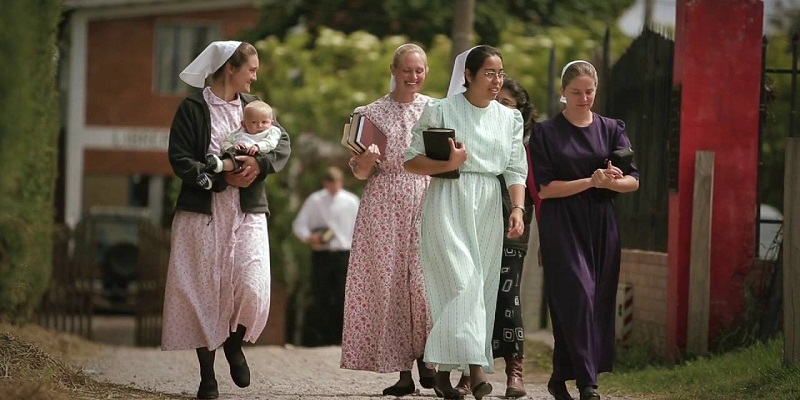
The Mennonites are a Protestant denomination of Europe and North America, born in Switzerland in the sixteenth century. Their name derives from Menno Simons, their Dutch leader.
Menno Simons was born in Witmarsum in Friesland in 1492. In 1515 or 1516 he was ordained a Catholic priest, and in 1532 he was appointed parish priest of his birthplace. But on 12 January 1536 he resigned his office and became an Anabaptist. The rest of his life he devoted to the interests of the new sect he had joined.
Although he did not have an imposing personality, he exercised considerable influence as a preacher and particularly as a writer among the more moderate supporters of Anabaptist views.
He died on 13 January 1559, at Wustenfelde in Holstein.
In 1525 Grebel and Manz founded an Anabaptist community in Zurich. They were persecuted in several parts of Switzerland from the beginning of the foundation of the new sect until 1710. But they could not be suppressed, and there are communities that exist to this day. In 1620 the Swiss Mennonites divided into Amish, or Upland Mennonites, and Lowland Mennonites. The former branch differs from the latter in the belief that excommunication dissolves marriage, and in other more secondary practices.
During Menno’s lifetime his followers in Holland (1554) divided into “Flemings” and “Waterlanders”, according to their differences over excommunication. The former subsequently split into different groups and dwindled into insignificance, and only three congregations remain at present in Holland. Division also split the “Waterlanders” until, in 1811, they united, abandoned the name Mennonites, and called themselves “Doopsgezinde” (Baptist persuasion), which is their present designation in Holland.
Menno founded communities exclusively in Holland and in northwestern Germany.
A certain number of Mennonites emigrated to southern Russia in 1788, because of offers of land and the promise of religious freedom. This emigration continued until 1824, founding important Mennonite colonies. In North America the first congregation was founded in 1683 in Germantown, Pennsylvania. A large number of emigrants then followed from Germany, Holland, Switzerland and, from 1870 onward, from Russia. There are twelve different branches of the sect in the United States, in some of which the membership does not reach 1,000.
Among the principal beliefs of the sect we find the rejection of infant baptism, oaths, lawsuits, military service and the use of weapons. They accept adult baptism and the Lord’s Supper, in which they teach that Jesus Christ does not become really present. Nevertheless, these two (baptism and supper) are not properly sacraments. An important principle is non-resistance to violence. In any case, not all today maintain these doctrines, and at present some Mennonites accept holding secular offices. The structure of the sect is congregational, with bishops, presbyters and deacons. The Mennonites are estimated to number about 250,000.
Bibliography: CRAMER, Bibliotheca Reformatoria Neerlandica, II and V (The Hague, 1903, sqq.); CARROLL, Religious Forces of the United States (New York, 1896), 206-220; WEDEL, Geschichte der Mennoniten (Newton, Kansas, 1900-1904); SMITH, The Mennonites of America (Goshen, Indiana, 1909); CRAMER and HORSCH in New Schaff-Herzog Encycl. s.v. (New York, 1910). N.A. WEBER, Mennonites, in The Catholic Encyclopedia, Volume X, 1911 by Robert Appleton Company.
Source: El Teólogo responde
