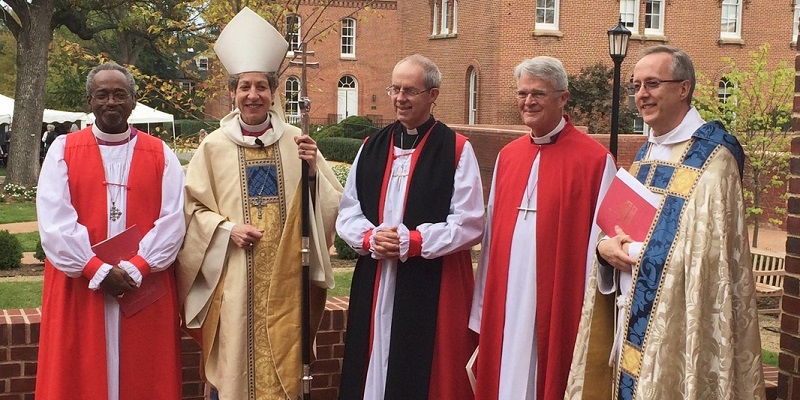
The term is used mainly to designate the members of the Anglican Communion (see ANGLICANISM) in the United States of North America and in Scotland. Both communities are historically connected, since the so-called Protestant Episcopal Church of America owes its first bishop to the so-called Scottish Episcopal Church. Extent. The Scottish Episcopal Church, with about 100,000 faithful distributed in a single province of seven dioceses, constitutes only a small minority of the Christians of the Scottish nation, since the national confession established by law is the Church of Scotland, Presbyterian in organization and doctrine (see PRESBYTERIANS). The Protestant Episcopal Church of America, the only part of the Anglican Communion that calls itself Protestant, occupies, by contrast, the second place in importance within the Anglican Communion, after the Church of England. With about three million members, it is not the largest of the religious denominations in the United States – it is surpassed by the Baptists (see) and the Methodists (see) – but it undoubtedly enjoys great influence because among its faithful it includes a high proportion of members of the nation’s governing classes. It has eight provinces and 104 dioceses, and because of the number of its participating bishops, its influence in the Lambeth Conference (see) is evident. Just as the growth of Anglicanism accompanied English colonial expansion, North American Episcopalianism has spread through the countries in which the United States has exercised its influence, for example, Cuba and the Philippines. It has also spread through various nations of Latin America. Unlike the Anglicans, Episcopalians have never been much concerned with questions of ecclesiastical territorial jurisdiction. This means that in South America problems sometimes arise because as many as three jurisdictions coexist: one of North American origin, another of English origin, and a third indigenous one.
History
The first English colonists arrived in Virginia in 1607. They brought with them the official religion of England. While these regions were an English colony, Anglicanism did not prosper greatly, since the official authority of the time had little interest in missionary works, and besides, many colonists were precisely English Puritans, or Roman Catholics, who had not accepted the established official religion. In 1701 Anglican missionary work began in earnest with the founding of the Society for the Propagation of the Gospel, with the explicit intention of fostering religion in the colonies overseas. Throughout this period there was never any thought of creating dioceses of the Church of England outside the island itself, and all Anglicans abroad remained under the jurisdiction of the bishop of London. The American Revolution of 1775 introduced a completely new situation, since with the separation of the thirteen colonies from the Mother Country, the Anglicans of the new republic had to regularize their ecclesiastical situation independently of the Church of England. Very soon, in 1783, the clergy of the colony of Connecticut elected Samuel Seabury, a missionary priest from the diocese of Lincoln in England, as bishop. According to English law at the time, the consecration of a bishop by English bishops was neither possible nor conceivable without an oath of loyalty to the English crown, which the North American citizen Seabury could not take. The difficulty was resolved the following year with Seabury’s consecration in Aberdeen by three bishops of the Episcopal Church of Scotland, which, because it had not been established by English law, did not require an oath of loyalty to the crown. In 1787 the legal difficulties in England were resolved, and the archbishop of Canterbury was able to consecrate two more North American bishops. Thus the English succession was added to the Scottish one, and from then on there were the three bishops necessary to ensure the continuation of the episcopal hierarchy. The Episcopal Church of Scotland occupies a situation very different from that of the Church of England, despite being the representative of Anglicanism in that country. This is explained by historical reasons. In Scotland, the separation from Rome occurred not as a consequence of the act of power that gave rise to the so-called Church of England, but from the movement, Calvinist in inspiration, developed by John Knox (see) and which gave rise to the Presbyterians (see). These Scottish Presbyterians always detested the via media of the Church of England, in which they saw only a disguise for popery, so that the attempts of the Stuart kings to impose Anglicanism in Scotland failed completely. The kings finally had to recognize the Presbyterian Church as the established religion in Scotland, where to this day it enjoys the support of the immense majority of the nation. The minority that accepted Anglicanism forms the Scottish Episcopal Church, which claims for itself continuity with the medieval Church in Scotland and shows strong Catholic tendencies, to which it can give free development because it does not suffer the restraints of state control (see ANGLICANISM, 5). Once the succession of bishops had been secured with the help of the Scots, the North American Anglicans were able to constitute themselves into normal provinces and dioceses. They adopted the title The Protestant Episcopal Church of America. If one takes into account that the majority of Anglicans, especially the educated, have never wished to call themselves Protestant, in order thereby to mark their distance from Lutheran and Calvinist communities, the use of that term by North Americans is striking. In fact, there have been proposals for its elimination, but it has been retained on the grounds that it has a meaning more historical than doctrinal, and that in the eighteenth century it simply meant non-papal, without implying the doctrines of Luther (see) and Calvin (see). The English origin of Anglicanism caused a certain suspicion among the citizens of the republic toward the Episcopal Church, which perhaps for that reason has always been a minority confession. The connection with the colonial past of the United States tends to confer on the Episcopal Church a certain social prestige in the democratic environment of the republic. The participation of the laity in its support and government is notable; its supreme authority is the General Convention, which meets every three years. Another characteristic is that it has no archbishops: the one who presides over a province is called the Presiding Bishop. In the case of the Scottish Episcopal Church, the president of the single province is titled the Primus (Primate).
Doctrine
The doctrinal situation of Episcopalians is that of the Anglican Communion in general; that is, it has no confessional writings of its own, but accepts the attitudes and practices received from the Church of England and expressed in the Common Prayer Book (see), and declares that it professes the faith of the primitive Church and of the Ecumenical Councils. Unlike the Church of England, it is organized on the basis of local congregations. It does not claim for itself a territorial jurisdiction. The Thirty-Nine Articles are not used. It has the same differences of emphasis as the Church of England with respect to the Catholic or evangelical aspects of the faith, with a development, however, that is freer in view of the absence of state control. This explains why, alongside completely Protestant parishes and very radical theologians, there are other parishes of almost completely Catholic doctrine and practice. In addition, there are some religious communities of men and women (see also ANGLICANISM, 6).
Liturgy
The liturgy of Scottish and North American Episcopalians is their own version of the Book of Common Prayer. The Scottish Book of Common Prayer was prepared in 1637 under the direction of the archbishop of Canterbury, Laud, and was revised recently in 1929. It is considered the best existing version of the Anglican liturgy, since even in the first version of 1637 it restores much of the canon in its traditional order. When he had himself consecrated by the Scottish bishops in 1784, Seabury, the first North American bishop, signed a concordat with the Scottish Episcopal Church promising to strive to introduce the Scottish liturgy into the United States. In 1798 the General Convention approved a Prayer Book more or less on the Scottish model. This book remained in force until 1892, when the General Convention began a series of slight changes that finally became, in 1929, a new Book of Common Prayer. The liturgy of the Scottish Episcopalians is, perhaps with the exception of that of the Church of South Africa, the most similar to the Catholic liturgy of all Anglican liturgies. That of the North American Episcopalians has the curious characteristic of incorporating the very traditional Eucharistic liturgy of the Scottish type, with variations in the other offices that represent a strange departure from the traditional usages that have survived in Anglicanism. For example, the clergy are not obliged to recite the Divine Office (see), and the offices themselves had a form that owed little to the Breviary. In 1929, nevertheless, the traditional elements were restored permissively, though without the obligation of daily recitation (see also COMMON PRAYER BOOK).
Present situation
Episcopalianism shows the same tendencies and faces the same problems as the rest of the Anglican Communion, that is, the same ecumenical pressures in opposite directions. In the United States, Episcopalians are currently involved in endless discussions with a group of ten confessions. Nevertheless, the negotiations show very slow and prudent progress. Episcopalians of that country take part in the discussions with the Scottish Presbyterians. Conversations with the Roman Catholic Church are a matter for the whole Anglican Communion, and the Anglican delegation also represents the North American Episcopalians (see also ECUMENISM). See also: ANGLICANISM; PRESBYTERIANS.
BIBL.: K. ALGERMISSEN, Catholic Church and Christian Confessions, Madrid 1963; L. ROSTEN, The Religions of America, London 1957; E. MOLLAND, Christendom, London 1959; F. L. CROSS, The Oxford Dictionary of the Christian Church, London 1957; W. K. LOWTHER, CLARKE, Liturgy and Worship, London 1932; W. W. MANROSS, A History of the American Episcopal Church, 3rd ed., New York 1959; R. MATZERATH, Episcopal Church, U.S., in New Catholic Encyclopedia, 5, New York 1967, 487-491; I. I. ADDISON, The Episcopal Church in the United States, New York 1951.
Author: Ronald Baron
Source: Gran Enciclopedia Rialp
