
Exegesis of the biblical texts.
Seventh chapter of the book The Bible and Jehovah’s Witnesses.
Jehovah’s Witnesses say:
Since the time of ancient Egypt and Babylon, the use of religious images, shrines, and pictures in the home has been popular. These things have been valued by people who believed that they would bring security and blessing to their homes. But is this practice pleasing to Jehovah? Does he approve of those who turn to material objects of devotion instead of placing full trust in him, the living and true God?
As proof that the use of religious images as aids to devotion is not pleasing to him, God gave his law to the Israelites forbidding them to use them. He also warned them against coveting the gold and silver of the images they found among the pagan peoples (Ex 20:4-5; Deut 7:25).
Did God’s attitude change when Christianity was introduced? No, because the Bible shows that Christians also avoided the use of images (Acts 17:29); following the advice of the apostle Saint John to “keep yourselves from idols,” they walked “by faith, not by sight.” They placed their complete trust in the invisible God.
(The Truth That Leads to Eternal Life, 143-144).
The Bible says:
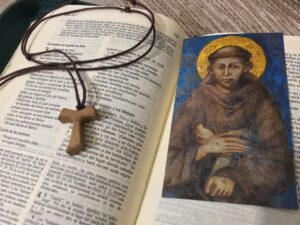
a. God forbids the worship of images:
In the Old Testament the worship of every kind of image, a plastic representation of the divinity or of the sacred, was severely forbidden. The first commandment of the Decalogue already says this in categorical words: Ex 20:4-5. Every kind of image presented as divinity is forbidden.
Despite this very clear prohibition, the first of the Law, immediately after promising to fulfill it, the people make for themselves a golden calf and worship it as God:
This is your God, Israel, who brought you up out of Egypt.
This sin of idolatry causes God to decide to destroy the people. Only the intercession of Moses succeeded in moving God to have mercy and forgive them (Ex 32:1-14).
The people of Israel, a very sensitive and carnal people, surrounded by idolatrous nations, are very prone to this sin of idolatry. Moses warns them repeatedly (Deut 4:9-28). The prophets compare idolatry with adultery. It is like abandoning Yahweh, the legitimate Spouse, to go after other lovers.
The true reason for this prohibition is that God is the one God. He does not accept being first among the gods, but the only God. Consequently, the other gods are nothing. Isaiah ridicules idols and those who worship them (Is 44:9-20).
Naturally, this prohibition remains in force in the New Testament. Saint Paul says in his speech at Athens (Acts 17:29):
If we are God’s offspring, we must not think that the divine nature is like images of gold or silver or stone, carved by human skill and imagination.
b. God commands images to be made:
 God is not material, but spiritual. Therefore the people also cannot worship material representations of the true God, because they run the risk of confusing the true God with the image that represents him, even coming to believe that he is a material god.
However, it should be noted that the prohibition refers directly to the worship of images, not to the mere fact of making them, provided that they serve us as a sign of God’s presence but are not identified with God himself.
In this sense, God commands images to be made:
Ex 25:10-22: You shall make an ark of acacia wood… you shall make a mercy seat of pure gold… you shall also make two cherubim of gold.
There I will meet with you; from above the mercy seat, from between the two cherubim that are upon the ark of the testimony, I will tell you all that I command you for the children of Israel.
The Ark of God, the cherubim, and the mercy seat do not deserve divine honors; worship cannot be given to them as though they were God. But the people also need these sensible signs. God commanded this to be built as a sign of the presence of God himself in the midst of the people.
The Ark of God is approached for prayer because it is a sign of God’s presence: Jos 7:6.
In the same way, Solomon placed cherubim and other adornments in the temple of Jerusalem: 1 Kgs 6:23-30.
Even more noteworthy is the construction of the bronze serpent that God ordered Moses to make:
Num 21:6-9: Make a bronze serpent and set it on a pole. Everyone who has been bitten and looks at it will live.
Naturally, this is not a matter of that bronze serpent having any special virtue that could raise it to the rank of divinity. Turning to it was an act of faith and trust in the Word of God, who had spoken to them in this way. Later, when the people deviated from this intention and paid worship to it, Hezekiah had it destroyed: 2 Kgs 18:4.
Jesus Christ considers this bronze serpent a symbol of himself. In his conversation with Nicodemus he says:
As Moses lifted up the serpent in the desert, so must the Son of Man be lifted up, so that everyone who believes in him may have eternal life (Jn 3:14-15).
In the New Testament, the permission of images that represent divinity takes on a new character because of the Incarnation of the Son of God. God remains purely spiritual, but he has become intimately united to a human nature, which is material. For this reason, the representation of images of Christ is completely licit, since it is the representation of someone who is truly God. Not the materiality of the image, but the Person represented in it. In the same way, because of their relationship with Christ, it will be licit to represent images of the Virgin and of the saints.
In any case, the Christian must know that the image, even if it is of Christ, is not the divinity. It is something purely material, and worship cannot be given to this materiality. But, at the same time, it represents the Son of God, or other persons intimately related to him. It is to these persons—Christ, Mary, the saints—that veneration is given; adoration belongs only to Christ. The image is simply a representation and a remembrance of those persons.
Source: Apologetica.org
