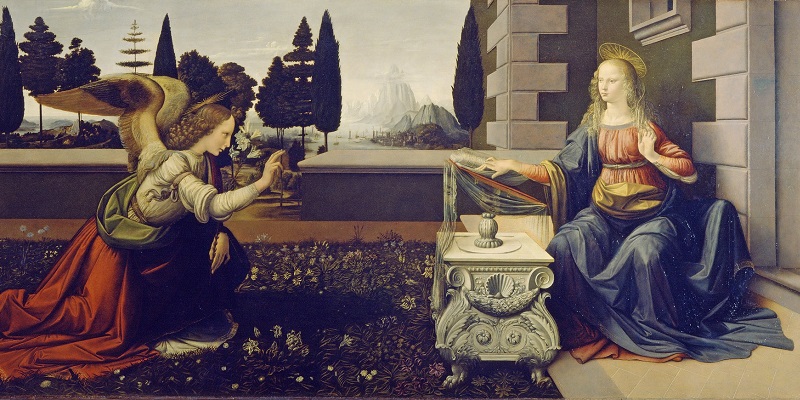
1. In the account of the Annunciation, the first word of the angel’s greeting — Rejoice — is an invitation to joy which recalls the Old Testament oracles addressed to the daughter of Zion. We emphasized this in the previous catechesis, also explaining the reasons on which that invitation is based: the presence of God among his people, the coming of the messianic king and maternal fruitfulness. These reasons find their full fulfilment in Mary.
The angel Gabriel, addressing the Virgin of Nazareth, after the greeting “rejoice”, calls her “full of grace”. These words of the Greek text: “rejoice” and “full of grace”, are profoundly connected: Mary is invited to rejoice above all because God loves her and has filled her with grace in view of divine motherhood.
The faith of the Church and the experience of the saints teach that grace is the source of joy and that true joy comes from God. In Mary, as in Christians, the divine gift is the cause of profound joy.
2. “Full of grace”: this word addressed to Mary appears as a proper qualification of the woman destined to become the mother of Jesus. The constitution Lumen gentium fittingly recalls this when it states: “The Virgin of Nazareth is greeted by the angel of the Annunciation, at God’s command, as ‘full of grace’” (n. 56).
The fact that the heavenly messenger calls her in this way gives the angelic greeting a higher value: it is the manifestation of God’s mysterious saving plan with regard to Mary. As I wrote in the encyclical Redemptoris Mater: “The fullness of grace indicates the supernatural gift from which Mary benefits because she has been chosen and destined to be the Mother of Christ” (n. 9).
Full of grace is the name Mary has in God’s eyes. In fact, according to St Luke’s account, the angel uses it even before pronouncing Mary’s name, thereby highlighting the main aspect that the Lord sees in the personality of the Virgin of Nazareth.
The expression “full of grace” translates the Greek word “kecharitomene”, which is a passive participle. Therefore, to express more accurately the nuance of the Greek term, one should not simply say full of grace, but “made full of grace” or “filled with grace”, which would clearly indicate that it is a gift made by God to the Virgin. The term, in the form of a perfect participle, expresses the image of a perfect and enduring grace that implies fullness. The same verb, in the meaning of “to fill with grace”, is used in the Letter to the Ephesians to indicate the abundance of grace which the Father grants us in his beloved Son (cf. Eph 1:6). Mary receives it as the first fruit of the Redemption (cf. Redemptoris Mater, 10).
3. In the Virgin’s case, God’s action is certainly surprising. Mary possesses no human title to receive the announcement of the Messiah’s coming. She is not the high priest, the official representative of the Jewish religion, and she is not even a man, but a young woman with no influence in the society of her time. Moreover, she comes from Nazareth, a village never mentioned in the Old Testament and one which must not have enjoyed a good reputation, as suggested by Nathanael’s words reported in St John’s Gospel: “Can anything good come out of Nazareth?” (Jn 1:46).
The extraordinary and gratuitous character of God’s intervention becomes even more evident if it is compared with the text of St Luke’s Gospel which recounts the episode of Zechariah. That passage emphasizes Zechariah’s priestly condition, as well as the exemplary life that makes him and his wife Elizabeth models of the just of the Old Testament: “They walked blamelessly in all the commandments and ordinances of the Lord” (Lk 1:6).
By contrast, not even Mary’s origin is mentioned. Indeed, the expression “of the house of David” (Lk 1:27) refers only to Joseph. Nothing is said about Mary’s conduct. With this literary choice, St Luke stresses that in her everything derives from sovereign grace. What has been granted to her does not come from any title of merit, but solely from the free and gratuitous predilection of God.
4. In acting this way, the evangelist certainly does not wish to cast doubt on the exalted personal value of the holy Virgin. Rather, he wishes to present Mary as the pure fruit of God’s benevolence, who took possession of her in such a way that he made her, as the angel says, full of grace. Precisely this abundance of grace is the foundation of the hidden spiritual richness in Mary.
In the Old Testament, Yahweh manifests the superabundance of his love in many ways and on numerous occasions. In Mary, at the dawn of the New Testament, the gratuitousness of divine mercy reaches its supreme degree. In her, God’s predilection, manifested to the chosen people and in particular to the humble and the poor, reaches its culmination.
The Church, nourished by the word of the Lord and by the experience of the saints, exhorts believers to turn their gaze toward the Mother of the Redeemer and to feel, like her, loved by God. She invites them to imitate her humility and poverty, so that, following her example and through her intercession, they may persevere in the divine grace that sanctifies and transforms hearts.
Author: H.H. John Paul II (8-V-96)
Source: L’Osservatore Romano, weekly edition in Spanish, 10-V-96
