
There is only one true God
There can only be one true God. If there were more than one, either one would command the others —and this one would be the only true God— or they would be independent of one another. But this is impossible, because the true God must have absolute dominion over everything that exists outside himself. Otherwise, he would not be almighty. And God —as philosophers show— can do all things. The Bible says: “Thus says Yahweh…; there is no other God besides me.” The Hebrews, out of reverence for God, did not even want to pronounce his name. They wrote it only with consonants: “YHVH.” The consonants had to be filled in with vowels. Hence the names “Yahveh” or “Yehovah,” by which God is called.
“God is love”; therefore he is Trinitarian, because love calls for otherness; it needs another person to love. That is why in God there are three persons: Father, Son and Holy Spirit. The Father loves us and has made us his children. The Son has saved us by dying for us. The Holy Spirit helps us with his grace to be good Christians. By reason alone we can come to know something about God: his eternity, his all-perfection. But not the intimate life of God (the Trinity). The Second Person is like the idea that springs from the intellect. That is why he is called the Word. The Third Person is the Love that springs between the first two Persons. Nevertheless, the three Persons are simultaneous in time, because all Three are eternal.
The Father is God, the Son is God, the Holy Spirit is God
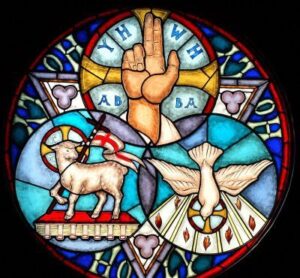 The Second Person of the Most Holy Trinity proceeds from the Father, but is not later than him in time. It is a procession of origin, not of time. We can illustrate this with an example. If I turn on the light in my room at night, I see my hand and its shadow on the table simultaneously. The shadow is caused by my hand, but I see both at the same time. There is no priority in time. The shadow and the hand appear before my eyes simultaneously, although the shadow is caused by the hand.
Jehovah’s Witnesses, who do not believe that the Son is God as the Father is, deceive the unsuspecting who listen to them by saying that if the Son is begotten by the Father, he is later than the Father and not eternal as he is. They ignore the philosophical distinction between priority of origin and priority of time. For example: fire gives rise to light; but light is not later than fire, rather it arises simultaneously with fire. The same occurs in God with the Father and the Son.
Christ said: “It is better for you that I go away, because if I do not go, the Comforter will not come to you; but if I go, I will send him to you.” The Holy Spirit is also a Divine Person; therefore he must receive the same adoration and honor as the other two.
Jehovah’s Witnesses deny that the Holy Spirit is a Divine Person; nevertheless, Sacred Scripture gives the Holy Spirit attributes of God: omniscience(250), omnipresence and omnipotence. The Holy Spirit is the active power of God; he is God in action. Jesus Christ says that the Holy Spirit inspires and teaches us, and Saint Luke says that to lie to the Holy Spirit is to lie to God. Saint John says that he inspires and consoles us. Saint Paul says that he is the giver of life and that he sanctifies us.
The Holy Spirit helps us to understand better what Jesus told us and gives us strength to follow the Lord. In the Creed of the Niceno-Constantinopolitan Council it is said that the Holy Spirit proceeds from the Father: ex Patre. This formula means that he has the same nature as the Father, that is, that he is God as the Father is.
When we live in sanctifying grace, we are living temples of the Holy Spirit. He dwells in us and fills us with his gifts. Without his inspiration and help, we can do nothing good. Jesus Christ says that sin against the Holy Spirit is not forgiven. Theologians interpret this as the will not to repent. And God cannot forgive one who does not want to repent. Such hardness can lead to final condemnation and eternal perdition.
The Catechism speaks of the Gifts of the Holy Spirit, which are permanent dispositions that make man docile in following the promptings of the Holy Spirit. They are seven:
· Gift of Wisdom: It is a special taste for spiritual things.
· Gift of Understanding: It is a grace of the Holy Spirit for understanding the Word of God and going deeper into revealed truths.
· Gift of Counsel: It is a light for knowing at every moment what God’s will is.
· Gift of Knowledge: It enables us to distinguish between what is true and what is false with regard to eternal life.
· Gift of Fortitude: It is a special strength for courageously doing what God wants of us and bearing the adversities of life.
· Gift of Piety: It is a filial affection toward God as Father.
· Gift of Fear of God: It is a humble attitude of fearing to offend God, acknowledging our weakness.
The three Persons are not three equal gods, but one true God in three distinct Persons
The three Persons are distinct, because the Father is not the Son nor the Holy Spirit, and the Son and the Holy Spirit are distinct from the Father and from each other. But the three Persons have the same and only divine nature. The same greatness, power, wisdom, goodness, holiness, the same willing and the same acting, etc. What one Person does, all three do; nevertheless, certain activities seem more appropriate to one Person than to another: Creation to the Father, Redemption to the Son and Sanctification to the Holy Spirit. It is not that the three Persons divide among themselves divinity, power, wisdom, etc.; rather, each of the three Persons possesses all divinity, all power, all wisdom, etc.
This is a profound mystery, but we are sure that it is so, because God himself has said it, and God can neither be deceived nor deceive us. The Trinity is a mystery of love. Love is a mutual self-giving in order to form a “we.” In the Trinity, the Three Persons are united by love, forming one single nature.
 Jehovah’s Witnesses also deny the Trinity, saying that this word does not appear in the Bible. It is true that the word Trinity is not there, but the doctrine is there; it is deduced from the whole Gospel and Christ summed it up when he said that one must baptize in the name of the Father and of the Son and of the Holy Spirit. Precisely because this formula expresses the Trinity, Jehovah’s Witnesses eliminate it in the administration of their baptism, thereby disobeying what Christ said.
Jehovah’s Witnesses say that we copied the Mystery of the Most Holy Trinity from Hinduism, in which the three divinities Brahma, Vishnu and Shiva form a trinity. However, Father Ceferino Santos, S.J., explains in his Chair of Oriental Philosophy at the University of Comillas in Madrid that, although these three divinities are named in the Mahabharata and in some Puranas before Jesus Christ, they were divinities independent of one another and even opposed to one another. The Hindu trimurti (triple form of the divinity) is something entirely different from the Trinity of the Christian faith. The Hindu trimurti never becomes a trinity in the Christian sense.
These Hindu divinities are related as a trimurti from the fifth century after Christ, probably through the influence of the preaching of the apostle Saint Thomas in India. There are testimonies going back to the third century, from different sources, that Saint Thomas evangelized India. There he was killed, and his body is buried in the Cathedral of Madras (India).
That is to say, the historical truth is completely the opposite of what Jehovah’s Witnesses go about saying, deceiving the unsuspecting who trust them. You should not speak about religion with Jehovah’s Witnesses, because with their lies and sophistries they can harm you. Saint John already warns us not to receive into our house anyone who comes with a doctrine that is not that of Jesus Christ.
Author: Fr. Jorge Loring
