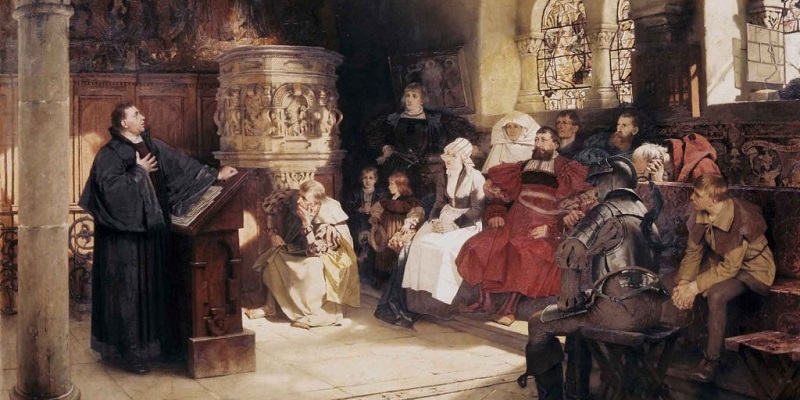
These seem to me to be a little further away. For Catholics, I mean.
We agree. But watch out.
Lutheranism is Luther. It is a very personal heresy, although they all are, of course…
–These seem to me to be a little further away. For Catholics, I mean.
–We agree. But watch out.
 Lutheranism is Luther. It is a very personal heresy, although they all are, of course. Let us consider man’s fundamental experience of his moral life. We are all aware that we are free, that we “can” choose. And if we do wrong, we feel the weight of our guilt. But it is also true that we are all aware that we are not free, that our freedom is sick, bound, powerless to do the good it wants and avoid the evil it hates (Rom 7:15). Well, in Pelagius the first conviction prevailed – we are free: we can – until it obscured the need for grace. And in Luther, after agonizing moral struggles, the second predominated, to the point of denying the need to do good – we are not free: we cannot; we cannot even with the help of grace.
The theological doctrine of Luther (1483-1545) has deep biographical roots, which should be known. From the Augustinians of Erfurt he had received a bad philosophical training, nominalist, and a bad theology of grace, voluntarist or semi-Pelagian. The morbidity of his consequent spiritual experience is reflected in personal confessions such as this one: «I, although my life was that of an irreproachable monk, I felt like a sinner before God, with a very troubled conscience, and with my penance I could not believe myself at peace; and he did not love, he even detested God as just and punisher of sinners; I was secretly indignant, if not to the point of blasphemy, at least with immense resentment towards God” (Weimarer Augsgabe54,185). “At the very name of Jesus Christ, our Savior, I trembled from head to toe” (44,716). “I remember very well how horribly the divine judgment and the sight of Christ as judge and tyrant frightened me” (44, 775)…
This, of course, cannot be lived. What wayis there to escape this disastrous idea of God and himself?… Luther’s remedy was almost worse than the disease, it was an immense and multiple error. I have already described it in Luther, great heretic. I focus now only on his doctrine on the theme of grace-freedom.
Man is totally corrupted by sin, and it is best to recognize it with all its consequences. «Man always sins, even when he tries to do good. Man is so corrupted that not even God can rescue him from his rottenness: the only thing that is possible for God is not to take his sins into account, not to legally impute them to him» (L. F. Mateo-Seco, Martín Lutero: sobre la libertad esclava, Madrid 1978, 18).
Man is not free, he lost his freedom by becoming corrupted. It is useless, therefore, to continue tormenting the conscience with the psychological illusion of its supposed freedom. Luther, in his early works, still believed in the freedom of man (4,295); He began to doubt it from 1516, and came to furiously deny it in 1525, in one of his favorite works, De servo arbitrio, arguing with Erasmus. Human freedom is incompatible – with God, who foreknows and predetermines everything; –with Satan, because he holds man captive, and truly dominates him; –with the reality of original sin, which corrupted everything that man is, including his freedom; –and is irreconcilable with the redemption of Christ, which would be superfluous if man were free (18,786). Consequently, the very expression free will should disappear from human language; it would be “the safest and most religious” (18.638). Lucidus previously denied freedom, and his error was condemned at the council of Arles (473: Denz 331).
Sola fides. Therefore the Christian is saved by faith, not by works. Christian justification is necessarily only declarative, passive, “imputative” (WA56,287). Simply, through faith in the Savior, God does not take into account the believer’s sin. And although good works are expedient, as an expression of faith, they are in no way to be considered necessaryfor salvation. They can even be dangerous, when they weaken fiducial faith, and the person, striving to achieve good works, then tries to rely on his own righteousness. The Christian, therefore, must learn to live in peace with his sins. He must recognize that he is “simultaneously sinful and just (simul peccator et iustus): sinner in reality and just in the reputation of God” (WA56,272).
In fact, “it does not harm us to be sinners, as long as we desire with all our might to be justified.” But the devil, with a thousand tricks, tempts men “to work foolishly, striving to be pure and holy, without any sin, and when they sin or allow themselves to be surprised by something bad, he so torments their conscience and terrifies it with the judgment of God, that it almost makes them fall into despair… It is therefore advisable to remain in sins and groan for deliverance from them in the hope of God’s mercy.” (56,266-267).
Sola gratia. It is not possible that good works are necessary for salvation. If they were necessary, all men would be condemned, since all are sinners and must inevitably sin. Let us note well that the error of this heresy of Luther, sola gratia, is not, as has been affirmed so many times in post-Tridentine Catholicism, in “attributing everything to divine grace”,since, indeed, all grace and salvation must be attributed to God. On the contrary, to claim that salvation is achieved in part by the mercy of divine grace, and in part by the force of human freedom, which comes to complete what is lacking in the free action of God, is pure semi-Pelagianism.
Although it may seem paradoxical, the error underlying Luther’s thought is the same one that has frequently contaminated his Catholic opponents with semi-Pelagian naturalism: the error of thinking that the action of grace is extrinsicto the good action of man; That is to say, it is the enormous error of ignoring that precisely the action of divine grace is the intimate cause of man’s free action, and thus produces in him and with him the good, saving and meritorious work of eternal life. Attributing everything, therefore, to the grace of God does not in any way exclude human freedom, since the latter is precisely caused by the former. The will moves moved by the grace of Christ.
A correct ecumenical dialogue requires taking these truths into account. According to this, when Lutherans accuse Catholics of being semi-Pelagians, and that we do not attribute to the mercy of divine grace all of man’s salvation, but rather part of it, it would be a very serious error to answer them that attributing all salvation to divine mercy is equivalent to annulling human freedom. By saying this we will confirm their conviction that we are semi-Pelagians. On the contrary, from the Catholic faith
–we must affirm to the Lutheran that, indeed, everything is grace, but that precisely God’s mercy is greater when his grace truly renews man in his being, and when it truly empowers his faculties, making him an active and operating instrument of supernatural works; and
–We must likewise affirm to the Catholic who fears that an accentuation of grace implies the annulment of freedom, that divine grace does not act in human nature from the outside, extrinsically, but from within, healing it, inclining it and actively empowering it in its own natural entity towards good works. We will see this when we remember more carefully the Catholic doctrine of grace.
A permanent heresy. Like Pelagianism, Lutheranism is a permanent heresy, which, of course, extends its temptation beyond the Protestant camp. I already pointed out the present-day “Protestantization” that threatens the Catholic Church from many sides (41). But focusing only on the theme of grace-freedom, which concerns us now, it is worth noting that
–the current loss of faith in the freedom of man, and the consequent almost annulment of the consciousness of sin, starting from premises very different from those of Luther, finally lead to a similar effect. As G. Piovene points out, «among the diversity of current philosophies [and the same happens in the main schools of psychology] a constant is discovered: none presents itself as a philosophy of freedom. Above all, it attempts to establish the mechanisms by which man is conditioned: economic, psychological, derived from the structure of language or the historical situation in which he lives” (Elogio della libertà, Milan 1970,287). This Lutheranizestoday’s culture.
–The elimination in Christianity of soteriology, salvation-condemnation, practically carried out by Luther with his “sola fides”, also affects many Catholics, since they consider it incredible that acts completed in the present life can determine an eternal life of reward or chastisement. As we already saw, there is no longer properly a question of salvation/damnation (08-09). Faith in Christ the Savior is enough, and good works are not necessarily necessary. This is “Lutheran Catholicism.”
When a Catholic considers his bondage to sin to be irremediable, he closes himself to the grace of effective repentance, and thus Lutheranizes his Christian experience of sin and salvation. In this spiritual attitude, if he goes, for example, to the sacrament of penance, he looks for a Lutheran-style justification in Christ: “I am a sinner, and as I will inevitably continue to be one, I do not even intend to amend myself; But I put all my faith in Christ, and so God forgives me, and will always continue to forgive me. And enough of that.
Between Pelagius and Luther. The predominant temptation of current Catholicism is in Pelagius, in anthropocentric voluntarism, which does not want to recognize the need for grace, for the supernatural aid of our Lord Jesus Christ, “who is truly the Savior of the world” (Jn 4:42). But Luther’s temptation is also present today. In reality, it must be said that the Catholic people today experience both temptations at the same time.
In this way, in certain environments, we find the strange hybrid species of a Pelagian-optimistic Christianitywith regard to the multitude, that is, with regard to youth, the workers, modern culture, progress and technology, and Lutheran-pessimisticwith regard to the individual, since it does not believe in the real possibilities that the person has, not even with the help of grace, to effectively escape from their sin and live holy. Any priest verifies this as a minister of the sacrament of penance. We are, therefore, although it may seem incredible, before a Lutheran Pelagianismor a Pelagian Lutheranism. Anything can be expected from those who distance themselves from the Catholic doctrine of the Church. But let us briefly consider another serious error.
 Quietismdoes not deny freedom, like Lutheranism, but it advocates being still, not acting. In the history of spirituality, quietist tendencies of very diverse styles are recorded – Manichaeans and Gnostics, Cathars and Fraticelli, Brothers of the Free Spirit, Beghards and Beguines, Spanish Alumbrados of the sixteenth century – but the most characteristic quietism, the one I consider here, is that which occurred at the end of the 17th century around Miguel de Molinos (+1696; Denz 2201-2268; +2181-2192), Fenelón (+1715), Father Lacombe (+1715) and Madame Guyon (+1717;Denz2351-2373). The inner pathof Molinos is not identical to the purest loveof Fenelón, but they coincide in some orientations. The Church, when condemning radical and typical quietism, schematized it in its most typical features:
Total passivity. «Wanting to act actively is to offend God, who wants to be the only agent; Therefore it is necessary to abandon oneself completely and entirely to God” (Denz 2202). «Natural activity is the enemy of grace, and prevents the operation of God and true perfection; because God wants to work in us without us” (2204).
Quietude in prayer, no active devotions. “He who uses images, figures, species and concepts of his own in prayer does not “worship God in spirit and in truth” (Jn 4:23)” (2218). The quietist conception of prayer is reminiscent of zen: “In prayer one must remain in dark and universal faith, in stillness and forgetfulness of any particular thought…, without producing acts, because God takes no pleasure in them” (2221).
Personal annihilation, mystical death. «It is not appropriate for the souls of this interior path to carry out operations, even virtuous, by their own choice and activity; otherwise, they would not be dead” (2235).
Total indifference. The soul must not be interested in heaven or hell (2207), nor in its own spiritual state, “but must remain like a lifeless corpse” (2208). “With free will resigned to God, we must leave the thought and care of all our things to God himself, and let him do his divine will in us without us” (2213).
Impeccability. “On the occasion of temptations, however furious they may be, the soul must not make explicit acts of the contrary virtues, but must remain in the aforementioned love and resignation” (2237). The falls that occur “are not a sin, because there is no consent in them” (2241), nor is it convenient to confess them (2248, 2260).
Both Lutheranism and quietism start from a terrible theology of the relationship between nature and grace. The Church teaches that grace does not destroy nature, but rather perfects and elevates it, with the free collaboration of man. But quietism thinks that grace, to divinize man, needs to annihilate his actions. Fortunately, seventeenth-century quietism did not leave many traces on Christian spirituality. What there will always be among Christians is laziness, indolence, resistance to the grace of God when it moves something that is painful. But quietism is not that; It’s something else.
Author: Fr. José María Iraburu
