Pepe Rodríguez is a Spanish journalist, the author of several anti-Christian and anti-religious pamphlets, and, as he declares on his website (pepe-rodriguez.com), he is considered one of the foremost experts on “sect-related issues.”
His works vary in content and tenor, but the great majority are anti-Christian and, more pointedly, ANTI-CATHOLIC. Rodríguez mounts a powerful wave of attacks against Christianity in general, and against Catholicism in particular.
Among his works are the following titles: La vida sexual del clero, Mentiras fundamentales de la Iglesia Católica, Mitos y ritos de la Navidad, Dios nació mujer (The Sexual Life of the Clergy; Fundamental Lies of the Catholic Church; Myths and Rites of Christmas; God Was Born a Woman), etc.
From his works one gathers that Mr. Rodríguez is an atheist, a champion of attacks on the faith of believers, and endowed with a sensationalism greedy for attention. It is enough to look at the titles just mentioned, which are obviously crafted for the purpose of drawing readers’ attention, in an act of publicity characteristic of sensationalist best-sellers.
Let us begin by making clear that Mr. Rodríguez claims that Christian culture and doctrine are WRONG on a series of essential points, and even in irrelevant details: an attitude similar to that of the Jehovah’s Witnesses, who in their eagerness to attract attention suggest that Christianity is mistaken, and propose a new set of beliefs, such as neither donating nor receiving blood, refusing military service, not believing in hell, or holding that Christ “died on a stake and not on a cross” — in short, contradicting icons and doctrines that had not been attacked before they did so, thereby giving the impression that they proclaim a truth “hidden” from the eyes of the world for centuries. This is exactly what Rodríguez attempts.
“Mentiras fundamentales de la Iglesia Católica”
In the note accompanying this book, it is explained that the author made a “rigorous” reading of the Bible, making it clear that “the message of the Bible is opposed to what the Catholic Church says.”
Before we begin commenting on his points, let us note that Mr. Rodríguez is not the first person ever to read the Bible, nor the first to conclude something like: Everyone else is wrong — I am the one who REALLY knows what the Bible says!
The sect-related problems in which he is supposedly an expert arose precisely from people who read the Bible (or other religious writings) and received a “spark of illumination” that led them to feel that they alone had understood the text in question, and that everyone else had not.
The Bible has long been studied by theologians, philosophers, and scholars of far greater renown than Rodríguez, and it is rather presumptuous to think that ALL of them were wrong, and that one man (Rodríguez is not even a theologian, but a journalist) understood it better.
Among the points he addresses is, for example, the following:
God does not believe in the postmortem survival of human beings, nor in hell.
We already pointed out the resemblance between Pepe Rodríguez and the sect of the Jehovah’s Witnesses. The latter deny the existence of hell, and believe that after death comes a period of unconsciousness that will last until Armageddon.
Suffice it to say that the teaching that there is a hell is a clear doctrine in the Bible; one need only read verses such as (Apocalypse 19:20, Apocalypse 20:10, Apocalypse 21:8, etc.).
As for postmortem survival: how many times do expressions such as “eternal life,” “kingdom of heaven,” “resurrection,” etc., appear in the New Testament?
Mary, the mother of Jesus, had at least seven children.
Here too Rodríguez imitates several sects (including the Jehovah’s Witnesses). The latter in particular are keen to affirm that Mary “had other children,” so that if Rodríguez thought he was teaching us something new, he arrives a bit late; several sects before him have already come to us with this business in hand, and the Church has had sufficient reason not to accept it.
The Church has long maintained the dogma that Mary is the EVER VIRGIN, and there are biblical reasons to justify it. Rodríguez says that Mary had “at least seven children.” I invite anyone to search any Bible for the expression “sons of Mary” — then tell me how it went.
And if Mary had other children, why did Christ, as He died on the Cross, place her in the care of the Apostle Saint John?
Moreover, let us note some statements that sound contradictory among the points Rodríguez puts forward:
Jesus was a Jew, a faithful observer of the Hebrew Law, who never founded — nor ever intended to found — any new religion or Church. Jesus was never a Christian nor, still less, a Catholic.
Jesus was executed when he was between 41 and 45 years old, not at the age of 33 of which tradition speaks.
First: if Jesus was just an ordinary Jew, where did Christianity come from? Various testimonies (far older than Rodríguez) make clear to us the beginnings of Christian doctrine, with Christ precisely; one need only read the Didache, Saint Clement of Rome, Papias, Saint Ignatius of Antioch, etc.
Besides, history would not have recorded a Jew like all the others, nor would anything be known about him. Jesus must have been a figure of ENORMOUS historical influence, since the very (Western) calendar is reckoned from his birth.
It goes without saying that the age at which Jesus was crucified matters little. The fact is that He was crucified to Redeem and Save us, at whatever age it may have been.
Contradiction, or falsehood?: If Jesus was a “faithful observer of the Hebrew Law,” why was he executed?
We hope Rodríguez can tell us what moved the Jews (or even the Romans) to execute the “faithful observers of the Hebrew Law.”
Moses is not the author of any of the five basic books of the Bible.
The Pentateuch (Genesis, Exodus, Leviticus, Numbers, and Deuteronomy) is indeed attributed to Moses, but this is not a rigorously historical claim.
To begin with, the style reveals that Moses was not its author, since he is spoken of in the third person singular. Deuteronomy briefly narrates the death of Moses (which Moses himself could not have written).
But even if Moses was not the author, the books of the Pentateuch were based on earlier writings (originals or copies) which did come from Moses. The Law of Moses has been followed by the Jews for a very long time, and there is no doubt that they have reasons for doing so. Among these reasons may be oral tradition, which would have worked in a way similar to the composition of the Qur’an, for neither was it Muhammad who personally wrote the Qur’an, although it is attributed to him.
Neither does “Catholic” mean “universal,” nor did the Jesus of the Gospels intend his message to have that character.
(Καθολικον): It means UNIVERSAL, according to the Diccionario Manual Griego-Español of José M. Pabón Urbina, former professor of Greek Language and Literature in the Faculty of Philosophy and Letters of the University of Madrid (Editorial Bibliograf, 1969).
What credentials does Rodríguez present for contradicting a university professor of Greek?
His curriculum vitae (which he displays on his website and which I reviewed carefully) does not contain so much as a short online course in Greek. And now he comes to tell us that Catholic “does not mean universal”!
At this rate, what other knowledge of Greek will he bring us? We run the risk that one day he will tell us that “Alpha is not the first letter of the Greek alphabet.”
As for the claim that Christ did not intend His message to be catholic (universal), let us recall his words:
“Go ye into the whole world, and preach the gospel to every creature.” (Mark 16:15)
He goes on with a sensationalism proper to the sects (which are supposedly the principal object of his criticism), and he contradicts, just as they do, twenty centuries of theological and doctrinal uniformity in the Catholic Church.
Come now, let us be logical: if the Catholic Church really were founded upon so many deceptions and “fundamental lies,” how is it that it has survived for two millennia?
And what theological, paleolinguistic, or biblical studies does Rodríguez have? NONE.
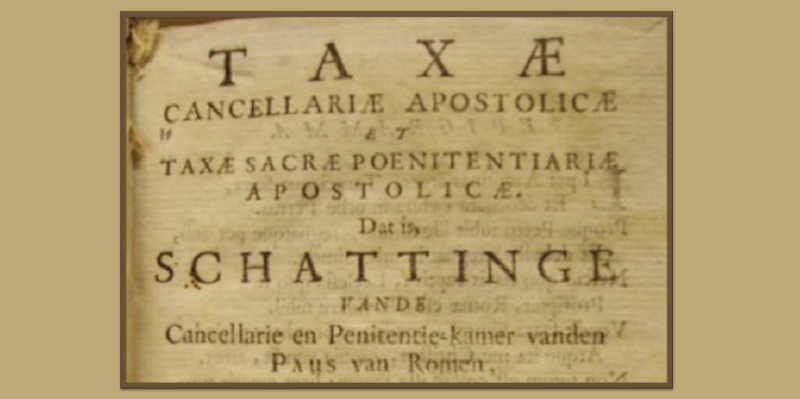
The Taxa Camarae, the “high point of human corruption”
The Taxa Camarae is a document (patently false) attributed to Pope Leo X, supposedly dating from the sixteenth century, and consisting of a schedule of fees to be paid in order to obtain absolution for a whole variety of sins.
Pepe Rodríguez displays the Taxa Camarae and defends its authenticity on his website, bestowing upon it the label of “high point of human corruption.”
I personally cannot say much about this matter. What I would like to point out is that a research team has studied the question, and has compiled a magnificent collection of data, interesting in the extreme for demonstrating the falsity of this simoniacal document.
It was members of apologetica.org who carried out a painstaking investigation, maintaining correspondence with Rodríguez, from which work it emerges:
- That the Taxa Camarae published by Rodríguez has no support in any pontifical document.
- That Mr. Rodríguez outwardly uses very select and cultivated words when expounding the subject, but when someone confronts him, his apparent seriousness evaporates and turns into absurd replies, personal attacks, and evasions of the topic.
Below are some excerpts from the work of apologetica.org, which can be found in full by following this link.
Exchanges between apologetica.org and Pepe Rodríguez (Excerpts)
A. Tapfer: dear mr. Pepe […] i would like to know if you can give me the information about that tremendous edict of the pope taxa camarae for a catholic friend so he can see the light of where he stands, that church is tremendous. he says that it isn’t true, please tell me where you got it, so he can go and see and convince himself. some book or library, my friend has challenged me, […]
Pepe Rodríguez: 1) The Taxa Camarae can be found in any good library of religious and/or medieval history, including the Vatican Library and those of the major seminaries. Perhaps also in Protestant libraries, since this document and others like it forced Luther’s understandable break.
A. Tapfer: mr. Pepe, […] my catholic friend says he is willing to accept that document if i give him a source, that is, where you got that document from, he lives near a very big library of the pope, and now he throws in my face that i believe just anybody, and says that with the data i gave him, which you gave me, he can’t find anything, that i should give him the source, that is what he repeated to me.
Pepe Rodríguez: I photocopied that document some 30 years ago, more or less, in a library in Paris. Let your friend look for it wherever he likes. In any case, most likely it is only to be found in books published during the nineteenth century and, perhaps, in some from the first or second decade of the twentieth.
Nino Mendoza: There is something important here: you seem to demand, as a condition for withdrawing this document from your publications and issuing the appropriate retraction, that we present you with the author, date, and circumstances of the document’s actual production. This, with only a little thought, is completely absurd. It is not for us to rummage through all the literature produced in the world over the last five hundred years to see whether we can find the author of a document that nobody knows where it comes from, what year it dates from, or what it is called (the data you provide — namely, Leo X, 1517, and Taxa Camarae — lead nowhere at all). On the contrary, it is you who are making the document known, and it is you who must procure a verifiable source before publishing it, or at the very least, as in this case, withdraw it from circulation immediately for lack of proper substantiation. I do not think it necessary to dwell any longer on something so obvious, above all for a person who, to judge by his curriculum, knows the scientific method perfectly well.
Mr. Rodríguez’s attitude regarding the subject
In his reaction to our position of doubt concerning the document he published without providing any foundation, one finds repeated derogatory remarks about this research team and the website hosting it (apologetica.org), such as: “fundamentalist group,” “fanatical Catholic sect,” “shamelessness and zero historical and scientific honesty,” “bad faith, fanaticism and ignorance,” “they boast of great academic and investigative rigor,” “flouting the truth with utter shamelessness,” “extremist Catholic sect,” “demagoguery, fanaticism, ultra-conservatism and virulence,” “utter cretinism.”
This is how Mr. Rodríguez frames his academic response to those who have called into question a document published by him.
A “translation” that smells like a copy (Excerpts)
The Spanish version of the Taxa found in the anticlerical work of 1936, photocopies of which Mr. Rodríguez publishes on the website of his authorship, is obviously a translation (from the French? from the German? from the Latin? We know nothing). The translation would date from 1936 at the latest. Well then: this translation (leaving aside the numbering of the thirty-five paragraphs) consists of 962 words, while Mr. Rodríguez’s translation from the French consists of… 962 words; the characters employed (letters and punctuation marks) in the version of the 1936 “little book” total 4,699, while Mr. Rodríguez’s version from the French totals… 4,699.
Is there any difference between the translation in the 1936 book and Mr. Rodríguez’s “translation from the French”? As far as we were able to check, there are only 3 differences in 962 words, namely:
– paragraph 11 of the Taxa: the 1936 translation says hubiese; Mr. Rodríguez’s translation says hubiere;
– paragraph 15 of the Taxa: the 1936 translation says obispo; Mr. Rodríguez’s translation says Obispo;
– paragraph 24 of the Taxa: the 1936 translation says en (“in”); Mr. Rodríguez’s translation says con (“with”).
The differences are minimal, as can be seen, and easily explained. Let us note:
– hubiese/hubiere: these are easily interchangeable forms (two variants of the Spanish subjunctive). The translation in the “little book” uses the form “hubiese” five times and “hubiere” only once, precisely in paragraph 11, where Mr. Rodríguez has “hubiese,” as in all the other five instances.
– obispo/Obispo: a difference that can hardly be called a “difference,” above all if one considers that the noun “obispo” (bishop) appears twice in the text of the Taxa, and that the 1936 book, for no apparent reason (probably by mistake), renders it once with a capital letter (paragraph 15) and once with a lowercase one (paragraph 16).
– en/con: another difference, the most substantial one in 962 words, though easily explained by… a copyist’s error?
Comparing the two translations, it is striking (to put it somehow) that not only are the use of commas, periods, and semicolons identical (virtually no difference in 4,699 characters!), along with the choice of verbs and nouns for every translated word, the use of identical verbal tenses and moods, the order of words in long sentences, etc., but also — necessarily — the style! And, as the proverb rightly puts it, “the style is the man.”
What is more, both “translations” contain this curious expression (paragraph 17 of the Taxa):
“El obispo u abad que cometiese…” (“The bishop or abbot who should commit…”). Note the use of “u” between “obispo” and “abad,” a usage that is incorrect, or at least anachronistic, as is attested by the successive editions of the Diccionario de la Real Academia Española: the only edition of that dictionary that records this use of “u” to avoid cacophony arising from a final “o” in the preceding word is the edition of 1791, while all the others exclude it (all the historical versions of the dictionary, with facsimiles of the pages, can be consulted on the Royal Academy’s most interesting website: http://www.rae.es).
Reinforcing the idea that this is an error or an anachronism comes the observation that the two translations of the Taxa in question do not use “u” after “o” and before “a” (as in “obispo u abad”): in paragraph 19, both Mr. Rodríguez and the 1936 book translate “El hijo de hereje quemado o ahorcado o ajusticiado…” (“The son of a heretic burned or hanged or executed…”); that is, in the same vocalic situation both use “o,” whereas both, a few paragraphs earlier, had used “u.” We have verified, finally, that in his other writings Mr. Rodríguez does not use “u” instead of “o” in the same vocalic situation, but uses what ought to be used, namely, “o” (for example, in chapter 5 of his book Mentiras… we read “no al Jesús divinizado o a cualquier otro”).
In short, the two translations are identical in everything, even in their errors and anachronisms.
This is scientifically inexplicable. Anyone who has ever done even the slightest bit of translation in his life will agree that it is humanly impossible for two people (and half a century apart!) to produce an identical translation of a text three to four pages long.
The Vatican Secret Archive: Swiss Guards armed with submachine guns are guarding the Taxa Camarae! (Excerpts)
Here is part of a message from Rodríguez (which can be found on his website: http://www.pepe-rodriguez.com/Mentiras_Iglesia/Taxa/Taxa_taxacamarae_falsa.htm):
The members of apologetica.org, who boast of working with rigor, honesty, and academic method, flout the truth with utter shamelessness when they claim that there are no better sources. There are indeed — many, and better ones — but neither they, nor their reference sources, nor anyone else can access them to check who is right. They know perfectly well at apologetica.org, though they keep silent about it in defense of their Catholic interests, that next to the Vatican Library there is an adjoining building housing the so-called “secret archive” — to reach its reading room one must pass through six strict security checkpoints, three of them protected by Swiss Guards armed with submachine guns — to which only duly authorized researchers are admitted, and even they are restricted to working solely with the documents listed in the catalogues offered to them. The first conclusion is that any document not appearing in a catalogue cannot be requested for study, because officially it “does not exist.”
According to the findings of the apologetica.org investigation, the Vatican Secret Archive is open to the public, there is NO checkpoint whatsoever manned by “armed Swiss Guards,” and, indeed, the notorious Taxa Camarae is not there.
The final part of this comment serves to show (once and for all) how Mr. Rodríguez confronts investigations opposed to his own — which can hardly be called investigations at all:
Mr. Rodríguez continues:
It is surely no coincidence that the hundreds of documents that “do not exist” are from the sixteenth and seventeenth centuries, an era with too many dark aspects and with a corruption the Church still wishes to hide.
Hundreds of documents? Are we to believe this gratuitous assertion just because it occurs to him to say so today? What will he say tomorrow — millions, perhaps? Why not? No one can set limits for him anymore! Once inside his Vatican bunker, who knows how many documents Mr. Rodríguez will find there, before which we, poor humans, will be able to do nothing but nod?
Reality outdoes fiction, Mr. Rodríguez.
No one today knows what those archives contain, so no one today can affirm or deny anything categorically regarding the veracity or otherwise of the Taxa Camarae (or of the “similar documents” that my critics were looking for and, logically, have not found); nor, of course, can those who in the centuries cited worked in the Vatican archives, yet without being able to access material without which any conclusion or affirmation can be no more than provisional.
Once again we are astonished: if “no one knows what those archives contain,” how does Mr. Rodríguez know about the “hundreds” of documents that are in there? Now, the reader will realize that this is the crux of the matter, and this is why Mr. Rodríguez explains to us in such detail the access to the archives and their contents: no one, today, can affirm or deny anything categorically regarding the veracity or otherwise of the Taxa Camarae.
In other words, what Mr. Rodríguez is saying is this: at first the Taxa was in any good library, as he had solemnly pontificated barely more than a month earlier; but after an intensive search of the best libraries in the world, it turns out that there is no proof whatsoever, there is no document, no historian has found it, it is not in any of the 230 European archives examined by dozens of Catholic and Protestant historians, no history of the Church mentions it, it appears in no collection of documents, none of the many people who have gone through all the documents of the time of Leo X ever found it… and what does Mr. Rodríguez conclude? It is in a bunker guarded by a regiment of Swiss Guards armed with submachine guns!
“Mitos y Ritos de la Navidad”
This work of Rodríguez’s is devoted to trying to demonstrate, on several points, that the Christian celebration of Christmas is false, or else of pagan origin.
Once again he falls into the sectarian sensationalism proper to the Jehovah’s Witnesses, who, like Rodríguez, emphatically deny that Christ “was born on December 25.”
A subject which, it must be made clear, is of no great importance for Christian theology within the mystery of the Incarnation. Christ was born and died to save us, and the exact date of his birth or death matters little. The fact is that society has taken December 25 as the date on which to celebrate Christmas, but it is in no way asserted that Christmas is celebrated in strict adherence to the actual date of Christ’s birth.
Among the points he “studies,” I comment on one example:
Balthasar was white until the sixteenth century, from which time onward he was depicted as a black man owing to the strategic needs of the Church.
I ask myself: what is the extraordinary importance of whether Balthasar “is black or white”? And when has the Church ever said “Balthasar was white,” and then changed it to “Balthasar was black”?
The fact is that, black or white, the Church in no document on Christmas doctrine or liturgy says that Balthasar is black. It is not the Church, then, that presents him as black “for strategic reasons.”
And in the twentieth century Balthasar has also been depicted as white — for example, in the famous classic Ben-Hur, both in the novel and in the film: in the novel Balthasar is said to be Egyptian, and in the film he appears introducing himself as “Balthasar of Alexandria,” with white skin and blue eyes.
Rodríguez says, in the introduction to this book:
And it is even less coincidental that the birth of Jesus-Christ, the Christian Savior, came to be fixed on December 25, the date on which, until the end of the fourth century of our era, the birth of the Sol Invictus was commemorated in the Roman Empire.
The explanation is very simple. Christians had to be cautious. Persecutions of Christians were frequent (and terrible) in the Empire before Constantine. Choosing the date of a Roman feast for a Christian feast allowed Christians to celebrate their festivities without attracting the suspicion of the Romans.
Rodríguez includes in his work a brief but significant historical error. With the Taxa Camarae affair, Rodríguez’s feeble historical and documentary rigor was placed on record, and detail by detail the evidence keeps piling up against him. Rodríguez says:
The Roman festivities in honor of Saturn, the Saturnalia, were originally rural feasts — sementivae feriae, consualia larentalia, paganalia — but they acquired great importance from the year 217 B.C. onward, after the defeat of the Roman army by the Carthaginian Hannibal near Lake Trasimene, prelude to the disaster of the Battle of Cannae (216 B.C.), which put an end to the Second Punic War and helped to awaken the religious spirit of the Romans.
What is the error? The error is that the Battle of Cannae did not put an end to the Second Punic War.
At the Battle of Cannae, Hannibal defeated the Roman army commanded by the consul Terentius Varro (it is striking that the Romans outnumbered the Carthaginians and their allies two to one).
Hannibal carried out an enveloping maneuver with which he crushed the Roman legions. This was one of the most tragic dates that the Romans of posterity would remember. Nevertheless, the Second Punic War went on. After his victory, Hannibal did not resolve to attack Rome; he was awaiting reinforcements from Africa and from Greece, and he trusted, moreover, that Rome’s allies would waver and break with the (Roman) Republic.
For 13 years Hannibal remained in Italy harassing the Romans, who in the meantime took Syracuse (a capture in which Archimedes died) and defeated the Macedonian armies.
In the year 207 B.C., the Romans defeated Hasdrubal, Hannibal’s brother, who was coming to his aid. And later on, Publius Cornelius Scipio proposed to the Senate an expedition against Carthage.
Carthage called Hannibal to its aid, and he abandoned Italy and returned to Africa; but in 202 B.C. Scipio defeated Hannibal at the Battle of Zama, a victory that earned him the byname Scipio Africanus — and with this battle the Second Punic War did indeed come to an end.
A little history never hurts.
“Morir es nada” (Dying Is Nothing)
This work of Rodríguez’s centers, basically, on denying that there is life after death; in a few words, on affirming that death is the passage of the human being from life into a total, definitive, and absolute nonexistence. Rodríguez’s interest in this subject is easy to understand: post-mortem life is a distinctly religious concept, and not an exclusively Christian one, being discussed and studied by other religions as well.
I will begin by commenting on the following: No one has exact knowledge of what lies after death; one may have intuitions, indications, beliefs, faith, suppositions, theories, hypotheses, etc., but NO ONE (and as the Christian that I am, I say it plainly), no one has proven and definitive knowledge of what lies after death.
Objective knowledge, proven and verifiable by science, includes, for example: the laws governing electricity, the movement and dynamics of machines, the nutritional content of foods, the existence of radiation invisible to the human eye, etc. Such knowledge rests upon a verification of its reality, causes, and effects that leaves no room for doubt.
The same does not hold in every aspect of daily life; things such as what lies after death, the very origin of the universe, or the way in which a human being acquires consciousness at birth, among many other unknowns that (for the moment) escape scientific analysis.
This leads me to the following assertion: whatever Rodríguez thinks about death is merely one more proposition, alongside the various propositions that do contemplate life after death.
The following statement of Rodríguez’s puts me on alert:
Do we look for explanations of love? Do we inquire into the mechanism of friendship? Surely not.
Surely not? Where does Rodríguez get this “surely”? Has he perhaps been out compiling statistics on the matter?
Well, it surprised me, because personally I certainly have looked for explanations of love, and I presume I am not the only one. Poetry and psychology have also looked for explanations of it… WHAT IS LOVE? is a question that has been asked far too many times for Rodríguez now to dogmatize that “surely no one looks for explanations of it.”
Precisely in dialogues on atheism and rationalism, where there are those who propose that everything is a matter of chemistry, one cannot help asking: is loving someone, or something, a mere chemical reaction?
Could human beings generate chemical reactions that produce something like LOVE? Could there be such a thing as a compound that would make us fall in love if we drank it?
Questions of this kind are, precisely, a way of looking for explanations of love, and of course there are people who do so. This extends to affection, respect, friendship, fear — in short, a whole range of feelings and emotions that very frequently collide with natural reason.
Rodríguez includes expressions that are hardly SERIOUS, or at the very least, hardly ACADEMIC. Note:
That was taken as a compliment back then, but nowadays it would be an invitation to flee the place in terror and go look for lodging somewhere else — what the devil has happened to us in so short a time?
Are expressions of this kind characteristic of a scientific, serious, adult, scholarly language?
I will briefly comment on another point:
I have never come across anything like the “soul” in all that I have studied of psychology or biopsychology; nor have I felt anything in myself, or perceived in others, that required a soul in order to express itself — the marvelous cerebral mechanisms we possess, capable of giving physical support and a perception of reality to all our emotions, are more than enough
Fair enough. But Mr. Rodríguez is not the only person who has studied psychology and biopsychology. The fact that he has not “come across” anything like the soul does not mean that NO ONE has “come across” such a thing.
Personally, I have heard testimonies of various kinds about post-mortem survival — accounts of apparitions, encounters with people already dead, visions of ghosts, etc., etc. To set them down here, just as I heard them, would be to fall into the same sensationalism as Rodríguez, and I will certainly refrain from doing so.
It is enough for me to say that I have heard them, and that I have no reason to doubt the people who told them to me. I have not gone through such experiences myself, but I believe that I cannot subordinate my beliefs solely to MY experiences; rather, I MUST take into account those of other people.
_________________________________________________________________________________________________________
So much for my comments on Mr. Rodríguez; I close with a brief reflection:
Human beings have been religious for thousands of years. Honestly, I believe that religiosity is older than atheism.
Well then, let us imagine for a moment that God does not exist, nor the supernatural, nor a “hereafter.” On that supposition, inexplicable events, miracles, or at the very least intimations of the supernatural would never occur. How long would human religiosity last, if that were so?
If there is no God, then there would be no indication whatever that there is one, and, for lack of it, religiosity would have died out long ago…
Author: Jesús Hernández
Source: Luxdomini.com
I thank Apologetica.org for allowing me to use material from their website
