Question:
Does the Roman Church have valid arguments to justify the use of the symbol [of the inverted cross]?
Answer:
Not only the “Roman Church,” but several non-Roman ones as well
 I. A brief presentation of the subject. I. A brief presentation of the subject.
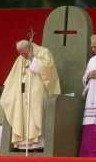
Pope John Paul II, during his visit to the Holy Land in the Jubilee Year 2000, celebrated a Mass in Galilee, at the place where tradition locates the Mount of the Beatitudes. The chair occupied by the Pope on that occasion bore a simple design of an inverted cross, as can be seen in the photograph accompanying this paragraph. The design, as the artist who made it explains, represents the death of Peter upside down, a datum preserved in the Tradition of the Church from a very early date. That celebration, besides being presided over by the man who today occupies the place of Peter -according to Catholic doctrine- was held only a few kilometers from Bethsaida, the hometown of the Apostle Peter, and from Capernaum, where the Apostle habitually resided. Later on, the design of the inverted cross on that liturgical chair was interpreted by certain persons of clearly anti-Catholic inspiration not as a Petrine sign, but as a satanic sign, since the inverted cross is an element frequently associated with satanic worship. In the present article it is my intention to offer the reader some elements of judgment that will allow him to assess the sign in its natural context, that is, the ancient tradition concerning the Apostle’s death, the history of art related to that event, the use of the symbol in settings of worship, the information provided by impartial sources, etc. The websites that present the “satanic” version of the papal chair offer none of these elements, and they present the photographs of that celebration in a thoroughly satanic context: inverted crosses in satanic rituals, suspense music, messages suggesting the beginning of the end, etc.; as if the cross of that celebration in the Holy Land had been displayed not at a Mass but at a witches’ sabbath. If the reader has time and a good Internet connection, let him view the photographs at full size: the beauty of many of these works is well worth it. |
Statistics of this article (Including the data of the appendix)Ø Literary testimonies of the crucifixion in Rome (without specifying the inverted position), from the 2nd-6th centuries: 9Ø Literary testimonies of the crucifixion upside down in Rome, from the 2nd-6th centuries: 7Ø Important literary testimonies of the crucifixion in Rome (without specifying the inverted position) from the 7th-20th centuries:10Ø Other important literary testimonies of the crucifixion upside down from the 7th-20th centuries (Catholic and non-Catholic): 22Ø Artistic testimonies of the crucifixion upside down from the 8th-20th centuries: 128 Ø Testimonies in Catholic churches of the inverted cross, without Peter, as a symbol of the Apostle: 17+ |
| Ø Testimonies in non-Catholic churches of the inverted cross, without Peter, as a symbol of the Apostle: 47+, and in detail:
Orthodox: 3 |
|
| Ø Catholic or Lutheran churches in Germany with the inverted cross on the tower:20
Ø Reference works (dictionaries, encyclopedias, etc.) that define the inverted cross as the “Cross of Peter”: 28 Ø Miscellaneous 7 |
II. Literary testimonies from the first six centuries of Christianity on the tradition of Peter’s death upside down, and other notable later testimonies.
| Literary work | Date of composition | Description |
| Acts of Peter and Paul | 2nd-3rd century | This apocryphal writing belongs to Catholic circles; in many churches of antiquity it was read during the celebrations, but it never formed part of the canonical books. Its dating is not exact; scholars propose various dates. Citations of this book made in the year 235 are known with certainty. There we read the following:
“And Peter, having come to the cross, said: ‘Since my Lord Jesus, who came down from heaven to earth, was raised upon a cross upright, and since he has deigned to call me, who am of the earth, to heaven, my cross ought to be planted head downward, with my feet pointing upward, for I am not worthy to be crucified like my Lord.’ So they reversed the cross and nailed him with his feet upward.” |
| Acts of Peter, Vercelli version XXXVII | end of the 2nd century | This work, unlike the previous one, comes from Gnostic circles, or at least from circles heavily influenced by Gnosticism, the first great heresy in the history of the Church. This datum is interesting insofar as it shows that they too acknowledged this version of Peter’s death as valid. There we read:
“[Peter said, addressing the executioners:] ‘And of you I ask this: crucify me thus, with the head downward, and in no other way.’” |
| Tertullian, De praescriptione haereticorum XXXVI/1 | around the year 200 | “How blessed is that church [of Rome], on which the Apostles poured forth all their doctrine along with their blood, where Peter endured a passion like his Lord’s, where Paul endured a death like that of John [the Baptist], where the Apostle John, after being plunged into boiling oil without suffering any harm, was banished to an island.” |
| Tertullian, Scorpiace XV/3 | year 211 or 212 | “At Rome Nero was the first to bathe the infant faith in blood. Peter was girded by another [a reference to Jn 21:18] when he was fastened to the cross.” |
| Origen, Commentary on the Book of Genesis III, quoted by Eusebius of Caesarea. | before 232 | This text of Origen is preserved only in the citation made of it by Eusebius of Caesarea, the greatest historian of Christian antiquity, in his Ecclesiastical History, III/1 (this chapter of his work was written in the year 312). There Eusebius states that he takes this datum from the third volume of the Commentary on the Book of Genesis by Origen, a work written before 232. The text of Origen quoted by Eusebius reads:
“Finally [Peter], having come to Rome, was crucified head-downwards; for he himself had requested to suffer in that way.” |
| St. Peter of Alexandria, Penance or Canonical Epistle, canon 9 | around the year 306 | “Peter, the first chosen of the Apostles, having been seized and imprisoned many times, and treated with great ignominy, was at last crucified in Rome.” |
| Eusebius of Caesarea, Ecclesiastical History, II/25, | year 312 | “It is recorded that Paul was beheaded in Rome itself, and likewise that Peter was crucified under the reign of Nero. This account concerning Peter and Paul is confirmed by the fact that their names are preserved in the cemeteries of that place to this very day.” |
| Lactantius, The Death of the Persecutors | between the years 316-320 | “Being a despicable and wicked tyrant, he [Nero] hastened to carry out the work of destroying the heavenly temple [the Church] and of abolishing righteousness. He was the first to persecute the servants of God. Peter he nailed to a cross; Paul he beheaded.” |
| St. Jerome, Lives of Illustrious Men, I | year 395 | “[At the hands of Nero, Peter] received the crown of martyrdom, being nailed to the cross with his head toward the ground and his feet raised on high, asserting that he was not worthy to be crucified in the same manner as his Lord.” |
| St. John Chrysostom, Sermon from the Metaphrast, MIGNE Greek Collection 59, 494. | end of the 4th century | Perhaps the most famous preacher of antiquity, in a most beautiful homily, says:
“Rejoice, O Peter, to whom it was granted to taste the wood of the cross of Christ. And in the likeness of the Master you wished to be crucified, yet not upright as Christ the Lord, but with your head turned toward the earth, as though showing yourself on the way from earth to heaven.” |
| St. Ambrose of Milan, Hymn “Apostolorum passio” | 4th or 5th century | St. Ambrose (340-397) is considered one of the fathers of Christian hymnography. Some of the hymns attributed to him are certainly his; others leave room for doubt. Among the latter is the hymn “Apostolorum passio,” which, if not by St. Ambrose, is no later than the 5th century. The hymn says, in its fourth stanza:
Verso crucis vestigio Its translation: “Simon [Peter], giving glory to God, hanging from the standard of an inverted cross, ascends [to heaven], not forgetting the oracle he had received [from Jesus, in John 21:18] But more important than the author of the hymn or its exact date is the fact that, from the 5th century onward, this hymn was sung in all the abbeys, monasteries, and churches of the West. Even today it can be seen in the Latin hymnal used by priests and religious (for example, the Latin Hymnal of the Liturgy of the Hours published by the Argentine Episcopal Conference, 1996, p. 68, from which I take the text). Finally, it is worth noting that the verse already speaks of the symbol (“the standard of an inverted cross”), which would later be given outward plastic expression. |
| Sulpicius Severus, Chronicorum libri duo, III,19. |
year 403 circa | Severus wrote a history spanning from the creation of the world to the year 400 of our era, omitting the information contained in the writings of the New Testament. Regarding our subject we read:
“Then Peter and Paul were condemned to death. Paul’s neck was severed with the sword; Peter was raised upon a cross” |
| Macarius Magnes, Apocriticus | year 410 circa | The author is a Christian philosopher who writes an apology for the faith of Christ against a “pagan philosopher” who raises objections to it. Both citations presented here belong to two of the pagan’s objections; he asks how it can be that Peter, a man with all the authority he supposedly received from Jesus, should end up on a cross; Macarius does not deny these facts, but simply explains them, echoing the tradition common among the Christians of the 5th century concerning the manner of death suffered by Peter. The work says:
“Yet we read that Peter was crucified after having fed the sheep for barely a few months, even though Jesus had told him that the gates of Hell would not prevail against him.” (Book III, chapter XXII of the objections) “And Peter also, who received authority to feed the sheep, was nailed to a cross and, as it were, planted upon it.” (Book IV, chapter IV of the objections) |
| Paulus Orosius, Historiarum adversus paganos libri septem, VII, 7, 10. | year 416 | At the urging of St. Augustine, Orosius wrote the first great work of universal history of Christianity (it can be found in Migne’s Latin Patrology XXXI, 663-1174). There we read:
[Nero] Bent as he was on rooting out the very name of the Christians, of the most holy apostles of Christ, Peter and Paul, the one he ordered to be nailed to a cross, the other he delivered to the edge of the sword. |
| Hymn “Decora lux” | 5th century | In the rich hymnal of the Latin Church, for the feast of Sts. Peter and Paul, we find this most ancient hymn, whose second stanza says:
Mundi magister, atque caeli Ianitor, Whose translation is: The teacher of the world and the keeper of heaven’s gate, Since this is a hymn that made its way into the common liturgy, practically all of Christendom sang it for centuries (down to the present day, as we shall see below) on the occasion of the feast of the Apostles, June 29. |
| Passion of Peter and Paul | 6th century | Of this work I have not yet been able to obtain the text, but I know from references in specialized works that it carries the tradition of the death of Peter crucified upside down. If I come across the text, I will publish it. |
| Jacobus de Voragine, The Golden Legend or Lives of the Saints, Vol. IV. | year 1275 | The author was bishop of Genoa (Italy). His work gathers together the innumerable lives of saints scattered about in those times. This work was widely read in the late Middle Ages. On the death of Peter he writes:
“Although both [Peter and Paul] suffered death on the same day and at the same hour, they nevertheless did not suffer it in the same place; hence the poet says ‘Ense coronatus Paulus, cruce Petrus, eodem sub duce, luce, loco dux Nero, Roma locus’, that is, “Paul was crowned with the sword, while Peter was given the inverted cross; the place was the city of Rome, under Nero.” |
| Guillaume Dufay, Hymn “Aurea luce et decore roseo” | middle of the 15th century | For the feast of the Holy Apostles Peter and Paul, June 29, this hymn became part of the Western liturgy in the Roman Breviary from the 15th century onward. Its second stanza sings:
Ianitor caeli, doctor orbis pariter, We give the translation which to this very day is prayed by all priests and religious, at least in Argentina, in the Liturgy of the Hours for June 29 (First Vespers): Today you wear the crown of glory, The Latin text is taken from the Latin Hymnal of the Liturgy of the Hours published by the Argentine Episcopal Conference, 1996, p. 68. The translation, from the 1997 Argentine edition of the Liturgy of the Hours, vol. III, p. 1507. |
 |
year 1554 and year 2000 | The crucifixion of Peter upside down is acknowledged as a valid tradition in the Protestant work “The Book of Martyrs” by John Foxe (1517-1587). There we read:
Chapter IX. Peter The text was taken from www.ccel.org, in English, from a page that is no longer online Foxe does not justify his “doubt” about the tradition. On the other hand, he seems to give the quo vadis Domine the same weight as the death of Peter in Rome by crucifixion, even though the two “traditions” are of very different value. In any case, what matters is that he records the tradition concerning the death of Peter. Foxe’s work is summarized in the Protestant publication “Christian Book Summaries”, Vol. I, Number 18 (year 2000), which repeats -without raising any objection- the manner of the apostle’s death by crucifixion upside down. At the end of that publication it is stated: “John Foxe (1517-1587) was a professor at Oxford, and later a minister in London, before being forced to flee to Europe when Queen Mary came to power. While in Europe he wrote this classic work, which he published after his return to England, when Queen Elizabeth ascended the throne.” And then it says: “John Foxe’s Book of Martyrs was originally published in 1554. […] More than a million copies exist, in various editions, and it can be purchased in bookstores and also on the Internet”. There are other citations in the publication affirming the central place this work held in the formation of nascent Protestantism. That publication is here (in English). (And a copy in case the link goes down, here). I consider this testimony important: Foxe’s book has educated generations of Protestants for almost five centuries now, and at present there are a million printed copies, so it is claimed. On the other hand, it appears that the Protestant publication “Christian Book Summaries” does not regard the fact as a groundless legend, but as a datum that may be preserved in continuity with the most ancient tradition. In conclusion, the tradition of Peter dying upside down is not unknown even within the Protestant tradition. Further below I give numerous modern practical examples. |
| Benvenuto Cellini Autobiography | between the years 1558-1566 | The famous Italian artist Benvenuto Cellini (1500-1571) worked for the popes for many years, about which he wrote an Autobiography much appreciated for its description of life in the society of those times. In chapter LVI of its first volume -according to the digital edition (in English)- we read:
I went on working for the pope [Clement VII, 1523-1534] doing now one trifle, now another, when the pontiff commissioned me to design a chalice of extraordinary richness. So I made both the drawing and the model for the work. The model was of wood and wax. Instead of making the upper part as is usually done, I designed three fairly large figures encircling the work; they represented Faith, Hope, and Charity. Corresponding to these three figures, at the foot of the chalice, were three circular scenes in bas-relief. One was the Nativity of the Lord, the second the Resurrection, and the third St. Peter crucified head downwards; for such were the instructions I received. While I had this work in hand, the pope took delight in looking at it frequently; since I knew that the pope had no intention of giving me any other commission, etc… |
| The Life and Epistles of St. Paul, by Thomas Lewin. Vol. 2, London, 1874, p. 368. | year 1874 | The work of Lewin (an English Protestant historian) is recognized in the field of historiography for its painstaking research. His testimony shows that in Protestant circles the tradition of Peter dying on the cross upside down is neither strange nor rejected. And this is because the datum is present, as we have seen, in extremely important writers and historians of Christian antiquity, and not only in works of a legendary character. There we read:
“Shortly after the second epistle [of Paul to Timothy] Peter arrived in Rome and, according to the general tradition, was crucified there in the Vatican -the site of other martyrdoms before his own- head downwards.” |
| History of the Christian Church vol. I, chap. IV, by Philip Schaff | year 1890 | The author is an eminent German-American Protestant theologian and historian whose principal work is the well-known Encyclopedia of Religious Knowledge in thirteen volumes, from which we shall quote a text further below.
In his History of the Christian Church -the whole work runs to eight volumes- Schaff states: “The martyrdom of Peter by crucifixion was predicted by our Lord, John 21:18-19, though no place is mentioned”. |
| The Catholic Encyclopedia | year 1908 | In the article on St. Peter the Apostle the encyclopedia gives the citations from Tertullian and Origen that we saw above, and indicates that all that is known about the manner of his death is that he “was crucified head downwards”, according to the testimony of those sources. |
| The Columbia Encyclopedia, sixth edition. | year 2001 | Under the entry “St. Peter”, the monumental encyclopedia says:
“Peter apparently left Antioch and made his way to Rome around the year 55; there he died, as head of the local church, a martyr under the reign of Nero. According to traditional accounts, he was crucified upside down.” |
III. Artistic representations of that tradition across a thousand years of history.
| Artistic work | Date of composition | Description |
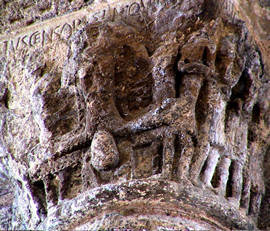 |
year 1050 circa | In the monastery of Conques (France) there is a series of capitals, among which this is one of the oldest, with the still-visible image of Peter, crucified upside down. |
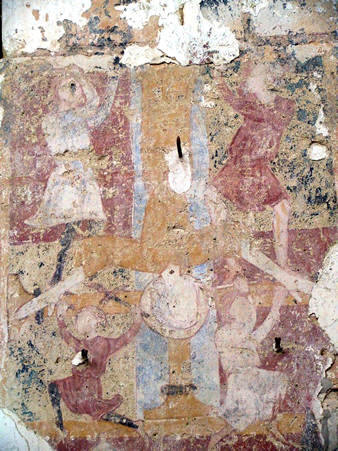 |
end of the 11th century | The Romanesque church of St. Genest de Lavardin (France) preserves numerous splendid paintings. Among them, a St. Peter crucified upside down. |
 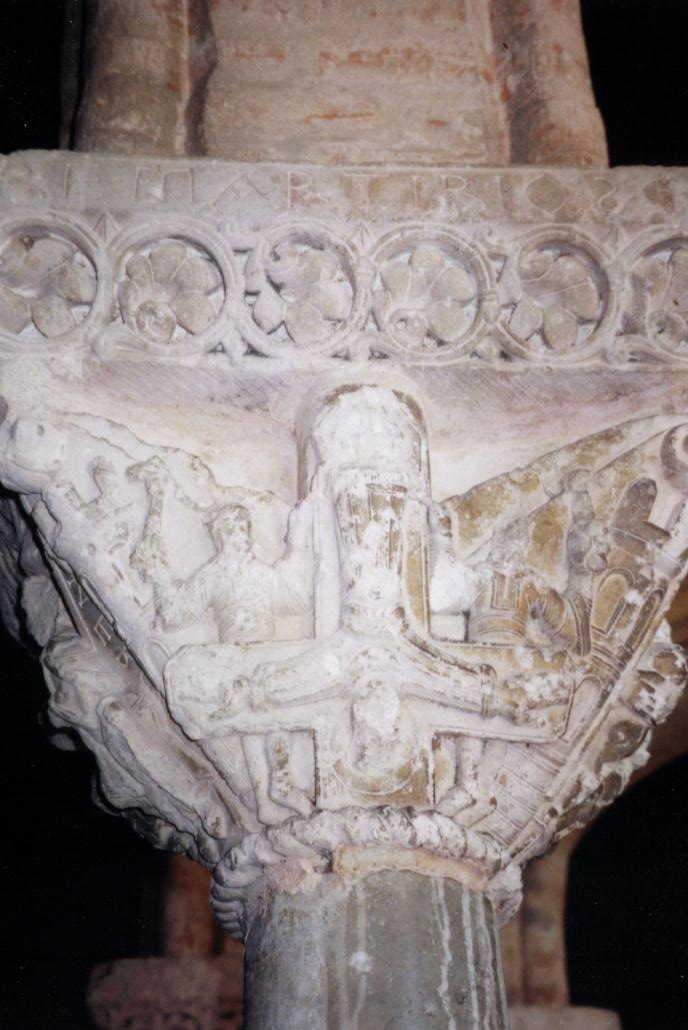 |
11th century | Capital of the cloister of the Monastery of Moissac (France). Scene of the martyrdom of Peter, crucified upside down. In the small photo, an idea of the exceedingly beautiful cloister. The French Revolution, which seems to have made a hobby of iconoclasm, went about smashing images throughout France. When it reached this one, it hammered off Peter’s feet, probably thinking they were the head of the image. |
 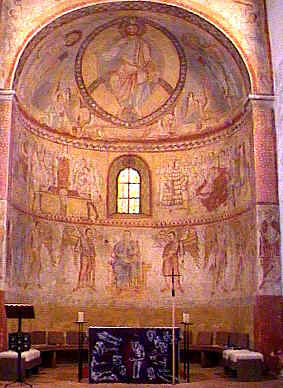 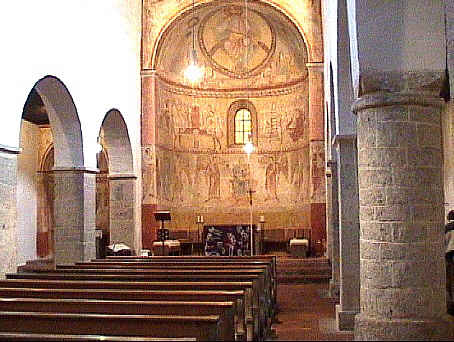 |
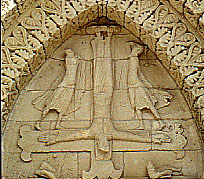
year 1119 | Church of the town of Petersberg (Germany). In the upper photo, an overall view of the church. In the next photo, the fresco of the main altar, where the figure of the inverted cross can already be seen at the middle level on the left. The detail with the crucifixion of Peter upside down in the last photograph. |
  |
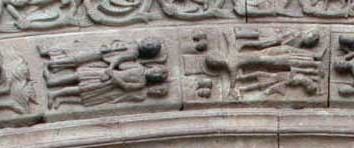
year 1122 | Church of St-Pierre-de-la-Tour, in Aulnay-de-Saintonge (France). On the tympanum of the north portal can be seen the scene of the crucifixion of the apostle St. Peter. |
 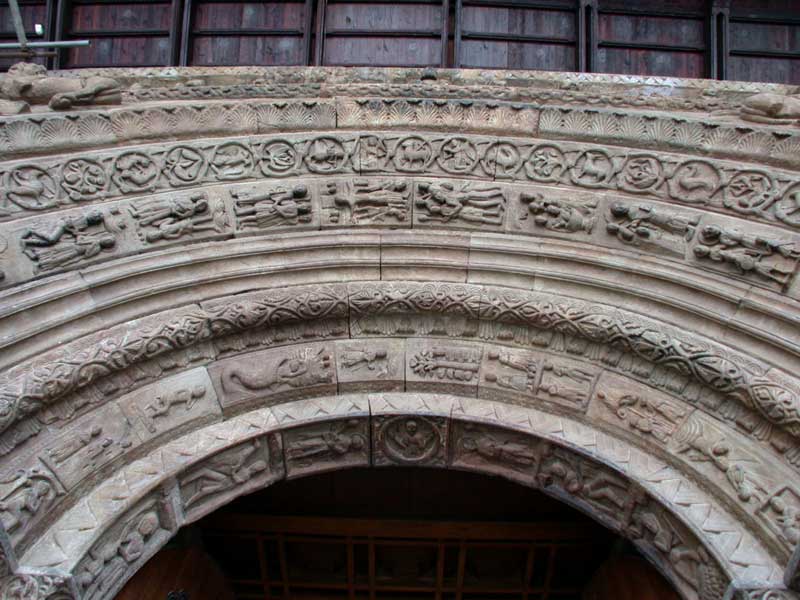 |
year 1169 | Portal of the Monastery of Santa Maria de Ripoll (Spain). The larger photograph shows the upper part of the impressive portal, with 73 stone representations of biblical, allegorical, and everyday motifs; at the center of the portal, the scene that interests us: Peter, crucified upside down (small photo). |
 |
year 1186 circa | In the Cathedral Church of Monreale, Sicily (Italy) are found some of the most prized and extraordinary mosaics in the world, magnificent expressions of Norman art. Among the many mosaics preserved to this day is the crucifixion of Peter, upside down. |
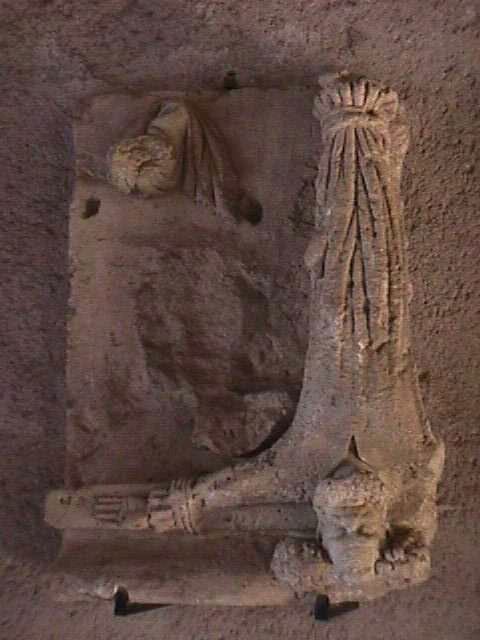 |
end of the 12th century | This relief of the crucifixion of Peter upside down, weathered but still clearly visible, is in the famous Château Comtal, in Carcassonne (France). |
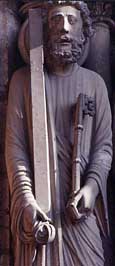 |
first quarter of the 13th century | On the south portal of the impressive cathedral church of Chartres (France) there is a kind of history of the Church in stone, from Christ in his first coming to his glorious manifestation at the end of time. Surrounding the Christ are the Apostles, the first of whom is Peter, carrying in his hands a key and a wooden beam, which represents his crucifixion. |
 |
first half of the 13th century | In the Chiesa Rossa of the municipality of Castel San Pietro (Switzerland) several mural paintings by an unknown author can be seen, among which is a sequence of images from the life of Peter; among these, the moment of the crucifixion upside down. |
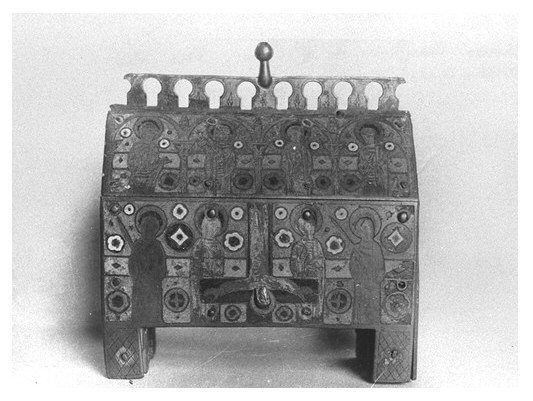 |
year 1250 circa | In the episcopal museum of Limoges (France) is found this Coffer of St. Peter, on whose front panel can be seen a work of goldsmithery with the image of St. Peter, crucified upside down. |
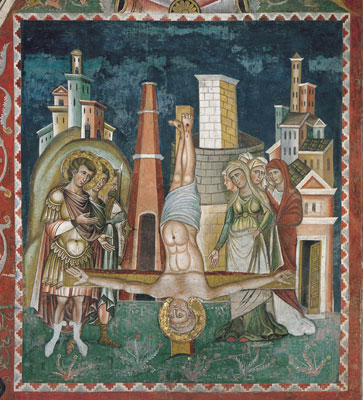 |
years 1277-1280 | The Crucifixion of St. Peter, Chapel of the Sancta Sanctorum, Palazzo Laterano, Rome (Italy). The author is known as the Master of the Sancta Sanctorum. |
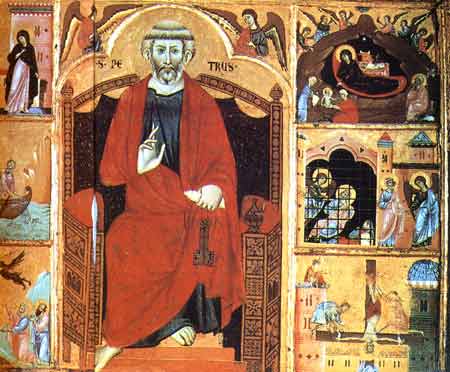 |
year 1280 | Altar frontal of St. Peter, Sienese school. National Picture Gallery of Siena (Italy). The central part of the frontal is presided over by St. Peter, seated and holding the keys, the attribute that characterizes him. On the sides appear scenes from the life of Christ and of St. Peter, such as the Saint’s denial and his crucifixion upside down. |
  |
13th century | Stained-glass windows in the Cathedral of Poitiers (France). This spectacular window represents Christ Crucified in the upper part, and Peter, crucified upside down, in the lower part (second photograph), as though he were a reflection of the Crucified One… |
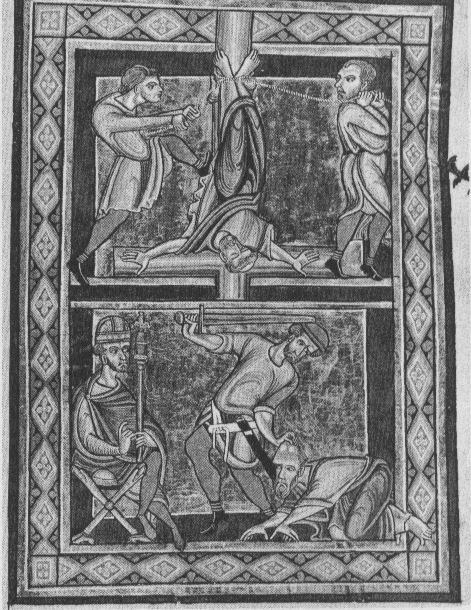 |
13th century | The Martyrdom of St. Peter and St. Paul, miniature in the Berthold Missal (Morgan MS 110, fol. 967), a manuscript from the monastery of Weingarten (Germany). The photograph is taken from The Catholic Encyclopedia, 1966 edition, alongside the entry for St. Peter the Apostle. |
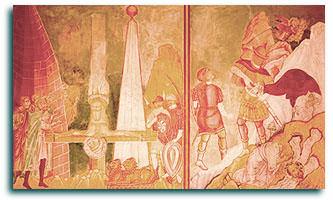 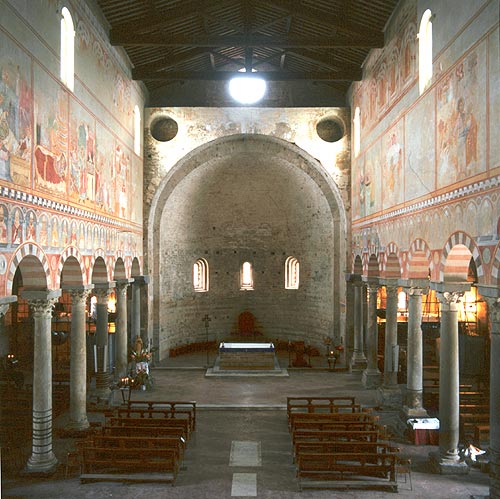 |
year 1300 circa | Frescoes in the church of St. Peter the Apostle, in San Piero a Grado, Pisa (Italy). The photograph shows the detail of the crucifixion of the apostle upside down. The work is attributed to Deodato Orlandi. |
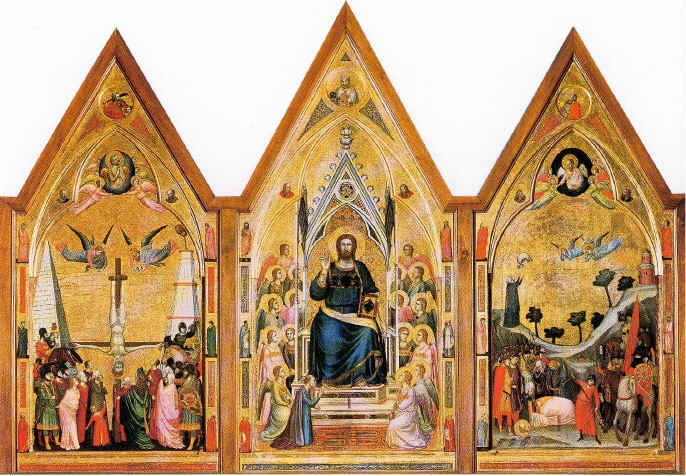 |
year 1325 circa | Giotto, Polittico Stefaneschi, Vatican Picture Gallery. Work on wood. On the left of the triptych, the representation of St. Peter crucified upside down. |
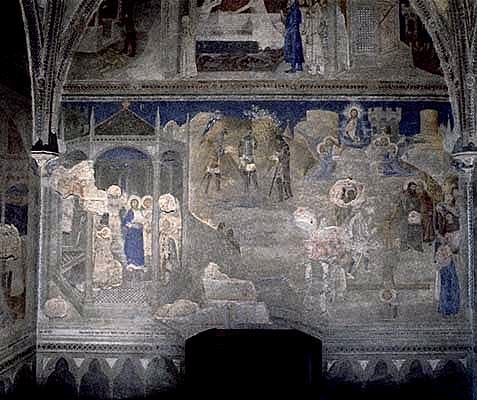 |
year 1345 | Chapel of St. Martial, in the Palace of the Popes at Avignon (France). One of the numerous paintings recalls Peter, crucified upside down. The paintings are by Matteo Giovannetti. |
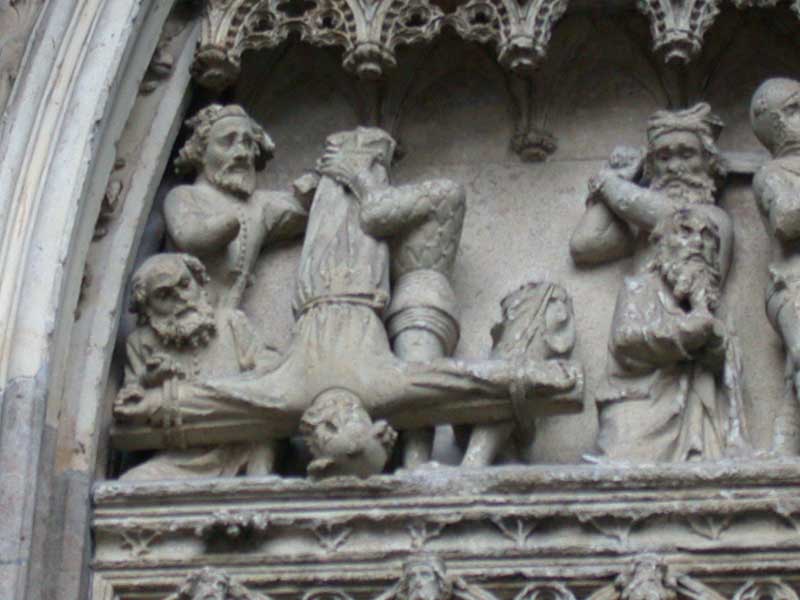 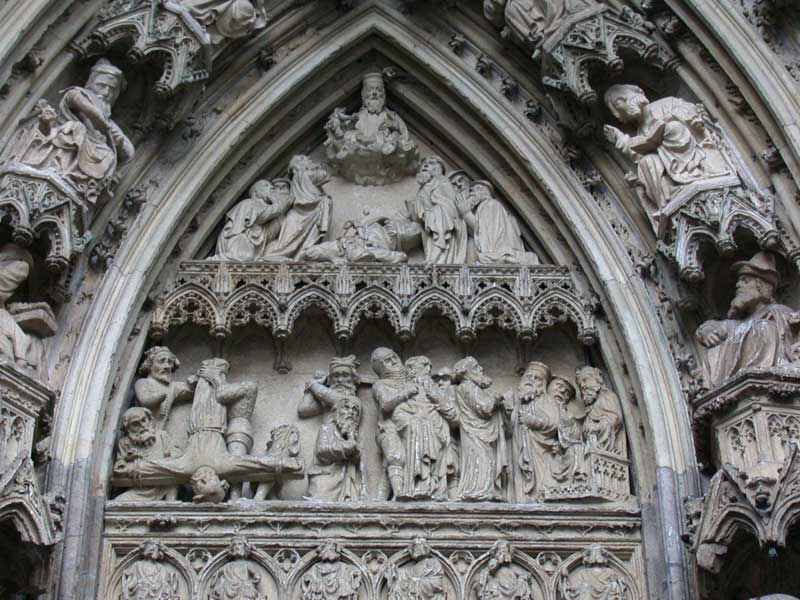 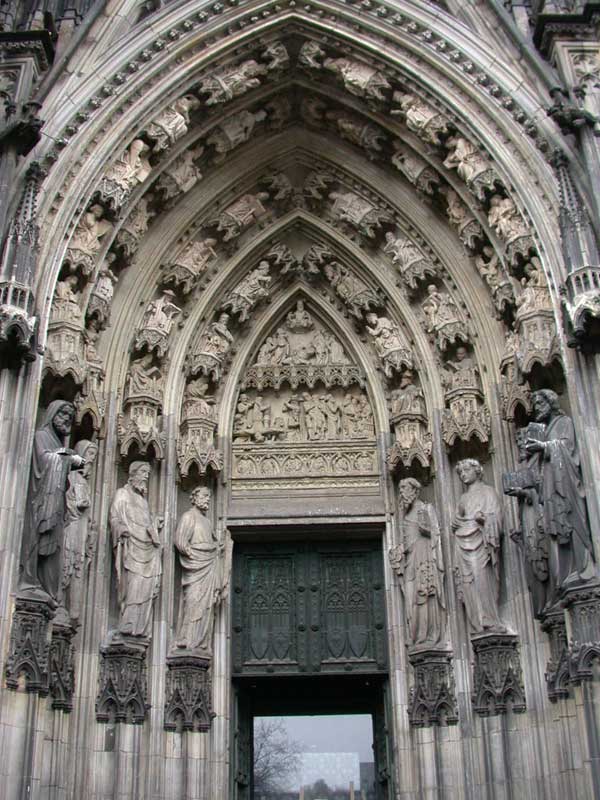 |
year 1375 | The cathedral of Cologne (Germany) is one of the most beautiful monuments of Christianity. The tympanum of the cathedral’s south portal (first photograph) is dedicated to St. Peter. In the center (second photograph), several scenes of the passions of Peter and Paul before Nero in Rome; on the left of the lower level (third photograph), the detail of the crucifixion of Peter, upside down. In the center, the beheading of Paul. It is very common, as we have seen and shall see, to represent both apostles giving their lives for Christ in Rome, Peter by an inverted cross, Paul by the sword, both data of a tradition that has no opponents. |
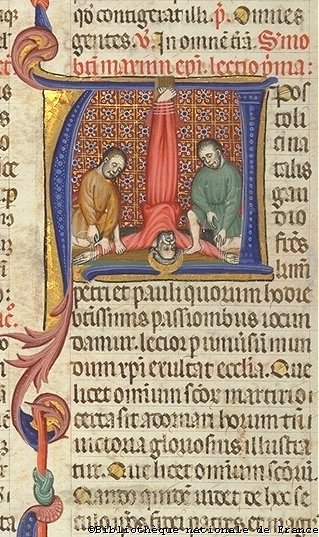 |
end of the 14th century | The Martyrdom of St. Peter in the Breviary of Martin of Aragon. In the National Library of France, ROTH 2529, fol. 341v. |
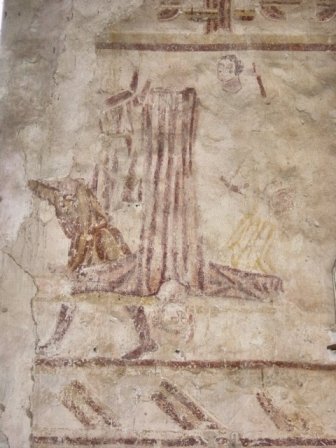 |
14th century | Mural paintings in the Romanesque church of Saint Medard, in the locality of Saint Mars de Locquenay (France). |
 |
1400 circa | Lorenzo Zaragoza, Altarpiece of St. Peter, with nineteen scenes from the life of the Apostle. In the Cincinnati Art Museum. At the lower right corner, the crucifixion upside down. |
 |
year 1426 | Masaccio, The Crucifixion of St. Peter. The Beheading of St. John the Baptist. Detail of the Pisa Altarpiece. Tempera on panel. The work is in the Staatliche Museen zu Berlin, Gemaldegalerie, Berlin (Germany). |
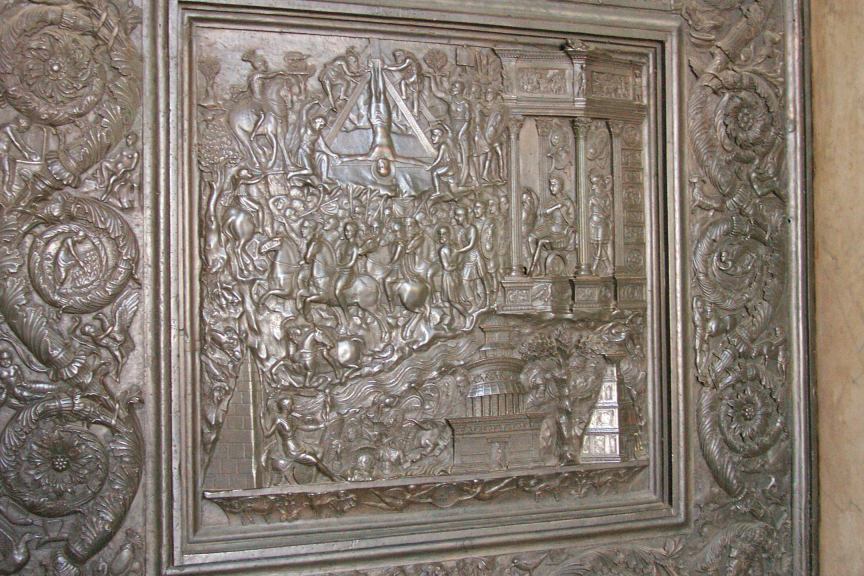 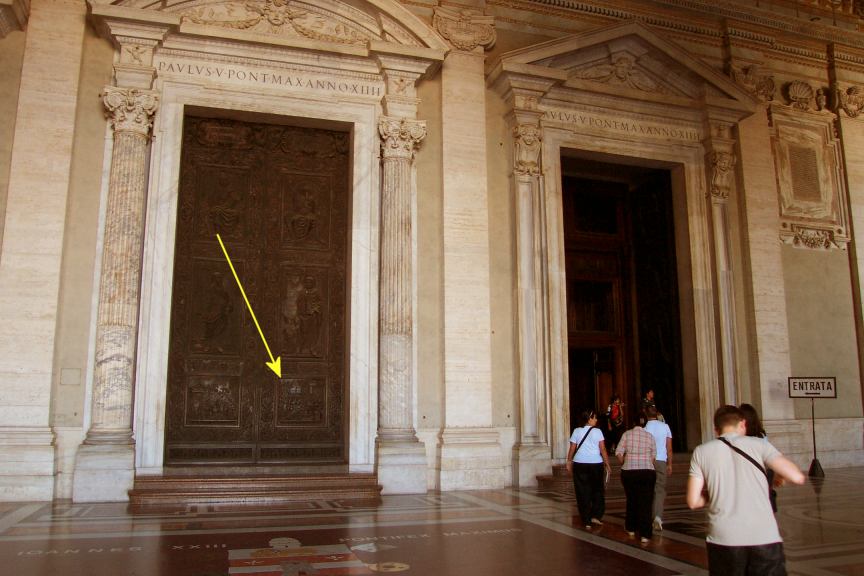 |
between the years 1433-1435 | Antonio Averulino, The Martyrdom of St. Peter. Central door of St. Peter’s Basilica, in bronze (Vatican). The work was commissioned by Pope Eugene IV. The upper photograph shows a panoramic view with the entrance to the temple; the arrow indicates the position of the panel with the crucifixion of Peter. In the photo below, the detail of the scene that interests us. How many millions of pilgrims have seen this work in the nearly six hundred years it has been there? |
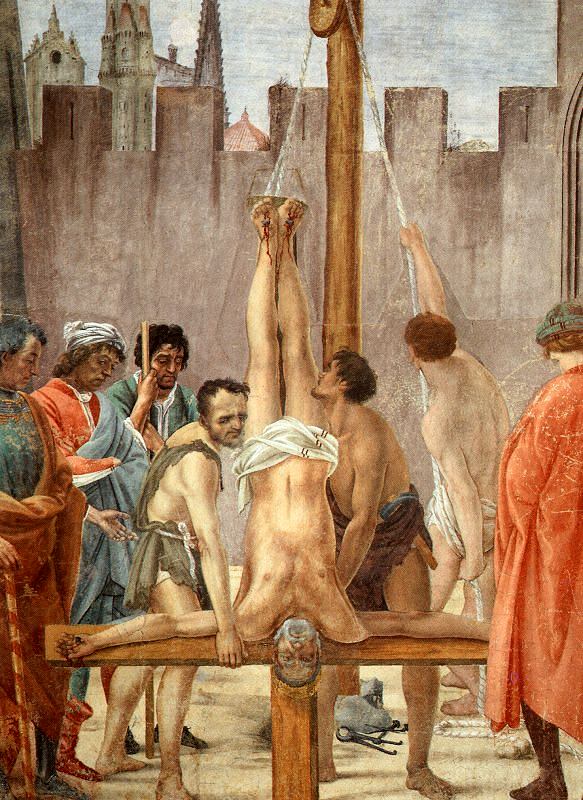 |
year 1490 circa | Filippino Lippi, The Crucifixion of Peter. Fresco in the Brancacci Chapel, Florence (Italy) |
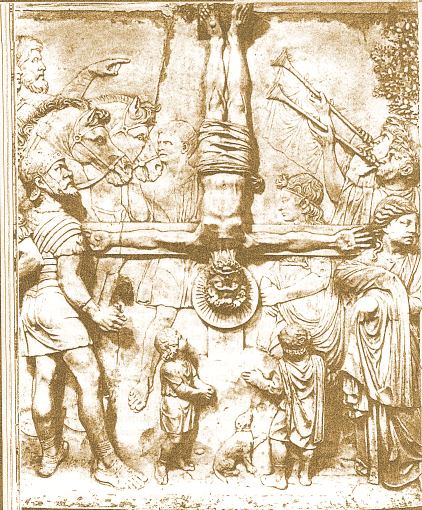 |
between the years 1471 and 1484 | Detail of a tabernacle commissioned by Pope Sixtus IV -who gave his name to the Sistine Chapel- which can be seen in the Vatican grottoes. |
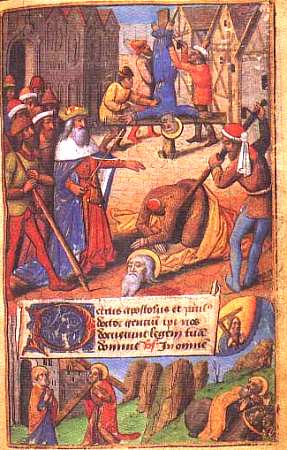 |
end of the 15th century | This other colorful miniature is found in an ancient Book of Hours in France. At the moment I have only these catalogue data: Add. MS. 11865, f. 87. As for our subject, the miniature shows two moments of the firm tradition concerning the deaths of Paul, beheaded, and Peter, crucified upside down. |
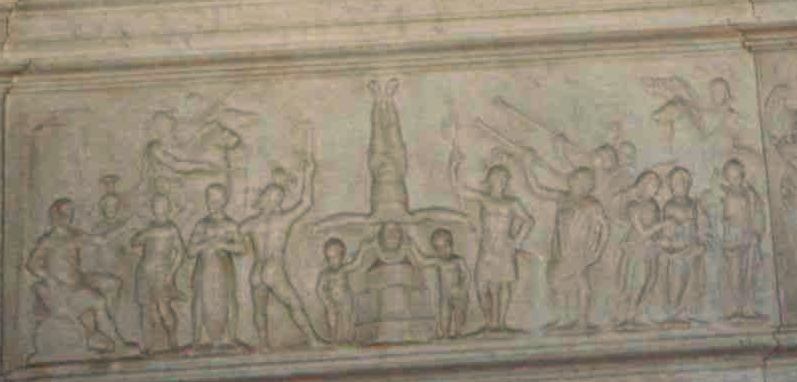 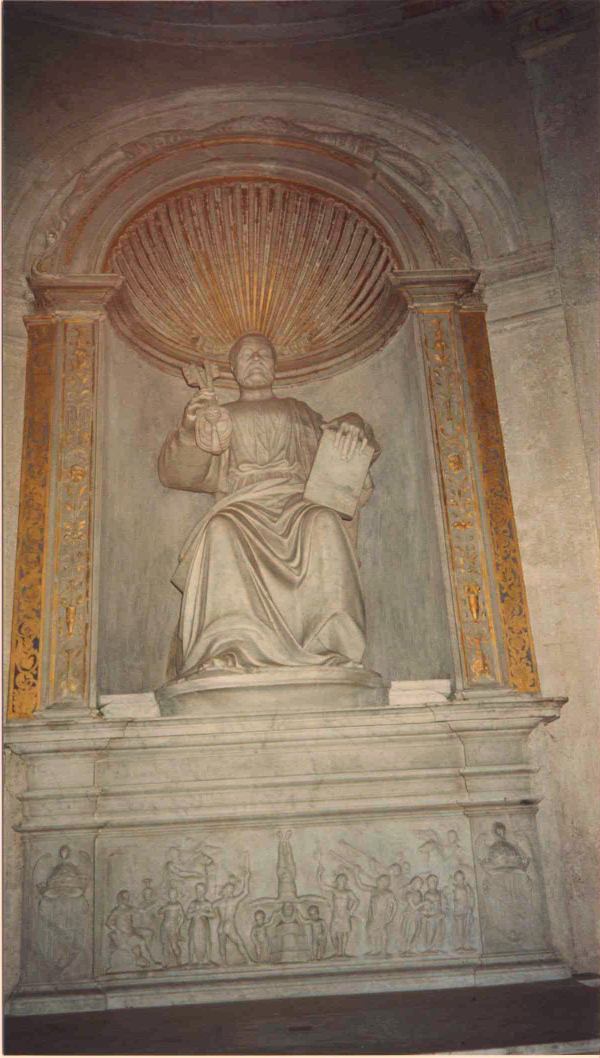 |
year 1502 | Bramante, Chapel of the site of the Crucifixion, church of San Pietro in Montorio, Rome (Italy). The famous artist created a sculpture to honor the place where the martyrdom of Peter was believed to have taken place. In the large photo, a panoramic view of the sculpture; in the detail, the scene of Peter, crucified upside down. |
 |
between the years 1546-1550 | Michelangelo Buonarroti: Fresco The Crucifixion of St. Peter, in the Chapel of Paul III, Vatican Museum. |
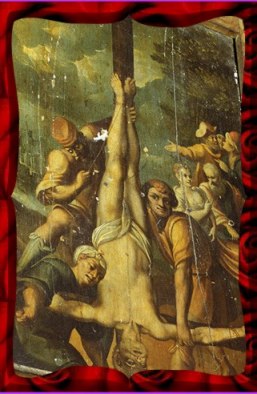  |
end of the 16th century | In the parish church of San Pedro de Gata (Spain) is found this splendid altarpiece with sculptures and paintings. At the central level, on the right, can be seen the scene of the crucifixion of Peter upside down (lower photo). |
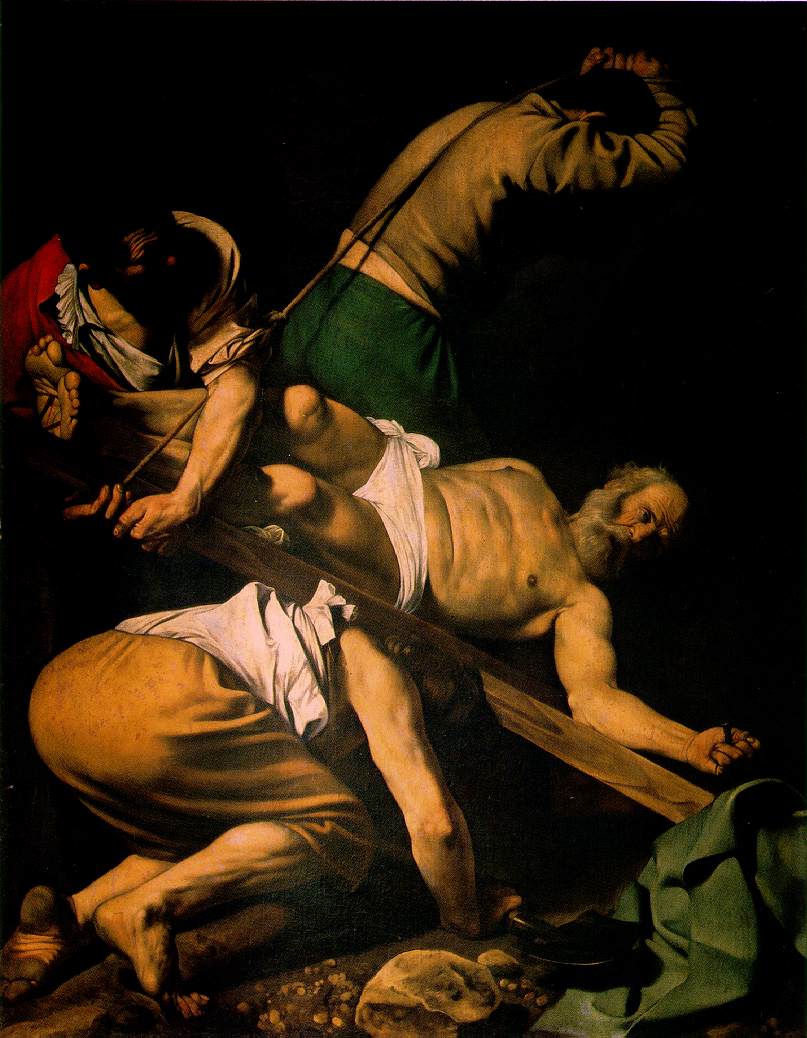 |
year 1600 or 1601 | Caravaggio, The Crucifixion of St. Peter. Oil on canvas. The work is in Santa Maria del Popolo, Rome (Italy). Copies of this splendid work and of several of the works I present here are found in many churches around the world. |
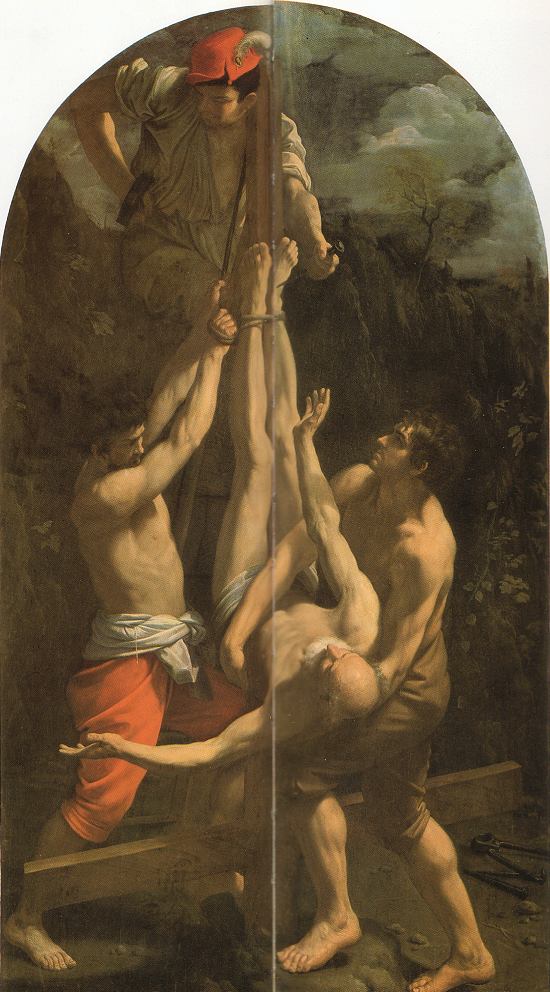 |
year 1604 or 1605 | Guido Reni, Martyrdom of St. Peter, Vatican Picture Gallery. |
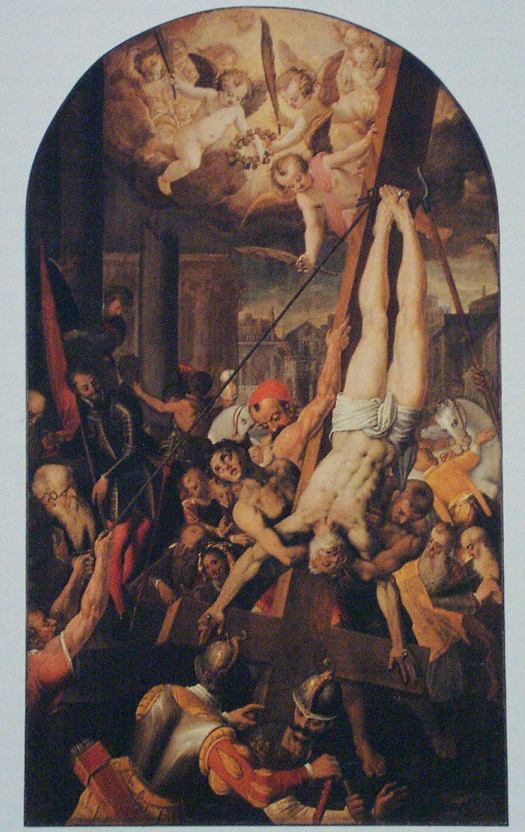 |
year 1605 | Paolo Piazza, Crucifixion of St. Peter, on a side altar of the Frauenkirche, the cathedral church of Munich (Germany). |
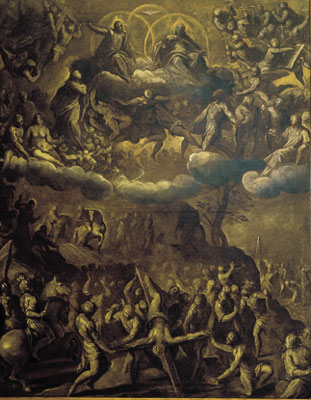 |
year 1614 | The Crucifixion of St. Peter, by Palma the Younger. Gallery of the Academy, Venice (Italy). |
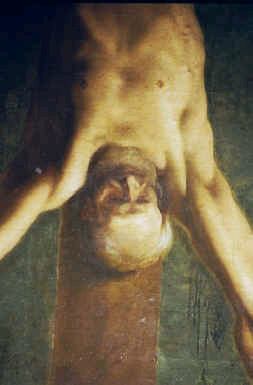 |
year 1616 | In the cathedral of Toledo (Spain) the main sacristy displays a good number of paintings. One of them is Peter, crucified upside down, by the painter Eugenio Caxes. |
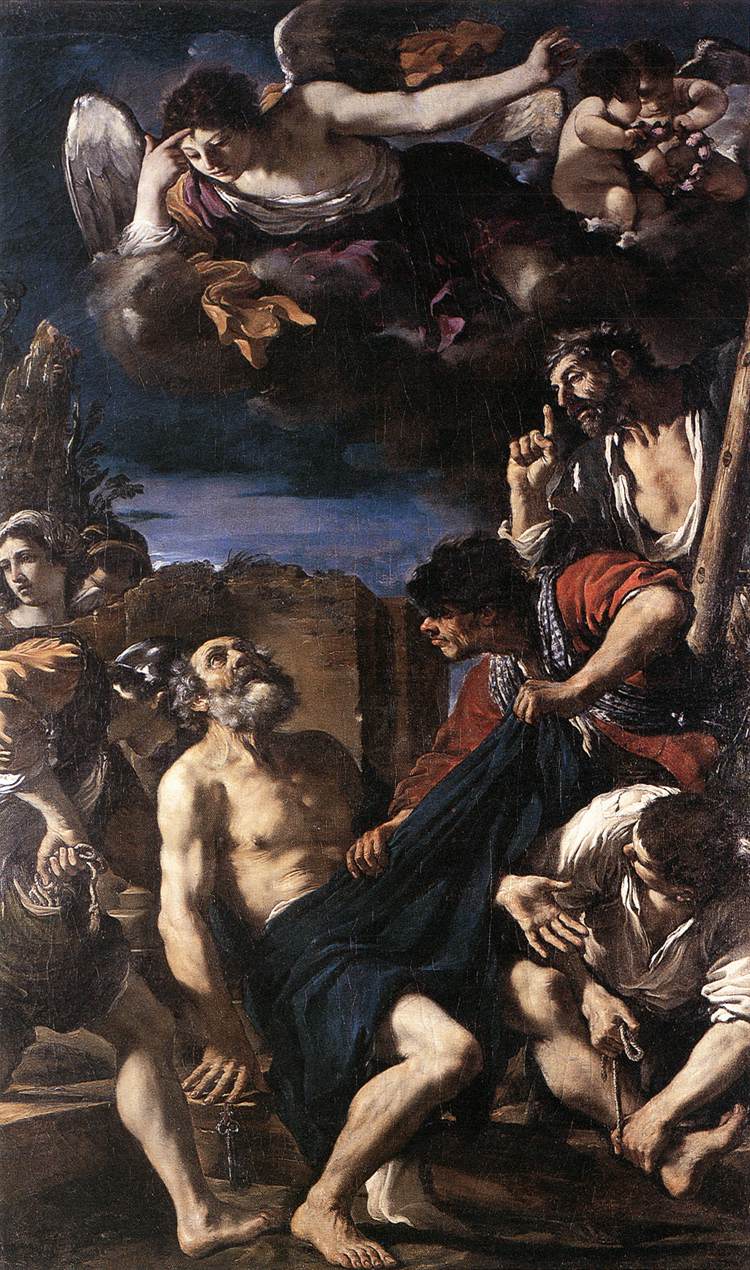 |
year 1618 or 1619 | Guercino, The Crucifixion of St. Peter, oil on canvas. Galleria Estense, Modena (Italy). Note the author’s interpretation: an angel is sent by God (his left hand points to heaven) to suggest to Peter that he have himself crucified upside down (the angel’s right hand pointing to his own head). |
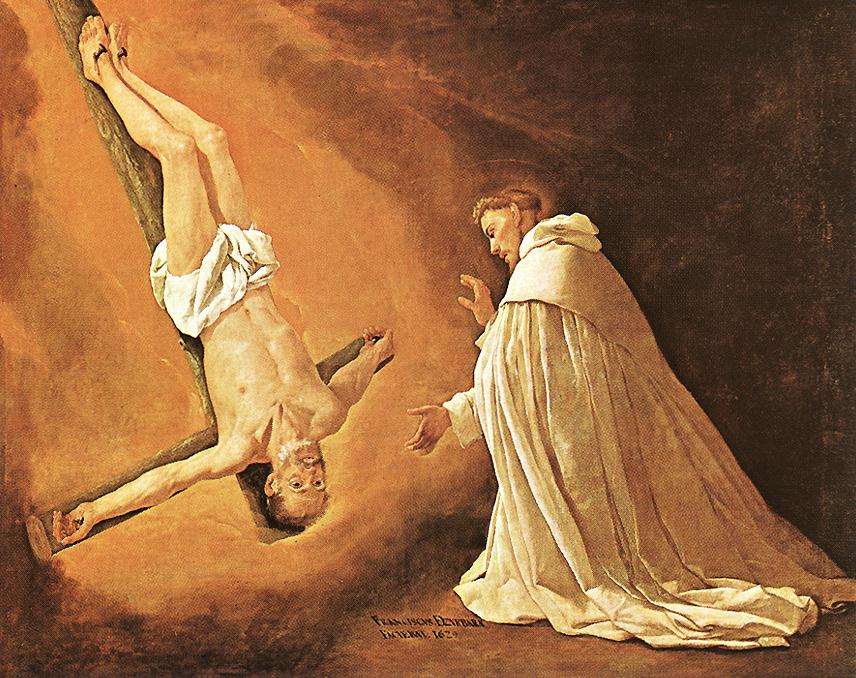 |
year 1629 | Francisco de Zurbarán, The Apparition of the Apostle St. Peter to St. Peter Nolasco, oil on canvas, Prado Museum (Madrid). |
 |
year 1629 | Francisco de Zurbarán, St. Peter, oil on canvas, church of San Esteban in Seville (Spain). The specialized art site from which I obtained this painting explains: “[Peter] is represented with his traditional attributes: the keys of Heaven and the wooden beam alluding to the inverted cross on which he died a martyr.” |
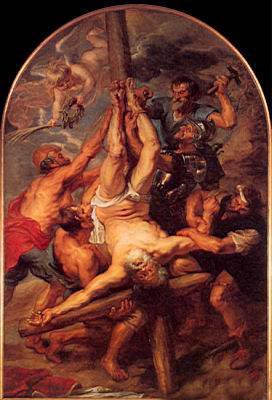 |
year 1640 | Peter Paul Rubens, The Crucifixion of Peter, Church of St. Peter, Cologne (Germany). Oil on canvas. |
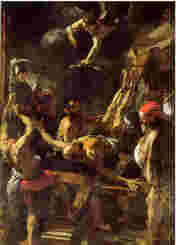 |
between the years 1630-1647 | Mattia Preti, The Crucifixion of Peter, in the Museum of Grenoble (France). The photo I obtained is small, but the actual painting is 3.36 meters high by 2.42 wide. |
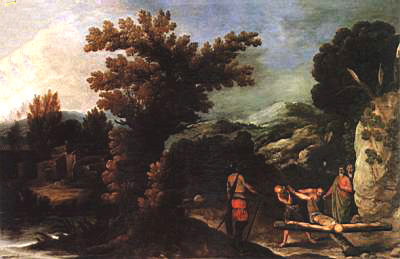 |
first half of the 17th century |
Francisco Collantes, Landscape with the Crucifixion of St. Peter. Oil on canvas. The work is in the Prado Museum, Madrid (Spain). |
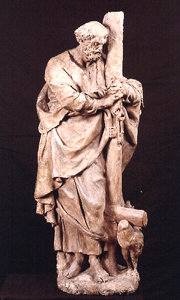 |
year 1658 | Artus Quellinus the Elder, Church of St. Andrew, Antwerp (Belgium). Marble. Peter, portrayed as a man of sorrows yet full of energy, embraces an inverted cross, the symbol of his passion. Further below we shall comment a little more on this image. |
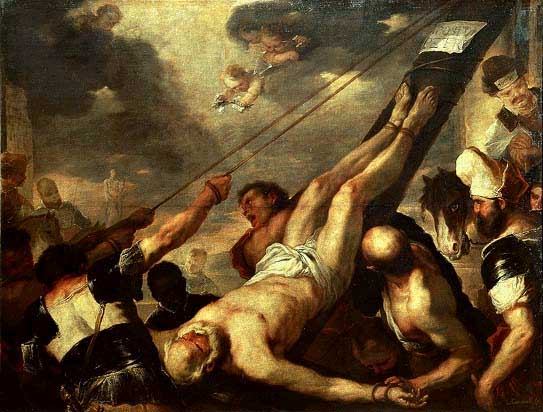 |
end of the 17th century | Luca Giordano: The Crucifixion of St. Peter. The work is in the Academy of Venice (Italy). |
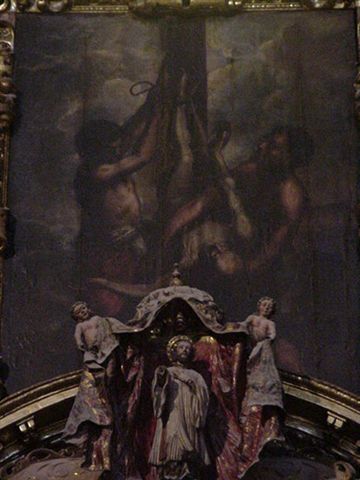 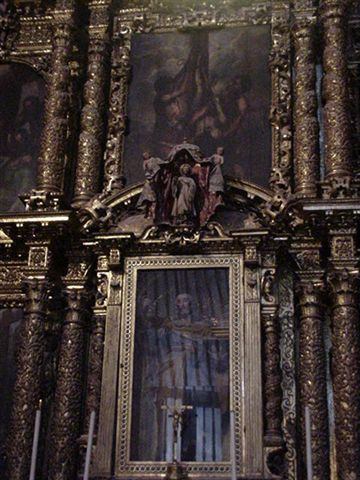 |
16th century | In the cathedral of Mexico City, in the chapel of St. Peter, there is a painting representing the scene of the crucifixion of Peter upside down. Thus have millions of Mexican faithful seen it for four centuries. In the upper photo, a view of the altarpiece; in the other photograph, the painting of the crucifixion. It is possibly a painting by Echave Orio from the 17th century, as Manuel Toussaint writes, and the author is of Flemish origin. (Photo: Luis Moreno) |
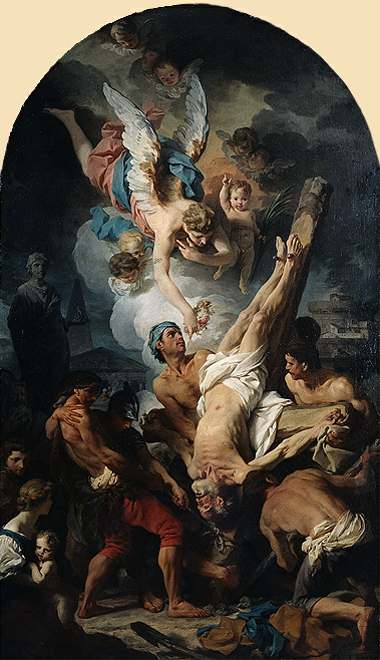 |
first half of the 18th century | Pierre Subleyras, The Crucifixion of Peter, Louvre Museum (Paris). Oil on canvas. |
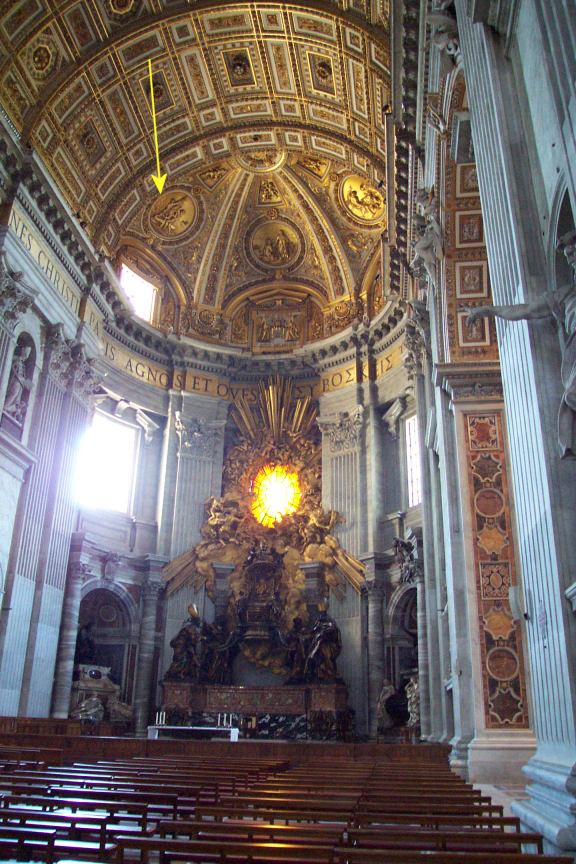 |
first half of the 18th century | In the Vatican Basilica, in the vault at the far end, next to Bernini’s splendid work at the altar of the Chair, there is a crucifixion of Peter upside down, in stucco, in a kind of round niche about three meters in diameter. The work is part of the ornamentation carried out by Giovan Battista Maini, perfectly visible as the photograph shows. |
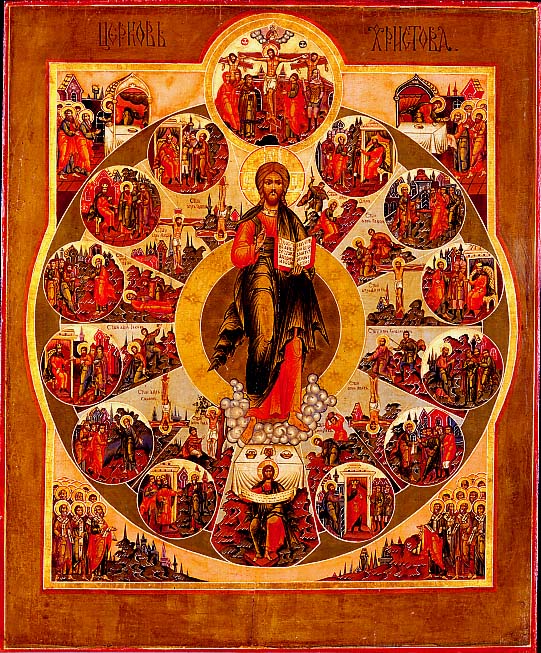 |
year 1850 circa | Icon of the Russian Orthodox Church, representing the Church of Christ. In the upper part, next to the head of Christ, are represented the martyrdom of Paul by beheading (right) and Peter crucified upside down (left). There are other martyrs represented in the same manner in the lower scenes. |
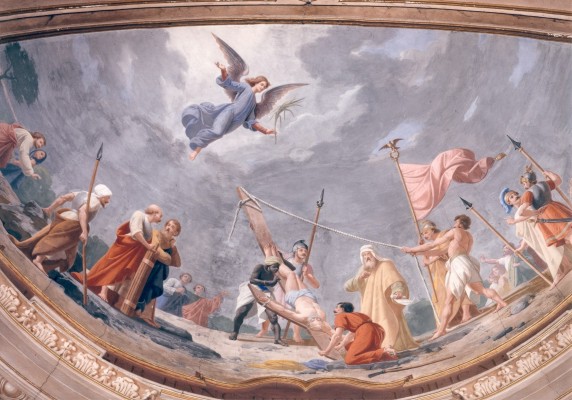 |
middle of the 18th century | Church of St. Peter in Gottolengo (Italy). On one of its vaults is found this most beautiful painting by the painter Franzoni, celebrating the testimony of Peter, crucified upside down. |
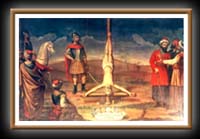 |
year 1864 | Martyrdom of St. Peter upside down, Cathedral of Salta (Argentina). According to the National Artistic Heritage of the Province of Salta, it is attributed to Francisco Ortega. |
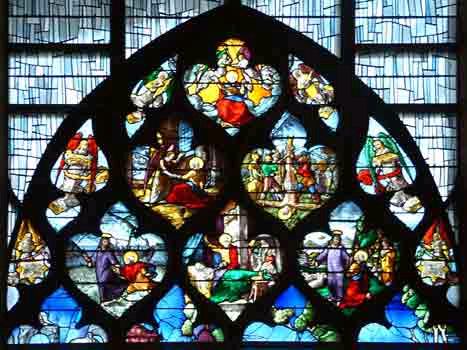 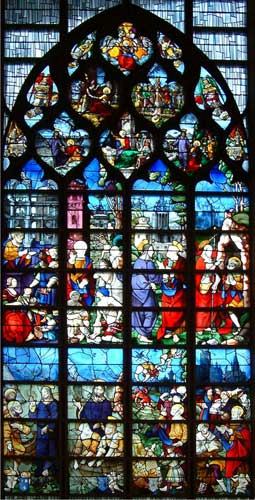 |
year 1869 | In the church of St. Joan of Arc in Rouen (France) there is a stained-glass window dedicated to St. Peter. In the upper part can be seen the scene of his death by crucifixion upside down. |
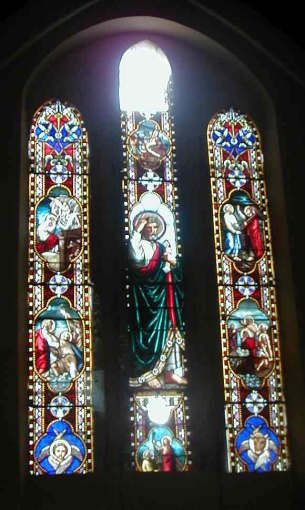 |
year 1889 | Cornusson Church in Garonne (France). In the central window of the three stained-glass panels, at the upper center, we see the crucifixion of St. Peter upside down, arms outstretched. |
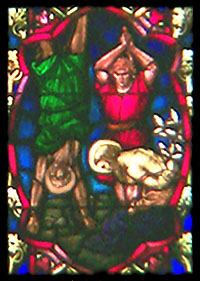 |
year 1919 | National Shrine of St. Francis of Assisi, San Francisco, California (USA). In the stained-glass windows of the eastern part of the temple is found, among many others, this image dedicated to preserving the memory of the martyrdom of Peter, crucified upside down, and that of Paul, by beheading. |
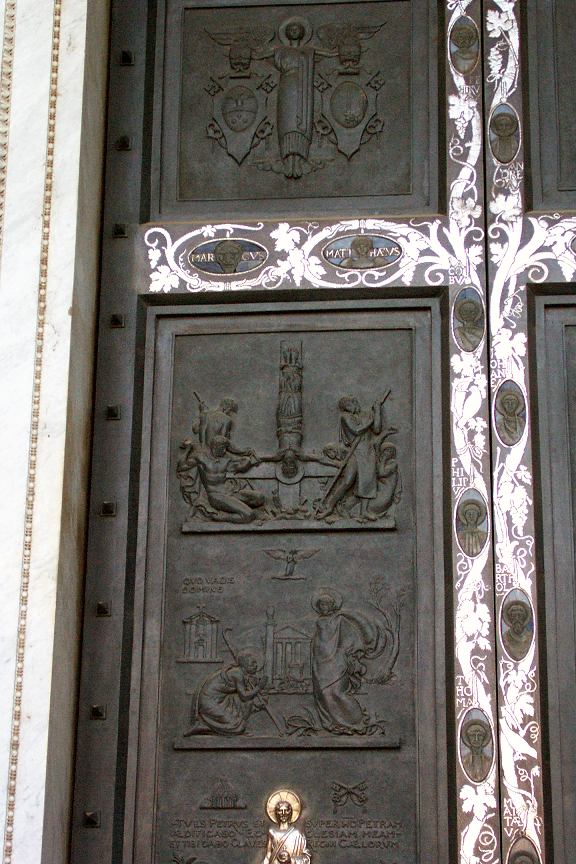 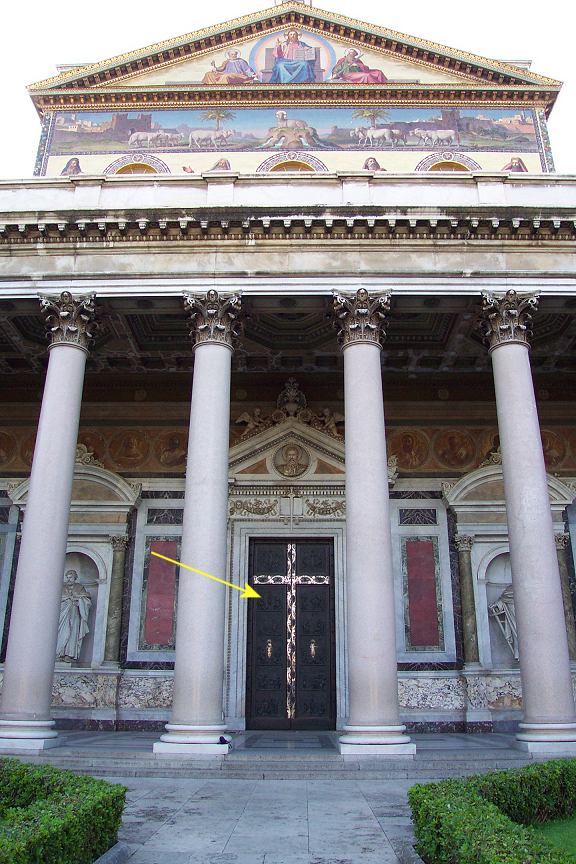 |
first half of the 20th century | Basilica of St. Paul Outside the Walls, in the city of Rome (Italy). The church guards the remains of the Apostle of the Gentiles, who died by beheading -according to tradition- in the imperial capital. The central door of the basilica (upper photo) contains scenes from the life and death of Peter and Paul. Among the scenes can also be seen the crucifixion of Peter upside down. |
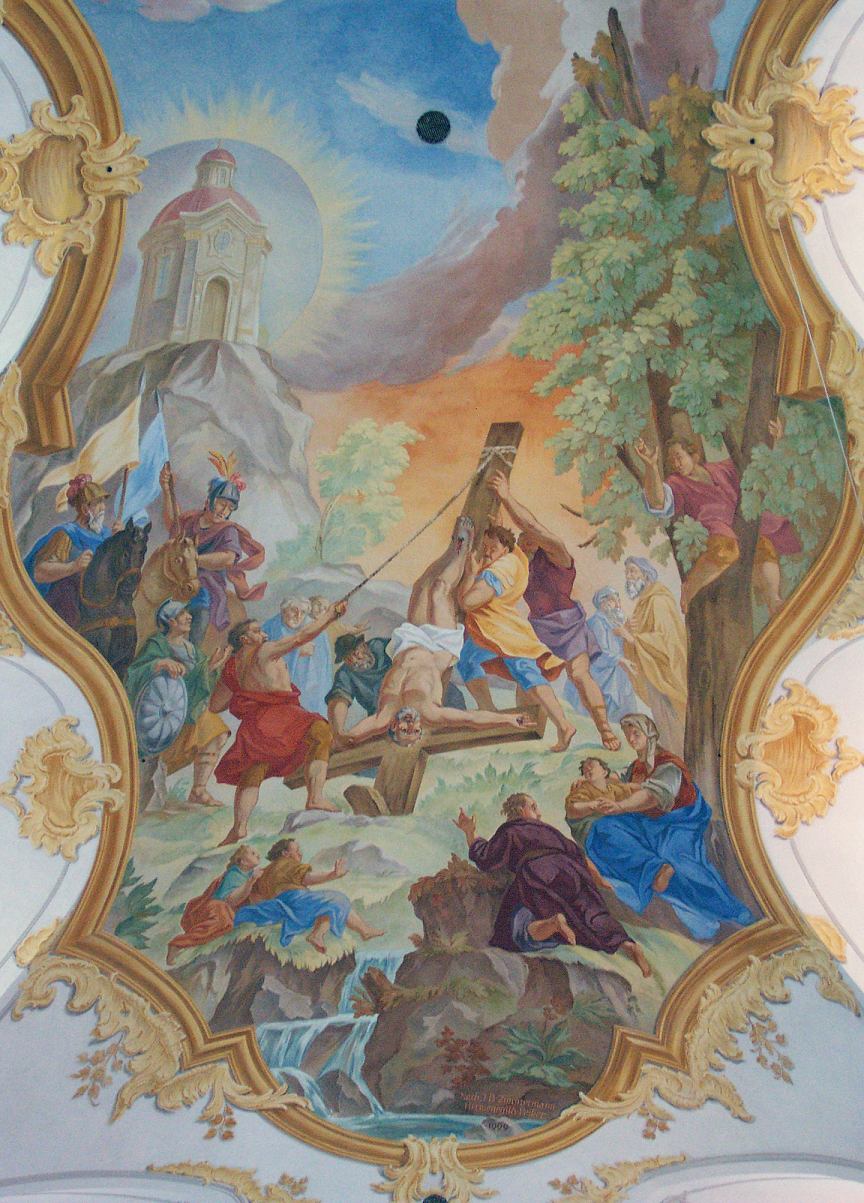 |
middle of the 20th century | On the vault of the main nave of the church of St. Peter in Munich (Germany) is found this enormous fresco recalling the martyrdom of Peter upside down. The church, destroyed by the Allied bombings of the Second World War, was completely rebuilt. |
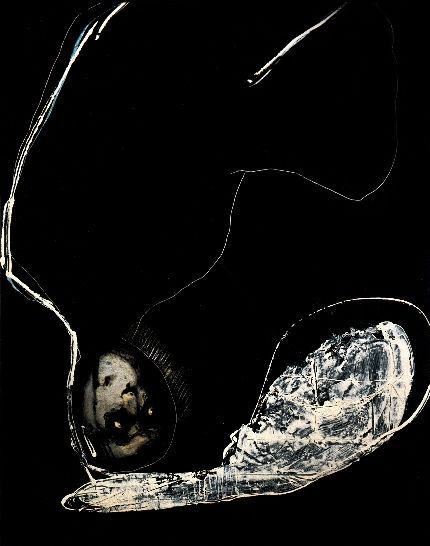 |
year 2001 | Stefano Billi, The Crucifixion of St. Peter. Oil and polyurethane varnish on wood. An example of the tradition concerning the death of Peter upside down in modern Italian art. |
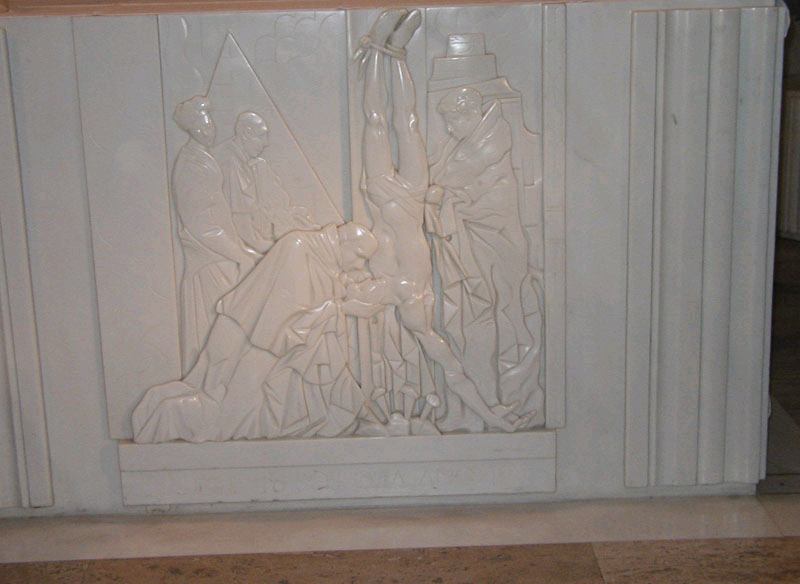 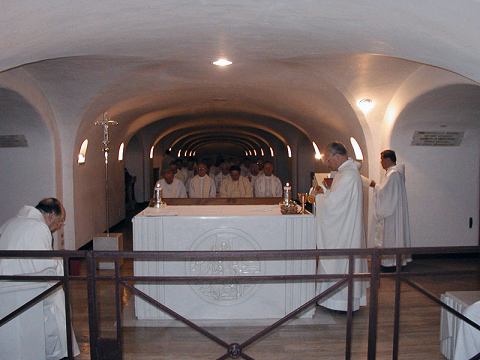 |
Beneath the high altar of St. Peter’s Basilica (Vatican) there are many crypts with altars for the celebration of Holy Mass. Several Popes also rest in those chapels. Facing the place that contains the bones of the Apostle Peter, there is a marble altar with reliefs, where the Eucharist may be celebrated (upper photo). On one of the sides of the altar can be seen the scene of Peter, crucified upside down. |
IV. Examples of the Petrine -not satanic- use of the symbol of the inverted cross in reference to the Apostle’s death, in Catholic churches and in churches belonging to several non-Catholic Christian denominations.
| Symbol | References | Comment |
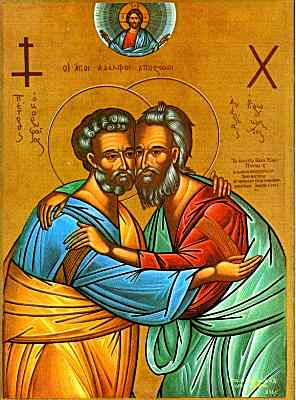 |
Orthodox Church, icon of the “Embrace of the brothers Peter and Andrew” (in various places, for example on this site) | This icon was painted by an Orthodox monk of Mount Athos, in Greece. The Orthodox Patriarch of Constantinople Athenagoras presented it as a gift to Pope Paul VI, in memory of the historic meeting between the two that took place in Jerusalem (January 1964), where they mutually lifted the ancient excommunications. In the part corresponding to Peter, an inverted cross. That this symbol is traditional in the Orthodox churches is demonstrated both by the painter and by the one who gave the gift. |
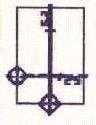 |
St. Peter’s Episcopal Church in Charlotte, North Carolina, USA. (website) | There is a design on that website in which two keys -taken from the scene where Jesus entrusts to Peter the keys of the Kingdom- cross each other forming an inverted cross. The complete design was found here. Moreover, the site of the Survey & Research Reports Charlotte-Mecklenburg Historic Landmarks Commission (the site is here) presents a detailed report on the history and architecture of that church’s house of worship. There we read: “The very entrance to the church has heavy double wooden doors, on which is engraved a shield, at the top, with interlaced keys and an inverted cross: more symbols of Peter.” The doors, like the building, date from 1893. The Episcopalian faithful have seen that shield for more than a hundred years as they enter the temple for prayer. |
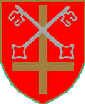 |
St. Peter’s Episcopal Church in Charleston, South Carolina, USA (the website was hosted here: www.stpeterscharleston.org). | The parish promotes its parish bulletin. The name of the bulletin is… “The Inverted Cross” (The inverted cross). There too there is a design with the keys and the inverted cross. |
 |
St. Peter’s Episcopal Church in Bettendorf, IA, USA (the website was hosted here: http://home.earthlink.net/~saintpeters/tour.htm) | On that website some photographs of the house of worship can be seen. For our purpose, let the reader look at the photograph I display here, which corresponds to the front of the Episcopalian temple, where next to a large cross -of Christ- there is an inverted cross. What did this Episcopalian community “of St. Peter” intend to represent by that sign? |
 |
Episcopal Church of St. Peter and St. Paul, Marietta, GA, USA (website) | On that page a brief explanation is given of the emblem representing that parish. The emblem carries an inverted cross, a sword, and a key, symbols of the two great apostles. The design appears on the main page and on several internal pages. |
| St. Peter’s Episcopal Church, Richmond, Virginia, USA (website) | On one of its pages we read the following account by one of its members: “The Episcopal church community to which I belong is called “St. Peter’s”. Our standard [banner] is covered with symbols that remind us of the life of this “rock”, upon which Jesus founded his church. At the top, a colorful rooster, whose crowing made Peter acknowledge his denial; in the center is the inverted cross, indicating the manner of crucifixion which a humble Peter, as tradition tells us, chose; and flanking the cross are two large, ancient keys… etc.” | |
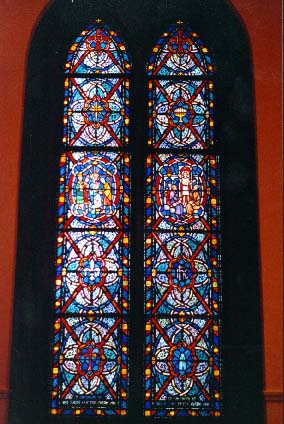 |
Trinity Episcopal Church, Covington, Kentucky, USA (website) | The church presents information about its activities and worship. It explains several stained-glass windows that enrich the temple, among them one of the “Annunciation”. It says that it has secondary symbols in addition to the central ones, and among them “the venerable offices of Peter, the keys crossed over an inverted cross: he did not feel worthy… ” etc. It is made clear that these secondary symbols of the window “were carefully selected to enhance the central motif” (the Annunciation). In the photo of the window presented by the site, the Petrine motif cannot quite be made out. |
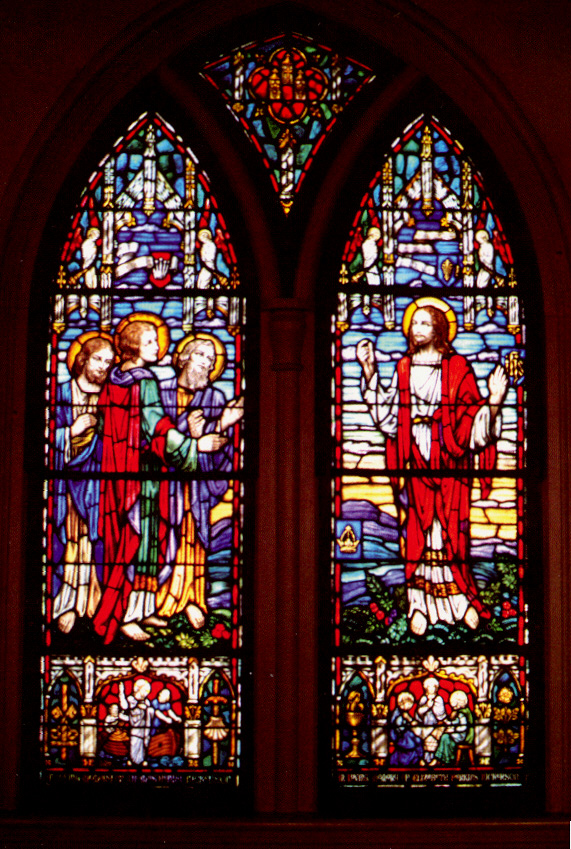 |
Emmanuel Episcopal Church, Athens, Georgia, USA (website) | In that church there is a beautiful stained-glass window with Gospel images and, at the foot of each window, some apostolic symbols. In the window of the Transfiguration, as the person in charge of the site explains, there is an inverted cross, the sign of Peter (lower left corner of the photograph). |
| St. Paul’s Episcopal Church, Chestnut Hill, Philadelphia, PA, USA (website) | The site describes the church’s various stained-glass windows. One of them represents Peter, with the keys in his hands, and at his side an inverted cross. The photograph offered by the site is not of good quality, and the symbols of Peter are not visible. | |
 |
Christ Church Episcopal Cathedral, Louisville, KY, USA (website) | For the re-dedication of the Cathedral church (May 2002) the faithful of that community presented more than thirty banners, on which various motifs of the Christian faith are represented. One of them, “designed by Father Joe Smith and Donna Bartman”, bears a large red inverted cross on a white background, plus a fleur-de-lis representing the city of Louisville. Both that banner and the others are permanently displayed in a hall of the cathedral complex. |
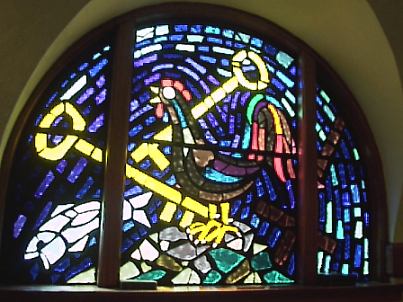
| First United Methodist Church, Midland, Texas, USA (website) | There is a brief tour with an explanation of the temple’s architecture and some of its symbolic elements. It is said there that there are twelve kneelers and that each one represents one of the Apostles. The one corresponding to Peter bears “his keys, his inverted cross and his famous rooster”. It is noted that the kneelers were handworked by women of the community. | |
 |
First United Methodist Church, Temple, Texas, USA (website) | In the church there are some stained-glass windows, among them one dedicated to Peter. In it can be seen “the symbols of Peter”, as the site explains: a rooster, two keys, a fish, a rock and an inverted cross |
| Carter Memorial United Methodist Church, Needham, MA, USA (the website is no longer online) | There are designs of the apostles on the doors, and Peter is represented by the inverted cross and the keys. Rev. Caroline B. Edge explains to the assembly, in a sermon of June 2002, the missionary meaning of those apostolic symbols, and says that “the symbol of Peter” is the inverted cross and the keys, and gives the reasons we already know. | |
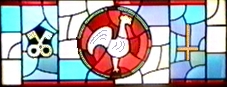 |
Christ Lutheran Church, Las Vegas, USA (formerly hosted at www.christlutheranlasvegas.org) | It presents a page with the stained-glass windows of its church. Among many others there is one representing Peter, with the keys, the rooster and an inverted cross, while offering the explanation of the latter which the reader can already imagine. It is also said that the windows were designed and executed by Robert and Patricia Metcalf, of Metcalf Studio in Lake Havasu, AZ. |
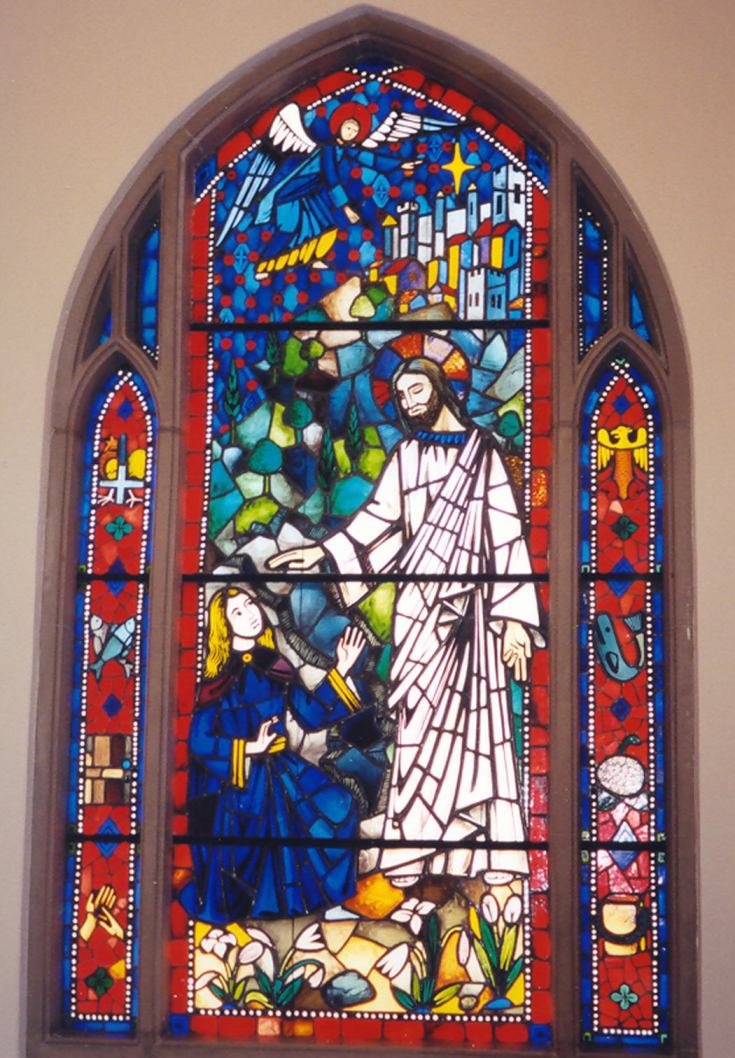 |
Grace Lutheran Church, USA (website) | On the site that community is presented as the “mother church of the Grand Canyon Synod of the Evangelical Lutheran Churches in America”. It contains a remarkable series of stained-glass windows, representing biblical scenes and a great number of Christian symbols (even a “seal of Luther”). In the window dedicated to the Resurrection of Christ, there is a rooster and an inverted cross, symbols -says the site- “of Peter’s denial and of his martyrdom”. |
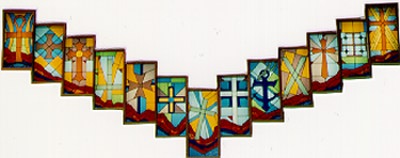 |
St. Luke’s Lutheran Church of St. Paul, Minnesota, USA (formerly hosted at http://www.stluke-church.com/raredosdescription.htm) | The church offers on its website, among other things, an explanation of one of the church’s stained-glass windows. In it the apostles are represented by different crosses. For Peter, an inverted cross. |
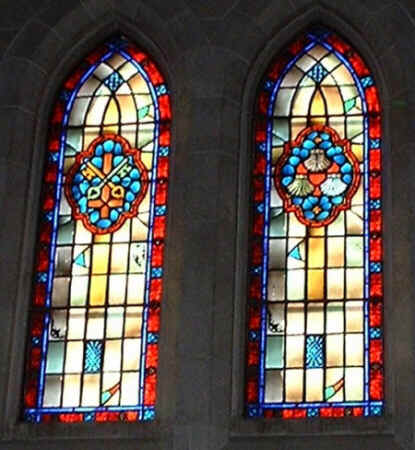 |
St. John’s Lutheran Church in La Porte, Indiana, USA (website) | It presents photographs of the temple’s stained-glass windows, installed in 1954. Among them is one dedicated to Peter, who is symbolized by an inverted cross. |
| Holy Trinity Lutheran Church of Lynchburg, Virginia, USA (formerly hosted at http://www.elca.org/syn/cong/va/24503/history.html ) | It presents on its website a history of the parish community and of the temple. Speaking of the windows of the central nave, it says that they represent many figures from the Bible and from the history of the Church, from Moses to H.M. Muhlenberg, “patriarch of Lutheranism in America”, by way of St. Francis of Assisi and Luther. Each figure is painted full-length, plus a symbol that characterizes him. For one of the windows the site says: “St. Peter, representative of the disciples, is presented holding in his hands the keys of the Kingdom, and is symbolized by an inverted cross. Tradition holds that he was crucified upside down”. | |
 |
St. Peter’s Lutheran Church, Battle Creek, MI, USA (website) | It carries the symbol of Peter with the inverted cross and the keys. And it explains: “The Christian symbol for St. Peter is the inverted cross and the crossed keys”. The church is affiliated with the “Evangelical Lutheran Church in America”. |
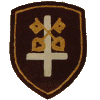 |
Good Shepherd Lutheran Church, Liverpool, PA, USA (website currently offline) | It carries the emblems of the twelve Apostles seen on the carpet beneath the temple’s main altar. The explanation corresponding to Peter says that “his symbol is the keys”. But on the shield there is also the inverted cross, as can be seen in the photo. |
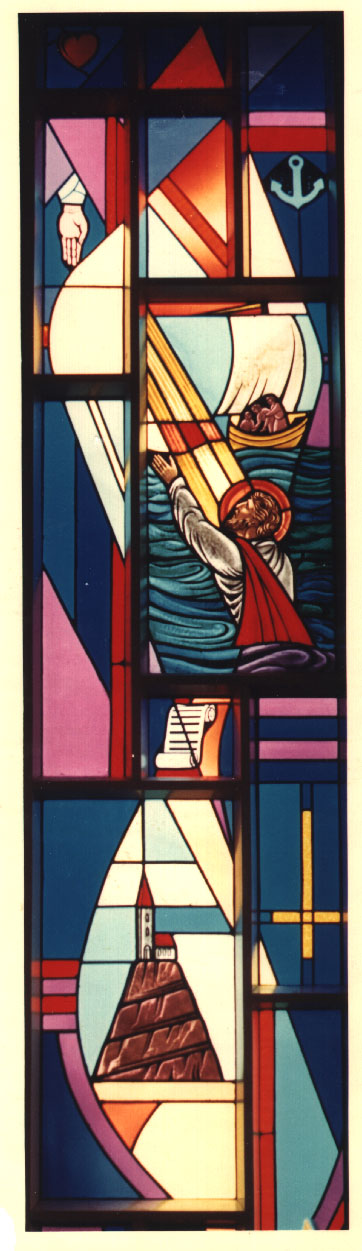 |
First Lutheran Church of Kennewick, Washington, USA (formerly hosted at www.kennewickfirstlutheran.org) | There are stained-glass windows alluding to some of the apostles, among them a very beautiful one referring to Peter. He is represented at the moment when Christ helps him not to sink into the waters (Mt 14:30-31). He appears surrounded by symbols alluding to his person. The person in charge of the Lutheran parish explains them thus: “In the upper part: a heart, symbol of Peter’s goodness; the anchor, for his faith; the Church upon a rock; the inverted cross for his crucifixion; the crown, symbol of Christ whom he adores”. The author of the work originally adds symbols not often seen: the “heart” as a sign of Peter’s goodness, or the “anchor” as a symbol of his faith. |
 |
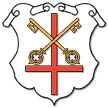
Trinity Lutheran Church, of Ann Arbor, Michigan, USA (website) | The temple has a modern tower laden with symbols, and in particular with crosses, referring to various aspects of Christian life and its history. Among them there is also an inverted cross, which, as the site explains, is “a symbol of St. Peter, who was crucified in that position”. |
 |
Official site of the Evangelical Lutheran Church of Brazil (website) | Among the liturgical emblems appears this one, of Peter, with an inverted cross and the keys. Under “Who we are” we read that the Evangelical Lutheran Church of Brazil “has 200 thousand members, distributed among 2000 congregations and mission points and served by hundreds of pastors”. Did none of them notice anything strange in an emblem that is nothing less than liturgical? |
 |
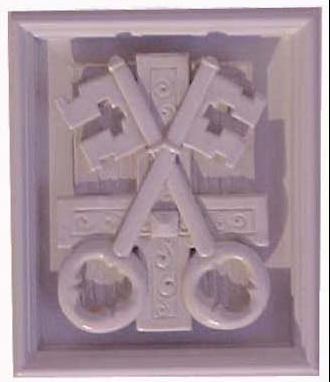
Trinity Presbyterian Cathedral, Sacramento, CA, USA (website) | We can see a very beautiful stained-glass window with the image of the Apostle Peter, holding in his hands the traditional keys. In the upper part of the window is a shield with the image of a rooster, and in the lower part a shield with an inverted cross. On the site it is explained that this “represents his death: according to tradition he died in Rome crucified upside down”. It is worth noting that this is a cathedral church. |
 |
First Presbyterian Church of Richmond, Virginia, USA (website offline) | It carries an explanation of a wooden reredos taken from the work “Symbolism of the Sanctuary” by Dr. W. Lapsley Carson, pastor of that church between 1922 and 1959. Among the symbols there is an engraving representing Peter, with the keys and an inverted cross. According to what is said there, the design was placed in the church “inadvertently upside down”. Here I publish it as it should be. The site explains regarding that shield: “The saltire or crossed keys, superimposed on an inverted cross, signify St. Peter… Peter was crucified upside down”. |
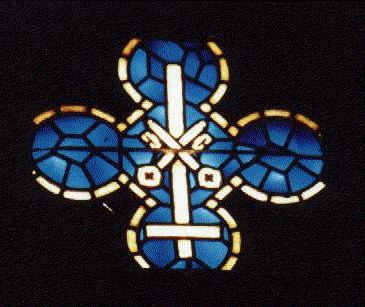 |
First Presbyterian Church, Waco, Texas, USA (website) | In one of its windows the symbology of Peter is displayed: an inverted cross and the crossed keys. The site says: “The inverted cross was the way Peter wished to die” |
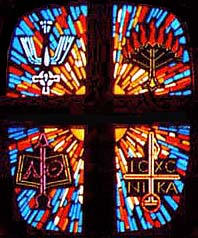  |
St. Peter’s by the Sea Presbyterian Church, Rancho Palos Verdes, CA, USA (website) | 
It offers on its portal several photographs of the abundant stained-glass material with which that church has been enriched: among them some dedicated to Luther, Calvin, and other important figures of Christianity. There is a symbolic sequence dedicated to the apostles in one of the corridors. Everything there is symbols. For Peter are presented: the keys, a fisherman’s boat, fish, fishing nets, an anchor, a rooster, a “70 x 7”, a cross upon a rock, a staff and an inverted cross (the photo at the foot of this paragraph). But that is not all: the faithful encounter another inverted cross on the main door, as soon as they arrive at the temple (the upper photo, to the left of this paragraph). And as if this were not enough, a rose window in the main nave once again reminds the faithful of the death of Peter upside down (lower photo, to the left of this paragraph). |
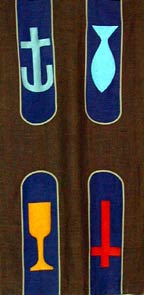 |
Valley Presbyterian Church, Paradise Valley, Arizona, USA (website) | It displays some banners which, as the site explains, represent the great confessions of faith from the beginning of Christianity down to our own days. It is also reported that the banners are displayed in that church on “Reformation Sunday”. On the banner of the “Apostles’ Creed” can be seen: an anchor, a fish, a chalice and an inverted cross. The site explains that this refers to “Peter, who according to legend was crucified upside down”, etc. It is worth noting that although the datum is acknowledged as “legendary”, it is used in the liturgical symbology on the very day on which the Reformation of Luther and company is celebrated. |
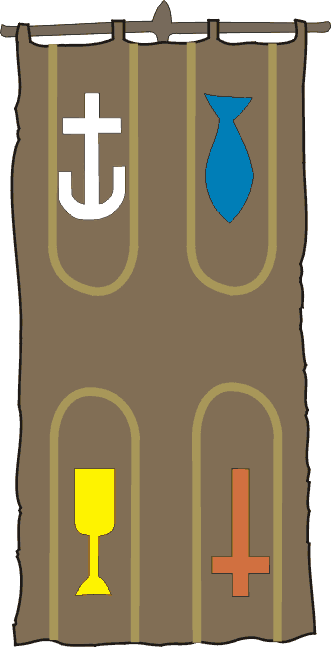 |
Calvary Presbyterian Church, Allenwood, NJ, USA (website offline) | A copy of the previous banner in another Presbyterian church. The site declares that the symbols, among which is an inverted cross with the familiar explanation, are “a simple reminder of the ESSENTIAL THEMES of the Christian faith” (original emphasis). |
| Graystone Presbyterian Church, Indiana, Pennsylvania, USA (graystonechurch.net) | It gives some data on the construction and meaning of the building. It also bears twelve plaques relating to the apostles -the place of Judas is occupied by Paul-; the plaques date from 1927. The site says: “The plaques -at the front of the Mack chapel- display traditional symbols painted in gold for each of the apostles. Peter: inverted cross with keys. Andrew … ” etc. | |
 |
Lookout Mountain Presbyterian Church, USA (website) | It offers a description of some elements of the parish temple. There is a series of shields with the symbols of the apostles. For Peter, the inverted cross and the keys, with the explanation we already know. |
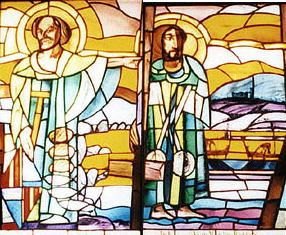  |
Anglican Church of Sts. Philip and James in Palma de Mallorca, Spain (website offline) | It offers abundant information about the community and the temple. The building has beautiful stained-glass windows dedicated to the twelve apostles and the symbols that usually represent them (the introduction page showed all the windows). When it represents Peter it does so in this way:
“His symbols are the Keys (which here form part of his vestments) and an inverted cross (because he felt unworthy to die like Christ, he asked that his cross be inverted, so that he might direct his gaze toward the heavens while he was crucified). This inverted cross is not immediately visible, since it is partly hidden by the bar dividing the two windows”. And with respect to the window of Philip the Apostle, to the left of Peter’s, it explains: “Philip is pointing with his left hand toward the inverted cross of St. Peter in panel 8”. In the photographs accompanying this paragraph can be seen the whole window and a detail with the two apostles mentioned and the inverted cross in the middle. |
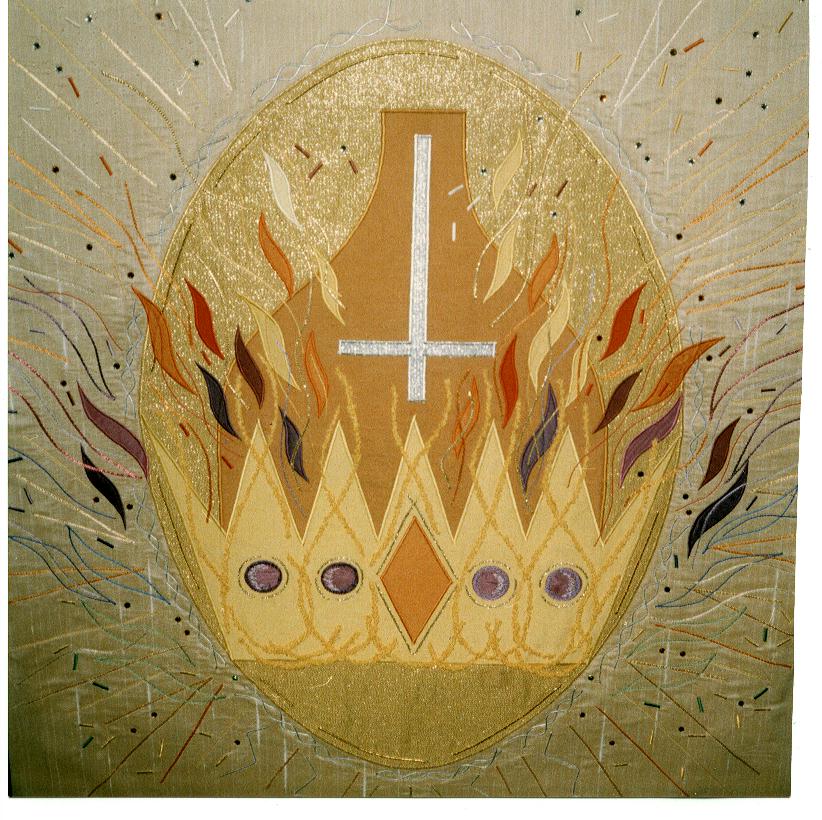 |
Anglican Church of St. Peter ad Vincula, Stoke on Trent, GB (formerly hosted at www.stoke1.org.uk ) | Speaking of that community’s temple, it says that the frontal of the main altar (note the importance of the place) bears a design rich in symbolism. The site explains that design in detail and among other things says: “In the upper part is the inverted cross of St. Peter, a sign of courage and fidelity, but also of humility; Peter thought he was not worthy to die in the same manner as Jesus”. A little earlier it had said: “The altar frontal was donated by a member of our congregation. It was created by Juliet Hemingray, one of the most celebrated designers of church objects in England: she produced all the vestments for the enthronement of the current Archbishop of Canterbury. To carry out the work, she made use of an original design suggested by the Rector of the church” (my emphasis). |
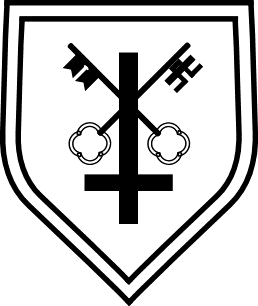 |
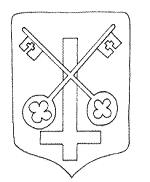
Anglican Church of St. Peter in Harborne, diocese of Birmingham, GB (formerly hosted at www.st-peterscofe-jun.bham.sch.uk) | A shield can be seen with the keys and the inverted cross, which was also repeated on the old site belonging to the parish school. In that same church there is a processional cross donated in the year 1925. It has a central piece in enamel with symbols of the passion, “also the crossed keys and the inverted cross, elements which are found in many parts of the Church as symbols of St. Peter”, the site explains, giving the reasons we already know. All this information could be seen on this page, www.st-peterscofe-jun.bham.sch.uk, belonging to the church (now offline). |
| Baptist Church of Hyde Park, Illinois, USA (website). At present the church is Unitarian |
In the windows of the upper part there is a rich symbology, in particular referring to different forms of crosses. As that website explains, we also find an inverted cross: “Beginning on the western side we find: the Cross of Peter, the cross of his martyrdom (because he was crucified upside down); etc”. The temple was built by and for the Baptist church, according to the website; with the passage of time it changed denomination (Unitarian). |
|
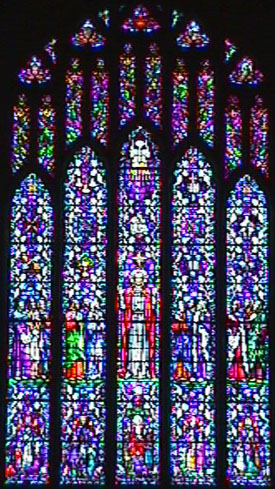 |
Broadway Baptist Church, Fort Worth, Texas, USA (website) | The site presents a photograph of the enormous stained-glass window called “of the Great Commission”, alluding to Christ’s command to preach the gospel to the whole world. “It takes hours to appreciate all the beauty of this window”, says the website. As regards our interest, there is an allusion to Peter at the far left of the work; above the Apostle there is an inverted cross and the keys. The Baptist site explains: “Below is the symbol of Peter, the inverted cross and the crossed keys […] Tradition says that Peter asked to be crucified upside down because he did not feel worthy to die in the same manner as his Lord.” The photograph I publish here, taken from the site in question, allows the symbols to be seen only with considerable difficulty. |
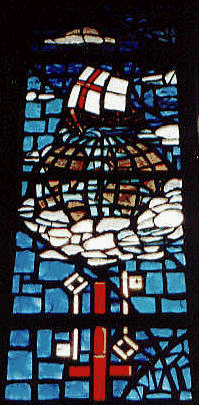 |
Christian Church Disciples of Christ of Cleveland Heights, Cheektowaga, NY, USA (website offline) | The temple was built in the sixties, but the stained-glass windows of the central nave were installed in 1980. There are twelve windows referring to the twelve apostles. Regarding the window corresponding to Peter, the webmaster explains: “Peter is represented by the inverted cross and the keys. The Universal Church is represented by the earth, set amid storm clouds, and by a ship in the midst of a stormy sea”. |
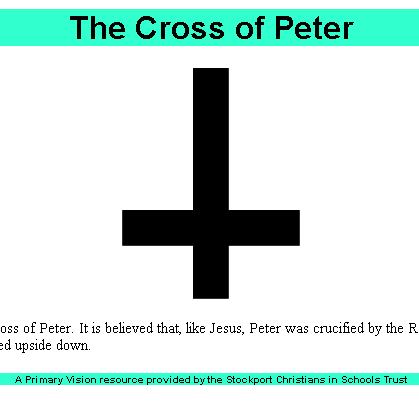 |
Site Christians in Schools, of the Anglican, Baptist and independent evangelical churches, GB (formerly hosted at www.cist.org) | The site “Christians in Schools” offered resources in English for Christian teaching and witness in the schools of the region of Stockport, Cheshire (England). Among the numerous resources is the explanation of Christian symbology, and also of our inverted cross. It is called the “Cross of Peter”, and carries this explanation: “The inverted cross is frequently known as the ‘Cross of Peter’. It is believed that Peter, like Jesus, was crucified by the Romans; but he thought it would not be fitting to die exactly like Jesus, and so he asked to be crucified upside down”. This testimony seems to me particularly interesting because it consists of school-level resources for the schools of England approved by the authorities of that region -it is not material proposed by one or two individuals- and, above all, because the authors of these educational resources are “a group of Christians of various denominations, including the Anglican, Baptist and independent evangelical churches in the region of Stockport, England, United Kingdom”, as writes David Scott, Treasurer and Administrator of the educational partnership.
This information about the Petrine use of the inverted cross by Baptist communities, in this box and in the previous ones, I consider particularly interesting given that Mr. Sapia, the principal promoter -in the Spanish-speaking world of the Internet- of the satanist reading of the inverted cross, himself belongs to the Baptist evangelical church “Rey de Paz” (“King of Peace”), in the city of Buenos Aires, of whose website he is the administrator. |
 |
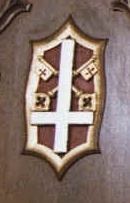
Site Church Schools, providing assistance to Christian schools, GB (formerly hosted at www.churchschools.co.uk) | It is dedicated to providing assistance to teachers and administrators of the schools of the Christian churches in Great Britain. The site is of professional caliber and belongs to the National Society. It is also said there: “All the material contained has been written by church school teachers and experts in church school administration, including diocesan education staff and legal advisers”. And also: “This site has been approved by the National Grid for Learning” (National Grid for Learning, a governmental entity –NGFL-). Among the abundant material is a page with Christian signs, and among them the inverted cross with the keys. And it is explained: “The symbol of Peter shows an inverted cross and two crossed keys”. The material is taken from the publication “Teaching Christianity at Key Stage 2”, in use in the Christian schools of that country. |
 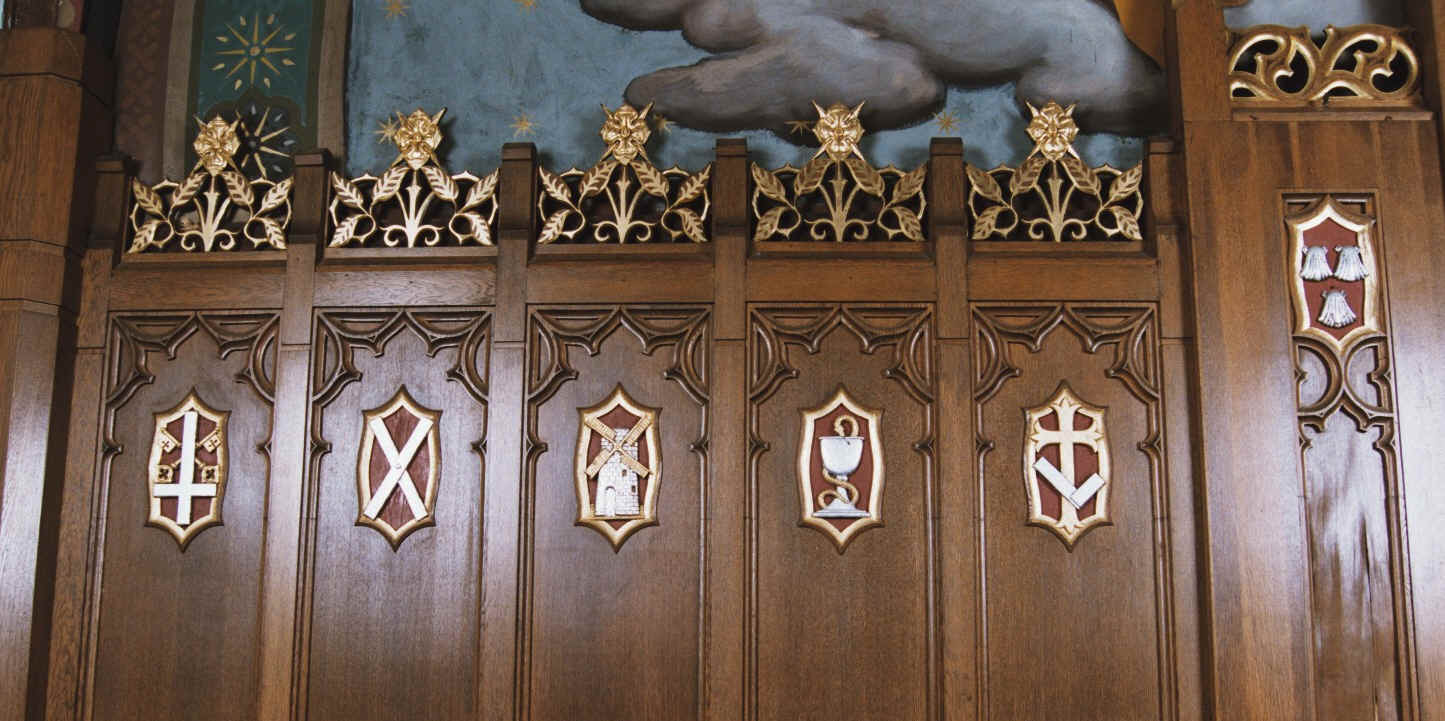 |
Catholic Chapel of the Immaculate Conception, Seton Hall University, USA (website currently offline) | In the sacristy of that chapel there is a beautiful oak cabinet with shields of the apostles. Peter’s bears an inverted cross and the keys. |
 |
Catholic Church of St. Peter and St. Paul in Waterloo, IL, USA (website) | The temple has on its entrance doors the signs of the apostles Peter and Paul: Paul’s is a sword, Peter’s is an inverted cross. |
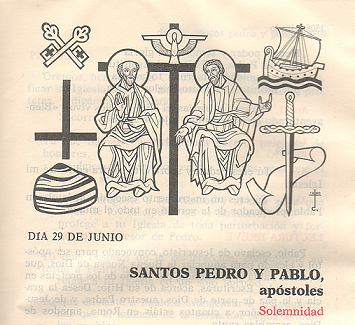 |
Liturgy of the Hours (Catholic Breviary), published by the Argentine Episcopal Conference, vol. III (1997) p. 1507 | In the breviary used by priests and religious for their daily prayers in Argentina can be seen the illustrative engraving for the feast of the apostles Peter and Paul (June 29). The design, made in 1980, presents the two glorious apostles on either side of the Cross of the Lord, above which a dove recalls the Holy Spirit. The signs of Paul are a boat -his apostolic journeys- a sword -he was beheaded in Rome, according to tradition- and a scroll -his writings; the symbology of Peter is represented with the keys, a rock -both images taken from Mt 16:18- and the inverted cross. |
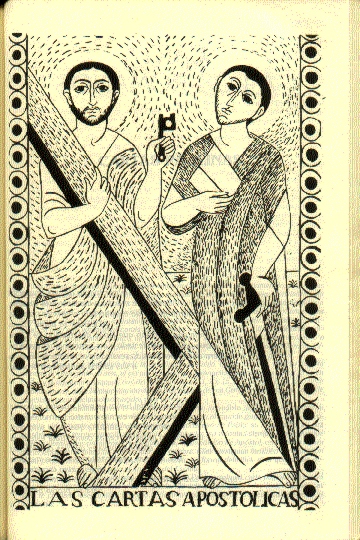 |
El Libro del Pueblo de Dios (Bible), Argentine Catholic version of the Scriptures, 18th edition, January 1998. | An engraving referring to the apostles Peter and Paul is displayed, introducing the apostolic letters. In it, Paul holds a scroll -his writings- and a sword -his martyr’s death by beheading, according to tradition; Peter is seen with a key -on account of Mt 16:18- and an inverted cross. After a brief introduction to the work, the Argentine edition of the Scriptures notes that “The illustrations of this Bible have been kindly provided by their authors, the Argentine artists Raúl Soldi (Old Testament) and Norah Borges (New Testament).” |
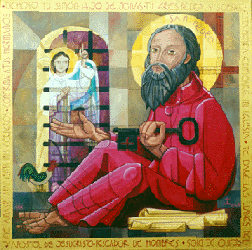 |
Catholic diptych “Paul and Peter” (formerly hosted at www.churchforum.org/arte/arc-sanpedro.htm) | Says the website where the painting can be seen:
“The work is the 2nd part of the diptych “Paul and Peter”, designed by Fray Gabriel O.S.B. and executed by Jaime Domínguez during December 1995 and January 1996 in the workshop of Contemporary Religious Art. The symbology corresponding to St. Peter is found everywhere in this work: the Rooster, the Key of Heaven, the Epistles and the inverted Cross.” [Upper right corner] |
 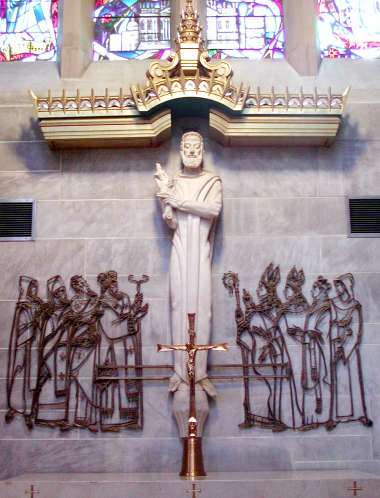 |
Catholic Cathedral of Mary Our Queen, in Baltimore, MD, USA (website) | There is an altar made with the motif of Peter, visible in the upper photograph to the left of this paragraph. Among several other symbols, as the cathedral’s site explains, an inverted cross can be made out behind the main statue (note the lower crossbar). All the sculptures of the cathedral date from 1954-1959.
In the same cathedral there is a stained-glass window with the same motif, visible in the second photograph. |
| Catholic Church of the Holy Name of Mary in Valley Stream, NY, USA (website) | There is a symbolic representation of the Twelve Apostles on twelve columns in the presbytery. Peter is represented with the inverted cross and the keys. The work dates from 1954. | |
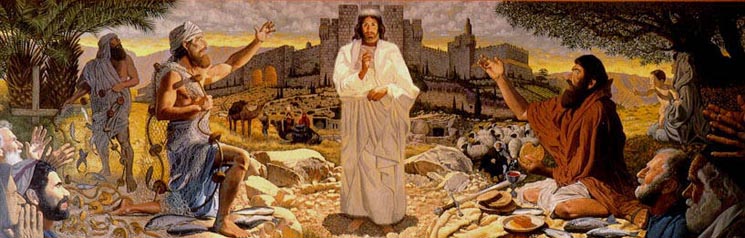 |
Catholic Church of the Apostles Peter and Paul, Bradenton, Florida, USA (website) | It presents a mural in which Christ appears after his Resurrection, surrounded by many symbols, landscapes, and biblical figures. On that same website it is explained who made the mural, how he did it, and many other details -for example, that it is four meters high by thirteen long. In the mural appear the symbols of the martyrdom of the Apostles who give the parish its name. Paul appears symbolized by a sword -on which the artist even designed the seal of Caesar Augustus Nero- while Peter is symbolized by an inverted cross, which can be seen at the far left of the mural. |
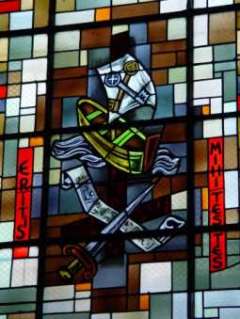 |
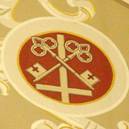
Catholic Church of Saint Léger ND de Boulogne, Lens, France | The stained-glass window presents several Petrine and Pauline themes: the boat of Peter upon the waves, the keys and an inverted cross (in the background, occupying the whole design); of Paul can be seen a sword and a scroll. Each element is explained on that parish website. |
 |
Catholic Church of the Most Holy Trinity, Augusta, Georgia, USA (website) | On one of its interior arches the temple represents the twelve Apostles of the Lord through their symbols. For Peter appears an inverted cross with the keys. |
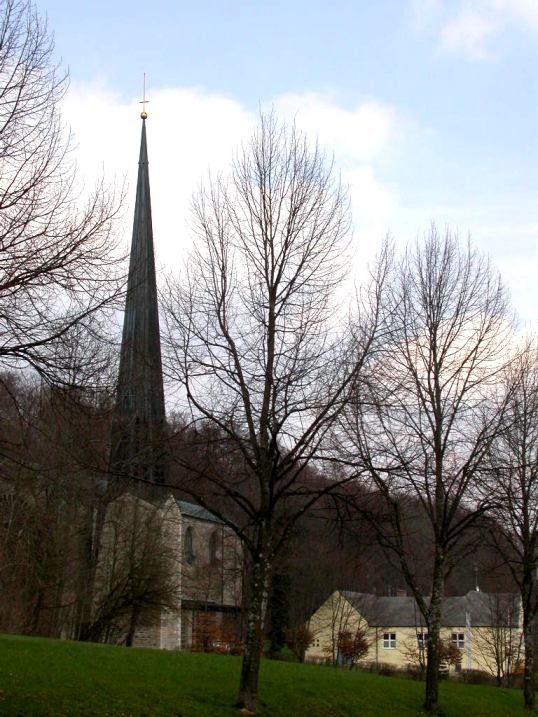 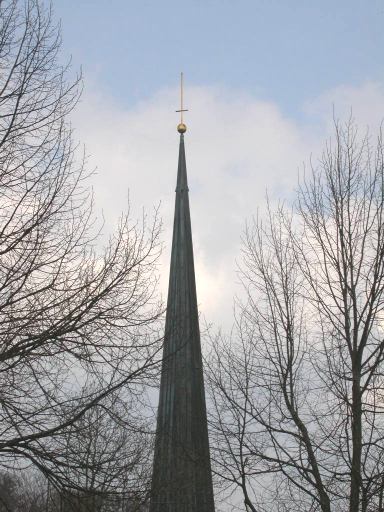 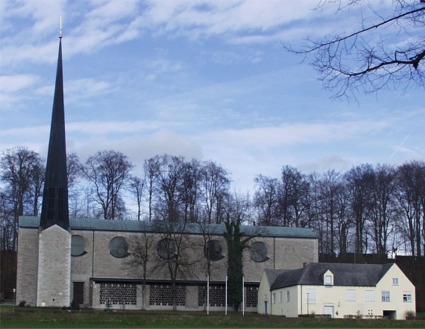 |
Catholic Church of St. Ulrich in Söcking, Bavaria, Germany (website) | The temple’s tower bears an inverted cross. We read on that parish’s website: Ihr 56m hoher Turm wird als Besonderheit von einem Petruskreuz bekrönt (Der Apostel Petrus wurde mit dem Kopf nach unten gekreuzigt, weil er aus Ehrfurcht nicht genauso wir Jesus sterben wollte), which means, in brief, that the tower has an inverted cross of St. Peter, in accordance with the tradition of his death upside down. The photos on the left are courtesy of Wolfram Zucker, of the parish of St. Ulrich. |
 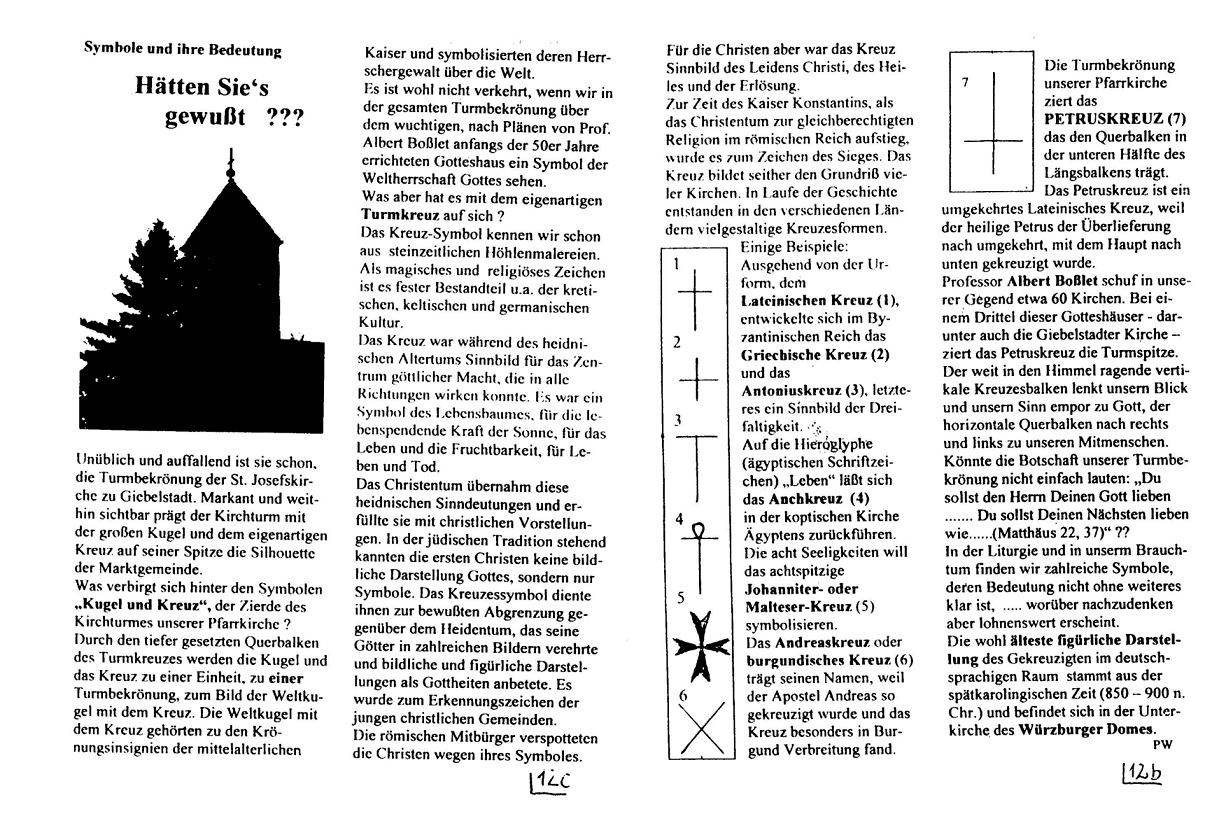 |
Catholic Church of St. Joseph, Giebelstadt, Bavaria, Germany, and some twenty churches in that region. | In the photocopy I publish here -upper photo- it is said that some twenty churches in Bavaria have on their towers an inverted cross of Peter, or “Petruskreuz”. The datum reached me from the municipal administration of the town of Giebelstadt, Germany. It is a leaflet published there commenting on the meaning of the various crosses visible on some churches. In it one can even see the tower of the parish of St. Joseph -of Giebelstadt- with its inverted cross (the quality of the photocopy is not good, but clear enough to make out that cross). In the leaflet several types of crosses are drawn, among them an inverted cross, and we read: “The cross crowning our parish church bears a Cross of Peter […] which is an inverted Latin cross, in accordance with the tradition of the death of Peter upside down. Professor Albert Bosslet built in our province some sixty churches; in a third of these churches -among which is our own- the towers bear a Cross of Peter”. I have not been able to ascertain whether all those churches are Catholic, or also of other denominations.
Professor Bosslet was a renowned German church-building architect (1883-1957); his work extends throughout the country. The churches we mention here were built in the first half of the 20th century. See in the lower photo the specialized bibliography used in the preparation of the leaflet. |
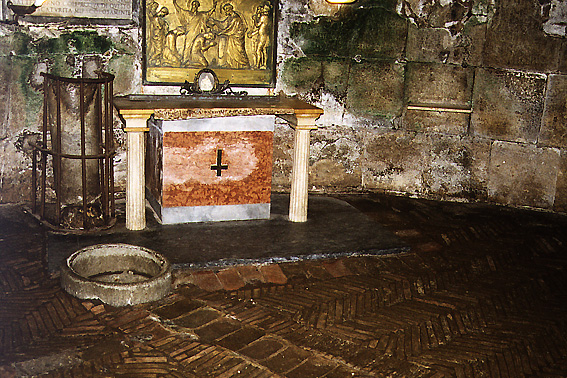 |
Catholic Chapel in the Mamertine Prison, Rome, Italy (website) | In this place, where Christian tradition locates the cell in which Peter is said to have spent his last days before being martyred, there is an altar, on whose front side can be seen an inverted cross. |
| |
Catholic Church of St. Andrew, Antwerp (Belgium) |
We have already seen this image above as a testimony to the crucifixion of Peter in the inverted position. I repeat it here because it also has the important value of showing Peter not crucified, but embracing an inverted cross, that is, the sign of his passion. Moreover, he carries the keys in his hands. The work dates from 1648. Was the use of the sign at John Paul II’s celebration in the Holy Land 350 years later a novelty? |
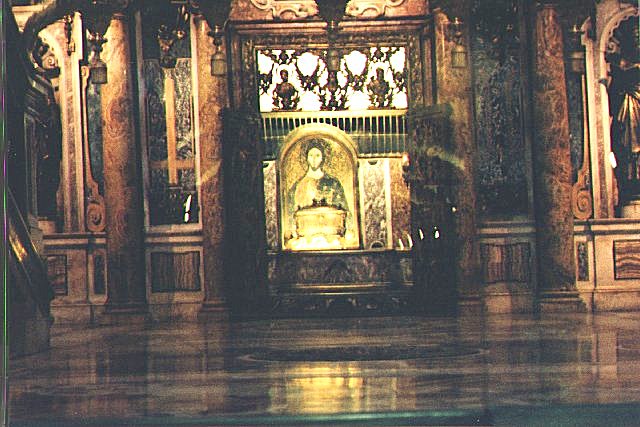 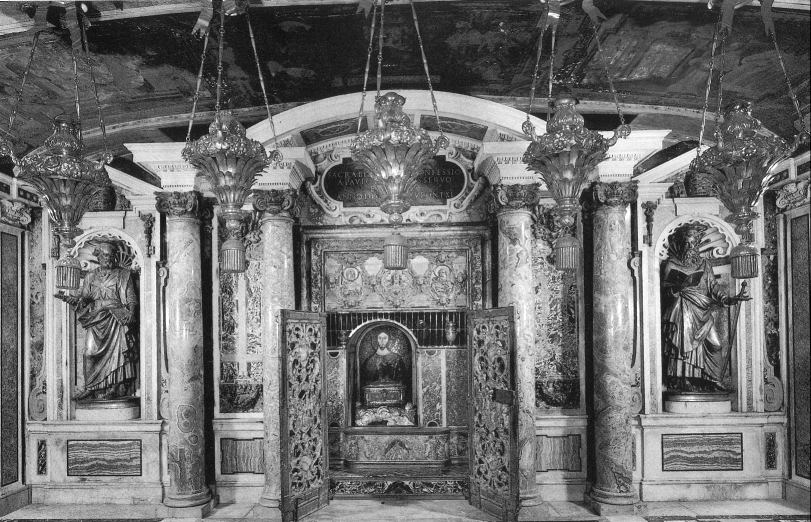 |
Catholic Chapel beneath the main altar of St. Peter’s Basilica, Vatican City. | A testimony I consider particularly interesting is the sign of the inverted cross beneath the High Altar of St. Peter’s Basilica in the Vatican: the High Altar is the one under the famous baldachin of Bernini, at the center of the basilica. Beneath that altar there are many chapels, among them the one guarding the bones which, it is believed, are those of St. Peter: the Apostle is said to have suffered martyrdom a few meters from there, crucified upside down as tradition hands down to us, and to have been buried in that place. In the photos I present here can be seen that chapel and the detail of the inverted cross, between the statue of Peter (to the left of the chapel) and the central icon of the Christ.
The chapel with its sculptures and marbles is the work of the famous architect and engineer Carlo Maderno, who was the chief architect of the renovations made to the basilica by Paul V, and also of the current facade. The inverted cross seen there was placed in that spot between the years 1607 and 1617. It should be noted that this chapel, with the icon of Christ, the inverted cross, and the statues of the princes of the Apostles, is clearly visible from the upper floor of the basilica, for it is an open chapel connected to the upper floor by two staircases, so that the thousands of pilgrims who come to that place daily can appreciate it without even descending to the lower level; one may also descend to it -most pilgrims do- and thus see the chapel from the level at which the photographs were taken. Since it was placed there, 32 popes and millions of people in the nearly four hundred years that separate us from that date have passed before the symbol of Peter. The black-and-white photo and the data on the workmanship I take from Der Vatikan, Goldene Jahrhunderte der Kunst und Architektur, by Maurizio Fagiolo dell’Arco, Augsburg 1989, pp. 172-173, a specialized work that goes step by step through the most outstanding places of the Basilica. It is a translation of the original: L’Arte dei Papi, published by Arnoldo Mondadori, Mailand. |
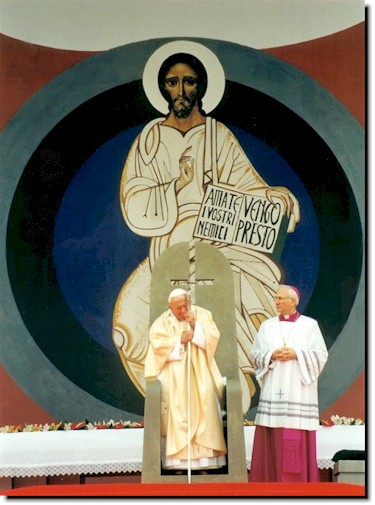 |
Altar for the celebration of Holy Mass on the Mount of the Beatitudes, Holy Land, March 2000. | The Pope, successor of Peter, celebrates Holy Mass a few kilometers from the house of Peter in the Holy Land. The person charged with designing the altar, among other liturgical signs, used this one of the cross of Peter on the papal chair. As the reader can infer, doing so was no novelty at all.
Tracking down information about that celebration, I obtained the datum as to who made that chair: it was Fr. Eduardo Ricoboni, of the Neocatechumenal movement. The celebration, in fact, was organized in its entirety by this ecclesial movement, which among other things laid in those days the foundation stone of a retreat house at the foot of the Mount of the Beatitudes. Fr. Ricoboni, besides being a priest, is an artist. I was able to contact him by telephone on February 13, 2003. I asked him whether he had been involved in the organization of the event, and he answered affirmatively. I told him that I was doing a study on the symbology of that celebration, and asked whether he could explain a little to me, to which he agreed most gladly. When I mentioned the chair and the design of the cross -without giving him any advance warning- he answered me: “The idea was Kiko Argüello’s [the founder of the movement] and it refers to the death of Peter; the whole liturgical setting was designed by him, I limited myself to executing it”. I told him what “was being said” about that chair; he laughed at it and replied: “The devil has nothing to do with this; it is about the death of Peter”. This is the testimony of the man who built the chair. So we know positively what the real meaning of the sign is. Whether or not Kiko Argüello had reasons for that design, the reader can see in everything I have set forth thus far. But there is more. |
V. Examples of the Petrine -not satanic- use of the symbol in secular settings and its recognition in reference works.
| Image | References | Comment |
| History of the Christian Church, Vol. II, chap. VI, § 77, by Philip Schaff (website). The digital edition depends on the paper work of 1910. The original work is from 1882.
I have personally seen the paper work of 1889, published in New York. The data in that edition are in volume 2, p. 270, note 4, and correspond perfectly with the digital edition I cite here. I have been able to consult a part of the bibliography cited by Schaff, but nothing that adds anything substantial to our subject. The other bibliography, which I have not been able to see, is very difficult to consult. But I do not lose hope of continuing the research. |
In his History of the Christian Church the eminent Protestant historian treats the subject of Christian art, and in particular of the cross and its representation in the first centuries. He says among other things: “Shortly after Constantine’s victory over Maxentius with the aid of the Labarum [the standard bearing the cross] (year 312), crosses appeared on helmets, shields, standards, crowns, scepters, coins and seals, in various forms. [Here Schaff adds a note which says:] The archaeologists distinguish seven or more forms of crosses: This testimony is very important for several reasons, but above all: a) the author is a Protestant and the work is a serious one; these are the sources consulted by Schaff for the specific subject of the cross, as they appear on this website: JUSTUS LIPSIUS (R.C., d. 1606, as Prof. at Louvain): De Cruce libri tres, ad sacram profanamque historiam utiles. Antw., 1595, and later editions. JAC. GRETSER (Jesuit): De Cruce Christi rebusque ad eam pertinentibus.Ingolst., 1598–1605, 3 vols. 4to; 3rd ed. revised, 1608; also in hisOpera, Ratisb., 1734, Tom. I.-III. WM. HASLAM: The Cross and the Serpent: being a brief History of the Triumph of the Cross. Oxford, 1849. W. R. ALGER: History of the Cross. Boston, 1858. GABR. DE MORTILLET: Le Signe de la Croix avant le Christianisme. Paris, 1866. A. CH. A. ZESTERMANN: Die bildliche Darstellung des Kreuzes und der Kreuzigung historisch entwickelt. Leipzig, 1867 and 1868. J. STOCKBAUER (R.C.): Kunstgeschichte des Kreuzes. Schaffhausen, 1870. O. ZÖCKLER (Prof. in Greifswald): Das Kreuz Christi. Religionshistorische und kirchlich archaeologische Untersuchungen. Gütersloh, 1875 (484 pages, with a large list of works, pp. xiii.-xxiv.). English translation by M. G. Evans, Lond., 1878. ERNST V. BUNSEN: Das Symbol des Kreuzes bei alten Nationen und die Entstehung des Kreuzsymbols der christlichen Kirche. Berlin, 1876. (Full of hypotheses.) HERMANN FULDA: Das Kreuz und die Kreuzigung, Eine antiquarische Untersuchung.Breslau, 1878. Polemical against the received views since Lipsius. See a full list of literature in Fulda, pp. 299–328. E. DOBBERT: Zur Entstehungsgeschichte des Kreuzes, Leipzig, 1880. This is specialized literature; fundamentalist fantasies are excluded here. b) the inverted cross is counted among the forms of the cross used after the fourth century, according to the data of archaeology. From this we may conclude that the inverted cross was used during the first Christian millennium as a sign of Peter. |
|
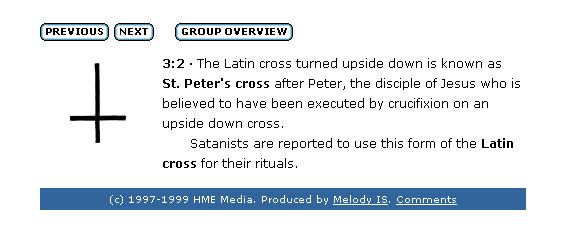 |
Website Symbols, digital version of the Encyclopedia of Symbols Thought Signs. The semiotics of Symbols. Western Non-pictorial Ideograms by Carl G Liungman (website) | The site presents abundant and serious material on symbols. Also the inverted cross, about which it says: “The inverted Latin cross is known as the cross of St. Peter, in honor of Peter, the disciple of Jesus who is believed to have been executed by crucifixion on an inverted cross. The satanists, it is claimed, use this form of the Latin cross for their rituals.” (It can be seen here)
The text sums up the situation very well: the inverted cross is of Christian origin and refers to the death of Peter upside down, according to the ancient tradition; at some point in history the followers of Satan began to use this symbol to represent their aversion to Christ. I think it opportune to note that, although both the cross “of Peter” and the “satanic” cross have the same shape, the symbolic value of the two is nevertheless opposed: if the inverted cross is used in relation to Peter on account of his death crucified upside down, then it carries a Christian value; the reason for that use across the broad spectrum of Christian churches has been sufficiently proven in this article. It is no longer “the Pope” who uses the sign; it is all the great Christian denominations. If the inverted cross is the cross of Christ turned upside down, that is, a contempt for Christ, then it carries an anti-Christian value. The satanists do not intend to display the cross “of Peter” in their dark rituals, do they? In the same way, Christians (Catholics, Anglicans, Methodists, Presbyterians, Orthodox, Evangelicals, Baptists) do not intend to display the “satanic” cross in their Christian worship. Everything is resolved by considering the context in which the sign is found. The important thing about this article is to give the reader the natural context of the sign in a Christian celebration. |
 |
Site Symbols in Christian Art & Architecture maintained by Walter Gas, an elder of the Presbyterian Church, Dallas, TX, USA (website currently offline
) |
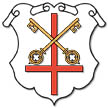
This site, specialized in Christian symbols and based on a remarkable thematic bibliography, carries twelve emblems corresponding to the twelve Apostles. For St. Peter the emblem bears the inverted cross and two keys. |
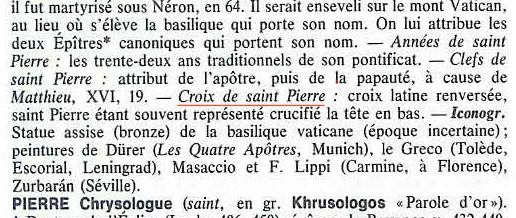 |
Dictionary of Names Le Petit Robert (2nd edition), Paris, 1990, page 1420. | Under “St. Peter” we read, among other things: “Cross of St. Peter: the inverted Latin cross, since Peter is frequently represented crucified with his head downward”. |
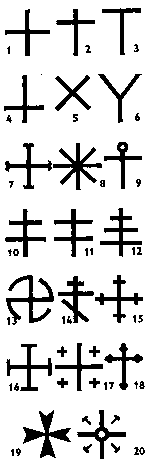 |
Símbolos, from Diccionarios Rioduero, Madrid 1978. Pp. 70-71 (website currently offline) | A chart can be seen with several crosses, among them an inverted one (number 4). The dictionary defines it as “of St. Peter”. |
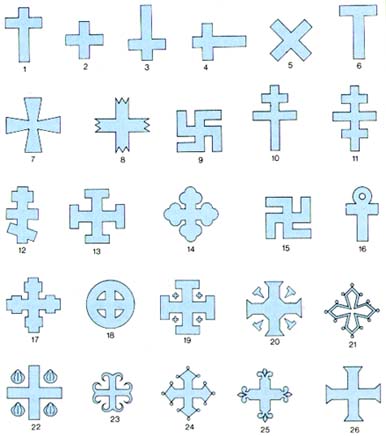 |
Larousse Encyclopedia (website currently offline) | On the web page where I found the design no further data are given; I hope to track down the work. At cross number 3 of the design (inverted cross) we read “of St. Peter”, according to the webmaster’s information. See the next box. |
| Encyclopedic dictionary Larousse du XXe Siecle, volume II, Paris, 1929, p. 595. | Under the term “Croix” it carries the following observation: “The four-ended cross, when it is crossed in the form of an x, is called of St. Andrew; when it is inverted it is called of St. Peter; etc.” The work therefore acknowledges that an inverted cross is identified as being “of St. Peter”, for the reasons evident in this article. Note the date of publication of this work: 1929.
Larousse repeats these data in later editions, not in all, but certainly in the major ones. For example the Grand Larousse Encyclopédique, vol. III, Paris 1960, p. 674 (term “Croix”). |
|
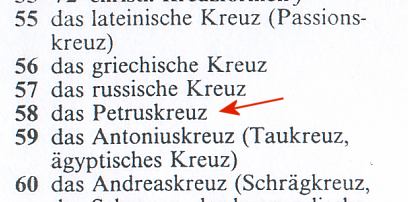 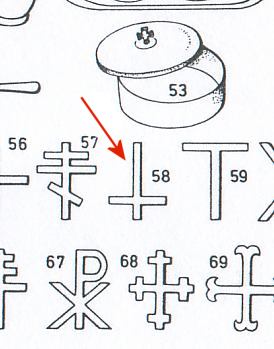 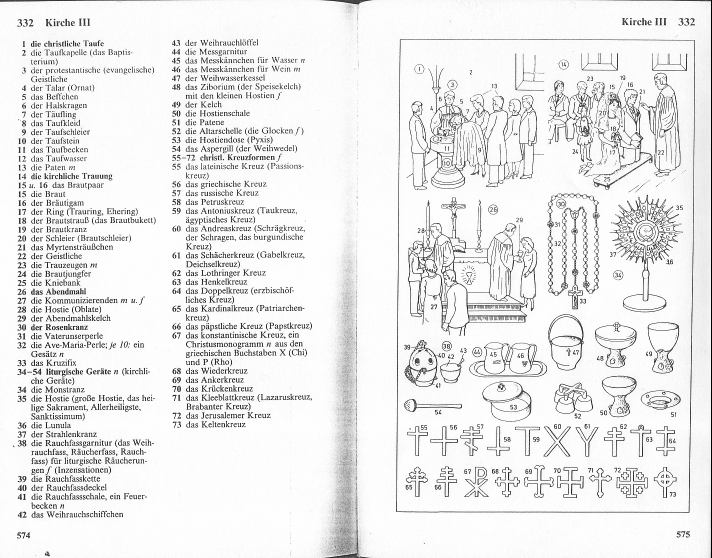 |
DUDEN Bildwörterbuch der deutschen Sprache(Picture Dictionary of the German Language) Mannheim, Leipzig, 1992. | The DUDEN collection, in German, is world-famous, and can be found in any good library. Volume IV is a pictographic dictionary. On pages 574-575 there is a diagram with church elements and numerous crosses, among which is seen an inverted cross whose reference reads: “Petruskreuz” (cross of Peter). |
| Grande Dizionario Illustrato dei Personaggi Biblici, by Martín Bocian, PIEMME 1991, p. 498. | Speaking of the Apostle Peter, the work -which is an Italian translation of the German original- notes the following: “From the 14th century onward the staff of Jacob, with three transverse crossbars, is a sign of the Petrine papacy, while the inverted cross indicates the martyrdom of Peter”. The text allows us to understand that the inverted cross has been used as a Petrine sign since the 14th century, although it provides no further data. | |
| Evangelisches Kirchenlexikon(Evangelical Church Dictionary)Göttingen, 1958, column 960. | This testimony is also of particular importance, because it is a specialized work of great scope (four volumes of large size and very small print…) prepared by the Evangelical Lutheran church.
Under the term “Kreuz” we read, among other things: “The Latin cross, when it is upside down, is the infrequent cross of Peter (see for example the painting by Holbein the Elder)”. |
|
| Der Grosse Herder (The Great Herder [Dictionary]), volume 5, 1954, column 786. | In this encyclopedic work in nine volumes, under the term “Kreuz” there are several designs of crosses. The design bearing the number 4 is an inverted cross, which the work calls the “Cross of Peter”. | |
| Wetzer und Welte’s Kirchenlexikon (Church Dictionary of Wetzer and Welte), 1891, col 1055. | This enormous work (thirteen volumes) shows, under the term “Kreuz”, several forms of crosses, among others an inverted cross. In the explanation of the graphics we read “N. 6: the inverted cross is known as the Cross of Peter”. | |
| Dictionnaire des Symboles, Emblemes & Attributes(Dictionary of Symbols, Emblems and Attributes) by M.P. Verneuil, Paris (undated, but from the end of the 19th century), p. 143. | The work is specialized in symbols. Under the term “Pierre, Saint” (St. Peter), after giving several symbols that represent the Apostle (keys, lamb, chains, etc), it says: “8th: The cross, instrument of his torment, because he was crucified upside down”. | |
| Christliche Symbole(Christian Symbols), by Oscar Doering, Freiburg im Breisgau, 1940, p. 160. | The author speaks at length of the symbols of the apostles. Of Peter he says that “he is represented by one or two keys, also a staff (because he is like a second Moses), or a cross-staff, as well as a tiara, a cross with the crossbar toward the bottom, a rooster”. | |
| Iconographie de l’Art Chrétien (Iconography of Christian Art), by Louis Réau, volume III, Paris, 1959, p. 1084. | A highly specialized work, in six thick volumes, published by the University Presses of France. The author has to his credit 18 works on iconography, several of them in multiple volumes. On the page indicated, speaking at length of the iconography of Peter, he enumerates several symbols such as the keys, the boat, the fish, the rooster, the chains, and then “the inverted cross, which evokes his crucifixion upside down”. | |
| Lexikon der Christlichen Ikonographie (Dictionary of Christian Iconography), by Kirschbaum-Braunfels, volume 8, Rome, 1976, column 161. | This is a specialized work on Christian iconography in many volumes. To the Apostle Peter the work devotes nine pages; among many other things it says that his attributes are the keys, a scroll or book, a staff in the form of a cross, “the inverted cross, as a sign of his martyrdom”, etc. | |
| Lexikon der Christlichen Ikonographie (Dictionary of Christian Iconography) by Herder, volume 2, 1970, column 569. | The work is a specialized one (eight volumes on Christian iconography). It devotes an article to the different forms of crosses, among which “The cross of Peter, which has the horizontal bar in the lower half of the vertical bar”. The work also presents a design with several crosses, where number 14 is an inverted Latin cross, indicated as the “Cross of Peter”. | |
| Dictionary of the Middle Ages, vol. 4, New York, 1984, p. 9. | It explains several forms of crosses, among others: “The cross of Peter, the one whose upper arm is longer than the other three (an inverted Latin cross), so called because St. Peter was crucified upside down”. On pages 10 and 11 several designs of crosses are shown, among them the inverted cross, with the name “Peter Cross”. | |
| Gran Enciclopedia RIALP, vol. VI, p. 776. | Under the term “Cruz” there is a design with many forms of crosses. Also an inverted cross (number 16) which the encyclopedia calls “Of St. Peter”. | |
| Brockhaus Enzyklopädie, vol. 12, p. 481. | This enormous and important German encyclopedia, under the term “Kreuz” (cross), says: “Besides these fundamental forms of crosses [which the encyclopedia has already mentioned] there are numerous variations or special forms, such as the cross of Peter (after the Apostle Peter, who wished to be crucified upside down), which consists of an inverted Latin cross”. | |
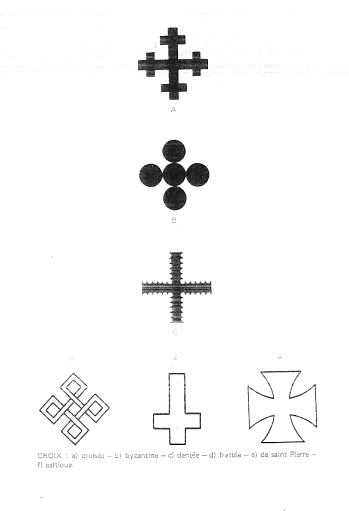 |
Symboles, signes et marques (Symbols, signs and marks) by Georges Nataf, Toulouse, 1973, p. 154. | Likewise a work specialized in symbology, it carries several charts with forms of crosses; in one of those charts -see the photograph- appears an inverted cross, and the work explains that it is the “cross of St. Peter”. |
| Study by the Andalusian Institute of Historical Heritage | The study carried out at the request of the “Hermandad de la Redención” (Brotherhood of the Redemption) with the aim of clothing the Apostles of Jesus for the “paso de Cristo” (processional float of Christ), concludes as follows: “St. Peter. Identifying symbols: keys, rooster, chains, inverted cross, crozier, tiara and cross with triple crossbar”. Which means that after a study of the history of art relating to Peter, the Andalusian Institute of Historical Heritage concludes that the inverted cross is a sign of the Apostle. | |
| Museum of the Benemérita Universidad Autónoma de Puebla, Mexico (website) | On that university’s site, under the heading “culture”, the University Museum is presented among other things, and some of the works found there are described. After a description of a painting of the Apostle Peter, the site adds for the information of visitors (my emphasis):
“Attributes of St. Peter: They are one or two keys of the kingdom, one for the heavens and another for the earth, which Peter received from Christ himself. An inverted cross which is the instrument of his martyrdom. The rooster, since he denied Jesus three times before it crowed. The boat, the net and the fish as a sign that he was a fisherman. Finally, tears of repentance for having denied his lord.” |
|
| Phil Phillips, Halloween and Satanism, Starburst Publications, Lancaster, PN, 1987 (website currently offline) | The author of the book says that, owing to the death of Peter upside down, “it was his cross that came to be a symbol of martyrdom in the early Church: the inverted cross.” The datum coincides with other well-sourced information that assigns the use of the inverted cross as a symbol of Peter to the times after Constantine (see above). Apart from the historical reference, this datum -like several others in this article- proves that the idea of the inverted cross as a symbol of Peter is no novelty at all and is widely diffused.
It may also be interesting for my reader to know that the website that publishes these texts is evangelical (at the end of the article it invites one to receive the Lord as personal Savior, to accept the Bible as sole authority, etc.). |
|
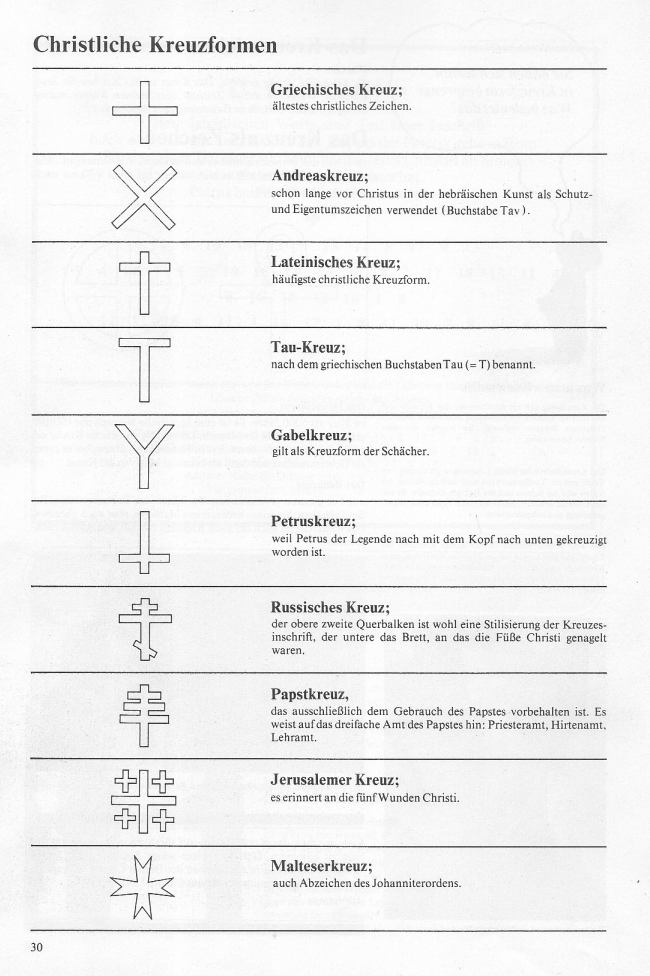 |
So bunt ist unser Glaube by Alexander Zieger, Leipzig, 1981, p. 30. | The work is a thick, highly illustrated volume, with information on the history, doctrine, structure, art, etc. of Christianity in general, and it was produced by the German Episcopal Conference. There is a page with designs of crosses and their respective explanations. Also an inverted cross, presented as the “Cross of Peter”, since “Peter, according to the legend, was crucified upside down”. |
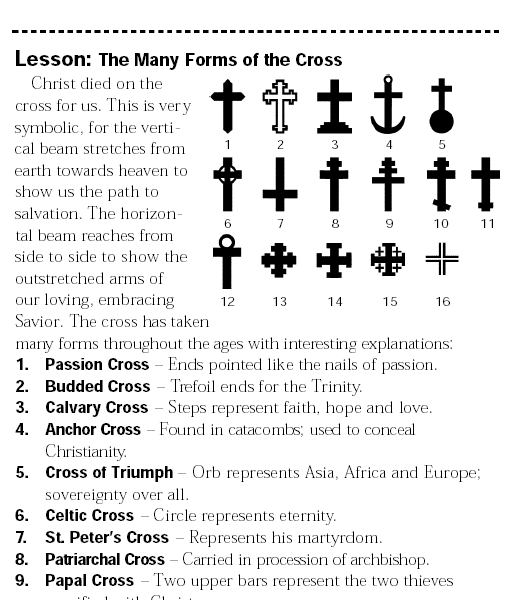 |
The Catholic Source Book, cited by FaithHelps, of Faith Magazine | This important reference work of the Catholic Church in the USA displays a series of crosses, among which an inverted cross (n. 7 in the design) with the respective explanation: “Cross of St. Peter: it represents his martyrdom”. |
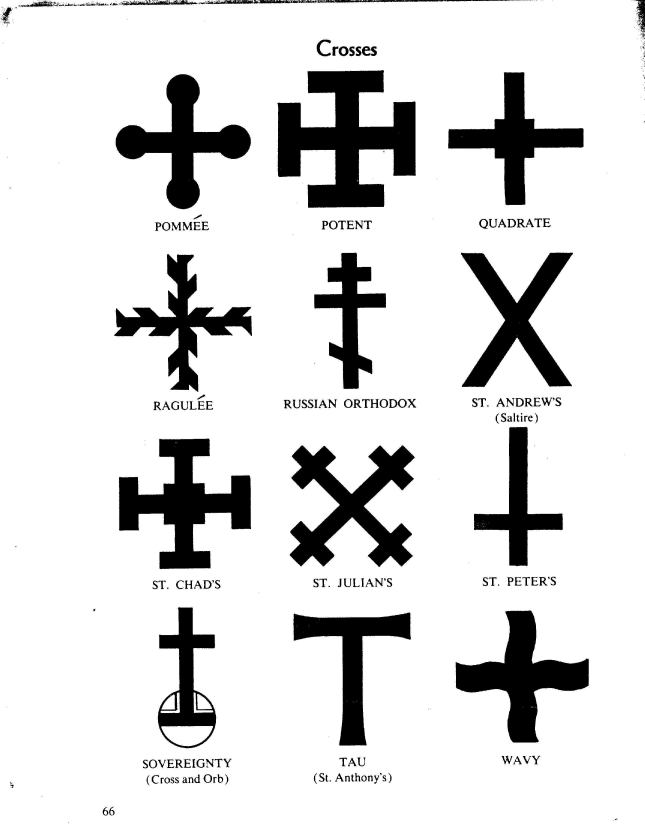 |
Saints, Signs, & Symbols, by W. E. Post, Morehouse Publishing (1974), p. 66. | In this work specialized in symbols we find the illustration seen here in the box on the left, with the inverted cross presented as “of St. Peter”. Walter Gas, an elder of the Presbyterian church, and without doubt a specialist in symbols (see above), says of this book:
“It is organized by categories such as crosses, stars, the church, etc. Very well illustrated. It includes a comprehensive chapter on the emblems of the saints. It also includes many rare symbols, difficult to find elsewhere. Particularly interesting for the study of Catholic symbolism”. |
 |
Site selling religious images (website) | Following the Christian tradition of representing Peter with an inverted cross, they offer a statue -of very dubious artistic beauty, I must say- in which Peter appears with the keys, chains and an inverted cross at his feet. |
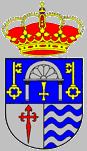 |
Coat of Arms of the Municipality of San Pedro de Mérida, Extremadura, Spain | It bears a golden inverted cross, as seen in the image beneath the arch. It is not a satanic sign but refers to Peter, who died upside down, whose name the municipality honors. |
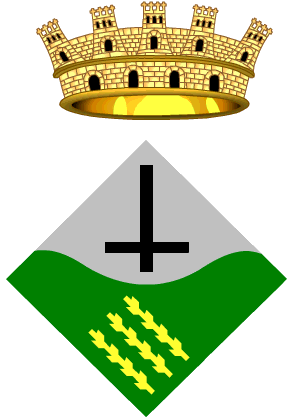 |
Coat of Arms of the Municipality of Esterri d’Aneu, Spain | On the shield stands out an inverted cross, which as the municipality’s official website explains represents the cross of Peter, “the primitive symbol given to the town as a sign of identification”. |
 |
Site of the International Catholic Stewardship Council (website) | A Coat of Arms can be seen with two crossed keys and an inverted cross, among other symbology. As those in charge of the site explain, these are “the insignia of Peter”. |
 |
Site Medieval Wares (website), Canada. | The site presents a craft organization specialized in the making of jewelry objects of a medieval character. Among its offerings are inverted crosses to be worn as pendants. According to the specialist, this is the “Cross of St. Peter, based on a crusader cross of the 12th century, found at Caesarea”. At the moment I have no opportunity to confirm this datum, but I will seek information. In any case, it is in harmony with the information in Schaff’s work (see above). |
Meanwhile, and with the aim of sustaining, far removed from all reality, a satanist key for interpreting the symbol used by John Paul II in the Holy Land, and of thus propping up their anti-Catholic prejudices, the promoters of so poor a cause propose to their readers over and over again:
| “it would not appear that the Inverted Cross forms part of any historical symbology of the Roman Catholic Institution”
Mr. Daniel Sapia |
A proposal which, for the same reasons, has had a surprisingly swift echo on the other side of the ocean:
| “that symbol is in no way a symbol of the apostle Peter, nor of Christians, and not even his papist church ever used that symbol to identify the apostle Peter, as you can verify in the Catholic Encyclopedia. THE INVERTED CROSS IS SOLELY THE SYMBOL OF INTERNATIONAL SATANISM, as brother Daniel Sapia has well demonstrated”
Mr. Tito Martínez |
Regarding the Catholic Encyclopedia mentioned by Mr. Martínez, I have commented on that “argument” in this place.
VI. Conclusions.
- These are elements I have been able to find to illustrate the subject, taken almost entirely from the Internet. One may suppose that the examples existing in reality number in the thousands.
- Of the numerous serious reference works I have cited here -more than twenty, Catholic, Lutheran, and non-confessional- only one mentions the satanic use of the inverted cross (though assigning it in the first place the Petrine meaning), while all the rest speak of the inverted cross simply as “of Peter”. Why?
- The tradition of Peter crucified upside down is acknowledged as such by all the great Christian churches. There exists no historical testimony that is serious -at least none that I know of- going against the most ancient tradition which affirms that Peter was crucified in Rome, upside down. There is evidence of its existence from at least the 3rd century, as can be seen throughout this article. The Catholic Church, for its part, never claimed to transmit this fact as an indubitable datum, or as though it were a dogma of the faith; she simply remembers the Apostles, and above all the testimony of their martyrdom, according to the data she preserves. Whoever does not wish to accept that tradition is quite free to do so, and it matters nothing for our purpose of explaining the origin of the sign.
- The satanic inverted cross and the Petrine inverted cross, though identical in shape, are absolutely opposed in origin and in meaning: one results from the inversion of the cross of Christ in mockery of him; the other results from the inversion by Simon Peter of his own cross in honor of Christ. The symbolism an inverted cross carries in a concrete circumstance is judged by the context: if it is in a Christian context, it is Petrine; if it is in an anti-Christian context, it is satanic. In any case, common sense must be used above all.
- The fact that the satanists make use of this sign because they see in it a rejection of the cross of Christ is a sad affair of their own. It is utterly ridiculous to think that the Christian churches must stop using this sign so that no one will believe those churches have turned satanic. Such a way of acting is foreign to any church that acts with a minimal share of the freedom of the children of God: the proof lies in the Petrine use of the symbol by all the churches mentioned above.
- The Pope’s accusers would seem to want to present us with a world in which the inverted cross with a satanic meaning is everywhere, heads public ceremonies, presides over school classrooms, rises upon the monuments in the squares, is displayed on every flag, opens every broadcast of the communications media…, in the way that the swastika cross -they suggest- was everywhere in Hitler’s Germany. This presentation is false.
- Why should a Catholic try to give “valid arguments for the use of the sign” when it is used in all the most important Christian denominations?
- We know positively the intention of the organizers of that Mass: it is the cross of Peter. With the foundation I have shown in this article, to doubt such a thing is an act of plain obstinacy, and is quite evidently based on prejudices, not on an interest in the truth.
- If I go to a gathering of satanists and see an inverted cross, what shall I think -that they are venerating the memory of the Apostle? If I go to a Mass presided over by the successor of Peter and see the inverted cross, what shall I think -that it is a contempt for Christ? Would that not be as ridiculous as the previous case? Would mine be a conclusion based on the meaning of the sign in its context, or on my preconceived ideas against the Pope?
- The anti-Catholic apologists of the web who published the material on the inverted cross either concealed or were ignorant of the information I present here: if they concealed it, they disqualify themselves; if they were ignorant of it, they acted immorally: it is immoral to accuse a person of nothing less than a form of satanism without informing oneself by every possible means about what one is talking about. Whoever publishes such an accusation on the Internet must know the subject thoroughly; otherwise he commits a grave sin of calumny.
- Those who published the satanist presentation of the papal chair ought to have known what I present in this article of mine, and ought to have informed themselves with certainty about the use of the symbol, in the same way that I was able to ascertain it in considerable detail: they were preparing to accuse, publicly and gravely, a person whose authority is very great for millions of people: ought they not to have informed themselves exactly before launching the accusation? How shall we define one who does not know what he could and should know?
- From now on no one will be able to deny that the inverted cross is a sign referring to the death of Peter upside down, a sign that represents a two-thousand-year-old tradition of the Church and that is used by all the great Christian churches down to our own day. Whether or not the Pope is the “workforce of the antichrist” will have to be ascertained elsewhere.
