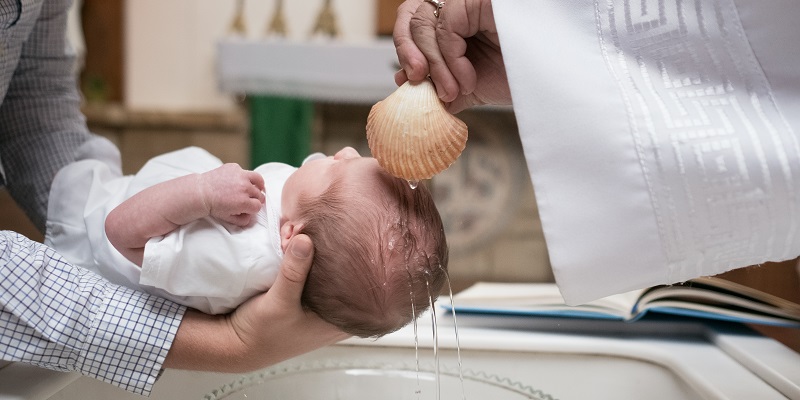
I recently became aware of an article written by Daniel Sapia (an amateur anti-Catholic fundamentalist on the Internet) in which he objects to infant Baptism. I wanted to make a copy and after studying it and identifying a large number of inaccuracies and contradictions, I decided to analyze it and synthesize some points in these few lines.
(Sapia’s full article can be found as usual on his websiteknoweisla Verdad.org)
Analyzing the comments:
I will place the comments on the Sapia article in a box with a background blue and the texts of the catechism, the Bible and other texts in depth green
| What are the biblical requirements for water baptism to be practiced?Can only those who meet these requirements be baptized?Is it biblical for someone to become a Christian simply by being baptized at birth? Is this the intention of the Catholic Church… Or are there other interests when baptizing children? It is important that we have no doubts regarding this doctrine. It is essential know what are the requirements essential that God enacted to be able to receive Baptism by water. Without these requirements, baptism has no spiritual value. and therefore, it does not cause the effects that we suppose and for which they want to make us trust that we are made children of God. |
With these few lines you can already see the purpose of Sapia’s study. It is not really about questioning infant Baptism and those who practice it as unbiblical, but specifically questioning the Catholic Church for it. This of course is due to the Catholic-phobia manifested in Sapia, which he has expressed on multiple occasions, even accusing Pope John Paul II of Satanism.
Sapia omits to mention (and I don’t think it’s out of ignorance) that infant Baptism is by no means practiced only by Catholics, it is also practiced by the Orthodox Church, the Catholic Anglican Church and a good number of Evangelical Churches among which we have none other than the Lutheran and Reformed (Calvinist) Churches. If Sapia really had a real intention to question what he considers false and not the Catholic Church, he would also make these churches the target of his attack, but when referring to them he affirms that their discrepancies are merely secondary because they are united in the same spirit.
Sapia is one of those who insistently defend that the differences that exist between evangelical churches are merely “secondary“(he loves to cover the sun with one finger), however we see him here confessing that the doctrine on baptism is fundamental. And so do the other Protestant confessions who do not hesitate to place a large number of anathemas on Sapia’s head.
What’s more, if we delve a little deeper into history we will see that these evangelical churches that practice infant Baptism today They really have been doing it since the time of the reform. Even until the Protestant Anabaptist movement, Protestants always practiced infant Baptism, and the reformers Luther and Calvin developed extensive biblical studies to refute those who denied infant Baptism and condemned them.
a little history
In the first great Protestant confession known as the confession of Augsburg “anathemize” emphatically to those who deny baptism to children:
| Augsburg Confession 1530 Article 9 (Lutheran Churches) Baptism: “We teach that Baptism is necessary for salvation and that through Baptism we are given divine grace. We also teach that children should be Baptized and that by this Baptism they are offered to God and receive the grace of God. This is why we condemn the Anabaptists who reject the Infant Baptism.” |
In the Luther’s Smaller and Larger Catechism There are sections dedicated to talking about the importance of infant Baptism. A manual made by prof. Georg Metzger (Lutheran), based on Luther’s Small Catechism, explains in a very didactic and biblical way why infant Baptism is completely biblical. You can consult the full study here:
The infant Baptism, Porf. Georg Metzger based on Martin Luther’s Small Catechism
Another of the great Protestant confessions is the confession of westminster by which a large part of the Reformed and Presbyterian churches are governed today. This also declares baptizing children as biblical:
| Westminster Confession 28. IV (Reformed Churches): “Not only those who actually profess faith in Christ must be baptized. and obedience to HIM, (1) but also children of one or both believing parents.” |
Among other renowned official Protestant confessions of faith and catechisms published by them used to indoctrinate the evangelical people we have:
| Heidelberg Catechism question 74. (Reformed Churches): “Ask: Should children also be baptized? Answer: Naturally, because they are included, like adults, in the covenant, and belong to the church of God (to). Both these and adults are promised by the blood of Christ, the remission of sins (b) and the Holy Spirit, worker of faith (c);For this reason, and as a sign of this covenant, they must be incorporated into the Church of God and differentiated from the children of the infidels (d), just as was done in the Old Testament covenant by circumcision (e), whose substitute is Baptism in the New Covenant (f).a. Gen.17:7.-b. Matthew 19:14.-c. Luc.1:15;Psalm 22:10;Isaiah 44:1-3;Acts 2:39.-d. Acts 10:47.-e Gen.17:14.-f. Col. 2:11-13. |
Also:
| Helvetic Confession (Old Protestant confession of 1566) “We oppose the Anabaptists, who do not accept infant Baptism for the children of believers.s. But according to the Gospel, “the kingdom of God belongs to the children,” and they are included in God’s covenant. Why then should they not receive the sign of God’s covenant? Why should they not be consecrated by holy baptism, taking into account that they already belong to the Church and are the property of God and the Church? Likewise, we discard the other doctrines of the Anabaptists that contain small findings of their own and contrary to the Word of God. In short: We are not Anabaptists and we have nothing in common with them.“ |
The Anglican Church (although not considered these last evangelical Christians) did the same:
| The 39 Articles of Religion, (Historical Doctrinal Confession of the Anglican Church) Chapter 27. “Of Baptism. Baptism is not only a sign of profession and a note of distinction, by which Christians are identified from the unbaptized;but it is also a sign of Regeneration or Rebirth, by which, as if by instrument, those who receive Baptism rightly are grafted into the Church;the promises of the remission of sins, and that of our Adoption as Sons of God through the Holy Spirit, are visibly marked and sealed;Faith is confirmed, and Grace, by virtue of prayer to God, increased. The Infant Baptism, as most in conformity with the institution of Christ, must be preserved entirely in the Church.” |
Additionally, the Reformed (who are considered evangelical):
| Belgian Confession 1619 Article 34 (The Reformed Confession of the Netherlands and of several current Reformed churches, of 1619) “We believe and confess that Jesus Christ, who is the end of the Law, by his shed blood has put an end to all other shedding of blood that could or would be done for propitiation and payment for sins; and that He, having abolished circumcision which was done with the shedding of blood, has ordained in its place the Sacrament of Baptism, by which we are received into the Church of God, and separated from all other peoples and strange religions, in order to be totally consecrated to Him, carrying His teaching and standard;and it serves as a testimony to us that He will be our God eternally, being a gracious Father to us. So He has commanded all His people to be baptized in the name of the Father, and of the Son, and of the Holy Spirit, with water only;giving us with this to understand, that just as water cleanses the dirt from the body when it is poured on us, which is seen in the body of the one who receives Baptism and sprinkles it, so the blood of Christ does the same within the soul when it is sprinkled by the Holy Spirit, being purified from its sin, and causing us to be regenerated from children of wrath into children of God. It is not that this happens by external water, but by the sprinkling of the precious blood of the Son of God;which is our Red Sea, through which we must pass, in order to avoid the tyrannies of Pharaoh, who is the devil, and enter the land of spiritual Canaan. Thus the ministers give us on their part the Sacrament, and what is visible: but our Lord gives what is signified by the Sacrament, namely, the invisible gifts and graces, washing, purifying and cleansing our soul from all dirt and injustice, renewing our heart and filling it with all consolation, giving us a true assurance of his paternal goodness, clothing us with the new man, and stripping us of the old man with all his works. For this reason, we believe that whoever wishes to enter eternal life must be baptized once with the only Baptism without ever repeating it;because we cannot be born twice either. But this Baptism is useful not only while the water is upon us, but also all the time of our life. Therefore, we reproach the error of the Anabaptists, who are not content with a single baptism which they once received;and that in addition to this, they condemn the infant Baptism of believers;whom we believe should be baptized and sealed with the sign of the pact, as the children in Israel were circumcised in the same promises that were made to our children. And by the way, Christ has shed his blood no less to wash the children of believers than he has done it for the adults. Therefore, they must receive the sign and the Sacrament of what Christ did for them;as the LORD in the Law commanded them to share the Sacrament of the suffering and death of Christ, shortly after they were born, sacrificing a lamb for them, which was a sign of Jesus Christ. On the other hand, Baptism means for our children what Circumcision meant for the Jewish people;which leads Saint Paul to call Baptism “the circumcision of Christ” |
The same reformer John Calvin makes a very good biblical defense of infant Baptism:
Surprising to see that the arguments used by Sapia TODAY were refuted more than 500 years ago by none other than one of the most famous Protestant reformers.
And there are many more Protestant confessions of faith and catechisms in favor of infant Baptism, but it is not the purpose of the study to see them all. At the moment, what has been presented is sufficient evidence to demonstrate my first point. Infant baptism is not something practiced only by the Catholic Church, but a doctrine believed since the times of the early Church and shared by evangelical Protestants, but denied among some of their groups only as a result of the Anabaptist movement.
Then Sapia continues:
| It should be clear that the Catholic Church, by referring to “Baptism”, is meaning “baptism by water, bath, act or rite of baptizing.” It is not referring to the Baptism of the Holy Spirit that the believer experiences when making the profession of faith, but to baptism, as an act, which “SHE IS AUTHORIZED TO PRACTICE” and through which is done the conversion. |
The birth of water and the spirit cannot be separated, Peter said “Be baptized” and you will receive “the gift of the Holy Spirit” (Acts 2:38)
For most fundamentalist sects, baptism is nothing more than a public manifestation of the believer’s faith, a “symbol” and therefore every time the Bible sees the importance of baptism, it only understands the importance of the profession of faith.
The reality is that although baptism is the sacrament of faith (Lutherans and Reformed agree with us on this point) one thing was the profession of faith that was made before witnesses (And what Catholics do every Sunday when professing the Creed) and another was baptism as a sacrament, which was with water as a visible element and is when the Holy Spirit cleanses sin and regenerates us.
Christ told Nicodemus that to see the kingdom of God you had to be born again (John 3:3), when Nicodemus does not understand Jesus explicitly explains that the new birth consists of being born of water and the spirit (Which is a reference to baptism).
Another absurdity of Sapia is seen in the emphasis he places on the words (referring to the Catholic Church) that “SHE IS AUTHORIZED TO PRACTICE.” Of course, perhaps here someone who is poorly informed could interpret that the Catholic Church claims to be the “unique” authorized to baptize, which is false. When an evangelical convert converts to the Catholic faith he is not rebaptized (as long as the Trinitarian baptismal formula has been used), and his baptism is considered valid.
| Jesus answered him: “Truly, truly, I say to you, unless one is born from above, he cannot see the Kingdom of God.” Nicodemus says to him: «How can one be born when he is already old?Can he enter his mother’s womb again and be born?Jesus answered: “Truly, truly, I say to you, unless one is born of water and the Spirit, he cannot enter the Kingdom of God.”.That which is born of the flesh is flesh;what is born of the Spirit is spirit. John 3:3-6 |
The next thing that the gospel narrates that Jesus began to do after giving this teaching to Nicodemus was BAPTIZE!!!
Both the early Church and the Church Fathers in general unanimously interpreted this to be a reference to baptism.
There is abundant biblical evidence that it is precisely at baptism that sins are forgiven. When Paul was already a believer he washed away his sins in baptism. Paul was always clear that it is “by baptism” that we participate in the death and resurrection of Christ and that we are remnants of Christ. It is there that we receive the bath of regeneration through the Word.
|
“And now, what are you waiting for? Arise, receive baptism and wash away your sins by invoking his name.” Acts 22:16 “Indeed, all of you baptized into Christ have clothed yourselves with Christ:” Galatians 3,27 “Buried with him in baptism, with him you have also risen through faith in the action of God, who rose from the dead.” Colossians 2:12 “Or do you not know that as many of us as were baptized into Christ Jesus were baptized into his death? We were therefore buried with him by baptism into death, so that, just as Christ was raised from the dead through the glory of the Father, so we too might live a new life.” Romans 6:3-4 “Husbands, love your wives as Christ loved the Church and gave himself up for her, to sanctify it, purifying it by bathing in water, by virtue of the word,” Ephesians 5:25-26 |
I was also struck by Sapia’s following comment on a text from the catechism:
| “By the Holy Spirit, Baptism it’s a bathroom that purifies, sanctifies and justifies (Cf. 1 Corinthians 6:11)” #1227 In this text, as in many others of the Catechism, the Catholic Church, to give it an “air of veracity”, annexes biblical verses that “supposedly” corroborate what is stated in the Catechism. Very good strategy, since few faithful will go to the biblical text to verify the agreement and therefore “accept” that what the Catechism says is biblical. Let’s see what Paul says in 1st Corinthians 6:11… |
Sapia here accuses the Catechism of taking the texts out of context. Curious for someone who, when asked how one is born again (John 3:3), instead of going to the answer that is two verses ahead (John 3:5), jumps to Romans 10:9.
The most curious thing is that Sapia then cites the following biblical passage to support his point:
|
“Do you not know that the unrighteous will not inherit the Kingdom of God? Do not err, neither the fornicators, nor idolaters, nor adulterers, nor effeminate, nor those who lie with men, nor thieves, nor the covetous, nor slanderers, nor swindlers, will inherit the kingdom of God. And these were some of you; but you have already been washed, you have already been sanctified, you have already been justified in the name of the Lord Jesus, and by the Spirit of our God” 1 Corinthians 6:9-11 What does the reader interpret?What baptism is Paul referring to?To Baptism, which is a bath in water, or to the true and effective Baptism, which is what the Holy Spirit works in the very heart of the person? I can’t help but think that if it were as simple as the Catholic Church says, that by baptizing with water purifies, sanctify and justifies to the person… Why don’t they place large basins with “holy water” in prisons around the world and turn all prisoners into Children of God? |
The curious thing is that the previous verse in no way contradicts Catholic doctrine, since we affirm that it is the Holy Spirit who washes us and regenerates us IN BAPTISM.It is not water, water is the visible sign that God has chosen, it is the Holy Spirit who, through that visible sign and the Word of God, makes us new creatures.
Sapia tries to distort Catholic doctrine to support his arguments even though he claims to know it. He tries to show that we Catholics think that it is only a matter of water and that is why the sarcasm of placing holy water pools in prisons to convert people into Children of God.
Being as disloyal as Sapia is in his intentional distortions of Catholic doctrine, Would you also be able to distort the doctrine of the same Evangelical Lutherans by saying that they believe that baptism is ONLY WATER??
| Study of Luther’s Small Catechism by prof. Georg Metzer “What is baptism?” Our catechism tells us first of all what baptism is not. Says: “Baptism is not simple water alone“”It is not simple water” means: common, natural water. It is not just water, like other water. This is how it seems according to our reason. We see nothing but the child being sprinkled with a little water on his head and at the same time a few words are spoken. It seems like an unimportant act.. Unbelievers laugh and mock holy baptism.In fact, there are also many heterodox churches that consider baptism as something that does not have much value, that it is not a big deal. But it is not like that. It is not just water, but something much more sublime.”But it is water understood in the divine command and linked with the word of God.” There are two things in baptism that make this water special: The command of God and the word of God. |
The same catechism with which Lutherans teach their children, brands those who think like Sapia as “unbelievers who laugh and mock holy baptism”
Sapia continues arguing:
| The idea that the Catholic Church maintains and instills is that she administers Salvation, using the baptismal rite for this purpose. Although she does not affirm that it is she who saves, but Jesus Christ, through his invocation of the Holy Trinity in the aforementioned rite. In other words, they do not consider the active participation of the baptized necessary. The Church has the power to give the Holy Spirit and “make a Christian” someone.(although to be precise, they are not making a “Christian”, but a “Catholic”, which is different) |
That the Church administers the mysteries of God is attested in the New Testament (1 Corinthians 1:4) so there would be nothing to object to the conscience of the Church regarding the faculties that have been granted to them by Christ himself. It was Christians whom he entrusted to evangelize and baptize (Matthew 28:19-20). Everything is in accordance with the Bible.
Then he affirms that the Church has the power to make someone a Christian, as if the Church could go through the homes of Muslims or Jews, secretly baptizing their children or something similar. It is really not the Church that determines whether the child will be baptized, but the parents CREYENTES who thus ask by virtue of their FE.Later we will continue to delve into this, but what I want to point out is that it is not the Church HA SIDO DIOS who wanted the children of believing parents to participate in his Alliance, and it is not surprising since in the old alliance it was the same, God commanded the children of the Jews to be circumcised at 8 days after birth. And that was not why a Jewish Sapia came out demanding that the Israelites take “the power” to make someone a Jew. Was the will of the Jewish child violated because his parents circumcised him, making him part of the People of God? NO! It has been God’s will that parents decide in everything (including matters of Faith) for their children until they can decide for themselves.
|
The New Covenant If this were correct…what is God’s NEW COVENANT with man? Here the PACTO is that God the Father tells us: “If you confess Jesus in your heart as MY SON and your ONLY AND SUFFICIENT SAVIOR, I grant you TO BE SAVED” (John 3:16). Here we, by our free will, we accept either we reject that pact. It’s that simple. |
This argument is Sapia’s attempt to try to differentiate between the old covenant (which was sealed with circumcision and which included children) and the new covenant (which was sealed with baptism, and according to him is now more limited). He thus tries to demonstrate that to belong to this pact one must believe and since the child does not believe he cannot be baptized.(In short, the child does not participate in the pact until he believes according to Sapia)
What Sapia forgets to mention is that to participate in all the alliances that God made with man it was also necessary to believe, it was also necessary that both parties “they will agree” and that did not mean that the children of the covenanting parents were excluded.
| “But with you I will establish my alliance: You and your sons, your wife and your sons’ wives with you, shall enter the ark.” Genesis 6:18 |
And here the alliance was not only made with Noah and with his entire house (his wife, his children, and even his children’s wives) but even with his future descendants.
| “God said to Noah and his sons with him: «Behold, I establish my alliance with you, and with your future descendants, and with every living soul that accompanies you: the birds, the cattle and all the vermin that are with you, with everything that has come out of the ark, all the animals of the earth.I establish my alliance with you, and never again will all flesh be destroyed by the waters of the flood, nor will there be any more flood to destroy the earth. God said: “This is the sign of the covenant that I make between me and you and every living soul that accompanies you for everlasting generations.”: I place my bow in the clouds, and it will serve as a sign of the alliance between me and the earth. When I cloud the earth with clouds, then the bow will be seen in the clouds,” Genesis 9:8-14 |
When God said “I establish my alliance with you and your descendants” Shouldn’t he have rather established the alliance with them and waited for the future offspring to grow up so he could also establish the alliance with them?This is how it should have been from our friend’s point of view.
The same is the alliance that God made with Abraham
| “On that day Yahweh made a covenant with Abram, saying: “To your descendants I have given this land, from the river of Egypt to the Great River, the river Euphrates:” Genesis 15:18 |
Why didn’t God wait for the offspring to be born?After all, according to Sapia’s mentality, how do you know if they would want that land?
| “This is my covenant that you must keep between me and you – also your posterity -: All your males will be circumcised.You will circumcise the flesh of your foreskin, and that will be the sign of the covenant between me and you. “In eight days every male among you will be circumcised, from generation to generation,” Genesis 17:10-12 |
In the previous passage, God again makes a pact with man (with Abraham) and the pact with him includes his descendants, since it says: “all your males will be circumcised” and this “from generation to generation.” Circumcision was done at 8 days after birth, and here no one thought that Abraham was violating the freedom of his children by circumcising them when they still did not have the capacity to decide. Why? Because he had the full right to do so. According to God’s design, the Father has the obligation to decide for the child who cannot do so yet, it is his responsibility. And the alliance with God, more than an imposition, was the greatest blessing that the children could receive, since they became part of God’s chosen people?
Thus, in the Old Alliance the parents also had to believe and accept said alliance:
| “Now therefore, if you truly listen to my voice and keep my covenant, you will be my personal property among all peoples., because all the earth is mine;You will be to me a kingdom of priests and a holy nation.” These are the words that you are to say to the children of Israel.” Exodus 19:5-6 |
To this proposition of the Lord all the people had to accept:
| “All the people responded together saying: “We will do everything that Yahweh has said.” And Moses brought to Yahweh the response of the people.” Exodus 19:8 |
But after the people had accepted, children were included.
| Obviously this does not suit the Roman Catholic Church. By every possible means, she must make the poor sinner feel that she is ESSENTIAL so that he can approach God.. |
As we have already shown, the reason the Catholic Church baptizes children is not due to Sapia’s paranoid reasons. Should we apply the same paranoia to the rest of the Protestant churches that baptize infants?
We cannot take seriously arguments based on paranoid and unhealthy speculation. Both Catholics, Orthodox, Anglicans, and Lutherans believe that baptism is necessary for salvation because through it we are born of water and the spirit.
If the Catholic Church attempted a macabre plan to enslave believers through baptism, it would not recognize baptism in Protestant Christian denominations.
Sapia continues, quoting the catechism out of context:
| If there is any doubt, let’s read the Catholic Catechism:
“Only through the Catholic Church of Christ, who is a general help of salvation, the total plenitude of the means of salvation can be achieved…” # 816 |
This text is not referring to baptism, but to the total plenitude of the means of salvation, and that is why the same catechism also says:
| “Those who are born today in the communities that emerged from such ruptures “and they are instructed in the faith of Christ, they cannot be accused of the sin of separation and the Catholic Church embraces them with brotherly respect and love… justified by faith in baptism, they have been incorporated into Christ; therefore, they are rightly honored with the name of Christians and are rightly recognized by the children of the Catholic Church as brothers in the Lord“(UR 3).”CIC 818 |
Sapia continues:
| What the Bible says:
The Bible affirms that we receive Salvation only when depositing BY FAITH our life and our heart in the Lord Jesus, accepting and recognizing Him as our only and sufficient Savior. At that moment we are Baptized by the Holy Spirit, which works in us the true conversion, from spiritual death to spiritual life, and that baptism with water is only a public testimony, and that by itself (the act of baptism) has no power of Salvation. |
I point out the great contradiction in the theological system of the Sapia denomination.
1) It states that a child cannot be baptized because he cannot believe
But then he emphasizes:
2) That we receive salvation only by placing our lives and hearts in Jesus BY FAITH
The real question would be Do children go to hell? Because first he was emphatic that they NO PUEDEN CREER, then it is emphatic that SOLO SE SALVA QUIEN PUEDE CREER, therefore, if it also emphasizes that children NO PUEDEN CREER, so CHILDREN ARE NOT SAVED!
But Sapia believes that we suck our thumb and believes that such a contradiction can be resolved with this simple explanation:
| According to Jesus’ own words, the Kingdom of God belongs to children.They don’t need to NADIE allow them access. This happens because children are ignorant of the sin of humanity, of man’s enmity with God the Father because of sin. They do not yet discern, they do not know the difference between good and evil, to see themselves stained by sin and in need of a Redeemer. |
Let’s analyze Sapia’s arguments, but before starting, note the great incoherence of saying that children do not know the difference between good and evil. THEY DON’T NEED A REDEEMER!!!! Now it turns out that children do not need the universal redemption of Christ. This is what a mind dulled by sectarianism can come to.
Sapia forgets that Scripture declares that there is no other name given to men by which they can be saved!And that includes children!
Children do not need the redemption of Christ as long as they are children according to Daniel Sapia!!!
We must clarify something: Christ did not say that the Kingdom of God belongs to children Sapia mistakenly paraphrases Scripture. The text says exactly:
| “But Jesus called the children, saying: ‘Let the children come to me and do not prevent them; because of those who are like these It is the Kingdom of God.” Luke 18:16
“But Jesus said to them, ‘Let the children come to me, and do not prevent them. because of those who are like these It is the Kingdom of Heaven.” Luke 19:14 |
Somehow some evangelical churches on the basis of the above passages have come to conclude that Jesus said that because these little ones “they have no original sin” and that therefore they have entrance to the kingdom of heaven and do not need to be born again. This conclusion is false. Everyone, including children, is deprived of the glory of God from the moment of birth:
| “Well, in the same way that in Adam everyone dies, so also all will revive in Christ.” 1 Corinthians 15:22 |
(Sapia should be asked if he believes that children are not descendants of Adam).
The passage NO DICE that children have no sin, nor do they need to be baptized, so that idea is “imposed” to that passage. The text says nothing about sin.
The use of the term “of those who are like them”, “of such” (a term used by the Reina-Valera) refers to those who “they are similar to them”.Jesus is not talking about a “condition” but of “provision”.Christ says that the kingdom of heaven is “those who are alike” to the children. Therefore nothing is said if children have sin or not, nor if they need to be born again, deducing such a conclusion from that text is “assumption”
Christ was emphasizing, not that children were in a state or condition “without sin”, but that the children possessed qualities that the adults who were listening lacked and that we lack if we want to enter the kingdom of heaven. Children are humble, they do not hold grudges, they are not contaminated by bad desires and their trust is placed completely in their parents. Likewise, we have to be “like them” in that sense. We must make ourselves humble before God, forgive at all times, make ourselves pure and clean of heart (but not because we have not had the opportunity to sin, but rather having rejected it after the opportunity arose) and just as children have complete trust in their parents, we must put all our trust in our heavenly Father.
This same idea is repeated by Jesus in other passages where he emphasizes the need not to be children but to have certain childlike qualities.
| “I assure you: he who does not receive the Kingdom of God as a child, he will not enter it. Mark 10:15
“And he said, ‘Truly, truly, I say to you, If you don’t change and become like children, you will not enter the Kingdom of Heaven. Therefore, whoever becomes small like this child, he is the greatest in the Kingdom of Heaven.” Matthew 18:3-4 |
The previous passage reaffirms our previous thesis, Christ was not saying that the greatest in the kingdom of heaven were the children, but those who “make them small” like children, those who had the “modesty” similar to that of a child because it is humility that Christ is placing as a requirement to enter the kingdom of heaven, and that is why Jesus refers to the adult who becomes a child.
But let’s continue looking at Sapia’s inconsistencies. Elsewhere he suggests that children They are NOT children of God:
|
Can a child BE MADE a child of God? The Catholic Catechism says: “…Therefore, the Church and the parents would deprive the child of the priceless grace of being a child of God if they do not administer Baptism shortly after his birth.” # 1250 It would be biblical to say it this way: “…therefore, the church and parents would deprive the child of the priceless grace of being a child of God if they do not preach to him the Gospel of Jesus Christ from an early age, as Paul said to Timothy:…and that from childhood you have known the Holy Scriptures, which are able to make you wise for Salvation through faith that is in Christ Jesus… (2 Timothy 3:15)” I believe that, thanks to this text of the Catechism (# 1250) There is no doubt that the Church assumes the right and power to administer the grace of God., through water baptism, without the need for the baptized person to “participate” in the act, much less exercise their faith. Is this biblical?What do the Holy Scriptures say about the way we are made children of God?Can someone HACERNOS Children of God?…let’s see: “To all those who believe In his name he gave them power to be made children of God” (John 1:12) Obviously God’s Plan is very different from what the Catholic Church affirms. While it is true that the role of the church of Christ (brotherhood of believers) is important to instruct in the knowledge that saves, thanks to the preaching of the gospel, we become Children of God NO thanks to the preaching of the church, but to our faith in Jesus Christ because of the knowledge that the church (body of Christ) instilled in us. |
In summary, we have, on the one hand, Sapia saying:
1) Children do not need baptism because theirs is the kingdom of heaven.
2) Children cannot believe therefore they are not children of God (at least until they can believe).
Therefore:
3) The kingdom of God belongs to those who are not Children of God!!!
Then on the other hand he maintains his inconsistency:
| A sick person needs a remedy, an ignorant person needs education, a lost person who goes to hell needs Salvation;So if children are to inherit Heaven, they don’t need something they already have, MIENTRAS SEAN NIÑOS.Clear and simple. |
According to Sapia, even though children are not children of God because they cannot believe, he affirms that they will not go to hell if they die. MIENTRAS SEAN NIÑOS, I mean, as long as THEY ARE NOT CHILDREN OF GOD!.
What happens if death surprises you at the precise moment you stop being a child?
|
“But with the gift it is not the same as with the crime. If all died for the crime of one How much more the grace of God and the gift given by the grace of one man, Jesus Christ, have overflowed to all! Mark 5:15-16 “So, as the crime of one brought condemnation upon all men, so also one man’s work of justice provides all the justification that life gives. In fact, just as through the disobedience of one man, all were made sinners, “So also through the obedience of one, all will be made righteous.” Romans 5:18-19 |
Sapia’s argument is not biblically tenable, we all went.”constituted“Sinners and we all need a redeemer.
It is important to clarify here that the Church never taught that children go to hell, even limbo was never a dogma or official doctrine, but rather an explanation that the Church came to give seeking to explain what happens to these children who die without baptism. Today we believe that they can be saved by paths not known to the Church.
What is striking is Sapia’s unbiblical position in arguing that children do not need a redeemer as long as they are children.
To further support his point that it is necessary to Believe First Sapia states:
“Finally, he said to them: Go into all the world; preach the message of salvation to all creatures; whoever believes (1) and will be baptized (2) will be saved;but whoever does not believe will be condemned (3).And these signs will follow those who believe…(4)” (Mark 16:15-18)These are words worth analyzing, because they are from Jesus Christ himself. In a very small phrase he summarizes the stages of the path to eternal Salvation or eternal damnation. (1) “…he who believes..” 1st step: FE.To believe is to accept the truth of the Gospel, to recognize oneself as a sinner, to understand that sins are faults towards God on a spiritual level and therefore they must be healed spiritual level, something impossible for the person through works, accepting Jesus Christ as the only one with the power given by the Father to redeem us, through his death and the victory of the resurrection. (2) “…and was baptized..” 2° step: BAUTISMO.Once we accept the need for a Savior on a spiritual level, and recognizing that Jesus Christ is the only one suitable, we become Children of God and are BAPTIZED by the Holy Spirit, who comes to dwell in us. The Lord commands us to publicly witness through the symbolic act of baptism the change from the “old life” (immersion) to the rebirth of the new man in Christ Jesus. (3) “…he who does not believe will be condemned…” Here it clearly indicates that the condemned will be the one who don’t believe, and not he who is not baptized. Furthermore, the symbolic act of baptism is not even remotely mentioned to condemn a person to eternal perdition (“whoever is not baptized will go to hell…”). Nor does it enable the salvation of the person through baptism alone, without profession of faith (“he who does not believe but is baptized will also be saved…) (4) “…these signs will follow those who believe…” As if it had not been clear up to this point, Jesus completes the sentence by indicating a series of signs (casting out demons, speaking new tongues, healing the sick, etc.) that will follow. to those who believe.He did not say: “…to those who are baptized…”, Jesus Christ said: “… to those who believe…” |
Here the error of Sapia and the Protestant Churches that are against infant Baptism consists in not interpreting the Bible in its context. In Mark 16:15-18 Christ is giving the great commission to preach the gospel. The gospel would be preached to ADULTOS which evidently they should BELIEVE to be justified by faith. The Church has never denied that faith in adults is necessary (nor does it mean baptizing them even if they do not want to), but as we saw previously, once the adult becomes part of the family of God, his children also by virtue of their father’s FAITH.
| “Peter answered them: “Convert and Let each one of you be baptized in the name of Jesus Christ, for the remission of your sins;and you will receive the gift of the Holy Spirit;because the Promise is for you and for your children, and for all those who are far away, for as many as the Lord calls = our God.” Acts 2:38-39 |
Peter commands all listeners (adults) to repent and be baptized (He is speaking to adults) so that their sins may be forgiven and they may receive the Holy Spirit (Adults must then believe), but then makes a clarification when he says “for the Promise is for you and for your children.” Would he mean here that they had to wait for their children to grow up to receive the promise?I don’t believe it.
Always in the alliances of God and his people always included children. Well, the truth also regarding the New Covenant was also prophesied that everyone would be included:
|
“Behold, the days are coming – declares Yahweh – when I will make a new alliance with the house of Israel (and with the house of Judah);not like the alliance that I made with their fathers, when I took them by the hand to lead them out of Egypt;for they broke my alliance, and I wreaked havoc on them – declares Yahweh -. But this will be the alliance that I make with the house of Israel, after those days – declares Yahweh -: I will put my Law within them and I will write it on their hearts., and I will be their God and they will be my people. You will no longer have to indoctrinate one his neighbor and the other his brother, saying: “Know Yahweh.”», for all of them will know me from the smallest to the greatest – – oracle of Yahweh – when I forgive their guilt, and I do not remember their sin again.” Jeremiah 31,31-34 “It will come to pass after this that I will pour out my Spirit on all flesh. “Your sons and your daughters will prophesy, your old men will dream dreams, and your young men will see visions.” Jeremiah 31,31-34 “…Jesus tells them -. Have you never read that you prepared praise for yourself from the mouths of children and those who are still nursing?Matthew 21:16 |
If children still breastfeeding can praise God, and no one can recognize that Jesus is Lord unless inspired by the Holy Spirit, who are these men who want to deny baptism to those on whom the Holy Spirit has decided to be poured out?
Just as Peter did not deny Gentiles receiving baptism because they had received the Holy Spirit, can any Protestant with his private interpretation of the Scriptures deny this to a child?
| “Can anyone deny the water of baptism to these who have received the Holy Spirit like us?” Matthew 21:15-16 |
Although the adult is justified by his FAITH in baptism, by virtue of the faith of the Father the child is alsoholy” (Son of God).
| “For the unbelieving husband is sanctified by his wife, and the unbelieving wife is sanctified by the believing husband. Otherwise your children would be impure, but now they are saints” 1 Corinthians 7:14 |
The above text is interpreted by some Protestants as meaning that when a member of the family is a believer, he is like an “island of faith” and the blessings that the believer receives are poured out on the rest of the family who will be motivated to convert. This interpretation, which certainly has some truth, falls very, very short and completely ignores the biblical language that Paul is using.
Paul says that with the faith of one of the spouses the children “they are saints” (in present tense).The passage does not say that your children they will be (in the future) saints, (from that moment “they are already saints”). Paul used the word “saints” throughout all his letters to refer to believers, (to the children of God).If we take only the letter to the Ephesians as a sample we can see that Paul uses the word saints in this sense at least 9 times: Ephesians 1,1,15,18;2.19;3.5;3.8;4.12;5.3;6.18;Another term that Paul uses that should catch our attention is that he says that otherwise his children would be “impure”, a word that is translated in other Bibles as “unclean” and that means that they are considered “pagans”, “gentiles”.
Paul is not just talking about “blessings” that believers receive, but about membership in the Church. The children of believers (saints) are in turn “saints” just like his parents Y EN VIRTUD DE SU FE, and the children of the Gentiles are considered Gentiles just like their parents by virtue of their unbelief.
Something additional that can be understood from the text is that children are already consecrated in the people of God by virtue of the faith of one of the spouses and therefore have every right to receive baptism.
Thus while Sapia affirms that they are not Children of God as long as they do not BELIEVE, Paul says just the opposite. and calls them “Saints” by virtue of the faith of their parents (term used to refer to THE CHILDREN OF GOD). Aren’t the Saints children of God either?
Once again Sapia’s private interpretation ends up contradicting Scripture. And he still has the nerve to state:
| What a contrast to the Catholic doctrinal labyrinth! |
Labyrinth is rather to say that children are the Kingdom of heaven. as long as they are children, but as long as they are children They cannot be children of God because they can’t believe, but If they will be saved if they die while they are children, but on the other hand he states that The only way to be saved is by believing.
|
In What does the Catholic Church base the practice of baptism of newborn children? The Catechism says: “The practice of baptizing young children is a tradition immemorial of the Church. It is explicitly attested from the 2nd century. However, it is very possible that, since the beginning of apostolic preaching, when entire “houses” received Baptism (Cf. Acts 16, 15.33; 18,8; 1Co 1,16), children have also been baptized (Cf. CDF, instr. “Pastoralis actio”: AAS 72[1980] 1137-1156).” #1252 to. “a tradition immemorial of the Church” The Church itself affirms and recognizes that the “practice” is not biblical, but is a tradition. b. “This explicitly attested since the second century” It is curious how not a single infant Baptism appears in the New Testament c. “…it is very possible that…when entire “houses” received Baptism…the children were also baptized…” The Church itself recognizes that this doctrine is based on TRADICIONES Y SUPOSICIONES. |
Ok, let’s continue seeing how Sapia now tries to disqualify the teaching of the catechism so as not to make it seem biblical.
First:
He claims that it is based only on a Tradition, but let us remember that what Sapia understands by Tradition is not what the Bible uses the term nor what we understand by tradition. (“paradosis” in Greek).
For Sapia, tradition is a merely human teaching transmitted from generation to generation, while for the Bible tradition simply means a teaching that is transmitted from generation to generation, from hand to hand without implying that it is “human” or “divine.”Thus, we must differentiate between tradition in a positive sense (that which comes from the apostles) and tradition in a negative sense (those traditions that are superimposed on the Word of God).
Thus, for example, Paul, on the one hand, condemns human traditions according to the world:
| “See that no one enslaves you through the vain fallacy of a philosophy, founded on human traditions, according to the elements of the world and not according to Christ.”Colossians 2:8 |
And on the other hand he sends keep the traditions received from him that contain the teaching received from Christ:
|
“So, brothers, stand firm and preserve traditions What have you learned from us? out loud either by letter.”2 Thessalonians 2:15 “Siblings, we command you in the name of the Lord Jesus Christ to separate yourself from every brother who lives disorderly and not according to the tradition that you received from us” 2 Thessalonians 3,6 |
When the Church affirms that baptism is a tradition “immemorial” He is not saying that it is not part of the teaching of Christ (which Sapia assumes). For more details regarding this, since this is not the topic, I invite you to consult my study:
Studying the Bible and Tradition in depth
Second:
When the Catechism says that it is attested since the 2nd century NO QUIERE DECIR which began to be practiced in the second century, SINO QUE QUIERE DECIR that there is written evidence that shows that children were baptized as early as the 2nd century. Origen even attests that this practice comes from the apostles. Sapia knows this is true and does not question it. Evidently in the second century a large part of the Christians who received their teaching directly from the apostles were still alive. Could it be that they began to baptize children on their own so soon?
The fact that there is evidence that it was already being done at that early date is evidence that it was something commonly practiced at that time.
Third:
When the Church says it is “very possible” that when entire houses were baptized, children were baptized, HE DOESN’T SAY IT because he thinks that the children in them were not baptized (The term “your house“definitely includes all of them) but objectively accepts that it is possible that none of those families mentioned in the Bible had children. (In that case only adults were baptized for obvious reasons).
|
“They answered him, “Have faith in the Lord Jesus and you and your house will be saved.”And they announced the Word of the Lord to him and to everyone in his house. At that same hour of the night the jailer took them with him and washed their wounds.;He and all his people immediately received baptism..” Acts 16:31-33 “Crispus, the ruler of the synagogue, He believed in the Lord with his entire house;And many other Corinthians, upon hearing Paul, believed and received baptism..” Acts 18:8 “Ah, yes! I also baptized Estéfanas’s family.For the rest, I don’t think I have baptized anyone else.” 1 Corinthians 1:16 “One of them, named Lydia, a seller of purple, a native of the city of Thyatira, and who worshiped God, listened to us. The Lord opened her heart so that she would adhere to Paul’s words. When she and those in her household received baptism, he pleaded: “If you judge that I am faithful to the Lord, come and stay in my house.”And he forced us to go.” Acts 16:14-15 |
Sapia then tries to disqualify these passages by trying to demonstrate that there were not necessarily children, something that the Church does not deny and that is why the “possibly” that Sapia criticizes:
Examples of comments from Sapia in this regard:
| Says Acts 16:15: “And when she was baptized, and his family, he begged us, saying: If you have judged that I am faithful to the Lord, enter my house and stay. And he forced us to stay.” What can we base on to affirm that there were children in the family of the baptized? Should a doctrine be validated because it is affirmed… or because it IS NOT DENIED? Can it be used Acts 16:15 to substantiate the Catholic doctrine of infant Baptism? Certainly not. |
Here Sapia certainly fails to argue anything, he simply states that the existence of children is not specified, but that is precisely why the Church uses the word “possibly” when talking about the existence of children in those families. Now, let us accept as possible that in one or two cases there were no children, it is much more likely that there were children in those families than that there were not.
| Says Acts 16:33: “And he [the jailer], taking them at that same hour of the night, washed their wounds; and immediately he and all his men were baptized.” On what basis can we affirm that “all his people” included children?Although there is a more forceful explanation that shows that this verse NO INCLUYE to the supposed babies who supposedly lived with “their own.” Let’s see what the biblical text said preceding: “He [the jailer] then, asking for light, rushed in, and trembling, fell down at the feet of Paul and Silas; and bringing them out, he said to them: Gentlemen, what must I do to be saved? They told him: Believe in the Lord Jesus Christ, and you and your house will be saved. And they spoke the Word of the Lord to him and to all those who were in his house” (Acts 16:29-32) That is, “all his” who were subsequently baptized, had previously received the Word of the Lord and had believed… Should we suppose that the babies in the house had also heard the gospel and believed? or were they baptized SOLO those who, having heard, believed in Jesus Christ as their Redeemer?Can it be used Acts 16:33 to substantiate the Catholic doctrine of infant Baptism? Certainly not. |
Here Sapia can claim something that he could not deny in the previous one, since here the apostle affirms that he spoke about the Lord to those in his house, even more so if there had been children. Would Paul have had to write “Did they speak the Word of the Lord to him and to those in his house except the children?” Not really. He could have said exactly as he said it because it is understood that babies are not preached to, but that does not mean that if there were babies they could not be baptized, and that is why Sapia forgets to note that Paul’s words to the jailer were: “Believe in the Lord Jesus Christ, and you and your house will be saved.” and not “Believe each one so that each one may be saved.”
Of course, we are clear that the adult has to believe, but Paul’s phrase is very significant because it confirms what he previously stated that with the Faith of one of the parents the child is HOLY and therefore has every right to receive baptism.
| Says Acts 18:8: “And Crispus, the ruler of the synagogue, believed in the Lord with all his house, and many of the Corinthians, hearing, they believed and they were baptized.” On what basis can we affirm that “the entire house of Crispus” included children? Although there is a more forceful explanation that shows that this verse NO INCLUYE to the supposed babies who supposedly lived “all over their house.”And curiously we note that it is not necessary to refer to another verse, since this one is explicit enough to demonstrate that everyone in his house was baptized. QUE CREYERON…How did the babies in Crispus’ house believe what was explained to them?Can it be used Acts 18:8 to substantiate the Catholic doctrine of infant Baptism? Certainly not. |
Let us note that Sapia makes it seem that there were no children in Crispus’s house because he states that he then says “hearing, they believed and were baptized”, but that refers to the last mentioned “many of the Corinthians” As in the case of Crispus when the same thing happened, it referred to adults who first had to listen, and if they believed they were baptized and “your house”
| Says 1st Corinthians 1:16: “I also baptized Estéfanas’s family; of the others, I don’t know if I have baptized anyone else.” What can we base it on to affirm that “Estéfanas’s family” included children?Can it be used 1st Corinthians 1:16 to substantiate the doctrine of infant Baptism? Certainly not. |
Here again Sapia maintains the line of argument that there is no evidence that in Estefanás’s ENTIRE FAMILY there was not a single child.(In times when there was no TV it is hard to believe)
As we have seen, it is possible that in some of the families there were no children, let us also accept that there is a remote possibility that in all those families together there was not a single child either. It is difficult but not impossible. That would not disprove the infant Baptism, but simply that they were not baptized because they did not have them. And that is why Sapia’s line of argument is limited to trying to prove that there is a possibility that there were none instead of denying that the term “his house” includes them (something that would be impossible to deny).
After all the approach, Sapia ends his study by stating that the infant Baptism is part of a macabre plan to keep those faithful to the Catholic Church enslaved and dependent. Here is an excerpt of his argument
|
SoIf it is not biblical, why does the Catholic Church baptize newborn children? Every living being, including humans, of course, NACE, CRECE, SE REPRODUCE Y MUERE.The main objective of the Catholic Church, always, has been to transmit the high degree of need that men have for it to gain the necessary graces that will allow them to live a heavenly eternity. “Outside the Catholic Church, the only true one, there is no Salvation” Obviously, to cement this belief, what better than to express it in every stage of life of the people. Furthermore, taking special care to ensure that BIEN CLARO, that NUNCA They can be sure that they “already got it”, argument that will serve to make the dependency “perpetual” (even post-mortem, with the famous “purgatory”) |
Sapia tries to make it look bad that the Church teaches that the Christian, although baptized, cannot have absolute certainty that he will save. This is because Sapia belongs to an evangelical denomination (Baptists) who affirm that once a man has confessed his faith in the Lord Jesus his eternal salvation is assured. However, up to this point, Sapia’s doctrine is increasingly becoming a minority among other evangelicals. What a unity in the same spirit, that everything that Sapia criticizes in Catholics is also professed by his “brothers” in the faith. The truth is that this doctrine is not biblical and is explicitly contradicted by Scripture, which assures that to be saved one must persevere to the end.
| “And as iniquity grows more and more, the charity of the majority will grow cold. But he who endures to the end will be saved” Matthew 24:12-13
“If God did not forgive the natural branches, he might not forgive you either..So, Consider the goodness and severity of God: severity to those who fell, kindness to you, if you continue in goodness;If not, you too will be broken off.” Romans 11:21-22 “And you, son of man, say to the children of your people: The justice of the righteous will not save him on the day of his perversion, nor will the wickedness of the wicked cause him to perish on the day he turns from his wickedness. But neither will the righteous live by virtue of his righteousness on the day he sins.. If I say to the righteous man, “You will live,” but he, trusting in his righteousness, commits injustice, there will be no memory of all his righteousness, but he will die for the injustice he committed..And if I say to the wicked: “You are going to die,” and he turns away from sin and practices law and justice, if he returns the pledge, restores what he stole, observes the precepts that give life and stops committing injustice, he will certainly live, he will not die. None of the sins he committed will be remembered any more: he has observed law and justice;He will certainly live.” Ezekiel 33:12-16 “The children of your people say: “The way of the Lord is not right.”Their behavior is not fair.. When the righteous depart from his justice to commit injustice, he dies for it..And when the wicked turns away from his wickedness and observes right and justice, he lives by it..And you say: “The way of the Lord is not right.”I will judge you, each one according to his conduct, house of Israel.”Ezekiel 33:17-20 “And this, taking into account the moment we live in. Because it is time to wake up from sleep; that salvation is closer to us than when we embrace faith.”Romans 13:11 “Like newborn children, desire pure spiritual milk, so that through it you may grow to salvation,” 1 Peter 2:2 “For our salvation is in hope; and a hope that is seen is not a hopeWell, how is it possible to expect something that is seen? Romans 8:24 “Athletes deprive themselves of everything; and that for a corruptible crown! We, however, for an incorruptible one. So I run, not as if at random;and I exercise boxing, not like hitting in a vacuum, but I strike my body and enslave it; lest, having proclaimed to others, I myself should be disqualified.” 1 Corinthians 9:25-27 “So, my dear ones, in the same way that you have always obeyed, not only when I was present but even more so now that I am absent, work with fear and trembling for your salvation,” Philippians 2:12
|
It is enough to look at a few biblical passages to realize that Sapia’s paranoia of seeing enslavement plans on the part of the Church is unjustified. If you want to go deeper into this topic (which is not what concerns us now) consult:
Security of salvation? Fernando Machado translated
Studying Salvation in depth, by José Miguel Arráiz
I additionally note to close this topic that the number of evangelical churches that have begun to abandon this doctrine (once saved always saved) are already the majority in the United States.
Sapia ends his presentation by taking a text out of context, a text from the catechism:
| Obviously, this does not suit the Catholic Church at all, since it would be evident that the title it holds as “Administrator and Attorney of the Divine Powers” is vain. So, the goal is to baptize, with the Roman Catholic rite, as many babies as possible. And if there are no trained ecclesial Ministers… No it matters!.. any can baptize.Yeah, any, you read that right…”In case of need, anyone, even if not baptized, if they have the required intention, they can baptize…” # 1256 By receiving Christ in our hearts we are Baptized by the Holy Spirit of God. An unbaptized person, therefore, did not receive Christ as his Savior. Therefore, he is not a Christian. However, the Catholic Church authorizes a NON-CHRISTIAN to (supposedly) CONVERT another into a CHRISTIAN.Incredible… |
By what right does the Roman Church authorize an unconverted person to speak “in the name of the Father and of the Son and of the Holy Spirit”, a spiritually dead person to minister spiritual life?Does this power come from God?Does God agree?Is the “product”… Christian… or Catholic?
Ok, to really understand what the Church means, let’s quote the catechism in its context:
| QUIEN PUEDE BAUTIZAR
Ordinary ministers of Baptism are the bishop and the priest and, in the Latin Church, also the deacon (cf CIC, can. 861,1; CCEO, can. 677,1). In case of need, any person, even the unbaptized, can baptize (Cf CIC can. 861, § 2) if you have the required intention and use the Trinitarian baptismal formula. The required intention consists of wanting to do what the Church does when baptizing. The Church sees the reason for this possibility in the universal saving will of God (cf 1 Tim 2:4) and in the need for Baptism for salvation (cf Mc 16:16). CIC 1256
|
As you can see, the paragraph that Sapia cites from the catechism is much longer than what he wants to point out, ending with an ellipsis and omitting the rest that clarifies what it means. “the required intention”, nothing less than “wanting to do what the Church does when baptizing.” In short, we are not talking about a NOT CHRISTIAN, zombie, unconverted or spiritually dead, but of a catechumen (a believer who, for reasons beyond his control, has not been able to be baptized yet), but as a good friend of mine said, “Apparently La Sola Fides does not work here…”
Conclusions
In view of everything stated, it can be included that:
First: Daniel Sapia has been dishonest by wanting to present the problem as “the Catholic position” versus “the evangelical position” when it is not so. If Sapia had noted that infant Baptism was not only practiced by Catholics but also by other evangelical Christian churches as recognized and respected as his, he would not have been able to try to achieve his objective of creating conspiracy theories resulting from the paranoia of fundamentalist sects.
Second: It has been unfair and partial, since if his love for the truth is real when defending a doctrine that he is convinced he believes to be biblical, he must have also included in his study the rest of the evangelical, Orthodox and Anglican Churches as the “heretical oppressors of the Christian people” according to his line of thought.
Third: It has been demonstrated that there are very biblical arguments in favor of infant Baptism. Although they do not agree with Sapia’s interpretation, it does not mean that they are not valid. These arguments are shared with many evangelical churches and it was the initial position of the Protestant reformers who harshly condemned the contrary doctrine.
Room: It has been demonstrated that the practice of infant Baptism has been attested since the second century, and at the same time is in accordance with the Word of God. We then have to see what the true doctrine will be. That which was practiced by the direct disciples of the apostles and that the Church continued to practice unanimously from then on, or that which arose in the 16th century as a result of the Anabaptist sect and which was harshly condemned by “the fathers of the reform.”
Author: José Miguel Arraiz
