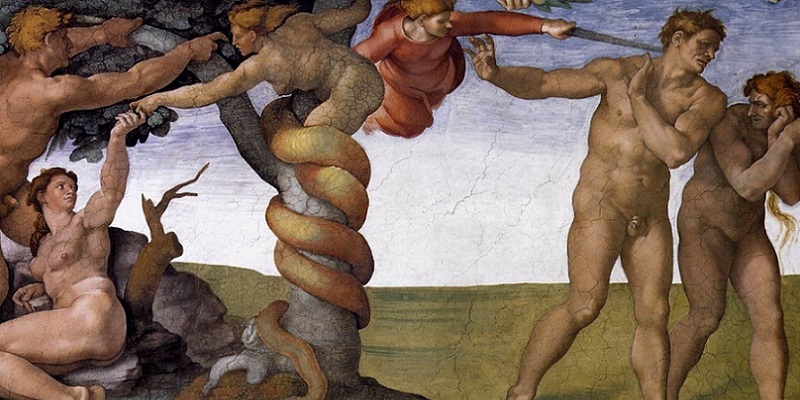
How does Original Sin reach everyone?
Saint Paul reminds us that: “By the disobedience of one man, all were made sinners” (Rom 5:19), but hope is not a vain fantasy that man cannot be freed from this condemnation; quite the contrary, he adds in the same letter to the Romans: “As one man’s trespass led to condemnation for all men, so one man’s act of righteousness (that of Christ) leads to justification and life for all men” (Rom 5:18).
Like the Apostle Paul, Saint Thomas Aquinas tries to explain this mystery to us, though we cannot fully understand it. “The whole human race is in Adam sicut unum corpus unius hominis” (“as one body of one man“). By this unity of the human race, all men are involved in original sin, just as they are also involved in the righteousness of Christ.
However, the transmission of Adam’s sin was clarified more forcefully at the Council of Trent. There it is made manifest to us that we are all born in a state of “death of the soul”; this does not mean that our soul is dead, but that it is in a state of enmity with God, which makes it be “as though dead.” The Council of Trent could not be clearer: “With Adam’s sin and with the fact that a sin has been transmitted to us, by which we are all born affected and which is ‘death of the soul'” (Council of Trent: DS 1512). Because of this certainty of faith, the Church grants Baptism for the remission of sins even to children who have committed no personal sin (Council of Trent: DS 1514). With good reason we profess that there is one Baptism for the forgiveness of sins.
We must give thanks to God for having manifested his Grace in the Council of Trent; this has helped us clarify many doubts about “original sin” that some very learned theologians today might have, and also to overthrow so much ignorance among our separated brethren. “Thanks to Revelation we know that Adam had received original holiness and justice not for himself alone but for all human nature: by yielding to the tempter, Adam and Eve commit a personal sin, but this sin affects the human nature that they will transmit in a fallen state (cf. Council of Trent: DS 1511-1512). It is a sin that will be transmitted by propagation to all humanity. For this reason original sin is called sin in an analogous sense: it is a sin ‘contracted,’ but ‘not committed’; in other words, it is a state, not an act.
Bibliography: CCC 402, 403, 404
Author: Alfredo Gómez Bolívar / Venezuela
Source: Apologetica.org
