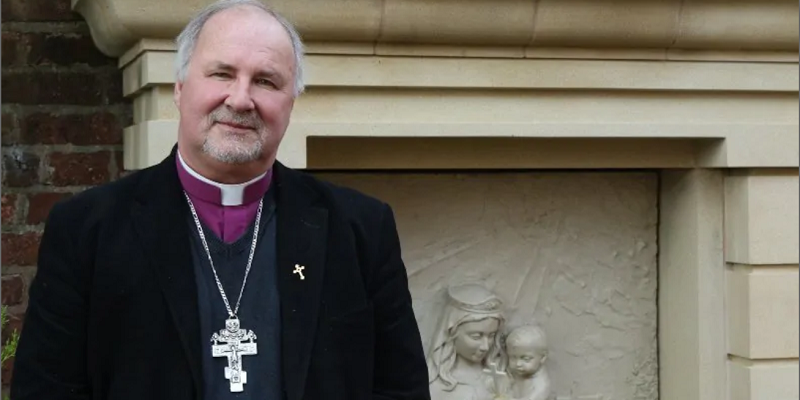
Anglican Bishop of London Is Received into the Catholic Church.
Monsignor Leonard: “In the Catholic Church the Truth Is Found without Subjectivism”
It is not common for the Anglican Bishop of London to convert to Catholicism. Such is the case of Monsignor Graham Leonard, who this past weekend took part in a Congress held in the Spanish capital by the association of converts to Catholicism “Camino a Roma.”
In an interview granted to the latest edition of the weekly Católicos del siglo XXI, he reveals the reasons that led him to take this surprising step.
–What is the origin of your conversion?
–Graham Leonard: My conversion to Catholicism goes back a long way; it was not sudden. For many years I felt deep concern over what was happening in what was then my Church, the Anglican Church. I have always believed that faith is a gift from God and that it is not the fruit of the individual discoveries each person may make. As a member of the Anglican Church, I was greatly troubled by the fact that ever more importance was being given within it to private, individual interpretations of the faith. Interpretations that depended on the situation, on the prevailing climate, on whatever the Church might see fit to decide and hold at any given moment.
–This slide into subjectivism, into relativism—did you perceive it only in recent years, or did you come to realize that it lay at the very root of the birth of the Anglican Church?
–Graham Leonard: In reality, it has always been this way since the Reformation of the sixteenth century. At that time, when the Anglican Church came into being, the faith was expressed as an attempt to respond to the political situation created by Henry VIII. Professor Powicke put it clearly in this way: “What can be said definitively about the Reformation in England is that it was an Act of State.” The Church in England found itself at the mercy of the political aims of the Tudor monarchy, forced to submit to them. In doing so, it ceased to be the Catholic Church in England and became instead the Church of England.
A Recurring Process
–Did this happen again?
–Graham Leonard: In fact, this process of adapting the faith to the needs of the moment has kept repeating itself ever since. For many years the doctrinal content of the faith depended on the interpretation of the formularies made by the jurists. In recent years it has depended on the General Synod. According to the Lambeth Conference—a kind of Synod of all the Anglican Churches of the world—each Church in each country is free to determine how to understand its faith. When I realized all this, I also understood that I could no longer continue to exercise my priestly ministry under these conditions.
–Was the Church of England’s acceptance of the ordination of women to the priesthood a decisive factor?
–Graham Leonard: That was the trigger, because it represented the establishment of a new communion, according to which it is required as necessary to believe something that the Church had never before required as a matter of faith. It was one more step in that process of subjectivism, according to which everyone is free to believe whatever they wish. It had already happened with faith in the resurrection.
–You are married, as is common among the Anglican clergy. How did your wife receive the decision of your conversion, which meant giving up a comfortable life as Bishop of London and moving into an uncertain situation?
–Graham Leonard: She would have wished to become a Catholic before I did, but she had never wanted to tell me, so as not to put pressure on me because of my responsibility within Anglicanism. She, like me, has been very happy since we entered the Catholic Church.
–How did your children receive the decision?
–Graham Leonard: We have two children and five grandchildren. They accepted our decision and respected it, but they decided to remain Anglicans.
–Have you felt welcomed in the Catholic Church?
–Graham Leonard: Very much so, without any reservation.
–Are the Anglican priests who, like you, have become Catholics happy?
–Graham Leonard: Yes, without a doubt. I do not know a single one who is not happy.
–What work do they do after their conversion?
–Graham Leonard: The same as any other Catholic priest: in parishes, as university chaplains, in hospitals, as teachers. For example, one of them, who had been a priest of the Diocese of London when I was his bishop, is now vicar general of the Catholic Diocese of Westminster. In my own case, the appointment I have received as Honorary Prelate of His Holiness has been seen by former Anglicans as an approval from the Holy Father, a welcome we had already received locally. In my ministry, I have concentrated on giving spiritual retreats to diocesan clergy, for example at the invitation of the Bishop of Birmingham. Only a few weeks ago I finished giving a retreat to the Benedictines of England.
–Some people, even within the Catholic Church, are asking that the primacy of the Pope cease to be jurisdictional and become merely an honorary primacy. What is your view?
–Graham Leonard: What is essential in the Petrine primacy is not honor but jurisdiction. And that is because it is a matter of defending the truth, the rights of the truth. The primacy of the Pope is essential for the Church because it is of divine institution. It is also essential for achieving true unity among the Churches.
–Why?
–Graham Leonard: Because unity, if it is to be authentic, can only be based on the truth. It is the Pope’s responsibility to ensure this unity in the truth.
No Concessions
–Do you believe concessions should be made in ecumenical dialogue in order to reach unity more easily?
–Graham Leonard: I do not think we should speak of concessions. The truth is not discovered through negotiations, but through obedience.
–How do you view the crisis the Catholic Church is suffering?
–Graham Leonard: As for the crisis of the Catholic Church, it depends on where you look, for there are many positive things in her, such as the new movements and the revitalization they are bringing about in the parishes. Basically, as a crisis wrought by the powers of evil, what is being attempted is to spread subjectivism as a method for ruining and destroying divine authority. I trust totally and always in the loving power of God and in His purposes for humanity. I trust in God completely, and because I believe in God I believe in the Church He has given us, and for that reason I have hope. It is this Church that must bring to fulfillment God’s plans for the salvation of man.
Author: Monsignor Leonard.
Sources: ZENIT.org. MADRID, 6 November 2001.
