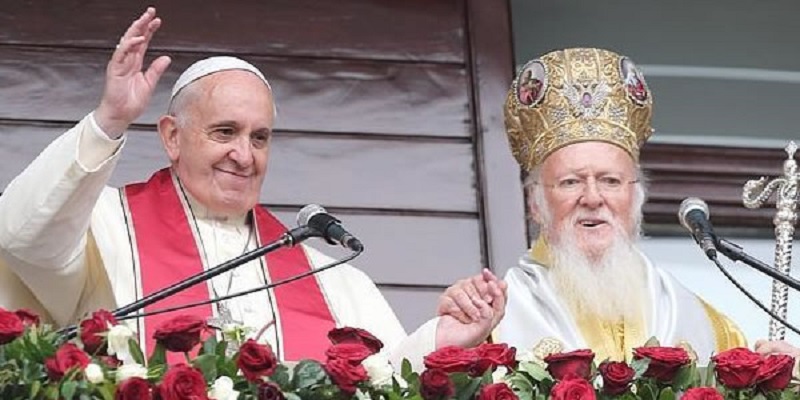
The Second Vatican Council in its decree Unitatis Redintegratio defines ecumenism as the movement promoted by the Holy Spirit to restore the unity of Christians.[1] It also exhorts all the Catholic faithful to “recognize the signs of the times and to take an active and intelligent part in the work of ecumenism”.
It establishes very clear guidelines for the ecumenical movement, which, through the ignorance of many Catholics, are overlooked, producing adverse and harmful effects, to the point that many faithful end up practicing a kind of syncretic pan-Christianity contrary not only to the spirit but to the very letter of the Council.
What Ecumenism Is Not
Below I present some examples of what some poorly formed Catholics confuse with ecumenism but which in fact is not:
Case number 1: A few years ago a neighbor had a prayer circle in her home. Wishing to participate in the ecumenical movement, she invited a group of Evangelicals. It is said that the prayers — in which some Catholic priest would occasionally take part — were “beautiful”. Subsequently the atmosphere became strained due to the teachings being preached, so that some Catholics stopped attending, while others continued to go. Today some of those Catholics are Protestants, the neighbor became a pastor, and after converting her garage she called it “The Evangelical Church of God’s Love”.
Case number 2: Scott Hahn (a former Presbyterian pastor) recounts in his book Rome Sweet Home his journey of conversion to the Catholic Church:
“It was hard, because she [here he refers to his wife] wanted nothing to do with the Catholic Church, and it was even harder because several priests I visited did not want to talk about their Church either. Every so often I would slip away looking for a priest who could answer some of the doubts I still had; but one after another they disappointed me. I asked one of them:
“Father Jim, what should I do — should I convert to Catholicism?” “First of all,” he told me, “please don’t call me ‘father.’ Second, I think you don’t really need to convert. After Vatican II that isn’t very ecumenical. The best thing you can do is simply be a better Presbyterian. It will do more good for the Catholic Church if you remain what you are.”
Astonished, I replied:
“Look, Father, I’m not asking you to take me by the arm and force me to become Catholic. I believe God may be calling me to the Catholic Church, where I have found my home, my covenant family.”
He answered coldly:
“Well, if what you want is someone to help you in your conversion, I am not the right person.”
I was left speechless.”[2]
Case number 3: A few months ago, my friend Salvador Melara (a former evangelical pastor) was invited to a Catholic evangelization congress to share his testimony of conversion to the Catholic Faith. They also invited a well-known international preacher. After Salvador spoke about the difficulties and renunciations he had to make to return to the Catholic Church, he listened in stunned silence as the other invited preacher said in the following address that “we Catholics should no longer believe we belong to the one Church that Christ founded” and that “all Churches are equal because they follow the same Christ.”
Here are three real examples of the disaster that can result from a poor understanding of ecumenism.
The Goal of True Ecumenism
The decree Unitatis Redintegratio states:
“It is only through Christ’s Catholic Church, which is the all-embracing means of salvation, that they can benefit fully from the means of salvation. We believe that Our Lord entrusted all the blessings of the New Covenant to the apostolic college alone, of which Peter is the head, in order to establish the one Body of Christ on earth to which all should be fully incorporated who belong in any way to the people of God.”[3]
True ecumenism seeks, through dialogue, to increase understanding among the different Christian confessions, pursuing unity with all those who are separated from the Catholic Church, in order to draw them to the fullness of faith that can be found only within her.
Pope John Paul II, regarding the kind of unity that ecumenism seeks, explains:
“Jesus himself, at the hour of his Passion, prayed “that they may all be one” (Jn 17:21). This unity, which the Lord has bestowed on his Church and in which he wishes to embrace all people, is not something added on, but stands at the very heart of Christ’s mission. Nor is it some secondary attribute of the community of his disciples. Rather, it belongs to the very essence of this community. God wills the Church, because he wills unity, and unity is an expression of the whole depth of his agape.
In effect, this unity bestowed by the Holy Spirit does not merely consist in the gathering of people as a collection of individuals. It is a unity constituted by the bonds of the profession of faith, the sacraments and hierarchical communion. The faithful are one because, in the Spirit, they are in communion with the Son and, in him, share in his communion with the Father: “Our fellowship is with the Father and with his Son Jesus Christ” (1 Jn 1:3). For the Catholic Church, then, the communion of Christians is none other than the manifestation in them of the grace by which God makes them sharers in his own communion, which is his eternal life. Christ’s words “that they may be one” are thus his prayer to the Father that the Father’s plan may be fully accomplished, in such a way that everyone may clearly see “what is the plan of the mystery hidden for ages in God who created all things” (Eph 3:9). To believe in Christ means to desire unity; to desire unity means to desire the Church; to desire the Church means to desire the communion of grace which corresponds to the Father’s plan from all eternity. Such is the meaning of Christ’s prayer: “Ut unum sint”.”[4]
In Reconciliatio et Paenitentia,[5] the Pope maintained:
“It should be repeated that, on the part of the Church and her members, dialogue, whatever form it takes (and these forms can be and are very diverse since the very concept of dialogue has an analogical value) can never begin from an attitude of indifference to the truth. On the contrary, it must begin from a presentation of the truth, offered in a calm way, with respect for the intelligence and consciences of others. The dialogue of reconciliation can never replace or attenuate the proclamation of the truth of the Gospel, the precise goal of which is conversion from sin and communion with Christ and the Church. It must be at the service of the transmission and realization of that truth through the means left by Christ to the Church for the pastoral activity of reconciliation, namely catechesis and penance.”
Hence the importance of avoiding relativism and the attenuation of the proclamation of the truth in ecumenical dialogue — a very common error among Catholics who fear falling into “proselytism,” a term now understood only in a negative sense (meaning the use of dishonest methods to win followers, which may include physical or moral violence, deception, etc.). An important clarification on this point is offered by Father Fernando Ocáriz:
“In some ecclesiastical documents following the Second Vatican Council, when the word ‘proselytism’ is used in a negative sense, that sense is made explicit, since the term does not carry it in itself. For example, in the ‘Ecumenical Directory’ of 1967, bishops are exhorted to counter the danger of proselytism in connection with the activity of the sects, but it is immediately clarified that “by the term ‘proselytism’ is here meant a manner of behaving contrary to the spirit of the Gospel, inasmuch as it resorts to dishonest means to attract men to its Community, by taking advantage, for example, of their ignorance or poverty, etc. (cf. Decl. ‘Dignitatis humanae’, 4).”
(…) In other ecclesiastical documents, the use of the term “proselytism” in a negative sense was gradually introduced, especially with reference to “proselytism by the sects.” At times the term has also been used to designate, without any qualification, an unjust form of activity. So, for instance, a document of the Pontifical Commission “pro Russia,” of 1992, states:
“What is called proselytism — that is, any pressure on the conscience, by whomsoever practiced or in whatever form — is completely different from the apostolate and is in no way the method by which the Church’s pastors are inspired.” In the new Ecumenical Directory of 1993, the nuance present in the earlier Directory, which specified the sense in which proselytism was being discussed, disappeared. From that point on, it has been common for this word to designate tout court behaviors aimed at compelling, pressuring, or in general treating people’s consciences in an abusive manner.
Nevertheless, in the ecumenical sphere the distinction between good and bad proselytism was not always abandoned. For instance, a 1995 document of the Joint Working Group of the Catholic Church and the World Council of Churches clarifies that, although the term proselytism “has recently acquired a negative connotation when applied to the activity of some Christians aimed at winning followers among members of other Christian communities,” historically this term “has been used in a positive sense, as a concept equivalent to missionary activity,” and it explains that “in the Bible this term carries no negative connotation. A ‘proselyte’ was one who believed in the Lord and accepted his law, and in this way became a member of the Jewish community. Christianity adopted this meaning to describe someone who converted from paganism. Until recent times, missionary activity and proselytism were considered equivalent concepts.””[6]
In this sense, the Catholic participating in ecumenical dialogue must be “proselytizing” (in the good sense), though not by seeking merely an ecumenism “of return”; for one does not ask others to renounce their own history of faith, nor does it imply uniformity in all expressions of theology and spirituality, in liturgical forms, or in discipline.[7] It is about presenting the truth with charity and respect, yet without attenuation, in pursuit of unity in diversity: unity in what is fundamental (one and the same faith) but with diversity in its expressions.
An example of this is found in the massive conversion of Anglicans who have chosen to return to full communion with the Catholic Church, formally accepting the Apostolic Constitution Anglicanorum coetibus.[8] Through the establishment of personal ordinariates they preserve crucial elements of spirituality, liturgy, theology, and discipline that form part of the Anglican heritage, while at the same time accepting the Catholic faith in its entirety and, recognizing the jurisdictional primacy of the Pope, remaining subject to the Congregation for the Doctrine of the Faith and to the other dicasteries of the Roman Curia according to their respective competencies.
Ecumenism Does Not Apply to Sects
Another common error widespread among many Catholics is the belief that ecumenism applies to sects. I frequently encounter well-intentioned (though poorly prepared) brothers and sisters trying to dialogue with Jehovah’s Witnesses, Adventists, Mormons, and other proselytizing groups of a sectarian nature — many of whom take advantage of this openness to dialogue to undermine their faith (many of these groups are not even Christian, since they do not profess a Trinitarian faith).
It is a fact that these groups have a doctrine specially oriented toward attacking key points of the Catholic faith. In some cases they may know only five or six biblical verses, but ones specifically selected to confuse the average Catholic (the phrase “ignorant Catholic, guaranteed Protestant” is not inaccurate, even if it may sound dismissive).
It is also important to acquire a solid apologetic formation — an indispensable element in the formation of those who wish to participate in ecumenical and interreligious dialogue. On this point Pope John Paul II remarked:
“It is essential in your particular Churches to develop a new apologetic for your people, so that they may understand what the Church teaches and thus be able to give reason for their hope.”
He then goes on to explain the need for this new apologetics:
“In a world where people are continuously subjected to the cultural and ideological pressure of the media and the aggressively anti-Catholic attitude of many sects, it is essential for Catholics to know what the Church teaches, to understand that teaching, and to experience its liberating power. A lack of understanding leads to a lack of the spiritual energy needed for Christian living and the work of evangelization.”[9]
Notes
- It can be read on the official Vatican website at http://www.vatican.va/archive/hist_councils/ii_vatican_council/documents/vat-ii_decree_19641121_unitatis-redintegratio_en.html ↩
- Scott and Kimberly Hahn, Rome Sweet Home: Our Journey to Catholicism, p. 82 ↩
- Unitatis Redintegratio 3 ↩
- John Paul II, Ut unum sint 9 ↩
- It can be read on the official Vatican website at http://www.vatican.va/holy_father/john_paul_ii/apost_exhortations/documents/hf_jp-ii_exh_02121984_reconciliatio-et-paenitentia_en.html ↩
- Fernando Ocáriz, Evangelización, proselitismo y ecumenismo, Scripta Theologica 38 (2006/2), pp. 620-621 ↩
- Benedict XVI, La revolución de Dios, p. 23 ↩
- It can be read on the official Vatican website at http://www.vatican.va/holy_father/benedict_xvi/apost_constitutions/documents/hf_ben-xvi_apc_20091104_anglicanorum-coetibus_en.html ↩
- John Paul II in his address to the Antilles Episcopal Conference during the “Ad Limina” visit on May 7, 2002 ↩
