Do Catholics value the Holy Mass enough?
What is the Mass today for many of us? On feast days, a social event for most. On other days, next to nothing. It is no more than a great unknown. One need only look at the people who attend daily and how they take part. How many know how to follow it? How many know the meaning of its rites?
The Mass bores me, say others. Just as one is bored at a football match when he does not know the game; whereas whoever knows or plays it is not only entertained, but grows passionate about it. In the Church many things are spoken of and preached. The Mass is taken for granted; its importance is scarcely stressed, and from having it always beside us we have lost, through routine, all sense of its grandeur. To see the King go by, or merely some famous figure—a film star, a beautiful model—or a football match, we are capable of travelling hundreds of kilometres and of preparing ourselves for it for several hours, besides paying a considerable sum. Yet to go and see our God and Father, and to let Him enter our house—Him, who is one of the family—we scarcely give it any importance. And He is the Being from whom we can inherit an immense treasure! And we call ourselves rational.
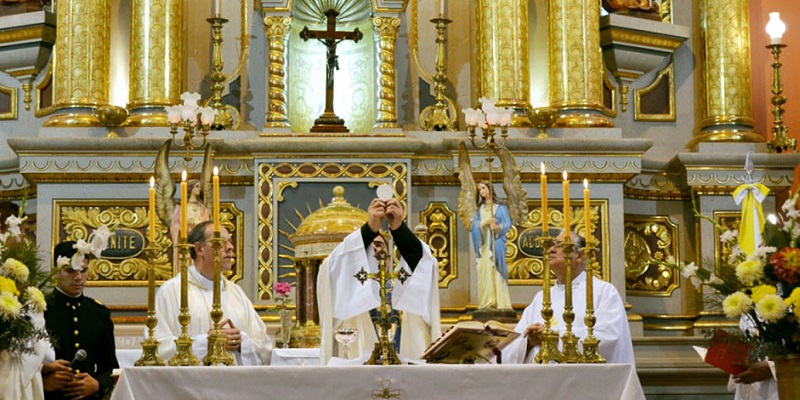
 Yet the Mass remains that prodigious miracle in which the Lord comes down each day into the hands of the priest and gives Himself to us out of love and to teach us to love.
The Mass sets us before the primordial mysteries of the faith, for it is the very self-giving of the Trinity to the Church. Thus it is understood that the Mass is the centre and the root of the Christian’s spiritual life. It is the end of all the sacraments. There is nothing comparable to it in our Religion. Before it, all else is secondary. Both on the Cross and on the Altar, Christ Himself offers His Body and His Blood for us. For this reason, it is somewhat saddening to see those people who, during Mass, devote themselves to reciting their private prayers or the rosary, or who wander distractedly kissing the feet of the saint of their devotion. They forget the King and busy themselves talking with His servants.
“This is my body. This is the chalice of my blood.” Transubstantiation, that great mystery of faith, tells us that Christ places Himself once more before us in person, with His blood, His body, His divinity. There is no need to go to Jerusalem to meet Christ: we have Him next to our house, in the Parish, and within ourselves when we draw near to receive Communion.
The priest is a representative of the eternal Priest, Jesus Christ, who is at the same time the victim. The Mass is a divine, Trinitarian action, not a human one. The priest who celebrates serves the design of the Lord, lending Him his body and his voice; but he does not act in his own name, but in the Person of Christ, and in the name of Christ.
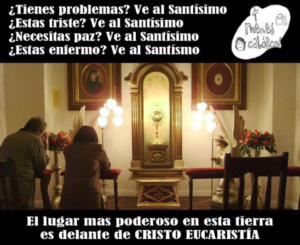
Out of love and to teach us to love, Jesus came to earth and remained among us in the Eucharist. One day, when Mother Teresa of Calcutta was insistently begging God for the salvation of mankind, the Lord answered her: “I do want it, Teresa, but they do not.” God, like one more poor beggar, begs for our love and our salvation. Just as the elderly in nursing homes are forgotten by their children, so too the Lord in the Tabernacle waits all day long for a visit from His own.
If we were offered a million pesetas for each day that we went to visit some great personage for half an hour, would we fail to see him even a single day? In the Mass, God Himself offers us an infinite treasure so that we may be happy eternally. He offers us His very Self, the Creator of the world and of all its treasures, who has moreover promised them to us as an inheritance. And we—what do we do? Will Christ have to repeat once again those words: “Father, forgive them, for they know not what they do”?
Author: Alejo Fernández Pérez / Spain
Source: Apologetica.org
