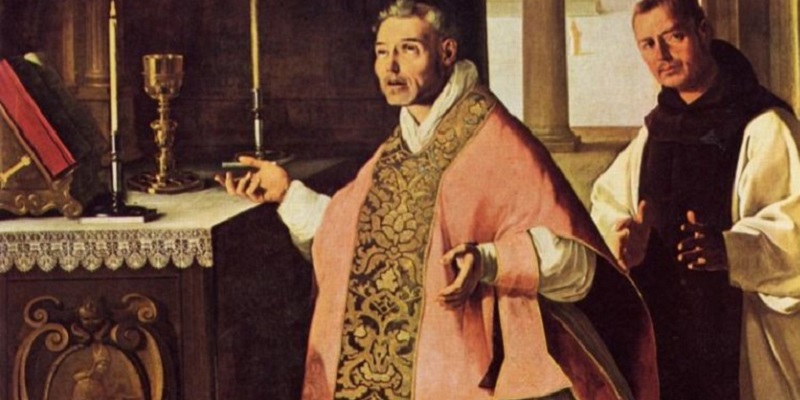
A Eucharistic prodigy in the Shrine of Guadalupe (Cáceres)
The Venerable Father Cabañuelas, or Friar Pedro de Valladolid, which was his religious name, the protagonist of the prodigious event before us, was one of the eminent men who, by their virtue, shed luster on the emerging religious life in the Guadalupe monastery in the early years of the establishment there of the Order of Saint Jerome, in 1389.
He and others were the outstanding disciples of the Venerable Father Friar Fernando Yáñez de Figueroa, an illustrious native of Cáceres of the oldest nobility and first prior of the monastery; they shone for their holiness throughout the first half of the fifteenth century. Some of them, eight in all, were immortalized by Zurbarán’s brush in as many canvases of the eleven that decorate the sacristy of the Shrine of Guadalupe. The remaining three depict scenes from the life of Saint Jerome.
Father Cabañuelas embraced religious life when still very young and always distinguished himself by his deep devotion to the Eucharist, in whose contemplation and meditation he spent a great part of the hours of day and night. But the Lord wished to purify his faith in the great Mystery, allowing the enemy of souls to trouble his imagination with terrible doubts about the real presence of Christ in the Sacrament of the Altar, doubts that increased until they caused him tremendous anguish while he celebrated the Holy Sacrifice.
The miraculous event that dispelled all his doubts and radically cured him of all his uncertainties for the rest of his life can be placed chronologically around 1420, when he was about fifty years old. He himself relates it to us, although in the third person, in an account in his own hand found among his papers after his death, which we transcribe below.
It happened to a friar of this house, he says, that one Saturday, while saying Mass, after he had consecrated the Body of Our Lord Jesus Christ, he saw something like a cloud that covered the altar stone and the chalice, so that he could see nothing but a little of the cross that was behind the altar stone; this filled him with great fear, and with many tears he begged the Lord, in his mercy, to reveal to him what that thing was and to deliver him from so great a danger. And while he was thus greatly afflicted and frightened, little by little that cloud began to withdraw; and, once it had withdrawn, he did not find the consecrated Host and saw that the pall that had been over the chalice had been removed; and he looked into the chalice and saw it empty. When he saw this, he began to weep very bitterly, asking God for mercy and devoutly commending himself to the Virgin Mary.
And while he was thus afflicted, he saw the consecrated Host coming, placed on a very radiant paten, and it set itself over the chalice; and drops of blood began to come forth from it in abundance. And after the blood had fallen into the chalice, the pall placed itself over the chalice and the Host upon the altar stone, as it had been before. And the said friar, being thus greatly frightened and weeping, heard a voice that said to him: Finish your office, and let what you saw remain secret to you”.
The moment in which Zurbarán depicts him on the canvas, one of the best, together with “The Pearl”, for the beauty of its composition, the expression of the faces, luminosity, and color among all that came from his brush, is the moment when, seeing the radiant paten with the consecrated Host appear again through the air, he falls to his knees, astonished and enraptured, recognizing and submitting his intelligence to the evidence of the miracle, while the lay brother who was serving him, also on his knees, seems not to have perceived what had happened—something Father Cabañuelas also notes in his account of the Eucharistic prodigy worked in that “miraculous Mass”.
The event soon became known and was spread throughout the nation, and even the kings of Castile themselves, Don John II and his wife Doña Maria of Aragon, together with Prince Don Henry, the future Henry IV, went to Guadalupe to know and speak with the servant of God, already at that time elected prior of the monastery. They were so captivated by his virtue and holiness that the queen chose him as her adviser in matters of the spirit, and ordered in her will that, when her remains were brought to the Shrine, those of Father Cabañuelas should be placed beside them, as indeed was done.
We still have a precious testimony of the “miraculous Mass”: the corporals and the pall, with a few drops of blood, used in it, recognized before an apostolic notary in the seventeenth century, were declared authentic and are today the most precious relic honored in the Guadalupe reliquary; they were likewise a renowned Eucharistic relic, exposed for the veneration of the faithful between two lighted candles at the National Eucharistic Congress of Toledo, October 1926.
Father Cabañuelas died on March 20, 1441, in the odor of sanctity, greatly loved and venerated by all.
Friar José Torrejón, O.F.M.
Source: Web Católico de Javier
