–Mind you, this subject too…
–The Lord will help me.
I wish to treat of the harmful attitude of the philo-Lefebvrists within the Catholic Church, though not without first describing very briefly the position of the Lefebvrists and the anti-Lefebvrists. I deal especially with the philo-Lefebvrists because they are close to us, and they continually hover about the confessors and defenders of Catholic orthodoxy.
—The Lefebvrists regard Archbishop Lefebvre as the St. Athanasius of our time, and the Priestly Fraternity of St. Pius X (SSPX) as an indispensable guarantor of the doctrinal and liturgical orthodoxy of the Church. The Lefebvrist Bishop Bernard Tissier de Mallerais, author of a substantial biography of Archbishop Marcel Lefebvre (1905-1991), understands his life as a beautiful ascending line (Marcel Lefebvre, une vie, Clovis 2002, 2nd ed.). A missionary priest and Bishop of Senegal (1947), he was elected superior of the Congregation of the Holy Spirit (1962). He resigned this office in order to found, at Écône, Switzerland, the SSPX (1970), which in the postconciliar period distinguished itself very markedly by its unbending attachment to the ancient Mass and by its opposition to certain doctrines of Vatican II.
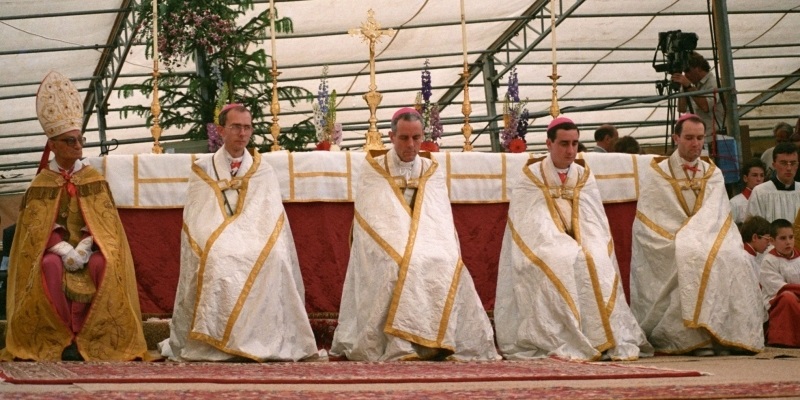
The Holy See applied certain sanctions to him and to his Fraternity. Firm in his intentions, in 1976 Lefebvre celebrated the «messe interdite» (the forbidden Mass) before 10,000 faithful and 400 journalists. And his name gained still greater resonance when, in 1988, without the necessary authorization of the Holy See, he ordained at Écône, before the television cameras of numerous nations, four Bishops for the service of the Fraternity. The consecrating Bishop and the four who were ordained thereby incurred the penalty of latæ sententiæ excommunication.
Tissier de Mallerais, for a time rector of the Seminary of Écône and one of the four Bishops ordained by Archbishop Lefebvre, writes the biography of this solitary rider within the Church, and unveils for us the mystery of a man whose extraordinary self-assurance sprang precisely from an extraordinary assurance in God (ib. 10).
—The anti-Lefebvrists stand extremely far, in doctrine and in spirit, from Archbishop Lefebvre and the SSPX, and they feel a great aversion toward them. That is why they protested harshly when Benedict XVI lifted the excommunication of the Lefebvrist Bishops (21-I-2009). This act provoked among them a furious resistance, for they are convinced that the Lefebvrists must be rigorously kept outside ecclesial communion. Even the Bishops of Germany, in a collective Declaration (5-III-2009), voiced grave reservations about this measure of the Successor of Peter. So great was the resistance the anti-Lefebvrists put up that the Pope himself judged it fitting to justify the remission in a subsequent Letter addressed to all the Bishops of the Church (10-III-2009):
This discreet gesture of mercy toward the four Bishops, the Pope observed, had for many reasons stirred up, both within and beyond the Catholic Church, a debate of a vehemence not seen in a very long time. Yet the remission of the excommunication tends to the very end that the sanction itself serves: to invite the four Bishops once again to return. Such a gesture became possible once the parties concerned had recognized, in principle, the Pope and his authority as Pastor, notwithstanding their reservations regarding obedience to his doctrinal authority and to that of the Council.
It is not a little curious that precisely those who show the greatest harshness toward the Lefebvrists are precisely those who display the greatest indulgence toward so many pastors and theologians who gravely offend the faith and the discipline of the Church. Beyond doubt, this grave want of ecclesial charity does no little to hinder the return of the SSPX to full communion with the Catholic Church.
We, obviously, feel far closer to the Lefebvrists than to those numerous “Catholic” pastors and theologians who have lost the faith, since they deny or call into question the divinity of Christ, the virginity of Mary, the uniqueness of salvation through Christ, the Eucharistic presence, the real distinction between the ministerial and the common priesthood, the existence of the angels, of purgatory, and so many other truths of the Catholic faith.
The followers of Lefebvre, on the contrary, confess with us that “one same faith” of the Church, and for this reason we hold them in esteem, and we denounce every attempt to demonize them, for we wish to further their complete reincorporation into the Church. Nevertheless, we do not on that account forget that, as Benedict XVI says, they still harbor reservations about obedience to the doctrinal authority of the Pope and of the Council, and that for this very reason they must return to the full communion of the Church.
—The philo-Lefebvrists share, to a greater or lesser degree, the positions of the Lefebvrists. Of these I now wish to treat at greater length. Of course, the criticism I shall make of the philo-Lefebvrists holds a fortiori for the Lefebvrists. The former are often good and faithful Christians, but their philo-Lefebvrism, more or less pronounced, harms them greatly and scandalizes not a few Catholics, above all the less well formed, awakening in them confusion, distrust of the Pope, aversion to the Second Vatican Council and to the present liturgy of the Church.
The philo-Lefebvrists greatly obstruct the return of the SSPX to full communion with the Catholic Church. Though it may seem a paradox, so it is. They, without being Lefebvrists, take up a great part of their principal theses, understand or even justify the ordination of the four Bishops, hold certain documents of the Council to be irreconcilable with the earlier Magisterium, look with aversion upon the Mass in its ordinary form –some going so far as to deny its validity– implacably condemn certain gestures of John Paul II and of the Church in the postconciliar period, and in this way, though they do not intend it, they are proving the Lefebvrists right, they strengthen them in their positions, and for this reason, without doubt, they gravely hamper their reincorporation into the full communion of the Catholic Church. In fact they achieve precisely the contrary of what they intend.
I have already sketched in summary the physiognomy of the philo-Lefebvrist Catholics. But it is readily understood that their identity cannot be defined with precision, for it is realized in countless degrees. There are cases in which philo-Lefebvrism scarcely goes beyond a great, though not entirely well-understood, esteem for Catholic Tradition. But in other cases there are Catholics near to Lefebvrism who almost identify themselves with the Lefebvrists, above all when they admit as legitimate the causes that occasioned “the schismatic act” of the ordination of the SSPX Bishops.
The philo-Lefebvrists, of course, in no way acknowledge their condition, just as neither did the Semipelagians admit their Semipelagianism, nor did the Jansenists acknowledge being such. If we reproach them for some of their attitudes, pointing out to them, for example, certain published words that seem to us irreconcilable with full fidelity to the Pope, to Vatican II, and to the Church, it is almost certain that they will defend their position tenaciously, with a profusion of data and arguments, proving to us beyond dispute that they are not Lefebvrists. But they do not prove to us that they are not philo-Lefebvrists, which is what it would be well for them to prove, by answering the objections we set before them.
I shall limit my considerations here and now to the illegitimate ordination of the four Bishops of the SSPX, to the acceptance of Vatican II, and to certain gestures of Pope John Paul II. I set aside, on the other hand, many other quæstiones disputatæ concerning the validity and liceity of the postconciliar Mass, the decree Dignitatis humanæ, the fulfilment of the Sunday precept by attendance at the SSPX Mass, the present status of the Lefebvrists in the Church, and so forth. And I pass to the principal subject:
The most extreme philo-Lefebvrists affirm, together with the Lefebvrists, that “Archbishop Lefebvre always acted with a good and upright conscience, likewise in ordaining Bishops. When obedience to certain norms of the Church clashes with what conscience shows, with moral certitude, to be the divine Will, conscience must be followed. Such is the case of Lefebvre, who resolves to break canon law, seeing the Church in a state of extreme necessity: “il s’agit d’une nécessité évidente… parce que Rome est dans les ténèbres” (Tissier 575) [1]. He holds that without the SSPX the Christian people run grave risk of being lost, for the Church is drifting away from full doctrinal orthodoxy and from the true traditional liturgy. In these circumstances, to ordain Bishops who will preserve the SSPX, indispensable for the salvation of the Church, is an absolute duty, for “salus animarum suprema lex.”” To these arguments respondeo dicendum:
To set the law of the Church against a well-formed conscience is one of the most frequent causes today of doctrinal and pastoral degradation: with a “good conscience,” whenever circumstances seem to require it, “Masses” are celebrated without a priest, contraception is practiced chronically within marriages, and so on. But the Catholic faith teaches us otherwise. A conscience that refuses to obey the gravest laws of the Church is not well formed, because for the personal conscience to be upright and well formed it does not suffice that it conform to itself alone (auto-nomos, autonomy of conscience); it must also obey the commandments of God and of the Church. Archbishop Lefebvre could not have had a clear conscience that the illegal ordination of the Bishops was the Will of God. He could not confuse the divine Will with his own.
To ordain Bishops without the permission of the Holy See is a gravely evil act, which the Church punishes with excommunication, and it is likewise a sacrilege, a grave abuse in the matter of the sacraments (Catechism 2120). Never, therefore, can such an action be justified by a noble end, unless extreme conditions render impossible the fulfilment of this ecclesiastical law, as could occur in certain ordinations carried out in China, when it was not even possible to communicate with Rome: ad impossibilia nemo tenetur. Archbishop Lefebvre, without being in analogous circumstances, in ordaining four Bishops for the SSPX, disobeyed a very important law of the Church, and not only did he perform those consecrations without the Pope’s permission, but he did so while knowingly opposing the express will of the universal Pastor of the Church.
The law of the Church ordains that no Bishop is permitted to confer episcopal ordination unless the pontifical mandate has first been established (c. 1013). So grave is the prohibition that the Bishop who should do so, along with those ordained, incur an excommunication latæ sententiæ reserved to the Holy See (c. 1382).
John Paul II, two days before those ordinations, sought to dissuade Archbishop Lefebvre by a letter that ends thus: “I earnestly invite you to return humbly to full obedience to the Vicar of Christ. Not only do I invite you to this, but I beg it of you by the wounds of Christ, who on the eve of His Passion prayed for His disciples ‘that all may be one.’ To this petition and invitation I join my daily prayer to Mary the Mother of Christ. Dear brother, do not allow the year dedicated in a very special way to the Mother of God to bring a fresh wound to her Mother’s heart. Vatican, 9 June 1988, John Paul II.” Archbishop Lefebvre resists this command, presented humbly by the Pope as an exceedingly urgent entreaty.
The episcopal ordinations of Archbishop Lefebvre are, then, a gravely schismatic act. A few days after they were carried out, John Paul II, in the Apostolic Letter–Motu Proprio Ecclesia Dei (2-VII-1988), denounced with great sorrow the illegitimate episcopal ordination performed by Archbishop Lefebvre, and stated:
That act, the Pope declared, was in itself a disobedience to the Roman Pontiff in a most grave matter and of capital importance for the unity of the Church, such as is the ordination of bishops, by means of which the apostolic succession is sacramentally maintained. For this reason that disobedience –which entails a genuine rejection of the Roman Primacy– constitutes a schismatic act (canon 751). In carrying out that act [18-VI-1988], despite the public monitum addressed to him by the Cardinal Prefect of the Congregation for Bishops on the previous 17 June, the Most Reverend Archbishop Lefebvre and the priests Bernard Fellay, Bernard Tissier de Mallerais, Richard Williamson, and Alfonso de Galarreta incurred the grave penalty of excommunication provided by ecclesiastical discipline (canon 1382). The canon 751 cited by the Pope affirms that schism is the refusal of submission to the Supreme Pontiff.
The first error-sin of Lefebvre and of the Lefebvrists lay and lies in the condemnatory discernment of the present Church and specifically of Pope John Paul II, as we shall see in another article.
Archbishop Lefebvre, in a meeting with his closest collaborators: «On ne peut suivre ces gens-là, c’est l’apostasie, ils ne croient pas à la divinité de Notre Seigneur Jésus-Christ […] Procédons au sacre!», that is, to the ordination of Bishops (Tissier 578) [2]. In a meeting (1987) with Cardinal Ratzinger, Prefect of the Congregation for the Faith: «Le schisme? rétorque Mgr Lefebvre. Si schisme il y a, il est bien plus le fait du Vatican avec Assise et […] c’est la rupture de l’Église avec son magistère traditionnel. L’Église contre son passé et sa Tradition, ce n’est pas l’Église catholique; c’est pourquoi il nous est indifférente d’être excommuniés par cette Église libérale, oecuménique, révolutionnaire» (ib. 576) [3]. «Rome a perdu la foi, Roma est dans l’apostasie, on ne peut faire confiance à ce mond-là» (ib. 577) [4].
The second, fundamental error-sin of Lefebvre and of the Lefebvrists lay and lies in believing that they are necessary in order to keep the Church from tumbling over a precipice of heretical errors and sacrilegious liturgies. This is what they think: the Church, at this moment of her history, has absolute need of us in order to be saved. We find ourselves, then, under the grave moral obligation to endure and to grow, which is not possible except by ordaining Bishops. Therefore, although we already know that this gravely offends against the law of the Church and the express will of the Pope, nevertheless, in spite of everything, we shall do it. We shall perform that act even foreseeing that anathemas and excommunications will fall upon us. And there you have not a few philo-Lefebvrists who justify that decision, or who at least understand it with benevolence –suspending judgment– thereby harming themselves and scandalizing the people of God.
In an interview with journalists (9-XII-1983) Archbishop Lefebvre had already announced the ordination of Bishops as a possible necessity of conscience: «Je pense quand même qu’apparemment ce serait un acte de rupture avec Rome, qui serait grave. Je dis encore “apparemment”, parce que je pense que devant Dieu il est possible que mon geste soit un geste nécessaire pour l’histoire de l’Église, por la continuation de l’Église, […] du sacerdoce catholique. Alors je ne dis pas qu’un jour je ne le ferai pas, mais dans des cinconstances encore plus tragiques» (Tissier 571) [5]. Such circumstances came about, in his judgment, at the meeting of Assisi: «C’est diabolique… C’est une impiété inqualifiable envers Notre Seigneur Jésus-Christ» (ib. 563-564) [6].
The major premises that led the SSPX into schism are false. And all the Lefebvrist evils proceeded and proceed from those errors. The Lord has no need of anyone in order to save His Church, and out of pure love for her, not out of need, He normally employs for this the mediation of her members, Pastors and faithful. But He employs precisely the active mediation of those who, under the impulse of His grace, humbly fulfil the canonical laws and the mandates of the Pope. On the contrary, by breaking the law of the Church and resisting a will that the Pope expresses with his authority as universal Pastor, no salvific action can be accomplished. There can only ensue enormous harm to the Church. The pastors who, without passing through the gate, enter into the fold to feed the flock “are thieves and robbers” (Jn 10:1-9).
It is the Church that saves us. In their ignorance of this so central a truth the progressive modernists and the most extreme integrists seem to coincide. The Second Vatican Council teaches it clearly: the Church alone is “necessary for salvation” (LG 14); she alone is the “universal sacrament of salvation” (LG 48; AG 1). It is not we who save the Church, however many straits she may at times suffer on account of the errors, abuses, and sins of her members. Archbishop Lefebvre departs from the splendor of the truth when he thinks and says that the ordination of his Bishops is «un geste nécessaire pour l’histoire de l’Église, por la continuation de l’Église».
With God’s favor, I shall continue with the theme.
Author: Fr. José María Iraburu
Translation of the French texts
- It is a matter of evident necessity… because Rome is in darkness. ↩
- One cannot follow such people; it is apostasy, they do not believe in the divinity of Our Lord Jesus Christ… Let us proceed to the consecration [of Bishops]. ↩
- A schism? retorts Archbishop Lefebvre. If there is a schism, it lies rather in the deed of the Vatican at Assisi and […] in the rupture of the Church with her traditional Magisterium. The Church set against her own past and her Tradition is no longer the Catholic Church; and that is why for us it is a matter of indifference to be excommunicated by this liberal, ecumenical, revolutionary Church. ↩
- Rome has lost the faith, Rome is in apostasy; it is not possible to place one’s trust in that world. ↩
- I do think that apparently it will be an act of rupture with Rome, which will be grave. And I say “apparently,” because I think that before God it is possible that my act may be an act necessary for the history of the Church, for the continuation of the Church […], of the Catholic priesthood. So I do not say that one day I will not do it, but in circumstances still more tragic. ↩
- It is something diabolical… It is an unspeakable impiety toward Our Lord Jesus Christ. ↩
