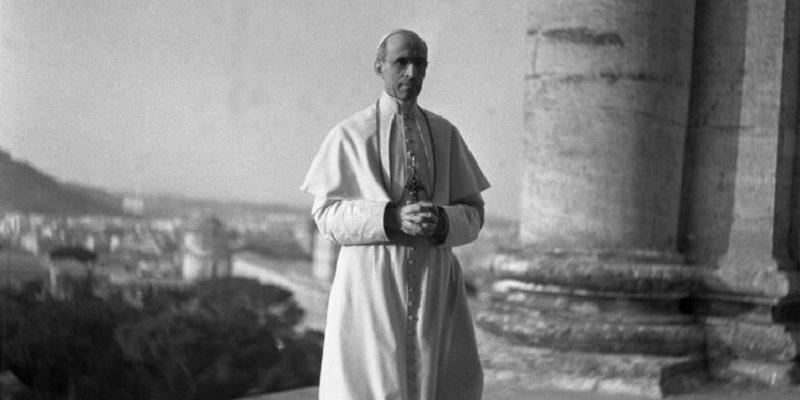
Analysis of Some Accusations Against the Pope of the Great War.
The vilification of Pius XII has resurfaced once again, fueled by a new torrent of inflammatory literature, coming for the most part from among the enemies of the Church. Critics of his papacy claim that Pius XII worked side by side with Hitler and the Third Reich. If he had raised his voice against the Nazi atrocities, they say, perhaps the Holocaust—the death of millions of Jews and other groups at the hands of the Nazis—could have been stopped.
It surprises no one that the secular media have enthusiastically circulated these sensational claims. Scandal always sells. But… are these allegations well founded? Take a close look at the history of a man who was anguished by the horrors of the Nazi regime and at his efforts to find the best way to oppose it.
Pius XII, Catholic Social Teaching, and the Holocaust
When you see a night illumined by an unknown light, know that this is the sign God gives you so that you may know that He is about to punish the world for its crimes by means of war, famine, and persecutions of the Church and of the Holy Father… The good will be martyred, the Holy Father will have much to suffer; several nations will be annihilated. And at the end of these things my Immaculate Heart will triumph. Thus spoke Our Lady to the children of Fatima, Portugal, when she appeared to them in 1917.
On the night of January 25, 1938, the skies shone with a purple light that the whole world could see. Science has tried to explain this phenomenon as a case of the aurora borealis, although it is not known why it became visible across the entire planet. (Auroras boreales are phenomena visible only near the North Pole.) This event is not mentioned much in today’s history classes; nevertheless, there is no doubt that Pope Pius XII had it in mind when he assumed the office of Supreme Pontiff in 1939 amid the growing horrors of what would become the Second World War.
The war announced in the prophecy became a reality. Pope Pius XII, in response to Our Lady of Fatima’s request, consecrated the world to the Immaculate Heart of Mary in 1942. In 1950 he also defined the dogma of the Assumption, Mary’s entrance into heaven body and soul.
Decades after his death there is an attempt to rewrite history, and Pope Pius XII is being defamed with regard to his conduct during the Second World War. In any case, we can find reasons to trust in the triumph of which Our Lady spoke. A triumph that will come as a consequence of persevering in the dissemination of historical truth. This truth is so forceful that it speaks for itself.
Inflammatory Publications
The vilification of Pius XII’s reputation has been driven by a torrent of defamatory literature, including John Cornwell’s best-selling book “Hitler’s Pope.” The book presents the thesis that Pius XII worked shoulder to shoulder with Hitler and the Third Reich. If the Pope had spoken out against the atrocities, the book says, it is possible that the Holocaust (the extermination of millions of European Jews and other racial minorities) could have been avoided. This thesis is now widely accepted as true.
This book, however, is full of misinterpretations and inaccurate historical details. Although the author claims to be a devout Catholic, his impartiality is at least questionable, since he declares himself in disagreement with the teachings of the Church on several fundamental points. He is one of the voices of a new wave of critics who are largely dissatisfied with the way Pope John Paul II has implemented the reforms of the Second Vatican Council and with the firmness of the Church’s position on moral issues.
It is no surprise that the secular media have circulated these criticisms intensely. Scandal always sells, and especially this one, which provides a scapegoat for the guilt of the Holocaust.
Although Cornwell’s book has recently brought this matter to the fore, it is known that the seeds of discontent were sown long ago in the years following World War II. Camille Cianfarra, the New York Times Vatican correspondent during the war, wrote a book in 1944 with the aim of highlighting the attitude evident in some American circles. Cianfarra then wrote: “The general belief there [in the United States] seemed to be that Pius XII was wavering indecisively, trying to anticipate who was going to win the war while preparing to join the victorious nations. Why had he not openly condemned the Axis powers? Why had he not joined the United Nations? In other words, deep down, there was a suspicion that the Vatican was playing both sides, avoiding taking a clear and firm position.”
This journalist, thoroughly secular and without bias toward the Church, concluded throughout her book and on repeated occasions that Pius XII’s actions during the war were a constant denunciation of the Nazi regime. Many have recently alleged that Pius XII remained “silent” during the war. Cianfarra writes: “The ultranationalist spirit, the exalted passions, the insatiable hatred, the bestial cruelty unleashed by the war have resulted in the collapse of ethical and moral values and have created a spiritual void in which the exhortations, appeals, prayers, and diplomatic efforts of Pope Pius XII have been lost, just as those of his predecessor Pope Benedict XV were lost in World War I. The voice of the Roman Pontiff, calling for love and goodwill among men, has been crushed by the clamor of arms.”
Still more evidence, such as the body of communications between President Franklin D. Roosevelt and the Holy Father, or the esteem world leaders had for the Pope in the years following the conflict, testifies to the effectiveness of his efforts during the war. That did not prevent accusations from being raised against Pius XII again during the 1960s, with the play “The Deputy” by the German playwright Rolf Hochhuth. This play presents the Pope as a cold, calculating, and unfeeling man who deliberately chooses to allow the Holocaust to happen.
A recent book by Ralph McInerny, “The Defamation of Pius XII,” explains in careful detail the various prejudices that guided Hochhuth in his work. As with John Cornwell, there are important elements in Hochhuth’s life that cast shadows on his truthfulness. Was he always faithful to historical truth, or did he have personal issues with the Magisterium of the Church and wish to blame someone for the Holocaust?
Fortunately, the recent wave of criticism has been countered by the overwhelming response of notable scholars who base their research on incontrovertible historical facts. The search for truth has been greatly aided by Vatican transparency regarding activities during World War II. Shortly after being consecrated Pope, Paul VI lifted the traditional seventy-five-year limit that restricts most documents of the Vatican Secretariat of State and commissioned a team of Jesuit historians to publish the documentation from the years 1936 to 1945. The research reveals the Pope’s true contributions during the Holocaust and allows for a greater understanding of Catholic social thought.
A Biographical Sketch of Pius XII
Looking at his biography, it becomes evident that diplomacy was one of Pius XII’s (Eugenio Pacelli’s) great talents. From his days as a young priest, ordained in 1899, Father Pacelli’s intellectual gifts made him highly esteemed, as he was a graduate in Civil Law as well as Canon Law.
Pope Pius X noticed Father Pacelli’s abilities and assigned him to assist with the monumental task of codifying the laws of the Catholic Church. The result was the code, or collection of canons, published in 1917. In that same year, Father Pacelli was sent as papal nuncio to Munich to implement Pope Benedict XV’s peace plan.
Although relations with the Kaiser were difficult, the nuncio was able to negotiate a concordat with the Bavarian state in 1925. The concordat was not a mere mutually agreed political arrangement but rather an attempt to secure freedom of religious profession and education for German Catholic families.
Although his diplomatic work brought threats against his life on more than one occasion, Father Pacelli’s pastoral work in Munich made him always well loved. The political climate in Bavaria was particularly tense after the assassination of Governor Kurt Eisner in 1919. Nevertheless, Archbishop Pacelli was one of the few public figures who remained in the city.
Germans filled the streets to bid him farewell when he was transferred to the new nunciature in Berlin in 1925. It was hoped that Monsignor Pacelli would manage to negotiate another concordat with Berlin, securing the religious rights of Catholic families and the freedom to educate their children in the faith. In July 1929 such an arrangement was reached, although the Nazi party violated its terms only a few weeks after it was agreed.
Likewise, there was always a reciprocal affection between the Archbishop and German Catholics, and it was a hard farewell when he was called to Rome in November 1929 to be elevated to Cardinal. Pope Pius XI then appointed Cardinal Pacelli Assistant Secretary of State and enlisted his help in the Vatican’s diplomatic forces. In 1929, Cardinal Pacelli was consecrated as Pius XII.
Pius XII and the Nazis
Initially, the Nazis did not seem to be a very great danger to the Church, at least not as much as the Communists. Communist ideology was then destroying Russia and persecuting Christians. While Cardinal Pacelli was in Berlin, he had been entrusted with the task of ordaining bishops to smuggle them into Russia, in an attempt to keep the faith alive in those places.
The collapse of the Austro-Hungarian Empire left a power vacuum in Germany, a vacuum that particularly seemed to favor Communism. The Church then sought to find an ally to counter this threat. The democratic nations, already weakened by the severe economic depression, were invariably reluctant to collaborate with the Vatican. This left Nazism and Fascism as the strongest anti-Communist options.
Without a doubt, the Fascists had already made it clear that they were no friends of the Church. Mussolini, head of the Fascist government in Italy, publicly denounced the curia as “black microbes that are as fatal to humanity as the germs of tuberculosis.” The Nazi party, which initially claimed to support family values and freedom of religion, seemed to offer, at least, leadership that would leave the German state intact. The Vatican, however, saw the dangers of Nazi ideology and continued proclaiming the truth.
Those who scrutinize the Pope’s writings looking for an explicit condemnation of the Nazi regime will have trouble finding it. Apparently, Pius XII’s detractors would have liked the Pope to have published a document identifying Hitler and his regime by name as one of the great evils of the age. Even so, to say that the Pope remained silent is to reveal a lack of understanding of the diplomatic language he employed: a language that maintained political neutrality while, at the same time, courageously denouncing error. To wish that the Pope had spoken more directly is to presume that the papal word could have stopped Hitler and the Nazi party in the mission on which they had already embarked when Pius XII was enthroned Pope in 1929.
The Pope did speak, but he spoke according to an important Catholic social principle: to proclaim the faith without politicizing it. The Church must never be used for political purposes; rather, she must declare the truths of the natural law.
It is the place of Catholics in the secular sphere to ensure that society operates in a way compatible with the natural law. This principle applies in many situations; for example, it is not proper for bishops or priests to identify the candidate Catholics should vote for in a presidential election. Instead, bishops and priests use the Church’s magisterial office to proclaim Catholic social doctrine, entrusting its application to the laity who are in the proper position in the secular realm.
John Paul II describes this as the “legitimate autonomy of the democratic order.” In his social encyclical Centesimus Annus, John Paul II wrote: “The Church respects the legitimate autonomy of the democratic order and is not entitled to express preferences for this or that institutional or constitutional solution. Her contribution to the political order is precisely her vision of the dignity of the person revealed in all its fullness in the mystery of the Incarnate Word.” Like Pope Pius XII, John Paul II has faced many offenses against the dignity of the human person, and also like Pius XII, he has held fast to teaching the truth concerning that dignity, which transcends every social or political system.
The Pope’s Public Pronouncements
This does not mean that Pope Pius XII’s role was to remain silent in the face of the reality of the Holocaust. What it means is that he had to teach the faith without politicizing it. The truth is that the Pope did speak out, and the Nazis heard what he said. In his Christmas Eve message of 1942, Pius XII referred to the “hundreds of thousands who, through no fault of their own, and solely because of their nationality or race, have been condemned to death or to progressive extinction.” He then called humanity to make a vow to eliminate such practices forever.
The reaction to the speech around the world proves that it was clearly understood. The New York Times, the following day, said: “Because the Pope speaks for all peoples and to all nations at war, the clear position he takes on the fundamental issues of the conflict has greater weight and authority. When a leader, impartially joined to nations on both sides of the struggle, condemns as heresy this new form of nation-state that subordinates everything to itself… the ‘impartial judgment’ is comparable to the verdict of a court of justice.”
Then, several governments protested that the Pope could have spoken more forcefully, mentioning Germany by name in his Christmas message. In any case, the Germans clearly understood that Pius XII was addressing them. The Reich Central Security Office said at the time that the speech had been “a long attack on everything our ideas represent.” The Vatican newspaper L’Osservatore Romano continued, for more than a year, publishing articles about the Christmas speech. The Pope had spoken loudly and clearly.
|
|
| Pius XII delivering his speech at Christmas 1942. To the right of the photo, behind His Holiness, we see Giovanni Battista Cardinal Montini, who would later assume the Roman Pontificate as Paul VI. |
The Christmas speech of 1942, although it was one of the most important delivered by the Pope during the war, was certainly not the first occasion on which Pius XII spoke against totalitarian regimes. His first encyclical, Summi Pontificatus, written the year he was elected Pope, identified two main errors that permeated Europe, errors that were materialized in a special way in the Nazi party.
First, the Pope emphasized the importance of the unity of the human race. Like John Paul II, Pius XII stressed the dignity of the human person created in the image of God and redeemed on the Cross. He placed the human person in the context of the natural law, speaking of the unity of the common dwelling place (the earth) “of whose resources all men, by natural right, make use to sustain and develop life; in unity for a supernatural end, God Himself, toward Whom all should tend; united in the means to attain such an end.”
A second point in the encyclical emphasized the subordination of civil authority to divine authority. The Pope writes about the danger of a state that “puts itself in the place of the Almighty and raises the government or a group to be the very end of existence, the supreme criterion of morality and the juridical order, and therefore inhibits any attempt to appeal to the principles of natural reason and Christian conscience.” Pius XII taught, in contrast to the principles of Nazism, that the state can only be the means by which the ultimate goal is reached: the sanctification of man.
Particularly strong was his argument that a state that consecrates itself as the supreme authority and as the reason for man’s existence violates not only Christian conscience but also the natural law itself. This is a significant distinction, because in making it, the Pope spoke with an authority that extended not only to Christians but also to all humanity.
While serving as Secretary of State to Pope Pius XI in 1933, Pius XII (then Cardinal Pacelli) had helped negotiate a concordat with the German government. Many of those who seek to defame him cite this concordat as evidence that the Papacy and the Nazi party operated by mutual agreement during the war. There is, however, a great difference between the concordat and this encyclical. As we have noted before, the concordat was signed not as a mutual sanction of the parties’ policies, but rather as an effort to secure religious freedom for German Catholics. The encyclical, on the other hand, was written with the intention of proclaiming the Church’s teaching regarding the unity of the whole human race and the primacy of the natural law.
The Nazi Response
The Nazi party never thought the Pope was remaining silent. In fact, they suspected that he was speaking quite loudly through the teachings contained in Summi Pontificatus. The German secret service complained as follows: “While the Catholic clergy were reluctant during the first months of the war, in recent months they have shown greater activity, mainly under the influence of the papal encyclical Summi Pontificatus. The attitude of the priests in this regard shows such unanimity that the fact that instructions have been transmitted from a central point is evident.”
Summi Pontificatus gained international prominence. In Great Britain it was widely published and distributed. The French held it in such esteem that they dropped 88,000 copies of the encyclical over Germany. Father John Rader, a key historian of Vatican activities during the war, described the Nazi reaction: “[The German government] responded by printing its own version of Summi Pontificatus and distributing it in Poland. Every mention of Poland in the text was replaced by Germany so that it would appear to the Poles as if Pius XII had written in favor of the Nazi cause… the German priests who were able to obtain copies [of the authentic encyclical] and dared to read it from the pulpit were arrested.
The Principle of Proportionality
The message of the 1939 encyclical and the Christmas speech of 1942 are only two of the many occasions on which the Pope spoke publicly about the evils of Nazism. If the Nazis reacted so clearly to these statements, one might ask: Why did the Pope not speak more directly, raising his voice?
We must bear in mind that the Pope was fighting a different war from the one the Allies and the Axis were fighting. He lacked an army, and his aims were, despite what his detractors may say, primarily spiritual. He expressed this clearly in his first encyclical.
In the events of the Holocaust, Pius XII was facing a great iniquity brought about by the Prince of Darkness. Once the Pope decided to enter the conflict, he had to take into account the principle of proportionality, that is: it had to be determined whether a good action (speaking out against iniquity) eliminated more evils than it could cause. This consideration was constantly in the Holy Father’s mind.
The historian Margherita Marchione tells us of a private audience that Cardinal Paolo Dezza, S.J., had with the Holy Father:
In December 1942, I gave a retreat for the Holy Father in the Vatican. On that occasion I had a long audience in which Pius XII expressed his sorrow and anguish while speaking of the Nazi atrocities in Germany and in other countries under German occupation. Then he said: “They complain that the Pope says nothing. If I spoke, things would become worse.” He reminded me that he had recently sent three letters: one to the man he described as “the heroic Archbishop of Krakow,” the future Cardinal Sapieha, and to two other bishops in Poland. “They answered me,” he said, “gratefully; but they added that they could not publish the letter because doing so would aggravate the situation.” He then cited the example of Pius X who, faced with the problem of Russia, said: “One must keep silent to avoid greater evils.”
Pius XII therefore kept silent in order to avoid greater evils. This principle was confirmed during the war: Vatican Radio broadcasts or notes in L’Osservatore Romano generated pleas from the Polish and German clergy not to continue if the persecutions were not to be aggravated. As much as the situation anguished him, Pius XII had to keep silent so as not to provoke new iniquities.
Meanwhile, the Pope trusted the local prelates to apply Catholic social principles with prudence and practicality. The noted historian Anthony Rhodes quotes the Holy Father as saying: “With regard to statements of an episcopal nature, we leave it to the bishops to decide what is published from our communications. Reserve is advised in view of the danger of reprisals and pressures, as well as other measures arising from the psychology and the duration of the war.”
Rhodes goes on to point out that when the Dutch bishops protested more strongly, the result was deportation to concentration camps for all baptized Catholic Jews. (Saint Edith Stein, who died in Auschwitz, was one of the victims of that deportation.) The Holy Father knew that it was better to leave to the prudent judgment of the bishops of each region the decision of when and how to speak firmly. Thus he concerned himself with establishing the Church’s teaching for the times at hand and entrusted its implementation to the bishops.
Papal Efforts to Save the Jews
If one wishes, the actions of Pope Pius XII speak of his efforts to prevent the Holocaust more clearly than his words. Historians tell us that the Holy Father’s actions saved more than 860,000 Jews. Within Rome and throughout Europe, religious houses opened their doors to hide thousands of Jews, suspending for a time the rules of ecclesiastical enclosure. In Rome, hundreds of Jews were fed by the Vatican daily during the period of occupation, finding refuge in Vatican buildings throughout the city.
We must also remember the Holy Father’s willingness to donate Vatican gold to pay the ransom placed on the heads of the Roman Jews during the occupation of Italy, or his immediate offer of funds and prayers to help the Romans after the Allies bombed Rome toward the end of the war. After the war, the Chief Rabbi of Rome converted to Catholicism. At his baptism he took the name “Eugenio” in honor of Pius XII. For him, certainly, the Pope was not silent.
When we read the history of this pope’s actions during one of the darkest periods of human history, we cannot help but see that the dangers against which he warned us are dangers we still face today. When we read statements that defame Pius XII, we cannot help but see that those statements seek to defame the Church of Christ and the truth she declares.
This is a battle for which the Lord Jesus has fully equipped his faithful. His own Mother has promised victory to those who use the weapons of prayer and penance. Thus armed, we seek “not” the “night illumined by an unknown light,” but another, much more familiar light: Jesus, the true light of man. “The light shines in the darkness, and the darkness has not overcome it.” (John 1:5)
Some Facts and Some Quotations About Pius XII and the Holocaust.
Monsignor Eugenio Pacelli, who would become Pope Pius XII, in his address to more than 250,000 pilgrims in Lourdes, France, on April 28, 1935: “They [the Nazis] are in reality miserable plagiarists who dress old errors in new clothes. It makes not the slightest difference whether they group themselves under the banners of social revolution, whether they are guided by a false conception of the world and of life, or whether they allow themselves to be possessed by the superstition of a racial cult of blood.”
As Cardinal and as Papal Nuncio to Germany, the future Pope Pius XII was a vocal opponent of the racial policies of the German National Socialist Party. During Lent of 1937, Pope Pius XI released the encyclical “Mit brennender Sorge” (“With Burning Concern”). The man who would one day be Pius XII (Monsignor Eugenio Pacelli) personally wrote the draft of the encyclical. It was then smuggled into Germany and read in every Catholic church at the same hour, on Palm Sunday 1937. In it, Nazi doctrine was firmly condemned and a warning was given against the potential Jewish genocide.
On September 20, 1938, Pius XI told German pilgrims that no Christian can take part in antisemitism, since, spiritually, all Christians are Semites.
March 1939, the newspaper “Das Berliner Morgenpost” attacked the new Pope Pius XII: “The election of Cardinal Pacelli is not received with pleasure in Germany because he always opposed Nazism and practically determined the Vatican’s policies under his predecessor.”
An editorial in the New York Times on December 25, 1941: “The voice of Pius XII is a lonely voice in the silence and darkness enveloping Europe this Christmas. He is almost the only ruler left on the European continent who dares to raise his voice.”
In February 1942, Protestants and Catholics in Nazi-occupied Holland prepared a letter condemning the deportation of Jews to the extermination camps. Only the Catholic bishops, “following the path indicated by our Holy Father,” read the letter publicly from the pulpit despite Nazi threats.
In his Christmas message of 1942, Pius XII pleaded for the “hundreds of thousands who, through no fault of their own, and solely because of their nationality or race, have been condemned to death or to progressive extinction.”
In May 1943, the hierarchy of the Dutch Catholic Church publicly condemned the deportation of Dutch Jews to concentration camps in Germany and Poland.
During the war, Pius XII supervised the provision of passports for thousands of Jews by providing them with false birth certificates, disguising them as Catholic religious, and providing shelter and refuge in cloistered monasteries and convents.
Pius XII responded to the plea of the World Jewish Congress in August 1943 and persuaded the Italian authorities to remove 20,000 Jewish refugees from internment camps in northern Italy.
In October 1943, Pius XII negotiated with the German ambassador to German-occupied Rome, thus saving the lives of thousands of Jews.
In December 1943, 500 Jewish refugees were released from Italian prisons through the intervention of Pius XII. In that same month, 3,200 Jewish refugees from Austria, Czechoslovakia, and Hungary were saved by the Pope by being transferred to a refugee camp supervised by the Vatican.
During and after the war, and again at the time of his death in 1958, Pope Pius XII received praise from religious and secular Jews for his efforts against the Nazi Holocaust. Former Israeli diplomat Pinchas Lapide stated that the number of Jews saved by the Catholic Church under the direction of Pius XII was estimated at 860,000, and that this number far exceeded the total number saved by all other churches and religious institutions. The government of Israel officially approved the creation of a forest with the planting of 80,000 trees in the Negev desert, southeast of Jerusalem, as a memorial to the heroic efforts of Pius XII and the 860,000 lives he saved.
Quotation from the 1996 Grolier Multimedia Encyclopedia: “Wishing to preserve Vatican neutrality, fearing reprisals, and realizing his impotence to stop the Holocaust, Pius XII nevertheless acted in individual cases to save many Jews and others with ransoms paid by the Church, documents, and asylum.”
The charity and pastoral example of Pope Pius XII during World War II strongly impressed Israel Zolli, the Chief Rabbi of Rome. In 1944 Rabbi Zolli entered the Catholic Church, choosing “Eugenio,” the name of Pope Pius XII, as his own baptismal name.
After his death, eulogies for the Pope’s efforts on the part of Jews came from all over the world. One of those who praised Pius XII was Albert Einstein, who declared: “When the [Nazi] revolution came in Germany, I, who was a lover of freedom, turned my attention to what the universities would do, knowing that they had always boasted of their devotion to the cause of truth; but no, the universities were immediately silenced. Then I looked to the editors of the great newspapers, who in past years had published fiery editorials proclaiming their love of freedom; but like the universities, they were silenced in a few weeks. Only the Church stood firmly in the path of Hitler’s campaign to suppress the truth. I had never had any particular interest in the Church, but now I feel great affection and admiration because only the Church has had the courage and persistence to stand for intellectual and moral freedom. I am compelled to confess that what I once despised I now praise without reservation.”
Golda Meir, then Minister of Foreign Affairs, praising the late Pope, said: “We share the grief of the whole world over the death of His Holiness Pius XII. During a generation of wars and dissensions, he affirmed the great ideals of peace and compassion. During ten years of Nazi terror, when our people passed through the horrors of martyrdom, the Pope raised his voice to condemn the persecutors and commiserated with their victims. The life of our time has been enriched by a voice that expressed the great moral truths above the tumult of daily conflicts. We mourn this loss of a great defender of peace.”
At the end of World War II, the World Jewish Congress sent two million lire as a gift of gratitude to the Vatican, declaring that the first obligation of the Congress was to thank Pius XII and the Catholic Church for what had been done to save the Jews.
Isaac Herzog, the Chief Rabbi of Jerusalem, declared: “The people of Israel will never forget what Your Holiness and your illustrious delegates, inspired by the eternal principles of religion, which form the very foundations of true civilization, have done for their less fortunate brothers and sisters in the most tragic hour of our history, which is living testimony of Divine Providence in this world.”
“Christ, by his blood, made Jews and Gentiles one, ‘breaking down the dividing wall… in his flesh’ by which the two peoples were separated” Pius XII, “Mystici Corporis Christi,” 1943.
Author: Sarah Weyker
Source: Envoy Magazine, August 2002
Translator: Carlos Caso-Rosendi (USA)
