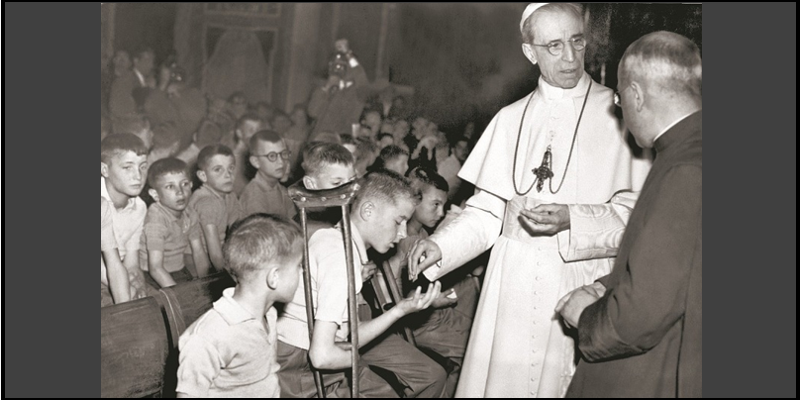
A book published in Italy offers previously unknown details.
VATICAN CITY, 29 May 2001 (ZENIT.org).- Were Pius XII’s silences simply silences, or rather a way of helping the Jews more effectively? More than that: can one really speak of silences? A new book published in Italy, with some previously unknown revelations, answers these questions.
«Pius XII. The Pope of the Jews» («Pio XII. Il Papa degli ebrei», Piemme publishing house), written by the Vatican correspondent of the Milan daily «Il Giornale», Andrea Tornielli, reconstructs, with documents that had not been published until now, the controversy surrounding Pope Eugenio Pacelli, who during his lifetime and after his death received the unanimous recognition of the Jewish world.
Since the 1960s, however, his figure has been called into question, first with the play «The Deputy» and, recently, with the publication of the book by the British journalist John Cornwell, «Hitler’s Pope».
But can it really be said —as his accusers try to do— that Pius XII was in some sense an accomplice of the Nazi persecution? Was it not rather a strategy to help the Jews persecuted by the Nazis more effectively and more freely, as the Pope himself confided to Don Pirro Scavizzi?
«After many tears and many prayers —the Pope told the chaplain who was gathering news about the persecuted—, I have considered that my protest would have aroused the fiercest rage against the Jews and multiplied acts of cruelty, since they are defenseless. Perhaps my protest would have brought me the praise of the civilized world, but it would have brought upon the poor Jews an even more implacable persecution than the one they already suffer».
We present below the interview conducted with Andrea Tornielli by Vatican Radio’s international news service.
–How are Pius XII’s silences to be explained?
–Andrea Tornielli: The documents clearly show that the «silences were not really silences»: in the book, I quote all the passages from the radio messages in which Pope Pacelli explicitly states very clear things. In any case, Pius XII did not publicly denounce Hitler, because he tried to save the greatest possible number of human lives. Thanks to his prudent attitude, the Church, the nuncios and the Vatican succeeded in saving, as the Jewish historian Pinchas Lapide calculated, about 850,000 Jews from persecution and death.
–One of the most interesting aspects included in the book is the one referring to a document in which Pope Pacelli condemned Nazism; a document that he later preferred to burn after seeing what had happened in Holland. Is there proof that this document existed?
–Andrea Tornielli: In 1942, the Pope was about to publish a very severe document against the Nazis, against Hitler, against the persecution of the Jews. But he was deeply impressed by what happened in Holland. In that country, after the bishops’ protest, the persecutions against the Jews worsened. The proof of the existence of this document comes from many testimonies, such as that of Sister Pasqualina Lehnert, Sister Konrada Grabmeier, Father Robert Leiber and even the French Cardinal Eugène Tisserant. These witnesses revealed that the Pope had written that document and that he decided to burn it personally in the kitchen, waiting until it was completely destroyed. The shock caused by the Dutch case was so deep that he preferred to burn it rather than cause further harm to the Jews.
–You also mention the admonition to the archbishop of Vienna, Theodor Innitzer, made by Pacelli when he was still Vatican secretary of state, in 1938…
–Andrea Tornielli: The case of Innitzer is very interesting, because that year this archbishop, together with other Austrian prelates, had enthusiastically welcomed Hitler’s arrival. Well then, Eugenio Pacelli and Pius XI urgently summoned Innitzer to Rome. Pacelli was very cold and forced Innitzer to sign, in his presence, a retraction, which was published in «L’Osservatore Romano». This shows that both Pacelli and the Pope, who at that time was Pius XI, rejected the position of the Austrian Church.
–You also speak of a plot against Hitler with the support of Pius XII.
–Andrea Tornielli: It is a very important case. In November 1939, and in the first months of 1940, there was an attempt by some German generals to bring down Hitler’s regime and to re-establish democracy. The Germans arranged for the news to reach the Vatican, and the Pope personally committed himself, running a great risk, to act as intermediary and to ensure that the news reached the British and American allies. Those generals later were unable to do anything, but the Pope took an active part in this project.
–Why is the Pope now accused of connivance with Nazism?
–Andrea Tornielli: An authentic «black legend» has been created that has nothing to do with historical debate. One thing is to discuss seriously the Pope’s attitude and the reasons why he decided not to make a public denunciation; quite another is to try to make him a scapegoat. This is what has been done with Pius XII. It must be acknowledged that the Pope did everything possible, while others did not do what they could have done…
–What gesture of Pius XII impressed you most in carrying out your research?
–Andrea Tornielli: There are many gestures: from the negotiations he carried out, using every possible and imaginable channel to stop the inspections in the Jewish ghetto in Rome, to the precise instructions given to the nuncios, not forgetting the fact that he himself spent his personal resources to send money to the nuncios in order to relieve the sufferings of the Jews.
Also important is the revelation that Pope Pacelli made to Don Pirro Scavizzi, the chaplain who traveled across Europe gathering news about the persecuted. Pius XII told him: «Tell them that the Pope suffers with them, suffers with the persecuted, and that if at times he does not raise his voice more, it is only so as not to provoke worse harm».
