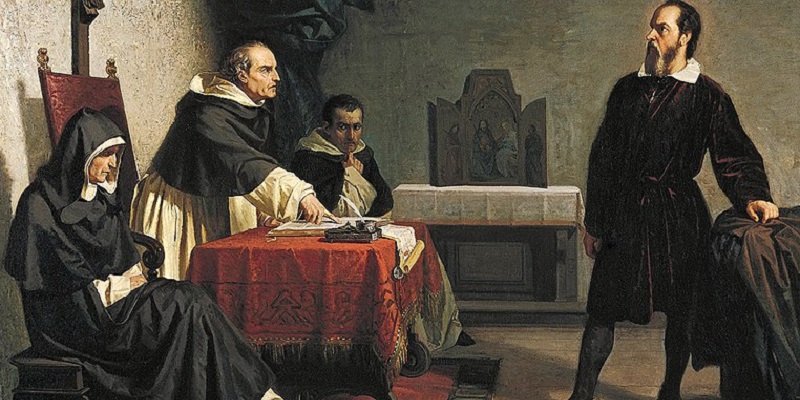
In October 1992, coinciding with the 350th anniversary of the death of Galileo Galilei, the special Commission of theologians, scientists and historians, created by John Paul II in 1981 to examine the possible errors committed by the ecclesiastical tribunal that condemned the famous astronomer in 1633, presented its conclusions. That examination did not bring to light any unknown novelty either: the pontifical theologians of the seventeenth century transposed the limits of the doctrine of faith in order to interfere in a question belonging to the scientific sphere. For his part, Galileo presented as irrefutable conclusions truths that he had not managed to prove scientifically; they would only be proved a century later. In any case, it should be noted that the Galileo episode is by no means representative: it is the only historical conflict of its kind.
The first half of the seventeenth century marks the beginning of what Paul Hazard called “the crisis of the European mind,” the title of one of his most famous works. A complex combination of factors changed people’s mentality.
In the philosophical sphere there lived Francis Bacon—who regarded experience as the only source of knowledge—and René Descartes, who defines truth as the clarity of concepts, rather than as their conformity to reality. And it is in the scientific-astronomical field that Galileo develops his new cosmology.
“His basic idea was the existence of a harmony in the universe and the application of mathematics to observed phenomena, moving away from Aristotelian physics. Galileo opened the way to modern science by affirming that material phenomena obey well-defined laws and that the task of scientists is to discover them through careful observations and controlled experiments. Science and philosophy separate in the seventeenth century: the object of the former will not be to seek answers to the philosophical whys, but to find the how of natural phenomena” (Valentín Vázquez de Prada). Science seeks quantitative solutions and separates itself from the search for metaphysical or existential unities of meaning.
THE PARADOX OF THE PROBLEM
Galileo, deepening Copernicus’s worldview, presented the heliocentric theory with a marked polemical tone against the ideas of his time. Its scientific basis was refuted as insufficient and erroneous, as indeed it was. His brilliant intuition, later confirmed, did not rest on correct proofs. Yet, before his theological judges, he put forward sound arguments in a field that was not properly his own: the interpretation of Sacred Scripture.
He appealed to criteria of Saint Augustine concerning an interpretation of the Bible that need not necessarily be literal. Some passages of the Bible—the one in which Joshua stopped the sun in its course—seem to corroborate the idea of the earth as the center of the cosmos. But this need not have been a scientific idea, but rather a metaphorical one ordered to the ultimate meaning of the universe, which is reached by faith. This would make the Old Testament compatible with the heliocentric theory.
Paradoxically, the Holy Office—by virtue of the opinion of a commission of theologian-astronomers—brought to light Galileo’s scientific errors.
According to Walter Brandmüller, a scholar of the subject, the members of the inquisitorial commission held ideas similar to those of the Italian astronomer, but could not verify them. However, they erred in their own field: the interpretation of the Scriptures. In the apparent dilemma, the Tribunal opted for the inviolability of the biblical text.
SEPARATING FACTS AND OPINIONS
For Brandmüller, this event manifests the historicity of human knowledge. The Church’s judgment is preserved from error only when it pronounces on faith and morals. But the Church did not condemn Galileo dogmatically. Only someone who considers himself exempt from fallibility—concludes Brandmüller—could judge the judges of Galileo.
Moreover, it is necessary to overcome past opinions that mix data with incoherent interpretations. For example, Owen Gingerich (cf. The Galileo Case in “Scientific American,” 1982, II) cites Pope Urban VIII when he warns Galileo that the movement of the tides might not be due to the movement of the earth, as in fact is the case. However, Gingerich focuses more on an alleged a priori: “perhaps the truth is not what you say according to your hypothesis” (interpreting in this view a safeguard of doctrine against any scientific achievement that might compromise it), instead of stressing the prudent observation of the Pontiff against what was an error of Galileo, as Gingerich himself logically acknowledges.
This author also says that Pope Paul V (prior to Urban VIII) was of the opinion that Copernicus—the starting point of Galileo—should be declared contrary to the faith, although he did not actually do so. The source on which he bases this claim is, according to Gingerich himself, “the gossip recorded in the diary of Giovanfrancesco Buanamici, a secretary of Galileo” (a source of little seriousness).
On the other hand, when Gingerich speaks of Galileo’s denial of his own ideas under pressure from the Inquisition, he separates it from its historical context. The point is not to justify, or not, a pressure of the Holy Office upon Galileo, but to affirm that a present-day view—which does not take into account the value, not only personal but also state and social, that religion had in the seventeenth century—cannot judge correctly a question in which historical mentality is fundamental. Gingerich does not deny the value of Sacred Scripture, but he fails to understand the harmonious and complementary character of the separation between the exegetical-scriptural method and the scientific-astronomical method.
It has been the Holy See itself that has best put all the dots on the i’s.
JOHN PAUL II: “A MISUNDERSTANDING THAT BELONGS TO THE PAST”
Like most of his adversaries, Galileo made no distinction between the scientific approach to natural phenomena and a reflection on nature, of the philosophical order, which that approach generally calls for. That is why he rejected the suggestion made to him to present the Copernican system as a hypothesis, inasmuch as it had not been confirmed by irrefutable proof. Such, therefore, was an exigency of the experimental method of which he was the inspired founder. (…)
Thus the new science, with its methods and the freedom of research which they implied, obliged theologians to examine their own criteria of scriptural interpretation. Most of them did not know how to do so. Paradoxically, Galileo, a sincere believer, showed himself to be more perceptive in this regard than the theologians who opposed him. (…)
The cultural horizon of Galileo’s age was uniform and carried the imprint of a particular philosophical formation. This unitary character of culture, which in itself is positive and desirable even in our own day, was one of the reasons for Galileo’s condemnation. The majority of theologians did not recognise the formal distinction between Sacred Scripture and its interpretation, and this led them unduly to transpose into the realm of the doctrine of the faith a question which in fact pertained to scientific investigation (…). From the beginning of the Age of Enlightenment down to our own day, the Galileo case has been a sort of “myth”, in which the image fabricated out of the events was quite far removed from reality (…). The clarifications furnished by recent historical studies enable us to state that this sad misunderstanding now belongs to the past. (Address to the Pontifical Academy of Sciences, 31-X-1992).
A UNIQUE CASE
The Pope has not carried out a “rehabilitation” of Galileo, for the Church had already acknowledged its error in 1741 when instruments became available that made it possible to verify the truth of Copernican heliocentrism. What the Church has underlined is that Galileo’s judges were mistaken in the field of the explanation of Sacred Scripture, biblical exegesis, by thinking that the “letter” of the Bible defended the Ptolemaic system, that is, that the Sun revolves around the earth (…)
According to Catholic doctrine, the Church’s infallibility is circumscribed to the solemn ex cathedra declarations of the Pope and of ecumenical councils in communion with the Pope. It is therefore evident that an ecclesiastical tribunal can be mistaken.
I would like to stress in this regard that the condemnation of the Holy Office against Galileo was never signed by the Pope, nor was it a condemnation of the Magisterium of the Church, but of a tribunal. Moreover, it is important to place the episode within its proper limits, because, being a unique case, a “Galileo myth” has been created that has little to do with reality. (…). Prof. JUAN JOSÉ SANGUINETI (Rome)
THE PAPAL COMMISSION
It was the Pope who wished to settle “a historical dispute which, amplified and mythicised, has been the instrument for spreading an obscurantist image of the Church in relation to scientific progress.” Within the framework of the annual meeting of the Pontifical Academy of Sciences, the conclusions prepared by an interdisciplinary commission, instituted by John Paul II in 1981, were made known; the commission was to examine in depth the circumstances of the condemnation made in 1633 by the Roman Holy Office of the Italian astronomer’s theories.
“Some media outlets presented this act as the rehabilitation of Galileo by the Church, as though the Church were now acknowledging the error of that time for the first time. The reality is that the heliocentric theory was officially recognised by the Holy Office already in 1741, when the mechanical and optical instruments appeared that made it possible to demonstrate that the Earth revolves around the Sun and on its own axis.
This desire for clarification must still overcome certain clichés, which forget that both Copernicus and Galileo were sincere believers and that their theories were taught in the universities of the Church.”
CONCLUSIONS OF THE COMMISSION
The conclusions of the examination can be excerpted from the address given before the Pope by Cardinal Paul Poupard, coordinator of the work:
“The objective of these working groups was to respond to the expectations of the world of science and culture regarding the question of Galileo, to rethink the whole question—with full fidelity to the historically established facts and in conformity with the doctrines and culture of the time—and loyally to recognise, in the spirit of the Second Vatican Council, the errors and the merits, from whatever side they came (…)
“The investigation has been broad and exhaustive, and has been carried out in each of the fields concerned (…)
“In a letter of 12 April 1615 addressed to the Carmelite Foscarini, Cardinal Robert Bellarmine had already set out the two true questions raised by the system of Copernicus: is Copernican astronomy true, in the sense that it is based on real and verifiable proofs, or, on the contrary, is it based only on conjectures and appearances? Are the Copernican theses compatible with the statements of Sacred Scripture? According to Robert Bellarmine, until proofs were provided of the rotation of the earth around the sun, it was necessary to interpret with great circumspection the passages of the Bible which declared that the earth is immobile. But if it were demonstrated that the rotation of the earth was certain, then theologians should—according to him—revise their interpretations of those passages of the Bible apparently in contrast with the new Copernican theories, so that opinions whose truth had been demonstrated would not be considered false (…)
“In fact, Galileo did not succeed in proving irrefutably the double movement of the earth, its annual orbit around the Sun and its daily rotation around the polar axis, while he was convinced that he had found the proof in the ocean tides, whose true origin Newton alone would later demonstrate (…)
“In 1741, in the face of optical proof of the rotation of the earth around the Sun, Benedict XIV had the Holy Office grant the Imprimatur to the first edition of the Complete Works of Galileo (…)
“The rereading of the archival documents shows once again that all the actors in the trial, without exception, have the right to the benefit of good faith, in the absence of contrary extra-procedural documents. The philosophical and theological qualifications abusively attributed to the new theories of the time concerning the centrality of the Sun and the mobility of the earth were the consequence of a situation of transition in the field of astronomical knowledge and of an exegetical confusion with regard to cosmology. Heirs of the unitary conception of the world that prevailed universally until the dawn of the seventeenth century, some theologians contemporary with Galileo did not know how to interpret the deep, non-literal meaning of the Scriptures when they describe the physical structure of the created universe, a fact that led them unduly to transpose into the field of faith a question of factual observation.”
GALILEO CONTINUED WORKING
I often speak of Galileo in my classes and lectures. Many listeners think that Galileo was burned by the Inquisition. That is why I usually recall that Galileo died a natural death at the age of 78 (…). In 1633, the famous trial against Galileo took place in Rome. He was not sentenced to death, nor did anyone intend it. No one tortured him, struck him, or laid a finger on him; there was no kind of physical mistreatment. He was sentenced to prison, which, taking into account his good dispositions, was immediately commuted to house arrest. From the trial until he died, he lived in his house. He continued working intensely, and published his most important work during that period. Three of the ten high dignitaries of the tribunal refused to sign the sentence. Of course, the trial should not have taken place, and it was regrettable. But Galileo’s work went on. (Pamplona)
Author: Mariano Artigas
Source: Arvo.net
