
Brief biblical study on the figure of Mary in the Gospel and on some Marian dogmas: Immaculate Conception and Assumption into Heaven.
Jesus gave the disciple whom he loved to his mother Mary:. And from that hour the disciple received her into his house (Jn 19, 27). Today, in which house is Mary received?
Why do we honor Mary? For many reasons but always the main thing is that in honoring Mary we follow the example of God and his son Jesus Christ, who honored her. The angel Gabriel, spokesperson of God, carrying the Father’s message, said to her: Hail highly favored (full of grace) (Lk 1, 27). He also said: Blessed are you among women. God the Father honors her here twice. God “exalted“to Mary (1, 52).
Elizabeth filled with the Holy Spirit (Lk 1, 41) also said to her, Blessed. Among all women… blessed (Lk 1, 42 and 45). Evangelical theologian, Rodelo Wilson, states that: “Blessed are you among all women” is a Hebrew way of saying the most blessed of all women. (1).
Mary is the only one called “blessed” personally by God. People who are truly filled with the Holy Spirit like Elizabeth have no reservations about honoring Mary. Furthermore, Elizabeth was Mary’s cousin; They probably visited each other frequently. But when Elizabeth learned of Mary’s unique identity her reaction was that of a Catholic, not a Protestant. She had a deep sense of reverence in the presence of Mary’s greatness: Why is this granted to me, that the mother of my Lord come to me (Lk 1, 43)?
And Jesus honored her too. He says that he did not come to destroy the law, but to fulfill it (Mt 5:17-18 and Luke 16:17). Jesus, being God, perfectly fulfilled the moral Law. Now, what is the heart of the law? The 10 commandments. Jesus fulfilled them perfectly. And the fourth commandment says You will honor your father and mother. He honored Mary perfectly. Jesus, though now glorified, remains a man forever. So he is still the Son of Mary. For this reason, the Catholic Church, which loves Jesus so much, wants to follow his example. If Jesus loves her so much, so do we love her. If Paul says that the elderly deserve DOUBLE HONOR and MOSTLY THOSE WHO WORK IN PREACHING AND TEACHING (1 Tim 5, 17), Would we say that the Mary, who is with God, does not deserve our honor? How foolish it would be to think that a friend of yours could not love your mother, because this would diminish the affection he has for you. On the contrary, if he truly loves you, he honors you by loving those you love.
When Jesus saw his mother, and the disciple whom he loved standing present, he said to his mother, Woman, behold your son. Then he said to the disciple: Behold your mother. And from that hour the disciple received her into his house (Jn 19, 26-27). Jesus had many friends, but one was the disciple whom he loved. Jesus does love everyone equally, because he is love. But one was “the beloved.” And to him Jesus gave his mother. Jesus loves all his children, but those who want to be like “the disciple whom Jesus loves” receive Mary too. We read in Matthew that the angel of the Lord told Joseph not to be afraid to receive Mary (Mt 1:20). Will the brothers be afraid to receive it? After all, if God can bless us (Eph 1:3), how much more can he bless the mother of his Son. In this quote, Paul bless God the Father and Jesus! (“We praise God the Father” says God Speaks Today. That is, “bless” is the same as “praise”!) And it says that God the Father blesses us using the same word.
In the evangelical magazine The Good Seed There is an article titled (March-April 1996, p. 16): “Prayer, intercessory mothers for their children“, and states the following: “God wants to bless our children and He has given fathers and mothers a certain spiritual authority in their lives. (Mary in relationship with Jesus!). Therefore, A mother’s prayer for her children is a powerful prayer.…every mother can pray effectively for her children… Whether we have children of our own or not, by the simple fact of being a woman, God has qualified us for motherhood. This implies the ability to have emotions of compassion, tenderness… He can use these qualities to make us excellent intercessors…” (p. 16). Imagine the mother of Jesus Christ then!
 In chapter 12 of the Apocalypse we find four characters in battle who represent groups of people and specific people. The woman with the man-son is Mary with Jesus. John (alluding to Genesis 3, 15) in verse 17 says: Then the dragon was filled with anger against the woman; and he went to make war against the rest of her descendants, those who keep the commandments of God and have the testimony of Jesus Christ. If you, brother, “you keep the commandments” and “you have the testimony of Jesus Christ, are of the descendants of Mary. You are his son spiritually. Or do you want to ally with the dragon against Maria? Therefore, when John received Mary as his mother at the foot of the cross, he did so in the name of all those who have a testimony of Jesus Christ.
An argument that the brothers use is John 2:4 to say that Jesus was against Mary: What do you have with me woman(2)? My time has not yet come. But it seems that it was not like that. Mary, who lived with Jesus for 30 years, knows him too well. She knew that Jesus did not scold her because she said to the servants: Do everything I tell you (Jn 2, 5). “My hour” was the hour when Jesus was to be glorified. She was anticipating the miracle of changing water into wine, in which she participated: Jesus did this beginning of signs in Cana of Galilee, and manifested his glory; and his disciples believed in him (Jn 2, 11). With the intervention of Mary, Jesus began his ministry manifesting his glory, and his disciples believed. It was impossible for Jesus to have despised Mary if she perfectly fulfilled the fourth commandment, especially when Mary, by wanting to help married people, was acting out of overflowing love. Could it be that Jesus would punish her for the charity she showed? Maria always points towards him: do everything I tell you(3) .
 The New Eve
 The New Eve
In the early Church, the idea of Mary as the antitype of Eve was rapidly developed with scores of works. The apologist Justin Martyr (in Dialogue with Trypho, 100: 4-6) wrote about the similarities and differences between Eve and Mary as an extension of the parallel between Adam and Christ of Rom 5, 12-21. “It is possible, however, that Justin already found precedents for this parallelism in the most primitive tradition of the Church” (Marian Texts of the First Centuries, Guillermo Pons, Edit Ciudad Nueva, 1994, p. 24. The list of parents is long)(4). Due to the importance that the early Church gave to this topic, we will discuss it in more detail later.
Jesus calls Mary “woman” (John chapters 2 and 19). John structures his gospel to make the connection between Eve, “the woman” who fell to the serpent, and Mary (Gen 3:15) and “the woman” mentioned in Revelation who did not lose the battle with the serpent, because her son triumphed as King. For this reason the woman appears as Queen: A great sign appeared in heaven: a woman clothed with the sun, with the moon under her feet, and on her head a crown of twelve stars. (Rev 12, 1). Paul understood Jesus as the New Adam (Rom 5, 14). We said that this idea gave impetus to the biblical reflection of Justin Martyr.
The first doctrine on the parallel: Adam… New Adam (Jesus Christ) and Eve… New Eve (Mary) leads our reflection to the following: If Adam, Eve and the New Adam came to earth without sin, to complete the parallelism, Mary must have been conceived without sin as well. Why say this about the three and not about Mary? It doesn’t make sense.
The Old Testament
We have seen that the OT is full of prefigures of the NT. In addition to the prophecies, there are people, events, even places that prefigure events in the life of Jesus. He himself mentions it in Luke 24, 27. In John we read: Search the Scriptures; because it seems to you that in them you have eternal life; and they are the ones who bear witness to me (Jn 5,39). We mentioned how the Apostle Paul understood Jesus in this way, he saw him as the New Adam (Rom 5:14). The Passover, in Exodus 12, prefigured the Last Supper and the paschal mystery of Jesus Christ. Another thing that prefigures Jesus and his mother Mary occurred in the time of King Solomon.
The Queen-Mother
The OT speaks of a practice that became a permanent custom. At court, the king’s mother occupied a special place. For reasons of the fourth commandment, the name of the king’s mother was associated with his taking power (1 Kings 14, 21; 15, 2 and 10)(5) . The king’s mother had a powerful and prestigious title: GEBIRAH (“lady” parallel to “lord”) and even wore a crown (Jer 13:18). The Gebirah is mentioned almost regularly in the lists of the kings of Judah (except Joram, Ahaz and Asa).
Solomon was made king (1 Kings 1, 45-46). He was the son of David, who prefigures Jesus who is also the son of David. Solomon was anointed and took the throne. (Read 1 R 2, 12.) Also Jesus. Solomon’s mother, Bathsheba, was given a seat at the king’s right side and she interceded for the people before Solomon. He bowed before her (1 Kings 2, 19), and stated that he could not deny the requests she made for the people (v. 20). In the entire history of the kings of Israel, the prophets never criticized this institution of the queen at the king’s side. On the contrary, it was accepted by them (although they condemned the kings many times for breaking God’s law): Daughters of kings are among your illustrious ones; The queen is at your right hand with gold from Ophir… The rich people of the town will implore your favor. All glorious is the daughter of the king in her dwelling…. I will make the memory of your name perpetual in all generations, for which the people will praise you eternally and forever.(Ps 45, 9-17).
It is clear that this example prefigures Jesus, messianic king (2 Sam 7, 10-17) and his Mother (Mary means princess in Aramaic). That is why the first Christians, being Jews and accustomed to this tradition, did not have any problem when the Church venerated Mary as Queen of Martyrs and Saints and intercessor of the Church. They saw Solomon and Bathsheba as prototypes of Jesus and Mary, since Mary consented to give birth to Jesus (Lk 1:31-33 and Mt 1:21) the King and Savior. Christ shares with us his royal power (2 Tim 2, 11-12. See Mt 19, 28 and Rev 3, 21 and 22, 5: and they will reign forever. How much more with Maria!
After Bathsheba, this custom remained institutionalized whenever there was a king of Israel (like Maaca in 1 Kings 15, 13). In Proverbs 31, we read that King Lemuel’s queen-mother wrote this chapter for her son before he came to the throne, so that he would know what kind of wife he should have. (See also Jer 13:18).
Pope Pius XII said that Mary is queen in a restricted sense and only in an analogous way does she share royal dignity by being the mother of Christ. Only Christ is King in the absolute and full sense. Mary’s title as Queen of Heaven does not come from her marrying God but is based on the honor of being the queen-mother of Jesus Christ, the King of Kings and Son of David.(6) .
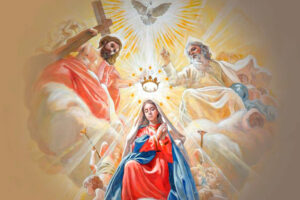
I don’t know why the brothers don’t want to admit that Mary can be queen when all Christians are kings: If we suffer, we will also reign with him (2 Tim 2, 12), as are the apostles: And Jesus said to them: Truly I say to you, in the regeneration, when the Son of Man sits on the throne of his glory, you who have followed me will also sit on twelve thrones, judging the twelve tribes of Israel.l (Mt 19, 28). To him who conquers, I will give him to sit with me on my throne, just as I have conquered and sat down with my Father on his throne.(Rev 3, 21. See 1 Sam 2, 8). Mary says that the humble are exalted (Lk 1, 52) for all generations (1, 48). All Christians share the royal dignity of Jesus but one was “full of grace” and so was her mother.
In Luke Jesus says: You are the ones who have remained with me in my trials. I therefore assign you a kingdom, as my Father assigned it to me (22, 28-29). Who better than Mary fulfills this word of Jesus? If he remained with Him until Calvary. She is Queen of the New Jerusalem with our King Jesus Christ. And since it is the destiny of all Christians to reign as kings with Christ (Rev 1:6; 5:10), Mary being the greatest Christian, why bother with her for being queen?(7) You will receive the incorruptible crown of glory (1 Pet 5, 4; See 1 Cor 9, 25). We do not worship Mary. But we do venerate her as her Son does. So when evangelicals see us praying to Mary they think we are worshiping her. They do not distinguish between worship and veneration like we do. Worshiping righteous people is biblical: And as Obadiah went along the road, he met Elijah; and when he recognized him, he fell on his face and said, Are you not my lord Elijah? (1 Kings 18, 7). And they came to meet him, and fell down before him(Elisha) (2 Kings 2, 15).
Elizabeth said to Mary: Blessed are you among women (Lk 1, 42). He says to Jesus in the same way: and blessed is the fruit of your womb. In Aramaic as in Hebrew it is a superlative, like saying “the most blessed among all women”, (and to Jesus: “the most blessed”). Elizabeth’s words express that Mary was the holiest of all women.
The brothers also quote Luke in a way that seems to go against honoring Mary: While he was saying these things, a woman from the crowd raised her voice and said to her: Blessed is the womb that bore you, and the breasts that you suckled. And he said to her: But blessed are those who hear the word of God and keep it. (Lk 11, 27-28). They say that Mary was blessed in the past but is not blessed now. But this is exactly the problem with the woman who shouts this in this Bible passage. She was thinking that Mary was “blessed” in the past but not now. Furthermore, he thought that Mary was great only for biological reasons: Blessed is the womb that brought you, and the breasts that you suckled. But Jesus oriented the woman toward the present. He said that what was important about her was not only the physical reasons but also the spiritual ones. Like the other disciples, Mary is blessed for hearing and keeping the Word of God. Maria is a model of this. He was faithful to the Word until the Cross, even until the day of Pentecost (Acts 1, 14).
 In Luke we read that Simeon says to Mary: And a sword will pierce your very soul (2, 35). It is tradition of the Church that this “sword” is the pain that Mary was to feel for the sufferings of her Son. But there is also another interpretation. In the OT “sword” often refers to the word of God (Is 49:2 and Wis 18:15). In the NT it is spoken like this seven times (Rev 1, 16; 2, 12 and 16; 19, 15 and 21; Eph 6, 17) In Luke 2, 35 we see how similar Heb 4,12 is. The “sword” that penetrates Mary’s soul is the word of God. She is a believer completely penetrated by the teaching of Jesus, the Word of the Father. She kept the Word:
And blessed is she who believed (Lk 1,45).
Maria kept (doesn’t say saved once) all these things meditating in your heart (Lk 2, 19).
And his mother kept all these things in her heart (Lk 2, 51).
Blessed are those who hear the word of God and keep it (Lk 11, 28).
Observe that what Mary says is future From now on all generations will call me blessed (Lk 1, 48). Only the Catholic Church fulfills this prophecy.
Some misinformed brothers say that the belief in Mary queen came from paganism because in Jer 44 the pagan goddess is called “queen of heaven.” But no Catholic thinks that Mary is the goddess Astarte or Ishtar. To be consistent, why not say then that the belief in the resurrection of Christ came from paganism that taught that Osiris and Dionysus, gods of fertility, died and were resurrected?(8) . The fact that something pagan has the same title as something Christian does not mean that one comes from the other. In Daniel 2:37 the pagan king Nebuchadnezzar is called “king of kings”, but that does not mean that this title cannot be applied to Jesus Christ as in Rev 17:14.
THE IMMACULATE CONCEPTION
 And the temple of God was opened in heaven, and the ark of his covenant was seen in the temple (Rev 11, 19).
The belief is that Mary was conceived without original sin. God had it as part of his saving plan from the beginning: And I will put enmity between you and the woman, and between your seed and her seed.… (Gen 3:15). It is not by chance that Jesus calls Mary “woman”, the new Eve – on the cross – because there she defeated Satan. (Paul also uses the word “woman” in Gal 4:4). Jesus exalts her as the New Eve: the woman.
There are many misunderstandings about the doctrine. Pope Pius IX, in 1854, proclaimed the faith of the Church: that Mary, from the moment of her conception, by a free gift of God and by the merits of Jesus Christ, was preserved from every stain of original sin. This doctrine includes that Mary never disobeyed God in her entire life.
The brothers say that only God is sinless, and then that Mary is a sinner. Proof of this is that she herself called Jesus Savior (Lk 1, 47). Furthermore, they say, Paul wrote that There is no one righteous, no one seeks God,… everyone sinned (Rom 3, 10-12 and 23) (9) .
We have touched on this last argument that no one is righteous before in chapter 18. Paul quoted King David. If we take the argument that no one is righteous we reach the extreme of absurdity because the Bible says that Elizabeth and Zechariah were righteous (Lk 1, 6 and 2, 5), and while Paul says “no one seeks God”, Cornelius did seek him (Acts 10, 3-5). Adam and Eve were righteous before they sinned. Aren’t the angels and saints in heaven just? Isn’t Jesus just? How can James say in 5:15: The effective prayer of a righteous man can do much if there are no righteous?
Without sin conceived
We read in Luke 1:28 that God through Gabriel calls Mary highly favored (Zeph 3:14, Jl 2:21; Zech 9:9), which in Greek is KECHARITOMENE (full of grace) or “the perfection of grace.” The root of this word is caris which means grace.(10). In fact, the form of the word in Greek implies that Mary IS ALREADY (past) perfected in grace. And, as Paul says (Phil 3, 9f), sin is incompatible with this. That is to say that in Mary there is no room, in her soul and heart, for sins. Grace is opposed to sin. Note that Mary is already full of grace. It doesn’t say “it will be full.” How can one “be full of grace” if Jesus had not died yet and we are sinners from birth? Mary was saved by Jesus, but before she sinned; like when someone jumps into a pool to save another who is drowning. And before jumping into the water, the “lifeguard” prevents another person from falling into the same pool. Then this person saves the other before they fall, saving them at the same time as saving those who are drowning.
Mary proclaimed that Jesus was her Savior (Luke 1:47). He saved her this way. His redemptive work applies to the past because he saved from the beginning of the world (Rev 13:8). Jesus also saved the great characters of the OT even though they were born before him. Paul talks about how God chose him by his grace before he was born (Gal 1:15). God chose Jeremiah like this: before you were born I sanctified you (Jer 1, 5). As a Protestant pastor who converted to the Catholic Church narrates: “My wife says that Jesus saved her from drugs, prostitution, terrorism, etc. That is, because of her faith in Jesus, she never fell into these things! Jesus saved her in a similar way as Mary by preventing her from falling.”
In order to talk about Mary we must clarify what we mean by man’s collaboration with the grace of God. There are several biblical texts that help us understand, for example 1 Cor 3:9 and 2 Cor 6:1. The Church says that Mary collaborated with a special grace that the Father granted her so that she would be prepared to be the mother of her divine Son. Mary articulates this collaboration fully: May it be done to me according to your word (Lk 1, 37).
More tests
When we understand that the OT prefigures the NT, and that the new is better than the old (e.g. the New Adam is better), we understand that Mary is foreseen, for example, in the “mother earth” from which the first Adam came. And this land was spotless. He was not under the curse yet (Gen 3:17). The immaculate elements from which the first Adam came, prefigure Mary from whom Jesus came (Rom 5, 14)(11) .
Mary is also prefigured in Eve, the mother of our race. (We must remember that the types are only shadows of the antitypes of the N.T.), As we saw, she is our mother because she is the mother of the Church, the body of Christ (Rev 12, 17). What Eve lost by disobedience, Mary corrected by her faith: Behold the servant of the Lord; let it be done to me according to your word (Lk 1, 38). While the serpent defeated Eve (Gen 3, 13), God protected Mary from its bite: AND When he saw the dragon that had been cast to the ground, he pursued the woman who had given birth to the man child. And the two wings of the great eagle were given to the woman, so that she might fly from before the serpent into the desert.… (Rev 12, 13-16).
We see in Genesis something very important: the seed says his (the seed of the woman) (3, 15), and the Greek word in the Septuagint version is SEMENOS (semen in Spanish). So, since a woman does not have semen, the only woman to whom it could refer is Mary, whose child was conceived without a man, because other people are born of a woman and a man, from whom the semen comes. Genesis tells us that there would be complete enmity between the woman and the serpent and that the woman was going to hurt the serpent: And I will put enmity between you and the woman, and between your seed and her seed. This woman (prefigured Mary) is in total enmity with the devil. Such total enmity would not exist if Mary had sinned as Eve sinned. They are not partners. The serpent is the source of all sin and evil. After all, it is God who makes Mary not sin: I WILL PUT enmity between you and the woman (Gen 3, 15).
There is no need to put Jesus or Mary in opposition as if they were one or the other. Catholics see how the two fight together against the devil (Gen 3, 15). In this first prophecy of the plan of salvation, we see that “the woman” who prefigures Mary and her descendant (Jesus) fight against Satan.
It is important to see how Mary is prefigured by other women that God uses to save his people from the evil one. The two women wound the head of God’s enemy in Genesis 3:15: Jael, in Judges 4:21, kills Sisera with a stake to the head. And as Elizabeth would say to Mary in Luke 2:42, so they say to Jael: Blessed be among women (Judges 5, 24). Another woman who prefigures Mary is Judith: She does the same with another enemy of God, Holofernes, she cut off his head (13, 8) thus saving the people of God. Of her as of Mary it is said: Blessed are you in all nations (Jdt 14, 7).. The people of Israel praise her saying: The Lord has shown you his favor. May the Lord Almighty bless you eternally (15, 9). It is clear that these women: from Genesis 3, Jael and Judith prefigure Mary that God uses as an instrument against the enemy. In the case of Mary, the enemy she conquers is the devil, who was also defeated by Jesus on the Cross planted on Golgotha. The interesting thing is that Golgotha means skull (Jn 19, 17). Then again an enemy of God – the supreme enemy – is defeated through the symbol of wounding his head: the wood of the Cross planted in the “skull.”
Mary is also the New Tabernacle. The first tabernacle was built in detail according to Exodus 25, 9 and 39, 42-43 to be perfect and spotless (2 Chr 7, 2). This prefigures Mary. The glory of God covered and filled the first tabernacle (Ex 40, 34-38). Compare this to Gabriel’s words in Luke 1:35 where Mary is covered with this glory, the glory of the Holy Spirit descended upon her.(12)

Mary was prefigured as the tabernacle perfectly built without stain. The translation of the Seventy (LXX) uses the same word and speaks in the same way about Mary (the power of the Most High fills her in Luke 1:35) as what happened to the tabernacle (Ex 40:34-35).
It is also clear that Luke wants us to see Mary as another perfectly constructed Ark of the Covenant. Also compare second Samuel (6, 9), we see that David says something similar to what Elizabeth says to Mary (in Luke 1, 43): How shall the ark of the Lord come to me?; David jumps in front of the ark (2 Sam 6, 14) as John the Baptist jumped for joy in front of Mary(Lk 1, 44) the New Ark of the New Covenant that contains Jesus the true bread of heaven (the first ark contained the manna). And it is not by chance that it is said of the ark that He was in the house of Obed-edom the Gittite for three months. (2 Sam 6, 11), just as it is said of Mary: And Mary stayed with her for about three months. (Lk 1, 56). This is how you find this link between the perfectly built ark and Mary in the book of Revelation: And the temple of God was opened in heaven, and the ark of his covenant was seen in the temple. And there were lightning, voices, thunder, an earthquake and great hail. A GREAT SIGN appeared in the sky: a woman clothed with the sun… (Rev 11, 19-12,1).
As Mount Sinai is holy because God is there (Ex 3:5), even more is Mary “holy” because of the presence of God in Her. It is true that none of these things undoubtedly “prove” the Immaculate Conception, but they do point to it. If you were God, how would you create your mother with or without sin?
God’s idea in saving Mary from sins is so that she does not receive in her soul the sin of Adam that Paul mentions. Jesus, being God, is perfect and nothing with stain can come close to God (Rev 21, 27). God dwells in inaccessible light (1 Tim 6, 16). God prepared Mary to receive the Son of God through the Holy Spirit.
Luther wrote more than 60 homilies and sermons praising Mary. Calvin wrote some too. Recently more and more Protestants (non-fundamentalists) are recognizing the privileged place of Mary, as we can see in talks given at the congress on Mary by the Lutherans, Reformed, etc.
It’s funny how much the brothers talk (although in a negative way) about Mary!
Recently in the newspaper Reform (5/15/94) they quoted a Baptist missionary who said that Mary was born with sin because all human offspring from the point of view of Genesis are cursed. Does it include Jesus Christ who is a descendant of David?
ASSUMPTION OF MARY INTO HEAVEN
Nor will you allow your holy see corruption (Ps 16, 10b).
Paul said to the Corinthians: Just as in Adam all die, so in Christ all will be made alive. (1 Cor 15, 22). So, since everyone dies because of Adam’s sin, Mary, who was saved from Adam’s sin by Jesus, did not receive the punishment of death. As we see in Acts 2:27, the interpretation of Psalm 16 “not seeing corruption” means the decomposition of the body.
Paul admits the possibility of a bodily assumption (2 Cor 12, 2-4). The brothers have no problem with the idea that Elijah was taken to Heaven (2 Kings 2:11) just like Enoch (Gen 5:24 and Heb 11:5), but the Mother of Jesus is a problem! The early Church had no problem with the idea of the Assumption of Mary because it was a belief that Moses was also taken to heaven.(13). So Jude gives us a third faithful servant of God who was taken up to heaven bodily, as we saw in the section on oral tradition.
The bones of the saints have always been venerated as read in the books of the first Christians. Why are the bones of Mary that would have been most venerated never mentioned in any early Christian book? Because Mary was assumed into heaven. This is how the first Christians testify. It is important to remember that Catholic teaching does not say that Mary ascended to heaven by herself, as Jesus did. She was assumed, she was elevated by Christ.
MOTHER OF GOD?
The Holy Know that will be born will be called Son of God (Lk 1, 35).
“To affirm that Mary is the Mother of God is to presume that she existed before God” (14) .
“Against Nestorius, who put two persons in Christ, morally united, thus making Mary mother of the man-Jesus, but not of the son of God, the Council of Ephesus (a. 431) defined: ‘If anyone does not confess that Immanuel (Christ) is truly God and, therefore, that the Holy Virgin is Mother of God (Greek: TEOTOKOS = gave birth to God)… let him be anathema…. The passages New Testament documents that support this definition are: a) Luke 1:35… b) Luke 1:43… c) Galatians 4:4…” (15) .
But when the fullness of time came, God sent his Son, born of a woman..(Gal 4, 4).
Most of the brothers reject the title “Mother of God”, while Catholics use it. They say that Mary is only “mother of Jesus” and not “mother of God.” The Catholic Church defends this title to defend the belief that Jesus is God and man, not just man. So, giving birth to Jesus is giving birth to the true God (as Luke 1:35 says), but it is not being the origin of God-Father.
Does the Bible talk about Mary being the mother of God? Yes. Elizabeth said: Why is this granted to me, that the mother of my Lord come to me? (Lk 1, 43). For Elizabeth, “the Lord” is God as the context demonstrates. Elizabeth said in v. 45 (and Mary in v. 46): He believed because what was told to him from the Lord would be fulfilled. The angel spoke “on behalf of God” and it was not just the man Jesus. The “Lord” is God (vv. 46 and 47). The person who was born to Mary is: God-with-us (Mt 1, 23). God sent his Son, born of a woman…(Gal 4, 4). See Mt 1, 23: The virgin will conceive and give birth to a son and they will call him Immanuel <<God with us>> That is why Ignatius of Antioch says: “Our God, Jesus Christ, was conceived in Mary according to God’s plan.”
The title “Mother of God” (TEOTOKOS) is very ancient. A piece of papyrus was found in Egypt dated 260 AD. invoking the intercession of the Theotokos (Papyrus 470 in the John Rylands Library, Manchester). When it was proclaimed at the Council of Ephesus, crowds of people in the streets shouted enthusiastically: “Hagia Maria Theotokos“ Holy Mary, Mother of God!
The Protestant error comes from confusing this concept: mother of God, with this other: creator of God. The mother does not create anything, she only forms a body from her own substance which comes to animate a soul. It is God the Father who begot his Son. Thus, the Virgin Mary formed a body that, animated by a soul, the Son of God assumed for himself in the first instant of his supernatural formation. And Mary, being the mother of Jesus, is our mother also because Jesus is our brother (Rom 8:29).
Fundamentalists say that Mary was the mother of Christ’s human nature not his divine nature. But upon reflection we realize that this is wrong. Our mothers are not mothers of our nature but of us. It is a person that is conceived, not a nature. What was born was the person of Jesus, not a nature. The mother of a creature does not generate its soul, but even so she is not called the mother of the child’s body but the mother of the child.
The brothers of the Light of the World Church say: “No. 9 Year 431 A.D. MARY MOTHER OF GOD. …That she is the mother of God is a lie. In Acts 1:24 it says that she is the mother of Jesus Christ, not of God”(16) . (Attention reader, Acts 1:24 has nothing to do with the matter!).
mother of all
Mary is our spiritual mother. As? We saw that Mary is the mother of Jesus, and that we are her brothers. We also saw that the Church is the body of Jesus (He is the head of the body says Paul to the Ephesians). Could it be that Mary is only the mother of the head of the body? If Mary is the mother of Jesus, and the Church is the spiritual body of Christ, Mary is the mother of the Church spiritually. If Eve was the physical mother of us all, and Mary is the new Eve spiritually (the “woman”), she is our mother spiritually. Through the first came sin, through the second came who defeated sin.
Abraham is called our father in faith because he is an instrument of God (Rom 4:11-18). Mary was also (Lk 1 and Mt 12, 50). If we have no problem calling Abraham our father, why object to calling Mary mother? For this reason, like Abraham, Mary is our spiritual mother who Jesus gave to us (Jn 19, 26-27).
Mary is God’s “masterpiece.” It is an example of what God can work in us when we do not put obstacles, such as doubts, selfishness and sins. Have you visited a museum where an artist’s works are presented to the public? Could you imagine the artist being offended by looking at his masterpiece? Would he be upset that people see his artwork instead of him? Of course not. The artist would receive honor for the attention you give to his work. And Mary is the work of God from beginning to end. And if someone praises one of your children, do you interrupt them by saying, “Please give me the credit”? No. You know you are honored when your child is honored. Likewise, God receives honor and glory when his children are honored. If Paul could call himself “father” of the Corinthians and Thessalonians (1 Cor 4:15 and 1 Tim 2:2-11), why is it so difficult to think that Mary can be our spiritual mother? Mary is our mother by the simple fact of her faith in Christ (Mt 12, 50). Have you accepted Mary as your personal mother?
The Protestant reformers left three feasts in honor of Mary for their biblical foundation and their link with Christ: The Annunciation, the Visitation and the Purification (Presentation of Jesus to the temple).
In your Commentary on the Magnificat Luther prayed this prayer: “O blessed mother, most worthy virgin, remember us and obtain for us that the Lord also may do great things in us.”
The Rosary
 The brothers criticize us because we pray the rosary. They quote Matthew to “prove” that the rosary is repetitions of vain prayers: And when you pray, do not use vain repetitions, like the Gentiles, who think that for their many words they will be heard. (6, 7). It’s a case of not knowing how to distinguish between repeated sentences and sentences that are “words.” The point of this quote is: “vain words” (vain repetitions), and that in praying with much talk, one will be heard. Thus the pagans thought they could manipulate and control their gods with many words, but God cannot be controlled (see 1 Kings 18, 25-29).. The prayers of the Gentiles were in vain for this reason.
Jesus repeated his prayer three times in the garden of Gethsemane using the same words. In Mark we read: again he went and prayed saying the same words (14, 39). He gave us the example of the widow who persisted in her prayer (Lk 18, 1-8). Day and night the angels repeat Holy, Holy, Holy in heaven (Is 6, 3 and Rev 4, 8). God was pleased with the repeated prayers of the young people in the oven (Dan 3:52-90). Paul tells us: Pray without ceasing (1 Thes 5, 17) The same brothers have repeated the Lord’s Prayer at least once in their lives.
The rosary is made up of the Lord’s Prayer, Hail Marys – whose formulas derive from the Bible – and meditation on the mysteries of the life of Jesus. When we pray the Rosary we say blessed are you among all women, thus we fulfill the biblical prophecy that Mary proclaimed: From now on all generations will call me blessed (Lk 1, 48). Blessing is the same as saying blessed/happy as we see in other translations. The Rosary fulfills the prophecy. If God blesses us (Eph 1:3), and blesses Mary through Gabriel, why shouldn’t we bless her? Blessed are those who hear the word of God and keep it (Lk 11, 28).
Jimmy Swaggart, formerly famous televangelist, says that when praying with the rosary one speaks to Mary ten times more than to God (an Lord’s Prayer). It is false because we bless Jesus the same in every “Hail Mary” when we say “and blessed is the fruit of your womb Jesus.” Furthermore, could the fact that Paul’s name occurs 126 times in Acts, while Jesus’ name is only mentioned 68 times, imply that the author of Acts thinks more of Paul than of Jesus? The fact that the book of Esther does not even mention the name of God does not mean that the author was an atheist. Mary keeps nothing for herself but always points to her Son: Do what I tell you (Jn 2, 5).
The rosary is not repeating vain words. When your children tell you “I love you, mom” over and over again all day, you never punish them by saying, “Son, this is empty repetition.” Maybe we as children of God and Mary say “I love you mom, pray for me to God.” Although repeated, words are vain only if we say them without meaning, like robots.
In summary: The Catholic Church recognizes that, for some people, devotion to Mary could go to the extreme, that is, without taking into account their relationship with Jesus Christ. She is a finite creature and Christ is infinitely greater than her. The point of reference in devotion to her is Christ; every belief about it has its meaning in the context of the Savior. For example, the belief in the Immaculate Conception is understood within the theology that the Church is the immaculate bride of Christ and the Assumption into Heaven prefigures what will happen to the Church when Christ comes at the end of time: we will all go to meet him. Pope Paul VI emphasized that Christ is the only way to the Father and that is why devotion to Mary is understood as the means to lead us to him: Do everything I tell you (Jn 2, 5). And as the Pope pointed out, these are words that completely harmonize with those spoken by the heavenly Father when Jesus Christ was transfigured: listen to him (Mt 17, 5).
What did the early Church say?
The Privileges of Mary.
Justin Martyr (155): Dialogue with Trypho, 100.
Irenaeus (189): Against heresies, 3:22:24.
Tertullian (210): About the Flesh of Christ, 17:4.
Epifanio (374): The Firmly Anchored Man, 120 and Haereses (also known as “Panary” or “Medicine Chest”), 78:6.
Mother of God.
Irenaeus (180): Against heresies, 5:19:1.
Alexander of Alexandria (324): Encyclical Letter to all non-Egyptian Bishops, 12.
Ephraim (338-373 AD): Songs of Praise, 1:20.
Athanasius (365): Treatise on the Incarnation of the Word, 8.
Cyril of Jerusalem (350): Catechist Readings, 10:19.
And finally:
“If devotion to the Blessed Virgin were separated from her Son, it would be necessary to reject it as an illusion of the devil” ( The glories of Mary Luis de Ma. Grignon. de Montfort, First part, Chapter, II, First Truth, par 4)
from the book New Dictionary of Mariology, Stefano de Fiores and Salvatore Meo, Edic Paulinas, Spain, 1988:
“In the Blessed Virgin, the conditions for having an active part in the kingship of Christ are marvelously fulfilled. From the annunciation at Pentecost she embraced the divine plan for her own existence, she listened to the word of God, she followed him in trials even up to the supreme hour of immolation. Now, therefore, in communion with the entire church, she obtains the reward of such fidelity. Resorting to the image of the Apocalypse, we will say that Christ makes his mother sit next to him on his throne (Rev 3:21), making her a partner in that divine power that he has to subject all things to himself (p. 1719).
“The woman in Revelation 12 wears a crown. The painful birth of the woman is Mary at the foot of the cross. Dressed in the sun = full of grace (Ps 104, 2; Ez 16, 10-13a; Is 52, 1; Song 6, 10). Star zone of God (Is 14, 13; Job 22, 12).”
Source: Fr. Daniel Gagnon
GRADES
1. Rodelo Wilson argues that Elizabeth said blessed are you between all women, and not blessed about women and, therefore, Mary is not special. But the fact that he only said it to her “bless you” – and not to others is the same. Maria is a woman between women as Jesus Christ lived between men (Phil 2, 7), but that does not mean that Jesus is not about the men. After all, if God can bless us as Wilson reminds us (see Eph 1:3), how much more can we bless the mother of his Son! Perhaps if we change the order of the words spoken to Mary by Elizabeth: Among all women, blessed are you, we see more clearly that God is indeed elevating her.
2. The Evangelist John does not mention the name of Mary. It says “woman.” In Benko’s book we read, “Jesus addresses Mary as <woman> (GUNAI), a term that sounds disrespectful. In use, in the New Testament, however, the word is not disrespectful in any way…. it is equivalent to our expression <madam>. The word is polite…”.(Evangelicals Catholics and the Virgin Mary, p.20).The punishment for not honoring the mother was death in the O.T.
3. In the Saint Jerome Biblical Commentary (Volume IV, NT II, p. 434) we read: “If John has seen a new story of creation unfold in the preceding <<seven days>>, he also reserved a special position for the one to whom Jesus addressed calling her <<woman>>. The woman of the first creation was called <<Life>>,… because she was <<mother of all living>> (Gen 3, 20). She is the mother of Jesus and He is firstborn among many brothers (Rom 8, 29). Mary is mother of new life, not only of the Word made flesh, but of all those who live by virtue of her life (14, 19ff.). She is, in other words, a figure of the Church, the new Eve, as the Fathers (of the early Church) called her. Another similar representation appears in the woman of Rev 12, who is simultaneously the mother of Christ and the new Israel, where also the images of Gen. have served to inspire the vision. Taking this into account, we can understand the importance of her being called <<woman>> in 19:26ff., where the beloved disciple, representing all Christians, is entrusted to her as to his own mother” (Christianity Editions, Madrid, 1972).
4. He continued the topic Irenaeus, Against heresies, 3:22; Tertullian in Of the flesh of Christ, 17:5-6; Victorinus of Petovio (year 304) in From world factory; Aphraates Demonstrations, 4:6 face inCarmina Soghita, 1 and Hymns about the Church, 37, Jerome Letters to Eustoquia Num 22:21 and 22:19
5. 1 Kings 22, 42; 2 R 5, 3; 8, 26; 9, 6-7 and 22; 12, 1; 14, 2; 15, 2 and 33; 18, 2; 22, 1; 23, 31 and 36; 24, 18 Is 24, 2; Ps 123, 2; Pro 30, 23, etc.
6. It is interesting to note how the woman in Rev 12 who symbolizes Mary, (because she gave birth to Jesus, it was not Israel that gave birth to him) is dressed: with the sun and the moon under his feet. In Genesis and other places in the Bible, the sun and moon symbolize the power to reign: And God made the two great lights; the greatest light to rule the day (1, 16). In Psalm 89 the throne (v. 27) of the king is like the sun (v. 36). And when Jesus was transfigured, his face shone like the sun (Mt 17, 2. See Mal 4, 2), Mary, the woman of the Apocalypse is linked to this same royal power.
7. In Jeremiah 7:18 the prophet deplored devotion to the “queen of heaven.” But this one referred to the goddess of fertility: Ishtar. It has nothing to do with Maria.
8. Recently (1996) the book was published Mary Through the Centuries (Mary Through the Ages), Yale University Press by the famous Lutheran historian Jaroslav Pelikan where he demonstrates the typology of Mary and Old Testament figures (Eve, Miriam, etc.). Furthermore, the author clearly states that there was no influence between the mother goddess of the pagans and the Catholic belief of Mary the queen.
9. The Greek word for “all” does not necessarily indicate absolute universality. In Romans 5:12 Paul says that death happened to everyone, but we know that Enoch and Elijah did not die. (See “everything” in Acts 1:1, and Mark 16:20).
10. In the article called Queen by S. de Fiores New Dictionary of Mariology we read: “The Virgin is presented in terms typical of royalty when she is called by the angel kejaritoméne (Lk 1, 28). Grace, in fact, expresses in the OT royal favor (1 Sam 16, 22; 2 Sam 14, 22; 1 King 11, 19) and love (Song 8, 10) or even both as in Esther (2, 17; 5, 8; 7, 3; 8, 5)” p. 1725.
11. “The beginning of Mt 1, 1 sounds like this: ….Book of the generation of Jesus Christ. Well, some exegetes observe, the title is the same as that which appears in Gen 2, 4 regarding the creation of the world: These are the origins of Adam. (“generation” and “origins” being the same word GENESEOS)… From this visible parallelism between Mt 1, 1 and Gen 2, 4; 5, 1 some deduce the following conclusion: Matthew considers the genesis-birth of Jesus as a second creation: Christ is the new Adam in the womb of Mary (cf Mt 1, 18.21) it would be like the new virgin earth from which the Spirit of God shapes the one who is the origin of the new humanity” New Dictionary of Mariology, p. 308.
12. “There is a parallel between Lk 1, 35 and Ex 40, 34-35. The force of the parallelism is here. As the cloud that envelops the tent of meeting means that the interior of the mansion is full of the glory of the Lord, so the power of the Spirit that descends and covers Mary with its shadow causes her womb to be filled with the presence of a being who will be Holy and Son of God. The point of the parallels indicated is in the equivalence between “the glory of the Lord” on the one hand and the appellation Holy and Son of God on the other. The child who will be born of Mary will be of divine nature” (New Dictionary of Mariology, pp. 1176-1178).
13. Jude 9 quotes the book of the Assumption of Moses, as we already saw in the third topic.
14. Ibid, Jeter, p. 67. Evangelical author Rodelo Wilson in his book Investigating the Trinity (Edit. CLIE, 1994) writes: “Under no (really none?) circumstances can we affirm that Mary is the mother of God… The Scriptures confirm when they say in Mt 2, 17 that the wise men <<entered the house, saw the child and his mother>>. She is called Mother of the child not of God” (p. 159). Mr. Wilson, who was this child?
15. Ibid, Lacueva, p.94 Here we see an evangelical theologian who, at least this one time, affirms Catholic doctrine. He previously admitted that: “One of the signs of the growing approach of many <Protestants> to the Church of Rome is the new interest in Mariology, awakened among the high hierarchies of the Anglican Church and among many of the <ecumenist> theologians” (p. 90). From his use of quotation marks it is clear that Mr. Lacueva does not agree with these “Protestant” “ecumenist” ones.
16. Small Compilation of Elementary Bible Studies. a manual made by La Luz del Mundo for “evangelical workers”
