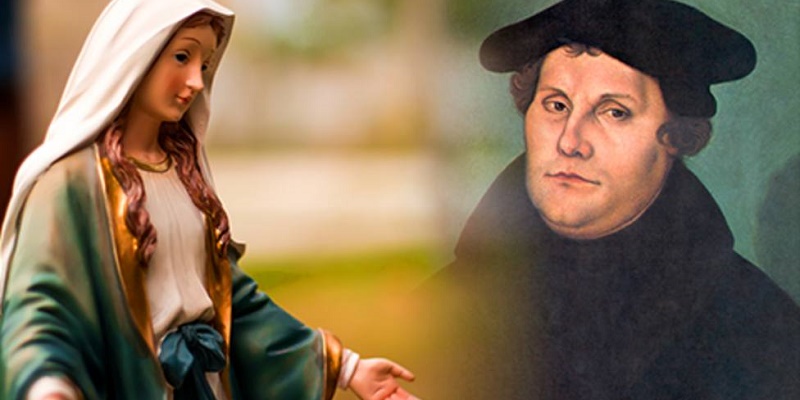
Protestant theologian invites readers to rediscover her unique role.
PARIS.- “In calling [Mary] ‘Mother of God,’ all her honor is summed up, and no one can say anything greater, even if he had as many tongues as there are leaves or blades of grass, as stars in the sky or grains of sand in the sea.” The person who writes this is not a holy Father of the Catholic Church. It is Martin Luther himself, in his commentary on the Magnificat (“Das Magnificat,” W 7, 572-573).
Anyone who thinks that the founder of Protestantism did not recognize the unique role played by the Virgin Mary in the incarnation of Christ is mistaken. So too are those who consider this woman to be a figure foreign to the Reformation.
In fact, speaking of Mary’s virginity corresponds to Luther’s thought. “Just as the wood had no merit other than being preserved by God and made fit for the cross, so Mary has no other dignity than that of being divinely preserved and made fit to be Mother-of-God” (“Das Magnificat,” W 7, 573).
In an article published in the Paris newspaper “La Croix” (August 13), the Lutheran theologian Élisabeth Parmentier, professor at the University of Strasbourg II, invites readers to overcome misunderstandings by which Catholics forget the Protestant recognition of Mary. “Many Protestants recognize that the total concealment of the mother of Christ is not in keeping with Sacred Scripture, nor with the confessions of the ancient Church, nor with the choices of the Reformers,” she states emphatically.
Drawing closer around Mary
And recalling the teachings of the Second Vatican Council on Mary, Élisabeth Parmentier proposes moving forward in ecumenical dialogue “around Mary.” It is a possible challenge. This is shown by the ecumenical team of
theological research that arose in France, known as the Groupe des Dombes. Its members, Catholics and Protestants, have taken the figure of Mary in order to give her “her whole place” and “nothing more than her place” (cf. Groupe des Dombes, “Marie dans le dessein de Dieu et la communion des saints,” Bayard Éditions-Centurion, 1999).
Differences
Parmentier certainly recognizes that differences exist between Protestant and Catholic theology concerning Mary. Many Protestants, unlike Luther, today do not believe in her virginity. The father of the
Reformation himself was negative with regard to the Assumption (whose feast is celebrated on August 15) and Mary’s universal motherhood. As for her intercession, his position is quite wavering. Even so, on several occasions he asks for Mary’s mediation: “May the sweet Mother of God herself obtain for me the spirit, so that I may explain this canticle of hers usefully and objectively” (“Das Magnificat,” W 7, 574-575).
Confluence
Now, the Protestant professor assures that “the tradition of the Reformation, which goes back to fidelity to Sacred Scripture, must save Mary from oblivion and confess with the Creed the highly specific role of woman and Mother of Christ.”
Parmentier invites Protestants and Catholics to deepen their understanding of the figure of Mary, so that this vision of an “ethereal and cloying” woman may be overcome and she may be valued with all the strength with which she appears in the Gospel. Thus an ecumenism is born that seeks to gather the disciples of Christ around Mary. As the book of the Acts of the Apostles says in its first chapter, “All these were persevering in prayer, with one accord, together
with some women, and Mary, the mother of Jesus.”
See also: The Protestant Reformers and the Virgin Mary
Source: Zenit, August 13, 2000
