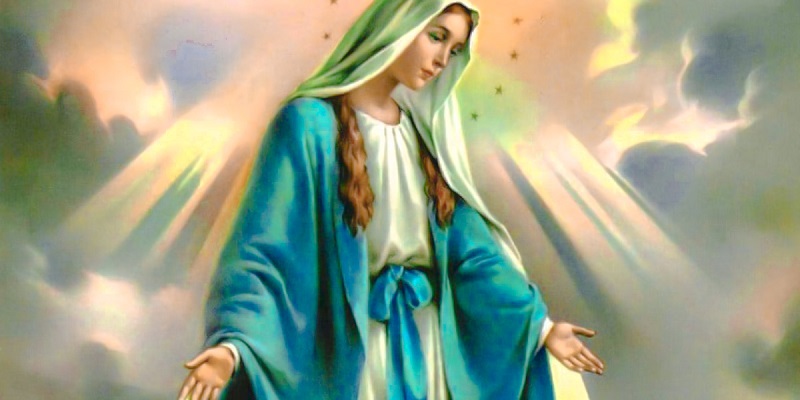
In our previous article I took as a starting point a conversation that I found in a Catholic training group on the Internet to address the doctrine of original sin. Today I want to start from the same conversation to address another no less important point: the doctrine of the Immaculate Conception of the Virgin Mary.
In this conversation, the differences between what we Catholics profess regarding dogma and what the Orthodox profess were analyzed, how Catholics recognize that the Holy Virgin is immaculate from the moment of her conception, while the Orthodox, although they call Her immaculate, do not recognize Her as such, but rather believe that She was immaculate only after the Holy Spirit descended on Her after the Annunciation and purified Her.
Given these differences, the following conversation takes place:
Fulano: The Orthodox Church calls Mary Immaculate because sshe knew no sin, but not in the Immaculate Conception, that is only a Latin belief…
Mengana: I say Why don’t we just agree that we all accept that the Most Holy Mother of God is Immaculate? and that is enough? without qualifiers, all honor and veneration be given to her…
Fulano: That’s the most coherent thing… since all Orthodox or Catholic Christians accept that she knew no sin.. well as Saint John says… “Whoever remains in GOD does not sin”…. and she remained in GOD.
Mengana: Alleluia!
And although it might seem tempting to join in the joy, my response here would be a resounding NO. It is NOT the most coherent thing, even though we want to be very ecumenical and seek unity with the Orthodox. The reason had already been given by Pope John Paul II: “Who would consider a reconciliation achieved at the cost of the truth legitimate? ” John Paul II, Ut Unum Sint, 18.
The Immaculate Conception of Mary is dogma of the Catholic faith, and we cannot take away the word “conception” just because the Orthodox only recognize the qualifier “immaculate”. If the Orthodox, as a result of the Eastern Schism, have remained stagnant in their theological development, to the point of currently firmly opposing dogma, that does not mean that in order to seek a supposed unity the truth must be sacrificed, much less if it is a dogmatically revealed truth.
Using that same way of reasoning, to seek unity with Protestants we could stay only with virginity before childbirth, which all Christians recognize, whether we are Catholic, Orthodox or Protestant. However, we know that this is not enough, and we proclaim: Most pure and chaste Virgin: before childbirth, in childbirth, and after childbirth!
This, of course, does not mean that we should not be open to dialogue, but a dialogue that does not attenuate or silence the truths of faith, because doing so would distort it. In Reconciliatio et Paenitentia The Pope maintained:
“It must be reaffirmed that, on the part of the Church and its members, dialogue, in whatever form it is developed – and they are and can be very diverse, given that the very concept of dialogue has an analogical value – can never start from an attitude of indifference towards the truth, but rather must be a presentation of it carried out in a serene manner and respecting the intelligence and conscience of others. The dialogue of reconciliation can never replace or attenuate the announcement of the evangelical truth., which has as its specific purpose conversion in the face of sin and communion with Christ and the Church, but must serve for its transmission and implementation through the means left by Christ to the Church for the pastoral care of reconciliation: catechesis and penance.”
It is understandable that we all long to see Christian unity restored. It is the will of our Lord, however that end is not sought by any means, including one that involves giving up some of the truth.
In order not to make these brief reflections too long, I would like to share the teaching of the Church regarding dogma, summarized in Ludwig Ott’s Manual of Dogmatic Theology.
_____________________________________________________________________________________________________
The Immaculate Conception of the Holy Virgin Mary
Extract from Ludwig Ott’s Manual of Dogmatic Theology. p. 314-321
§ 3. THE IMMACULATE CONCEPTION OF MARY
I. Dogma
Mary was conceived without stain of original sin (of faith).
Pope Pius IX proclaimed on December 8, 1854, in his bull Ineffabilis, which was truth revealed by God and that all the faithful had to firmly believe that «the most blessed Virgin Mary, in the first instant of her conception, was preserved immune from all stain of original guilt by singular privilege and grace of omnipotent God, in attention to the merits of Christ Jesus, Savior of the human race” (Dz 1641); cf. the encyclical Fulgens corona (1953) by Pius XII.
Explanation of the dogma:
to) By conception we must understand passive conception. The first moment of conception is that moment in which God creates the soul and infuses it into the organic matter prepared by the parents.
b) The essence of original sin consists (formally) in the culpable lack of sanctifying grace, due to Adam’s fall into sin.
Mary was preserved from this lack of grace, so that she began to exist already adorned with sanctifying grace.
c) Being free from original sin was for Mary an undeserved gift that God granted her, and an exceptional law (privilege) that only she was granted (singular).
d) The efficient cause of Mary’s Immaculate Conception was the omnipotence of God.
and) The meritorious cause of it is the saving merits of Jesus Christ. From this it follows that Mary also needed redemption and was in fact redeemed. Due to her natural origin, Mary, like all the other children of Adam, would have had to contract original sin (“debitum contrahendi peccatum origínalee”), but by a special intervention of God it was preserved from the stain thereof («debuit contrahere peccatum, sed non contraxit»). So that Mary also was redeemed by the grace of Christ, although more perfectly than all other men. While these are freed from an already existing original sin (reparative redemption), Mary, Mother of the Savior, was preserved before he stained her (redemptio praesertivativa either praeredemptio). Therefore, the dogma of the Immaculate Conception of Mary does not contradict in any way the dogma of the universality of original sin and the universal need for redemption.
F) The final cause (causa finalis proxima) of the Immaculate Conception is the divine motherhood of Mary: dignum Filio tuo habitaculum praeparasti (festival prayer).
2. Proof from Scripture and tradition
to) The doctrine of the Immaculate Conception of Mary is not found explicitly in Holy Scripture. According to the interpretation of numerous theologians, it is implicitly contained in the following biblical phrases:
α) Gen 3, 15 (Protoevangelium): «Inimicitias ponam inter te et mulierem, et semen tuum et semen illius; ipsa conteret caput tuum, et tu insidiaberis calcaneo eius». According to the original text, it must be translated: «I am going to put perpetual enmity between you and the woman, and between your seed and her seed; “This [the woman’s seed] will bruise your head, and you will bruise her heel.”.
The literal meaning of this passage could be the following: Between Satan and his minions on the one hand, and Eve and her descendants on the other, there will always be an incessant moral struggle. Eve’s offspring will achieve a complete and definitive victory over Satan and his minions, even if she herself is wounded by sin. The Messiah is included in the descendants of Eve, by whose virtue humanity will emerge triumphant from Satan. So this passage is indirectly messianic; cf. Dz 2123. Individually conceiving “the seed of the woman” and referring this expression to the Savior (perhaps due to the αύτός? with which the Septuagint version translates it), one came to see in the “woman” Mary, Mother of the Savior. This interpretation, directly messianic-Marian, has been proposed since the second century by some fathers, such as Irenaeus, Epiphanius, Isidore of Pelusius, Cyprian, the author of the Epistle ad amicum aegrotum and Leo the Great. But the majority of fathers, including the great doctors of the Church of the East and West, do not give such an interpretation. According to them, Mary and Christ are in total and victorious enmity against Satan and his supporters. From this the theology of late scholasticism and modern times concluded that Mary’s victory against Satan would not have been complete if the Virgin had been under his power for some time. Therefore, Mary entered the world without a stain of original sin.
The bull Ineffabilis makes approving mention of the messianic-Marian interpretation “of the fathers and ecclesiastical writers”, but does not give any authentic interpretation of the passage. The encyclical Fulgens corona, calling on the exegesis of the holy Fathers and ecclesiastical writers, as well as the best exegetes, advocates the messianic interpretation, which many theologians consider to be the full meaning (sensus plenior) intended by the Holy Spirit, and others as the typical meaning (Eve type of Mary) of that passage.
β) Lk 1, 28: “Hail, favored one.” The expression “favored one” (κεχαριτωμενη) serves as a proper name in the angel’s speech and must therefore express a characteristic note of Mary. The deepest reason why God’s good pleasure rests on Mary in a special way is her election to the dignity of Mother of God. Consequently, the endowment of graces with which God adorned Mary for having taken pleasure in her must be of a singular plenitude. But his endowment of graces will only be full if it is complete not only intensively, but also extensively, that is, if it extends to his entire life, beginning with his entry into the world.
γ) Lk 1, 41: Saint Elizabeth, filled with the Holy Spirit, says to Mary: «You are blessed(ευλογημενη) among women, and blessed is the fruit of your womb.”. The blessing of God, which rests on Mary, is considered parallel to the blessing of God, which rests on Christ in terms of his humanity. Such parallelism suggests that Mary, like Christ, was free from all sin from the beginning of her existence.
b) Neither the Greek nor the Latin fathers explicitly teach the Immaculate Conception of Mary. However, this dogma is implicitly contained in their teachings, since they propose two fundamental ideas that, logically developed, lead to dogma:
α) The idea of the most perfect purity and holiness of Mary. SAINT EPHREM says: «You and your mother are the only ones who in every respect are perfectly beautiful; For in you, Lord, there is no stain, nor blemish in your Mother. (Carmina Nisib. 27). Saint Augustine’s phrase according to which all men should feel like sinners, “except the holy Virgin Mary, whom for the honor of the Lord I set aside when I speak of sin” («excepta sancta virgine María, de qua propter honorem Domini nullam prorsus, cum de peccatis agitur, haberí voló quaestionem»), it must be understood, according to the entire context, in the sense that the Virgin was free from all personal sin.
β) The idea of both the similarity and the antithesis between Mary and Eve. Mary, on the one hand, is similar to Eve in her purity and integrity before sin; On the other hand, it is the complete opposite of her, since Eve was the cause of perdition and Mary the cause of salvation. SAINT EPHREM teaches:«Two innocents, two simple people, Mary and Eve, were completely equal. But, nevertheless, later the one was the cause of our death and the other the cause of our life. (Op. syr. II 327); cf. SAINT JUSTINE, Dial. 100; Saint Irenaeus, Adv. haer. III 22, 4; TERTULIAN, Christi meat 17.
3. Historical evolution of dogma
Since the 7th century, the existence in eastern Greece of a festival dedicated to the conception of Saint Anne has been known (Conceptio S. Annae), that is, of the passive conception of Mary. The festival also spread to the West, through southern Italy, beginning first in Ireland and England under the title of Conceptio Beatae VirginisAt the beginning, the object of this festival was the active conception of Saint Anne, a conception that, according to the Protoevangelium of Santiago, took place after a long period of infertility, being announced by an angel as an extraordinary grace from God.
At the beginning of the 12th century two British monks, Eadmer, disciple of Saint Anselm of Canterbury, and Osberto of Clare, defended the immaculate (passive) conception of Mary, that is, her conception free of all stains of original sin. Eadmer was the first to write a monograph on this subject. On the other hand, SAINT BERNARDO DE CLARAVAL, on the occasion of the introduction of this festival in Lyon (around the year 1140), discourages it as an unfounded novelty, teaching that Mary had been sanctified after her conception, but was still in the womb (Ep. 174). Under the influence of Saint Bernard, the main theologians of the 12th and 13th centuries (Peter Lombard, Alexander of Hales, Bonaventure, Albertus Magnus, Thomas Aquinas; cf. S.th. III 27, 2) declared themselves against the doctrine of the Immaculate Conception. They didn’t find a way
harmonize the Marian immunity from original sin with the universality of said sin and with the need for redemption that all men have.
The Franciscan theologian showed the correct way to find the definitive solution William of Ware and, above all, his great disciple John Duns Scotus († 1308). The latter teaches that animation (animatio) should precede only conceptually (ordo naturae) and not temporarily (ordo temporis) to sanctification (sanctified). Thanks to the introduction of the term praeredemptio(pre-redemption) managed to harmonize the truth that Mary was free from original sin with the need that she also had for redemption. The preservation of original sin is, according to Scotus, the most perfect way of redemption. Therefore, it was fitting that Christ redeemed his Mother in this way. The Franciscan order adhered to Scotus and began to decisively defend, against the Dominican order, the doctrine and the festival of the Immaculate Conception of Mary.
The Council of Basel declared itself in 1439, in its 36th session (which has no ecumenical validity), in favor of the Immaculate Conception. Sixtus IV (1471-1484) granted indulgences to this festival and prohibited the mutual censures that the two contending parties made; Dz 734 s. The Council of Trent, in its decree on original sin, makes the significant clarification that “it is not its purpose to include in it the blessed and most pure Virgin Mary, Mother of God”; Dz 792. Saint Pius V condemned in 1567 Bayus’ proposition that no one, apart from Christ, had been free from original sin, and that Mary’s death and afflictions had been punishment for actual sins or original sin; Dz 1073. Paul V (1616), Gregory XV (1622) and Alexander VII (1661) came out in favor of the doctrine of the Immaculate Conception; cf. Dz 1100. Pius IX, after consulting the entire episcopate, elevated it on December 8 to the category of dogma.
4. Speculative proof
Reason proves the dogma of the Immaculate Conception with that axiom that already sounded on Eadmer’s lips: “Potuit, decuit, ergo fecit.” This argument does not, of course, engender certainty, but it does engender a high degree of probability.
§ 4. MARY AND HER IMMUNITY FROM CONCUPISCENCE AND FROM EVERYTHING
PERSONAL SIN
1. Immunity from concupiscence
Mary was free from all the movements of concupiscence (common teaching).
Immunity from original sin does not have as a necessary consequence immunity from all those deficiencies that entered the world as consequences of sin. Mary was subject, like Christ, to all universal human effects that do not contain moral imperfection. Regarding concupiscence, it is likely that Mary was free from this consequence of original sin, since the movements of concupiscence are frequently directed towards morally illicit objects and constitute an impediment to tending towards moral perfection.
It is very difficult to reconcile with Mary’s spotless purity and innocence, which were most perfect, that she was subjected to those inclinations of the sensitive appetite that are directed towards evil.
The merits of Mary, just as the merits of Christ, are not diminished in the least because the inclinations of the disordered appetite are lacking, because such appetites are an occasion but not an indispensable condition for merit. Mary acquired abundant merits not because of her fight against disordered appetite, but thanks to her love for God and other virtues (faith, humility, obedience); cf. S.th. III 27, 3 ad 2.
Many ancient theologians distinguish with Saint Thomas between subjection (ligatio) and complete suppression or extinction (sublevatio, exstinctio) of the fornes peccati or habitual disordered appetite. When Mary was sanctified in her mother’s womb, the fornes, so that all disordered movement of the senses was excluded. When Mary conceived Christ, then the fornes, so that the sensitive forces were completely subject to the government of reason (S.th. III 27, 3). This distinction that Saint Thomas makes is based on the mistaken assumption that Mary had been justified from the original sin already existing in her. But, since the Virgin had been preserved from said sin, it is logical to admit that from the beginning she was free from concupiscence just as she had been free from original sin.
2. Immunity from all actual sin
By a special privilege of grace, Mary was immune from all personal sin during her life. (teaching proximate to faith).
The Council of Trent declared that no just man could avoid during his life all sins, even venial sins, except by a special privilege of God, such as that which the Church maintains with respect to the Mother of God («nisi ex speciali Dei privilegio, quemadmodum de blessed Virgine tenet Ecclesia»); Dz 833. Pius XII, in his encyclical Mystici Corporis, says of the Virgin Mother of God that“he was free from all personal or hereditary guilt”; Dz 2291. The sinlessness of Mary is indicated by Scripture in Luke 1, 28: “God save you, blessed one”. Any personal lack of morality is incompatible with the Marian fullness of grace.
While some Greek fathers, such as Origen, Saint Basil, Saint John Chrysostom and Saint Cyril of Alexandria, admitted in the Virgin the existence of some small personal faults such as vanity and desire for esteem, doubt before the words of the angel and weakness in faith at the foot of the cross, the Latin fathers unanimously maintained the impecency of Mary. SAINT AUGUSTINE teaches that, for the honor of the Lord, all personal sin must be excluded from the Virgin Mary (De natura et gratia 36, 42). Saint Ephrem the Syrian places Mary, because of her impeccability, on the same level with Christ (see § 3).
According to the doctrine of Saint Thomas, the fullness of grace that Mary received in her active conception—according to modern theology, she already received it in her passive conception—operated her confirmation in the goodness and, therefore, the sinlessness of the Virgin; S.th. III 27, 5 ad 2.
Author: José Miguel Arraiz
