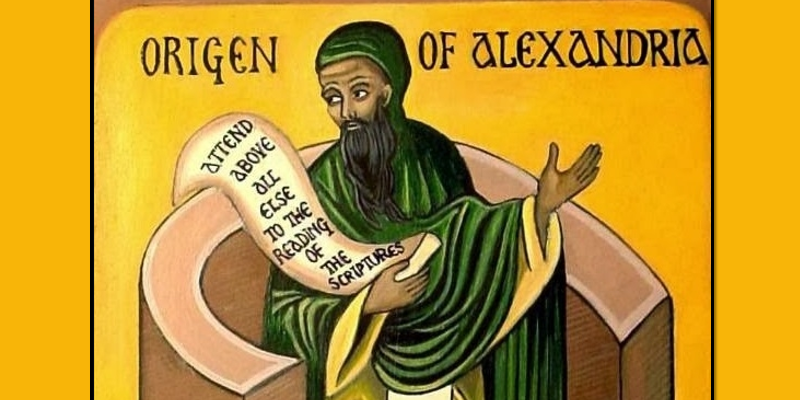
I recently had the opportunity to talk with a Protestant (Baptist) friend who told me that several fathers of the Church, including Origen, had “Protestant” positions. He alleged that Origen interpreted Matthew 16:18-19 in the Protestant style when he said: “And if we, as Peter says, ” You You are the Christ, the son of the living God,” Not as if flesh and blood revealed it to us, but as by the light of the Father in heaven shining in our Heart, we become a Peter”
Who was Origen?
He was an important ecclesiastical writer of the early Church, he was a man of impeccable conduct and notable erudition, considered the father of theology. Born around the year 185, he directed the school of Alexandria from 203 to 231. His prestige became so high that the bishops of Caesarea, Jerusalem and other Palestinian cities asked him to preach sermons and explain the Scriptures to their respective communities, which later brought him difficulties with his bishop (Demetrius of Alexandria) because he was not a priest. Origen obeyed and returned to Alexandria. He was later ordained a priest by several bishops to avoid this inconvenience, which again brought him difficulties with his bishop, because canonical legislation did not allow someone who had castrated himself to be admitted to the priesthood (a mistake he made in his youth by interpreting Matthew 19:12 too literally) and he was excommunicated by him and deposed from the priesthood. He went to reside in Caesarea of Palestine where the bishop of Caesarea ignored the censure of the bishop of Alexandria and invited Origen to found a school of theology in Caesarea which he directed for more than 20 years. He died around the year 253 as a martyr. Although he made some mistakes, he always tried to remain attached to orthodoxy and the teachings.
How important is Origen for Catholics and Protestants?
The Writings of Origen (as well as the writings of the Church Fathers and other ecclesiastical writers) are extremely important, not only for students of patristics and patrology, because they allow us to gain a thorough understanding of the thinking of the early Church and its way of interpreting the Scriptures. Although Protestants reject the writings of the fathers and ecclesiastical writers, many of them (the not extremely fundamentalist ones) recognize that they are indispensable for the knowledge of the history of the Church and the development of the Christian faith. And it often happens that although they almost never quote parents, they do so when they think that what they say may bring “water to their own mill.” I wanted to take the opportunity to study the writings of Origen, not only in terms of the points in which Protestants usually quote him, but in their entirety, in order to make a fair and not decontextualized comparison of his thought.
Origen and the primacy of Peter
This is the point where Protestants cite Origen the most, and it is mainly due to his interpretation of Matthew 16:18.
Origen, Commentary on Matthew 16:18
“And if we, like Peter, say, “You are the Christ, the Son of the living God,” not as if flesh and blood revealed it to us, but as by the light of the Father in heaven shining in our Heart, we become a Peter, and the world could say to us, ‘you are Peter,’ etc. Why is every disciple of Christ a rock? from whom those drank who drank from the spiritual rock that followed them, and upon each rock is built every word of the church, and its organization accordingly; Because in each of the perfect ones, who have the combination of words and decrees and thoughts that overly bless, the church is built by God.
But if you suppose that it is only upon Peter that God builds His church, what would you say about John the son of thunder?, or of each of the apostles? Would we dare to say that only over Peter in particular, the gates of hades will not prevail, and will prevail over the rest of the apostles and the perfect ones? Doesn’t the previously expressed comment “The gates of hades prevail over this” apply to each and every one of them? Likewise the other comment “On this rock will I build My church?” Are the keys of the kingdom given to Peter alone, and no other of the blessed will receive them? But if this premise “and I will give you the keys of the kingdom of heaven” is common to others, why not the things said before this, as well as the things said to Peter after this?
You are the Christ, the Son of the living God.” If anyone declares this, he will obtain the things spoken of in the gospel about Peter, but, as the spirit of the gospel teaches everyone who converts like Peter.”
But the allegorical way in which Origen here interprets Matthew 16:18 could not be understood as a rejection of the ministry of the bishop of Rome from the see of Peter. Origen himself in another of his writings explicitly recognizes as the very solid Stone on which Christ built his Church.
Origen, Homilies on Exodus. XIII.44
“But who is so happy that he is free from the weight of temptations, so that no thought of doubt surprises his soul? See what the Lord says to the great foundation of the Church, to that very solid rock on which Christ founded the Church: O man of little faith, why have you doubted?
Just like other Fathers of the Church, Origen considered Peter as the Stone, but he also considered, like us Catholics, that the basis of the Church is faith in Christ. Thus, Peter is called Stone by virtue of the ministry that would be conferred upon him, and by virtue of his faith.
It is doubtful that Origen interpreted, as we will see later, in the Protestant style, that with faith alone one is a stone of the Church and therefore, it is not necessary to be united with the Catholic Church, on the contrary, he teaches that apart from the Church there can be no true faith. Needless to say, Origen was always obedient to the teachings.
Origen, apostolic succession and Tradition
For Origen, the sources of Christian doctrine are the Scriptures and Tradition, and therefore he points out, like Tertullian and many other fathers of the Church, the existence of a Rule of Faith, which contains the fundamental teaching of the gospel. It also teaches that this teaching is possessed only by the Churches that by apostolic succession come from the apostles, and therefore only those truths that do not depart in any way from this apostolic tradition should be accepted as truth. (In short, no Sola Scriptura). In his work Of principle (The Peri-Archon) writes:
The Peri-Archon(De principiis), Preface 1-2
“…But since among those who profess to believe in Christ there are many divergences, not only in minor details, but also in extremely important matters,…it seems necessary to establish on all these points a fixed and precise rule of faith before approaching the examination of the other questions…But since the ecclesiastical teaching, transmitted in orderly succession from the apostles, is preserved and endures in the Churches to the present, Only those truths that do not depart in any way from ecclesiastical and apostolic tradition should be received as an article of faith.”
He adds, however, that a large number of questions remained unanswered, and the mission of theology is precisely to deepen and make explicit these truths of faith. What Cardinal Newman (notable Anglican priest converted to the Catholic Church) would explain more than a millennium later as the development and evolution of Christian doctrine).
The Peri-Archon (Of precipiis), Preface 3
“It is important to know that the holy Apostles, when preaching the faith of Christ, very clearly expressed those points that they believed were necessary for all believers, even those who seemed less diligent in the investigation of divine science; leaving the task of investigating the reasons for these statements to those who deserved the superior gifts of the Spirit, especially to those who, through the Holy Spirit himself, obtained the gift of tongues, wisdom and science. As for the rest, they were content with stating the fact, without explaining why, how, or the origin, no doubt so that as time went by, friends who were passionate about study and wisdom would have something to use their ingenuity to benefit – I am referring to those people who prepare themselves to be worthy receptacles of wisdom.
Origen and the Trinity
Origen frequently used the term Trinity (1), and although he was suspected of subordinationism By virtue of several of his texts, other of his texts seem to indicate the opposite. Thus according to the opinion of Saint Jerome Origen it was, while Saint Athanasius and Saint Gregory the Thaumaturge deny it.
In any case, in Origen’s texts it is clear that he thinks that the son comes from the Father from eternity (unlike heresies that would emerge later such as Arianism, revived today in the doctrines of Jehovah’s Witnesses). By virtue of that the Son has no beginning, and there was no time in which He did not exist (he refutes the Arian principle in advance) (2). He also taught that the Son had the same substance of the Father.
Origen, In Hebr. Frag.24,359
“What else can we suppose to be the eternal light but God the Father, of whom it could never be said that, being light, his Splendor was not present with Him? Light cannot be conceived without radiance. And if this is true, There was never a time when the Son was not the Son. However, it will not be, as we have said of eternal light, without birth (it would seem that we introduce two principles of light), but it is, so to speak, the radiance of the inborn light, having this same light as its beginning and as its source, truly born of it.. However, there was not a time when it did not go. Wisdom, coming from God, It is also generated from the same divine substance…”
Origen and the Virgin Mary
Origen applied the title “Mother of God” to Mary (3), and also taught the universal motherhood of Mary over the Church:
Origen, In Ioh1.6
“No one can understand the Gospel if he has not reclined his head on the chest of Jesus and has not received Mary as his mother.”
Like the rest of the fathers of the Church, he was in favor of Mary’s virginity after childbirth. He claimed that the children attributed to Joseph were not born of Mary (non weret orti of Mary) and there is no Scripture to prove it (4). He also wrote:
Origen, In Mt. Comm. 10.17: GCS10.21
“Mary kept her virginity until the end, so that the body that was destined to serve the word would not know a sexual relationship with a man, from the moment the Holy Spirit and the strength of the Most High had descended upon it as a shadow. I think it is well founded to say that Jesus has become for men the first fruit of purity that consists of chastity and Mary in turn for women. “It would not be good to attribute the first fruit of virginity to another.”
Curiously, almost all Protestants believe that Mary was not a Virgin after childbirth, she was not the mother of God and she is not the mother of the Church, hence why they never cite Origen (nor other fathers of the Church) in this regard. (You cannot bring water to your mill).
Origen and the Church
For Origen, the Church is the city of God on earth (5) and outside of it there is no salvation: “Extra hanc domum, id est Ecclesiam, Nemo salvatur” (6). For Origen there can be no faith outside the Church, the faith of the heretics is not true faith, but a “credulitas arbitraria” (7).
Origen and baptism
This is another point where Origen’s writings not only show a position opposed to the majority of Protestantism, especially those with Anabaptist tendencies. Origen teaches the doctrine of original sin and the need for infant baptism and additionally brings us solid evidence of how such baptism was already practiced in the time of the apostles.
Origen, In Lev. Hom. 8.3
“If you like to hear what other saints said about physical birth, listen to David, when he says: “I was formed, so the text says, in iniquity, and my mother conceived me in sin”; he shows that every soul that is born in the flesh carries the stain of iniquity and sin. This is the reason for that sentence that we quoted above: No one is clean from sin, not even the child who is only one day old.. To all this we can add a consideration about the reason that the Church has for the custom of baptizing even children, since this sacrament of the Church is for the remission of sins.. Certainly, if there were nothing in children requiring remission and forgiveness, the grace of baptism would seem unnecessary.
Origen In Rom. Com. 5.9: EH249
“The Church has received from the Apostles the custom of administering baptism even to children. For those to whom the secrets of the divine mysteries were entrusted knew very well that everyone carries the stain of original sin, which must be washed away by water and the spirit.”
Origen and penance
After baptism, Origen also recognizes the later forgiveness of sins through penance and confession of sins before a priest, who is the one who decides whether the public confession of sin should be made or not.
Origen, In Ps. Hom. 37,2,5
“Observe with city to whom you confess your sins; Test the doctor to see if he is weak with the weak and if he cries with those who cry. If he believes it necessary for your illness to be known and cured in the presence of the assembled assembly, follow the advice of the expert physician.”.
Evidently for Origen, the saying “I confess directly to God and now” was not valid either. ta!!’”
Origen and the Eucharist
Jesús Solano comments that Origen has a highly discussed text, which although it is not properly a Eucharistic text, he uses Eucharistic terminology in an allegorical sense. For those who know Origen’s passion for relating texts of Holy Scripture to each other and for seeking allegories in that environment of “gnosis” in Alexandria, the fact that he expresses himself with such allegories does not offer any serious problem about Origen’s orthodoxy. It would be unfair to the writer and unscientific to deduce Origen’s Eucharistic thought from one or another passage and not from all of them. Despite Origen having had numerous adversaries, there is no news that anyone challenged him for his Eucharistic doctrine.
Origen. Series of Commentaries. 85 (KLOSTERMANN, 196s; MG13.1734 A – 1735 A).
This bread that the Word God confesses to be his body, is the word that feeds souls., a word from the Word God and bread of the heavenly bread that has been placed on the table of which it is written: You have prepared a table before me in the sight of my persecutors. AND This drink that the Word God confesses to be his blood, is the word that quenches thirst and prodigiously intoxicates the hearts of those who drink., drink that is in the cup of which it is written: and how excellent is your cup that intoxicates. And this drink is the fruit of the true vine that says: I am the true vine, and it is the blood of that grape that, thrown into the winepress of passion, produced this drink. Just as bread is the word of Christ, made of that wheat that, falling to the ground, bore much fruit. Because God the Word did not say his body to that visible bread that he had in his hands, but to the word in whose mystery that bread was to be broken; nor did he say to that visible drink his blood, but to the word in whose mystery that drink was to be poured out. Because body or blood of the Word God, what else can it be, but the word that feeds, and the word that gladdens the heart?
An analysis of the rest of his texts proves Origen’s affinity for the most traditional orthodoxy regarding the Eucharist, which is in the same line as the rest of the fathers. Like Tertullian, he shows concern that the consecrated bread and wine will fall to the floor. He states that “Just as manna was food in enigma, now clearly the flesh of the Word of God is true food, as He Himself says: My flesh is true food and my blood is true drink.“. In all these cases, Origen refers to the “real food“not as bread, but as”the flesh of the Word of God“. He also affirms that receiving the body unworthily causes ruin for themselves and refers to the Eucharistic celebration as “the table of the body of Christ and the very chalice of his blood”. Origen. On Exodus. Homily 13.3 (W.A. BAEHRENS: GChS29, Origen Werke 6.274; MG12.391 A-B).
“You who usually attend the divine mysteries know, how when you receive the body of the Lord, you guard it with all caution and veneration, so that not even a little of it falls off, nor does anything of the consecrated gift disappear. Well, you think you are guilty, and rightly so, if something is lost due to negligence. And if you use, and with right reason, so much caution to preserve his body, how do you consider it less impious to have neglected his word than his body.
Origen. On Numbers. Homily 7.2 (BAEHRENS: GChS30, Origenes Werke 7.39s; MG12.613 C)
“Before, baptism was in mystery in the cloud and in the sea; now regeneration is clearly in water and in the Holy Spirit. Then the manna was food in mystery, Now clearly the flesh of the Word of God is true food, as He Himself says: My flesh is truly food and my blood is truly drink.”
Origen. On Jeremiah. Homily 19,13 (E. KLOSTERMANN: GChS, Origenes Werke 3,169,30-33: MG13,489 C. here is homily 18)
“…If you go up with Him to celebrate the Passover, He will give you the cup of the New Testament; He will also give you the bread of blessing, he will grant you his body and his blood”
Origen. On Ezekiel7.22 (MG13.793 B).
“And they will enter into them [the chosen things of the world] without consideration [Ez 7,22 according to the LXX; cf. V.20 also according to the LXX]…Thus it must be said that one enters without consideration into the holy things of the Church, if one, after the marital act, indifferent to the impurity that he has contracted in himself, consents to pray over the bread of the Eucharist, since this profanes holy things and carries out a decomposed action.
Origen. On Psalm 37. Homily 2.6 (MG12.1386 D)
“Are you not afraid to take communion with the body of Christ, by approaching the Eucharist as if you were clean and pure, and how you can escape the judgment of God? Do you not remember what is written: that because of this there are among you many weak and sick and many who die? Why so many weak ones? Because they do not judge themselves, nor examine themselves, nor understand what it means to participate in the Church, nor what it means to approach so many excellent sacraments. They suffer what those who have fever usually suffer when they dare to eat the delicacies of the healthy, namely, that they bring ruin upon themselves.”
Origen. Contra Celso. L.8. c33 (P. LOETSCHAU: GChSOrigenes Werke 2.249.4-9; MG11.1566 C).
And Celsus, for that reason, as a man who ignores God, of his thanks to the demons; We, on the contrary, giving thanks to the Creator of all, eat the bread offered with thanksgiving and prayer over the gifts received, made by prayer a certain holy and sanctifying body for those who use it with a healthy purpose.
Origen. Series of Commentaries. 82 (KLOSERMANN: GChS38, Origen Werke 1.194, MG13.1732 B).
[Mt 26,23]… And if you can understand the spiritual table and the spiritual food and the Lord’s supper, of all of which Christ had deigned to make him [Judas] partake, you will see even more the greatness of his wickedness, since he gave the Savior, teacher and at the same time food of the divine table and of the chalice (and this on the day of Passover), without remembering the corporal goods of the love of the master or the spiritual goods of his doctrine, always distributed without envy. Like this are all those in the Church who lie in wait for their brothers, with whom they were frequently together at the same table of the body of Christ and in the same chalice of his blood.
Conclusion
Was Origen a Protestant? Just answer these questions:
1) Do Protestants believe in apostolic succession and that Peter was the very solid rock on which their Church was built?
2) Do Protestants believe the sources of Christian doctrine are the Scriptures and Tradition, which is transmitted in orderly succession from the apostles and that only that which in no way departs from the tradition of the Church and apostolic should be accepted as truth?
3) Do Protestants believe that the Catholic Church is the city of God on earth, that outside of it there is no salvation and that the faith of those who separate from it is not true except credulitas arbitraria”?
4) Do Protestants believe that Mary is the mother of God (Theotokos), mother of the Church, and a virgin to the end and who cannot understand the gospel who has not accepted her as a mother?
5) Do Protestants believe that the Eucharist is the Body and Blood of the Lord, that anyone who is in sin cannot approach it, and that every precaution must be taken so that some of the consecrated gift does not fall to the floor?
6) Do Protestants believe that children must be baptized to cleanse them of the original sin in which we are all born and that such baptism was the practice of the Church from its beginnings?
7) Do Protestants believe that sins must be confessed to the priest?
If you can answer yes to all of those answers, then Origen was a Protestant. (And if so, I wish we had more Protestants like that!)
Notes:
(1) in Ioh. 10,39,270; 6,33,166; in Ies. man. 1.4,1)
(2) God is eternal, therefore the son is also eternal: “aeterna ac everlasting generation” (In Ier. 9.4; De Princ.. 1,2,3), and had no beginning (De Princ. 1,2,9s; 2; 4,4,1; In Rom. 1.5)
(3) According to the historian Sozomeno (Hist. Eccl. 7.32: EG 866)
(4) Origen, In Lc. 7: GCS9.45
(5) in Ier. hom. 9,2; in Ios. hom. 8.7
(6) in Ios. hom. 3.5
(7) in Rom. 10.5
Author: Eng. José Miguel Arráiz
Bibliography
BAC206. Patrology I, Johannes Quasten
BAC88. Primitive Eucharistic Texts I, Jesús Solano
Mariology, José C.R.. Garcia Walliness
