
Most non-Catholics are somewhat uncomfortable with the very idea of the Sacrament of Confession. They often exclaim, “But no one can forgive sins except God alone!” They think that this practice of the Catholic Church is, at best, a perverse presumption and, at worst, a grotesque blasphemy. Therefore, the following thoughts are intended to help clarify exactly what the Church teaches and why she teaches it.
Let us begin at the beginning. Definitely, only God can forgive sins. Period. There is no way around the matter. The Catechism of the Catholic Church confirms this in paragraph 1441, where we read: “Only God forgives sins.”
Second: our forgiveness depends completely on Christ’s saving work on the Cross. It is his Precious Blood that cleanses us from sin. He paid the debt that we could not pay (thanks be to God). Third: we must identify the real underlying question — in other words, the way in which God forgives our sins. That is, how and when is the Blood of Christ applied to our souls so that their purification takes place? Do we receive forgiveness the moment we simply recite a “prayer of repentance”? Or does it come when we walk into a church in response to an altar call? Or perhaps does it happen when we stand on our heads and quote John 3:16?
 The point is this: God could have ordered us to follow some procedure (or none) in order to obtain forgiveness. The question, then, is this: What means did God choose so that the Blood of Christ would be applied to our souls and, as a result, our sins would be forgiven? Well, we see in Scripture (and in the constant teaching of the Church) that our original forgiveness and purification come through the Sacrament of Baptism. In Baptism, the Blood of Christ washes our souls and our sins are forgiven (for example Acts 22:16, where Saint Paul was told: “And now why do you wait? Rise and be baptized, and wash away your sins, calling on his name”). However, what happens with serious sins committed after baptism? Do we have to be baptized again?
Not exactly. The Church has always believed and taught that valid Baptism is an unrepeatable event. That being the case, the question remains: How are we forgiven for serious sins committed after Baptism? First, allow me to make the following clarifying comments. I have used the term “serious” sin, and this requires an explanation. Of course, in one sense, all sin is serious. But the Catholic Church uses the designation “serious” to refer to what are known as mortal sins or grave sins. In other words, sins that inflict a mortal wound on the soul, placing the soul, so to speak, in a grave condition… which is something serious. While every sin is evil, not every sin kills the life of grace in the soul. This distinction is seen in 1 John 5:16-17, where there is a distinction between sin that leads to death and sin that does not. Definition: not every sin has the same gravity.
Sin that is freely chosen and understood to be a serious matter is called “serious,” “mortal,” or “grave” sin, which kills the life of grace in the soul. Such sins must be cleansed by forgiveness so that one may enter Heaven. Initially, every kind of sin is forgiven in Baptism. However, the question that still remains is this: How are these kinds of sins forgiven after Baptism? This is where the Sacrament of Confession enters the scene (note: this sacrament is also known as the Sacrament of Penance and the Sacrament of Reconciliation).
In the Sacrament of Confession it is God who forgives the sinner, but he does so through the priest (who is acting in the place of Christ). Now, the question is this: Where do we find support for this practice in Scripture? To answer this question, please consider the following: Mark 2:1-12. In this passage of Scripture, we find the familiar account of the paralytic who was lowered through the roof by his friends. What is interesting in this passage is the fact that the Jews initially protested against Jesus when he forgave that man’s sins. They said: “He is blaspheming! Who can forgive sins but God alone?” (verse seven). Jesus answered by saying: “The Son of Man has authority on earth to forgive sins” (verse ten). And, as if to validate what he had said, he proceeded to heal the man. Now, Jesus Christ — Son of God and Son of Man — said that as “the Son of Man” he had authority on earth to forgive sins. Jesus Christ is true God and true man, but it is under the designation “Son of Man” that he forgave the paralytic’s sins.
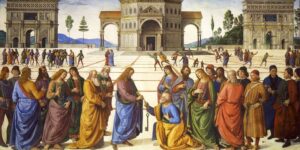 The point I am trying to make is this: Jesus Christ — the Son of Man — subsequently delegated the same authority to other men, specially chosen. This is seen in John 20:21-23. “Jesus said to them again, ‘Peace be with you. As the Father has sent me, even so I send you’. And when he had said this, he breathed on them and said to them, ‘Receive the Holy Spirit. If you forgive the sins of any, they are forgiven; if you retain the sins of any, they are retained’” (Jerusalem Bible). I have heard many attempts to rationalize away the apparent meaning of these verses, but invariably all of them end up emptying the words of their essential meaning. If the words mean anything, we see Our Lord delegating to specially selected men (in this case the apostles, and correspondingly their successors) the authority to forgive sins in the name of Jesus. And this is exactly what the Catholic Church teaches.
In paragraph 1441 of the Catechism (the paragraph cited at the beginning of this essay), we read: “Only God forgives sins. Since he is the Son of God, Jesus says of himself, ‘The Son of man has authority on earth to forgive sins’ and exercises this divine power: ‘Your sins are forgiven.’ Further, by virtue of his divine authority he gives this power to men to exercise in his name.” Thus, it is God who forgives sins, using the Sacrifice of Christ on the Cross, through Baptism (in our initial forgiveness when we are born again into the family of God) and the Sacrament of Confession (for serious sins committed after Baptism).
This has been taught and practiced by the Church from the beginning and is attested by Scripture, as the quotations above demonstrate. And all of this is related to the tremendous mystery of the Incarnation and the corresponding mystery of the Church. In other words, in the blessed Incarnation of Our Lord (when he takes to himself a sanctified human nature in order to rescue us), he, in effect, made holy the simplest of human actions and sanctified the most common material substances.
For thirty-three years he walked this earth doing things that anyone does: eating, working, sleeping, conversing, laughing, and so on. In all those things he was God — God in the Flesh — who was acting, thereby making all those actions holy. In other words, the greatest blessing ever granted to Creation is the Incarnation, so that through it God might show his delight in the material universe. First, God was not only pleased to create it, but was pleased to participate in it by assuming human nature to himself. Now the Church — as the Mystical Body of Christ — is, in effect, an extension of the Incarnation through time and space.
When we — as members of Christ’s Church — touch, comfort, feed, or heal, it is, in reality, Christ who is doing those things in us (that is why we are his Body). Nowhere is this mystery realized more profoundly than in the administration of the Sacraments. The Sacraments, as channels of grace specially ordained by God, use the material universe to bring us spiritual “goods” (God’s graces). And, as extensions of Christ’s Incarnation, it is seen that Christ is the principal minister behind every Sacrament. It is he who baptizes. It is he who gives us the Sacred Body and the Precious Blood in the Eucharist. It is he who unites a man and a woman in Holy Matrimony. And it is he who forgives our sins in the Sacrament of Confession. But let us note something important: in all these Sacraments Our Lord uses a human agent. This is why Our Lord said to the Apostles, “As the Father has sent me, even so I send you” (John 20:21).
We can speculate endlessly about why God has chosen to extend Salvation to us in this way (through the Sacraments). And such speculation can bear fruit, the fruit of deeper understanding. However, let it suffice for now to say that Scripture and the constant teaching of the Church (from the beginning) attest that Our Lord, by his divine authority, has ordered a sacramental “economy” of Salvation. Thus, in the Sacrament of Confession, we enjoy the same incredible blessing that the paralytic in Mark 2:1-12 enjoyed: we hear the voice of Christ through his priest saying to us: “Your sins are forgiven… rise, take up your mat, and walk.”
Let us then give thanks to God
Author: Bruce Sullivan
