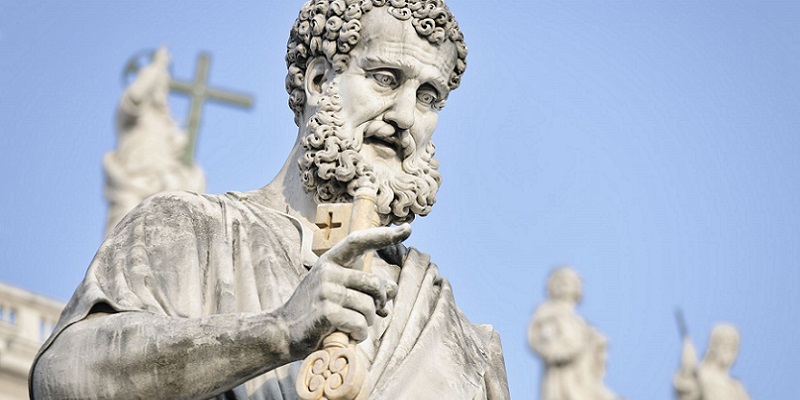
An analysis of the figure of the fisherman from Galilee according to the Scriptures.
From the obscure fishing villages of Capernaum on the shores of Galilee, Simon son of John rises to the place of greatest importance in the nascent Church. When Simon was chosen as a disciple, Jesus tells him that his name will be changed to Cephas (which means rock) < Jn 1:42 >. The life of Simon Peter, which begins as that of a simple fisherman, ends in a glorious martyrdom in the imperial city of Rome.
In the New Testament, the names Simon, Peter, or Cephas appear almost 200 times. The names of the other disciples taken together appear on approximately 130 occasions. In the lists of the apostles in the New Testament, Peter is first on the list. Matthew uses the word first (Mt 10:2) “to designate him as the most prominent of the Twelve.” He was the spokesman and authoritative voice of the Apostles, as we read in the first chapters of the Acts of the Apostles. Paul spent fifteen days privately with Peter before beginning his apostolate (Gal 1:18).
Jesus grants special prerogatives to Peter, as recounted by Matthew (Mt 16:13-20). Peter receives a new name, which in the Scriptures symbolizes a change of state or position (e.g., Gen 17:4-5). Jesus speaks Aramaic and gives Simon the Aramaic name Cephas (Rock), which is “Petra” in Greek, “Peter” in English, and “Pedro” in Spanish. In Greek, “Petra” is feminine, so the masculine “petros” was adopted. There is no distinction between Cephas the man and Cephas the rock upon which Jesus would build his Church (cf. CCC no. 552). Protestants affirm that Christ is the only foundation (1 Cor 3:11), attempting thereby to displace Peter. However, they mistakenly mix the metaphors. In First Corinthians, Paul is the builder and Christ is the foundation; in Matthew, Jesus is the builder and Peter is the foundation rock. Another New Testament metaphor illustrating the Church says: “You are built upon the foundation of the apostles and prophets, Christ Jesus himself being the cornerstone” (Eph 2:20).
Christ chooses Caesarea Philippi as the setting for his encounter with Peter. There Herod had built a temple to Caesar Augustus on top of a great rock, a center of pagan worship and the source of the Jordan River. As the bedrock there was an open cave that pagans referred to as “the Gates of Hell.” Standing before the “temple” erected in honor of “divine Caesar,” Jesus reveals God’s plan: to build a new “Temple,” the Church, to the true God, with Peter as the solid rock.
After establishing Peter as the rock, Jesus promises to give him the “keys of the Kingdom of Heaven.” A reference to the steward of the keys is given in Isaiah 22:15ff. The throne of David had been vacant since the Babylonian captivity (586 B.C.). The archangel Gabriel announces to Mary that her son Jesus will be given “the throne of his father David.” As Jesus is the new King of Israel, restoring the throne of David, he appoints Peter as royal steward, to legislate “over the house” of the king (cf. CCC no. 553). The keys represent an exclusive power, and this authority is granted only to Peter. The office of royal steward is hereditary in Israel. Familiar with their history, the Jews understand that Peter’s office must be filled by successors, just as the office of royal steward was in Judea. The steward may die, but the office continues.
 As guardian of Christ’s Kingdom, Peter is given the authority to “bind and loose.” This is a greater bond than “opening the gates of heaven to those who believe in the Gospel.” The Protestant scholar M. Vincent explains: “no other terms were in more constant use in Rabbinic canon law than those of ‘binding and loosing.’” These terms represent the legislative and judicial power of the rabbinic administrator. Christ now transfers these powers, in their reality, to the apostles; the first, in this case, to Peter. And the Aramaic scholar George Lamsa writes: “he has the key” means that he can declare certain things lawful and others unlawful; this is binding or loosing, forbidding or permitting, or forgiving. Other passages express Peter’s primacy. Jesus says to Peter: “Simon, Simon, behold, Satan demanded to have you [plural], that he might sift you like wheat, but I have prayed for you [singular] that your faith may not fail; and when you have turned again, strengthen your brethren” (Lk 22:31-32). Peter represents the apostles before God, and Jesus prays exclusively for him so that, in due time, he (Peter) may be the strength of the apostles. This shows us an example of the Pope’s primacy and his bond with the other bishops. Jesus also designates Peter as shepherd of his flock, with the universal Church in view (Jn 21:15-17). The Jews would understand the contemporary use of the words “feed” and “tend” as meaning to teach, govern, and legislate. Saint Augustine states: “the succession of priests keeps me [in the Catholic Church], beginning from the chair of the Apostle Peter, to whom the Lord, after his resurrection, entrusted the feeding of his sheep, down to the present episcopate.” Saint John writes at length after Peter’s death, reminding Christians of Peter’s singular position.
Papal infallibility is often challenged on the basis of Paul’s public rebuke of Peter, an episode narrated in Galatians 2:11-14. However, we can observe that Paul does not oppose Peter’s teaching, but Peter’s manner of life, which was not in accord with the teaching. Peter was an example to be followed, so his personal conduct was crucial.
The Pope’s infallibility does not guarantee impeccable conduct; it guarantees only an infallible magisterium under strict circumstances (CCC no. 891). Paul recognizes Peter’s stewardship as the “Rock,” referring to him as “Cephas” on eight occasions, the title Christ himself chose for him. Tertullian (c. 160-c. 225) writes: “If Peter was reproved [by Paul] … the fault was one of conduct, not of doctrine” (in Prescriptions against the Heretics). If we analyze chapter 15 of the Acts of the Apostles, where the Council of Jerusalem is described, nowhere is it mentioned that Peter’s primacy was annulled. On the contrary, Peter issues a pronouncement in which he binds and defines doctrine. Only after Peter addresses those present does the debating assembly “fall silent” (Acts 15:12). Then Paul recounts the signs and wonders God had worked. James speaks as bishop of Jerusalem, summarizing and citing the Sacred Scriptures. In his first letter, Peter refers to himself as “a fellow elder” (1 Pet 5:1). This simple greeting does not diminish Peter’s mandate. If we compare it with a presidential greeting—“my dear fellow citizens”—it does not take away his authority; nor is the Pope’s authority denied when he greets his “dear bishops.”
In the first century, Christians and Jews referred to Rome by the pseudonym Babylon—the persecutor of the People of God. Peter writes his first letter from Babylon (1 Pet 5:13), where he was later martyred. Jesus prophesied that Peter’s arms in old age would be stretched out, and John interprets Jesus’ words as the prophecy of Peter’s death (Jn 21:18-19). After decades of spreading the Gospel and legislating as bishop of Rome, the noble apostle Peter ends his apostolate crucified. But Peter’s mandate continues. The history of the early Church affirms that Peter’s crucifixion and burial occurred around A.D. 67. From the first century to our own day, Peter’s chair in Rome has been venerated among the Fathers of the Church.

Author: Steve Ray
Source: Apologetica.org
* * *
Bibliography
Greek definition of the word “first”: Greek-English Lexicon of the New Testament and other Early Christian Literature (William F. Arndt and F. Wilbur Gingrich [Chicago, IL: Univ. Chicago, 1957], 733).
Tertullian’s quote: William Jurgens, The Faith of the Early Fathers, Liturgical Press, 1:121.
Vincent’s quote: M. Vincent, Word Studies in the New Testament, (Grand Rapids, MI: Eerdmans, 1887, 1980), 1:96.
Lamsa’s Quote: George M. Lamsa, Old Testament Light [New York, NY: Harper & Row, 1964], 657.
Augustine’s Quote: Against the Epistle of Manich¾us in The Nicene and Post-Nicene Fathers, first series, ed. by Philip Schaff [Grand Rapids, MI: Eerdmans, 1983], 4:130).
Tertullian’s Quote: William Jurgens, The Faith of the Early Fathers 1:121.
Referencing Rome as Babylon: (Orac. Sybil. 5, 159 f.; 4 Esdras. 3:1; Apoc. Baruch, vis. ii; Rev. 14:8; 16:19; 17:5; 18:2, 10, 21).
* * *
Recommended reading:
Upon this Rock: St. Peter and the Primacy of Rome in the Scriptures and the Early Church, Steve Ray, Ignatius Press, 1999.
Peter in the New Testament, Raymond Brown, ed., Augsburg Publ. and Paulist Press, 1973.
And on this Rock: The Witness of One Land and Two Covenants, Stanley L. Jaki, Christendom Press, 1997.
The Keys of the Kingdom Stanley Jaki, Franciscan Herald Press, 1986.
Peter: Disciple, Apostle, Martyr, Oscar Cullmann, Westminster Press, 1953.
The Shepherd and the Rock: Origins, Development, and Mission of the Papacy, J. Michael Miller, Our Sunday Visitor, 1995.
Jesus, Peter, and the Keys, Scott Butler, Norman Dahlgren, David Hess, Queenship Publ., 1996.
