No one has ever said that life is easy. The optimist says that things could not be better… and the pessimist fears that this is true. But both observe every day that the tire goes flat, the power goes out, the little child gets sick, the porridge burns, the mother-in-law comes to visit, the rain spoils the outing, etc… What can one do? The Bible already said it: “The life of man is a continual combat.”
What I have never understood is why, if things are like that, some people insist on making life even more complicated. I mean those people who put everything in doubt, who look for the shadow cast by a lit bulb, who want to fix what is not broken. I think certain things are evident in themselves and that there is no need to go round and round about them.
Or as the wise man from my neighborhood says: “What is clear is clear. Am I making myself clear?”
Thus we often see how arguments are invented in order to question or confuse what really has no mystery at all.
This happens when I do not like something, but its truth is so great that it imposes itself on me. And it is very dangerous when it happens in the field of our faith.
We have no reason to doubt the doctrines and traditions we have received. We can read the Bible and, in the life of Our Lord Jesus Christ, find a clear path for our lives.
That is why we should be a little suspicious of those who approach us with the Bible in their hand to show us that our faith is wrong. After 2000 years of Catholic faith, is my separated brother going to tell me that he has just understood what the Bible really says?
catholics do not understand!
Not long ago I went to the Zócalo. There, a short distance from the cathedral, a man of about fifty approached me and introduced himself as a Seventh-day Adventist. (Those who around here call themselves “Sabbatarians” or “Sabbath-keepers,” because they go to worship on Saturdays and not on Sundays.) I was not dressed as a priest, but I have a rather Catholic face, and he asked me:
“Are you a ROMAN Catholic?”
Imagine the tone of voice you would use to ask someone: are you dying of AIDS? That is how his question sounded to me. When I told him yes, he went on:
“May I share with you a light from the Bible that can change your life?”
Man, what more could I want?… And the good missionary began to show me quotation after quotation from the book of Revelation of Saint John, insisting that “the great harlot of Babylon” is in reality the ROMAN Church (!) and that “the beast,” “the antichrist,” and who knows how many other things are the Pope.
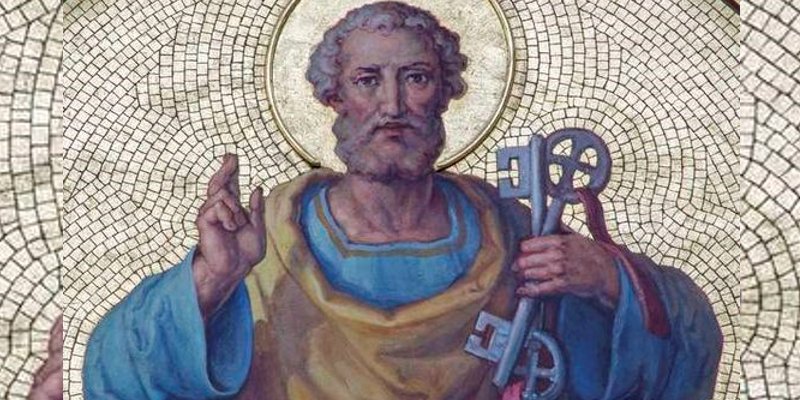
At that point I stopped him and asked: don’t you find it a little strange that John would call the Pope the antichrist, when he himself was present when Christ appointed Peter the first pope? The Sabbath-keeper smiled compassionately.
“I know. You are thinking of the passage in Matthew 16:18: ‘I tell you that you are Peter, and on this rock I will build my Church.’ I understand your confusion, but that is precisely how the ROMAN Church has deceived you.”
You think so?
“Of course. The problem with Catholics is that they do not understand the Bible. They do not realize that the Gospels were written in Greek, and to understand them correctly one must return to the meaning of the words in Greek.”
that sounds Greek to me…
Jesus’ phrase in Matthew 16 is so forceful that the sects either skip it or look for a way to change its obvious meaning. They cannot leave it as it is because then they would have to acknowledge that Christ founded one Church in Peter, and that the popes who have followed him in an uninterrupted chain from that moment continue to be its firm and secure rock. This man gave me the line he had been taught.
“In Greek the word for ‘rock’ is petra, and it means a huge rock. But the new name Christ gives to his friend is the Greek word petros, which means ‘a small stone,’ like those on the beach. Catholics think Christ was saying that the petra, which is his Church, and the petros, which is his friend, are the same thing. But you can see that in Greek they are quite different things, and that Christ is really telling us how far poor little Peter is from being what He, Christ, the Rock, is. This phrase of Christ proves the opposite of what Catholics believe.”
I agree, I told him, that we should go back to the Greek, because it is much closer to the language Jesus spoke. But why stop there? Why not go back to Aramaic?
“To what?”
Yes, to Aramaic. As a good student of the Bible, you surely know that Matthew’s Gospel was first written in Aramaic, which was the common language of the people. It was also the language Jesus spoke.
“Wasn’t it Greek?”
Greek was the language of culture and commerce at that time. Everyone understood it, although in the villages each person spoke his own language. That is why the first translation of Matthew’s Gospel was into Greek, so that everyone, and not only Palestinians like Jesus and the apostles, could understand it. Am I making myself clear?
We know that Matthew wrote in his own Aramaic language because an ancient historian of those times, Eusebius of Caesarea, reports this fact to us. Besides, the Greek translation preserves some Aramaic expressions used by Jesus. Jesus’ words from the cross—Eli, Eli, lama sabachthani!—are Aramaic words and mean, “My God, my God, why have you forsaken me?” (Mt 27:46).
Look, more than that: in the letters of Saint Paul (4 times in Galatians and 4 times in 1 Corinthians), the new name Jesus gave his friend is preserved in the original Aramaic. The word is “ke-fa.” What does kefa mean? The same as petra in Greek: a great rock.
The Aramaic word for a little stone is evna, and Jesus does not use that word. Do you see what I mean? In his own language, what Jesus says to Peter is: “You are kefa, and on this kefa I will build my Church.” That is, “Now you will be called ‘rock’ (Peter, in English), because in you, as on a rock, I will build my Church.” They are not different terms, as in Greek.
The friend stood thinking for a moment. Surely not many Catholics answer him with the same Bible he uses as an attacking weapon.
“Wait. If that is so, then why was it translated into Greek with two words (petra and petros) that have different meanings?”
The word petra is feminine. That is fine for the second part of the phrase: and on this rock I will build my Church. But to preserve the play on words in Greek, it had to be given a masculine ending for Peter’s new name. Would Jesus really say to his friend, “you are Petra”? It just so happens that the word petros also has the other meaning of a little stone. Certainly it is an imperfection in the translation, but Aramaic does not have the complication of masculine and feminine words.
Not only that. In Greek there is a very common word for a little stone, and the translator surely would have used it if that had been the meaning of Jesus’ phrase. That word is lithos. To say what you want to make the phrase say, it would rather be: “You are lithos, and on this petra I will build my Church.” But it does not say that. Am I making myself clear?
Since I had made him completely dizzy, the man smiled, looked at his watch, and told me he would like to keep talking but had an appointment elsewhere. I did not detain him any further.
One of the doctrines most attacked by our separated brothers is the authority Christ gave to Peter when he founded his Church upon him. We know that Jesus Christ is the true Cornerstone of the Kingdom of God on earth. But we also know that, while we await his glorious return, he has not left us without a shepherd.
Let us commend the Pope very much to God, so that he may remain faithful to the weighty responsibility Christ has given him.
Author: Siempre Fiel
Source: Churchforum.org
