
According to the film “Pirates of Silicon Valley”, when Apple set out to design the first graphical operating system (far superior to the then-reigning MS-DOS), the founder of Microsoft, Bill Gates, deceived Steve Jobs, the founder of Apple, into placing prototypes of his new computers at his disposal. He had told him he wanted to create applications for his new operating system, but what he actually did was copy it, giving birth to the well-known “Windows.”
When Steve Jobs saw computers compatible with IBM hitting the market preloaded with Windows, a pseudo-operating-system that copied nearly all of its features to the letter—such as the use of the mouse, windows, and so on—he felt betrayed, and after all the complaints he made to Gates he finally snapped at him, —You know we’re better—, to which Gates laconically replied, —The thing is, you don’t get it. THAT DOESN’T MATTER!—, alluding to the fact that his products, though of inferior quality but cheaper and more accessible, would end up prevailing.

Later Steve Jobs fell from grace when the new president of Apple, John Sculley, relieved him of his duties as head of the Macintosh division, and Jobs ended up leaving the company he himself had founded.
Apple was left without its genie in the bottle and began to decline. In an attempt to save itself, it started trying to resemble now more successful rival companies like Microsoft itself. After several years and on the verge of bankruptcy, Jobs returned—having triumphed with Pixar—and began to raise Apple from the ashes, recovering its essence and ceasing to imitate those who at the outset had been its imitators.
—We are not Microsoft! We are Apple!— he would say when he looked at the product line Apple was developing at that time, which was not faithful to his vision of costlier but higher-quality products. And so it was, when Apple recovered its essence, that the iPod, iTunes, the iPad, and the iPhone appeared, and the once-glorious company became glorious again.
I, though I have a love-hate relationship with these products, acknowledge that they are of enormous quality; in fact my daughters still do their schoolwork with a first-generation iPad.
A similar story
When I recall this story and, at the same time, the history of the Catholic Church and Protestantism, a sense of déjà vu comes over me. How so? Because, all proportion kept, there are certain similarities to the business world.
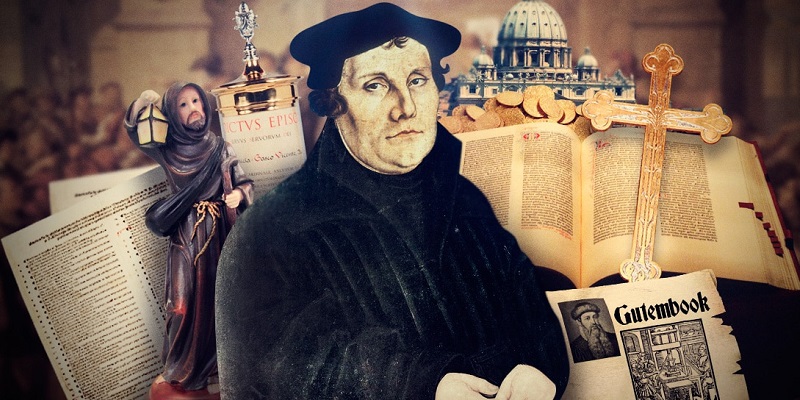
It is the Catholic Church, the only one founded by Christ, that has offered us the “original product,” of which Protestantism made an inferior-quality “copy” that it adapted and made accessible to every taste through its many denominational divisions covering different “market segments.”
—If you want, for example, to make a lot of money, Protestantism has denominations that offer you the promise of attaining it through the “prosperity gospel.”
—If you want to be successful in life, there are denominations and mega-church pastors who offer you that. Thousands of publications by preachers such as Dante Gebel, Cash Luna, and others flood the market with their books and videos, all focused on achieving that goal.
—If what you want is to feel excitement, and even the excesses of throwing yourself to the floor convulsing or laughing uncontrollably, there you have the Pentecostals and their “laughing revival.”
—If what you want is “sobriety” and an austere life lived apart from the world, there are the Amish.
—If you are homosexual and do not want to be holy by the path the Church teaches, through chastity, there you have the Gay Evangelical Churches.
—If what you want is “fellowship” and to have friends who treat you well in a climate of brotherhood, there you have the Jehovah’s Witnesses (at least as long as they do not expel you, in which case no one will ever speak to you again. In any case, don’t worry: as long as you affirm that the end of the world is imminent, that the Catholic Church is the Great Harlot, and you have no accident requiring a blood transfusion, you’ll be fine).
And so on, because in Protestantism there is something for everything. If you have a phobia of medicines, you will find a denomination where using them is a sin or a “lack of faith”; if you don’t like coffee, there is also one for which drinking coffee is a sin. Even if what you want is to take part in a collective suicide, you can surely find one that suits your particular “need.”
Faced with this “clever” strategy, the Catholic Church began to lose “customers,” and some of its leaders felt tempted to imitate their competitors. Modernism, which had earlier infected Protestantism, also infected many Catholics who embraced it in the hope of “surviving,” of “adapting.”
The problem
The problem is that when we do that, just like Apple, we betray our “essence,” our “reason for being.”
The immortal Chesterton said:
|
“The difficulty of explaining why I am a Catholic is that there are ten thousand reasons all amounting to one reason: THAT CATHOLICISM IS TRUE.” |
I love Catholicism because there I have found the truth, not because it “feels nice,” gets me more friends, or makes things exactly as I would like them.
Jesus Christ said, “Heaven and earth shall pass, but my words shall not pass,” and so true were those words that after 2,000 years the Gospel is still in force. No one today believes in Zeus or Aphrodite, nor believes that the pederastic relationship between Achilles and Patroclus was noble, but the Gospel keeps surviving the test of time, and Catholicism, which is its fullness, will go on being attractive—though not to everyone—as long as it remains faithful to its message.
It will not attract those who seek wealth, or excitement above all things, but it will go on being attractive to whoever seeks the truth, which is what it is for.
Just as Apple’s products are not for everyone, Catholicism, though open to all, is not for everyone. Many are called, but few are chosen. Wanting to dilute it to make it digestible to the majority is like trying to water down a Coca-Cola hoping to stretch it: in the end it tastes of nothing. It is like the salt the Gospel speaks of, which loses its flavor and is only good for being trampled underfoot.
Thus, if today the contemporary world, in one of its cyclical moral regressions, begins to think that abortion is fine, we have no reason to accept it. If they accept that homosexual relationships are something natural, why should we yield? Have the Lutherans and Calvinists already yielded? That is their concern. If gender theory is imposed as a fashion, we do not have to run and applaud it. Being a Catholic is the only thing that frees a man from the degrading slavery of being a child of his age (Chesterton).
Examples
But don’t take my word for it, since I am only a rank-and-file Catholic. Let us look at the facts and at how those areas where Catholicism has become infected with modernism languish, while those that cling to their essence flourish.
Let us go, for example, to Germany, the cradle of Luther and the see of cardinals such as Reinhard Marx, who, while still calling himself Catholic, denies that living in adultery is always a sin and values cohabitation and homosexual unions. He has even gone so far as to say that we must ask homosexuals for forgiveness for affirming what the Catechism of the Catholic Church teaches.
As we see in a recent news item from REL, today Germany is a secularized society without faith. It went from being a country that in 1963 ordained 400 new priests, to one that in 1993 ordained only 238; in 2013 it dropped to 98, and in 2014 it reached an all-time low of 58. The German Catholic Church has already closed 515 churches in the last decade, while the Evangelical Church has closed 340. The number of parishes has fallen from 13,300 in 1995 to 10,800 in 2015.
Germans have been leaving the Catholic Church in droves. In 2015, 181,925 Germans formally chose apostasy. The number of infant baptisms has also fallen by a third, from 260,000 baptized in 1995 to 167,000 in 2015. The situation is even more depressing where marriages are concerned. Twenty years ago, 86,456 couples married in the church. Last year the figure was cut almost in half: in a country of 80 million people, only 44,298 couples pledged eternal love in a church. The proportion of people who attend church has dropped from 18.6% in 1995 to 10.4% in 2015.


In the interview-book “Salt of the Earth” with Cardinal Ratzinger, at that time prefect of the Congregation for the Doctrine of the Faith, who would go on to become Benedict XVI, he answered Peter Seewald:
Peter Seewald —Regarding the criticisms of the Church, you once said there was a “canon of topics”: the ordination of women, contraceptives, celibacy, and the marriage of the divorced. The list dates from 1984.
[…] This discussion seems to keep moving wearily in circles. Perhaps a few clarifications would help us get out of this dead end […].
Cardinal Ratzinger —I would like to point out once again that these are genuine issues, but I also believe we lose our bearings when we turn them into standard questions and into the only concerns of Christianity.
There is a very simple reflection against this (mentioned, by the way, by Johann Baptist Metz in an article on the Petition of the People of the Church). These matters have already been settled in Lutheranism, which, on these points, has taken the other path. It is very clear that this has not solved the problem of being a Christian in today’s world, and that the problem of Christianity, the effort to be a Christian, remains as dramatic as before.
Metz, if I remember rightly, asks why we should turn ourselves into a clone of Protestantism.
In fact, he says, it is good that the experiment has already been carried out, because it shows that being a Christian today does not rest on those questions, that solving those matters does not make the Gospel any more attractive nor make being a Christian any easier.
It does not even secure an agreement that would favor the unity of the Church. I believe we must make it very clear: it is not because of these questions that the Church is suffering.”
(Salt of the Earth, Joseph Ratzinger and Peter Seewald 1996)
But while in Germany and other European countries churches are sold off and used as bars or discos, traditional Catholicism flourishes and is revitalized. There you have, for example, the Lefebvrists, who in a very short time are going to set up their fourth seminary in the United States, after the previous ones became too small for them—a most evident sign of vitality. As Paco Pepe comments on his blog, they enjoy not the slightest ecclesiastical or civil protection, only what the faithful give.

And we are talking about a fraternity that until recently was in schism, and has still not completely resolved its irregular situation, yet even in that situation they were more Catholic than some cardinals, bishops, and priests who publicly contradict the Catholic faith and are not reprimanded or sanctioned but are even praised in the highest spheres of the hierarchy.
By this I am not saying that I support Lefebvrism, but rather making it clear that, faced with a diluted and modernist Catholicism, even Lefebvrist traditionalism is more Catholic and therefore more attractive to those who seek the fullness of the Catholic faith.
Today we are in a situation very similar to the one Apple was in. Either we insist on imitating the Microsoft of that era, selling cheap but inferior-quality products in order to reach everyone, or we are faithful to our essence and sell the original product: the Gospel that Jesus Christ left us, without discounts or adulterations, “that henceforth we be no more children tossed to and fro, and carried about with every wind of doctrine by the wickedness of men, by cunning craftiness, by which they lie in wait to deceive” (Ephesians 4:14).
Adapt the Gospel to the world, or transform the world with the truth of the Gospel? For me the choice is obvious.
Reform or apostasy!

Author: José Miguel Arráiz
