
A good article to learn about some aspects of the Organization.
Given their proselytism, which especially threatens the most ignorant layers of the population, it is good to know their origin and history through the “presidents”, the Jehovah’s Witness doctrine, and the contradictions they handle about Scripture, God, The name of “Jehovah”, the Trinity, Christ, The supernatural order, Adam, Eve and the devil, etc.. with their continuous changes in the group’s doctrine, as well as some “conflicting” issues: blood transfusions, rejection of the cross or respect for national symbols.
When at a gathering of friends there is talk of home visits, or when in our neighborhoods we see groups of people, two by two and armed with black briefcases, neatly walking through the door of each of the houses, our thoughts inevitably turn to Jehovah’s Witnesses; tireless home visitors who week after week knock on the doors of homes in large urban centers, offering the latest issue of “Watchtower” or “Awake!”
This reference is actually, in itself, inevitable since in reality we are facing one of the most successful home distribution companies of religious bibliography: the Watchtower Bible and Tract Society, created by Charles Russell in 1880, later perfected and modernized by his successors in leadership: Joseph Rutherford and Jonathan Knorr. Equipped with the pyramidal structure typical of home sales companies – zone managers, home promoters, promoter training school, sales manual… -, the Watchtower is a model that, with more than 100 years of proven effectiveness, many modern sales companies can still look at with interest today. A model that deserves to be seriously studied, because it is the matrix on which some contemporary groups such as Scientology or Amway are growing rapidly.
A. Origin and history through the “presidents”
A.1. Charles Taze Russell
 The one who over the years would be the founder of the “Watchtower” was born in 1852, in Pittsburgh, United States, into a Presbyterian family. He worked from the age of fourteen, dedicating himself to commerce together with his father.
At the age of seventeen, when he was struggling with serious doubts about his faith, he rediscovered his faith in the divine inspiration of the Scriptures through an Adventist sermon. From then on he began to fervently study the Bible, coming to the conclusion that the belief in hell is not founded on the biblical text and that the end of the world is near. Consequently, he will also begin to maintain that men, when interpreting the Scriptures, have falsified the meaning of the Word of God.
He immediately began to preach his convictions, managing to gather some disciples with whom he associated with an Adventist group in Rochester led by Nelson Barbour, with whom he published a book and a magazine.
But he finally separated from Barbour in 1878, devoting himself completely to the Pastor’s mission from that moment on. From Barbour, Russell acquired the conviction (typical of Adventism) that Christ has already come a second time in 1874, although in a spiritual or invisible way.
In 1879 he married Mary Frances Ackley.
In 1880 he founded the magazine that was originally called “Zion’s Watch Tower”, which from 1939 was called “The Watchtower Announcing Jehovah’s Kingdom”, better known among us in its Spanish version: “The Watchtower”
In 1881 Russell launched his “Tracts”, a series of pamphlets that collected his teachings, to disseminate which he used some volunteers whom he called “pioneers”.
The growth and development of publishing and sales activity determined that in 1884 he established, in partnership with his father, the “Zion’s Watch Tower Tract Society” incorporated in the state of Pennsylvania, whose name will be from 1896 until today “Watch Tower Bible and Tract Society”. In 1909 he moved his headquarters to Brooklyn, founding a new legal company in the state of New York.
In 1914 he established the “International Bible Student Association” in England, where he had already arrived in 1891. At that time he toured other European countries, holding conferences in parallel, which he accompanied with the publication of articles in some newspapers; It is even said that he himself prepared a photodrama of the creation at that time.
In 1888 there were already 50 organized pioneers who worked door to door and were called “peddlers.”
He also founded two management or holding companies: the United States Investment Company and the United Cemeteries Company.
His marriage to Mary Frances Ackley lasted 18 years. In 1897 his wife abandoned him, requesting legal separation in 1903 alleging serious insults, which was granted in April 1906, with repeated acts of adultery being proven during the process. In 1908, Mrs. Russell was awarded by the court with a lifetime pension, which she only began to receive in 1909, after requiring repeated interventions by the justice system, an embargo, and even an arrest warrant against Russell that was never carried out. It was after these events that Russell moved the Society’s headquarters to Brooklyn.
The founder of the Jehovah’s Witnesses also had to face a defamation process against the Anabaptist pastor Ross, during which he repeatedly committed perjury by claiming to know Greek, Latin, Hebrew, philosophy and theology, statements from which he had to retract during the same interrogation. He also lied by trying to deny the story of his divorce and the lifetime pension he owed his wife. He even stated that he had been ordained a pastor, having to confess the opposite before the defense.
Charles Taze Russell died on October 31, 1916, during one of his lecturing trips, at the age of sixty-four. The Watchtower chronicles claim that during his preaching life he traveled more than a million miles, preached something like 30,000 sermons, and wrote 50,000 pages of books and pamphlets.
A.2. Joseph Franklin Rutherford
 The second president of the Jehovah’s Witnesses was born on November 8, 1869 in the state of Missouri, to Anabaptist parents. He obtained a law degree in the same state, working as a court stenographer.
He was popularly known as “Judge Rutherford”, although in reality he was never appointed judge, but from his office in the courts he held this position on a supplementary basis on four occasions.
Joseph Rutherford came into contact with the group founded by Russell at the age of twenty-four, through books sold by a propagandist. He joined the “Russellians” and was finally baptized in 1906 by Alexander Hugh Macmillan.
Beginning in 1907, in his capacity as a lawyer, he served as legal counsel to the Society first in Pittsburgh and then in New York. Upon Russell’s death, he was unanimously elected president of the Watch Tower Law Society at the annual meeting in Pittsburgh on January 6, 1917, thus becoming the founder’s first successor.
But shortly after assuming the presidency he had to face difficulties, on May 8, 1918, along with seven other leaders of the Society, he was sentenced to twenty years in prison for preaching against military service and thus having sowed insubordination and disloyalty in the navy and the army. Finally, all of them were acquitted and released after paying bail of $10,000 each.
In September 1919 he organized a conference in the city of Cedar Point, Ohio; There Rutherford revealed that a new mission was beginning, with him being chosen by God to continue Russell’s work. He reinstalled his headquarters in Brooklyn, continued publishing the magazine “The Watchtower”, to which he added a new bimonthly magazine called “The Golden Age”, which in 1937 was renamed “Consolation” and from 1946 “Awake!”.
From this time, the Society began printing its own pamphlets and newspapers, and later books.
But Rutherford was not satisfied with the printed word, but faithful to one of the characteristics of the Watchtower, he knew how to progressively and successfully incorporate new technological resources. In 1922 he began to broadcast his speeches on the radio, and in 1924 he inaugurated a radio station owned by the Society: WBBR, in New York. For ten years the radio was its main propaganda instrument. Finally in 1937 he gave up commercial radio, which he replaced with the phonograph and the truck with speakers.
Since 1934 the Society produced portable phonographs that were used first for Bible studies and then for door-to-door propaganda. This system fell into disuse during the war. In this way, the Jehovah’s Witnesses, led by Rutherford, were the pioneers in the use of the media for proselytizing purposes in the United States.
In 1917 Rutherford published “The Realization of the Mystery of God” which appeared as volume VII of Russell’s “Studies in Scripture”, since he presented it as the posthumous work of the “pastor”.
But perhaps his most important “contribution” was the progressive modification of the organization of the group, originally of a congregationalist type under the leadership of “elders”, until it formed a strongly centralized theocratic structure. This operation began in 1919 with the support of the new magazine he founded (The Golden Age).
At first he centralized the propaganda work and made it independent of the supervision of the elders of the congregations; The next step was the appearance in 1922 of a monthly bulletin with instructions for each month, which today is called “Our Kingdom Ministry.” The definitive step was taken in 1932, when The Watchtower published that the election of elders is contrary to Scripture. In line with this principle, the congregations abolished the position of elders and placed their trust in the “service director,” until then charged only with supervising the sale of books. It is important to keep in mind that the “director” was appointed directly by the headquarters.
Finally in 1938 elections were completely abolished, and all appointments began to be made directly from the Society’s central office. All these changes caused the departure of most of the former members of the group; but the crisis could be overcome quickly thanks to the massive incorporations achieved by the proselytizing campaigns.
This centralization was called “Theocracy” by Rutherford. The name appears for the first time in 1928 in the book “Gobierno”. According to the doctrine set forth by the “Judge,” the theocracy of the Watch Tower society already inaugurates the perfect theocracy of the millennium, thereby enjoying some privileges such as infallibility in appointments and inerrancy in doctrine.
But Rutherford not only innovated the structure but also introduced substantial changes in many exclusively doctrinal points. This is how he wrote against the use of the symbol of the cross and imposed the elimination of the celebration of Christmas among the members of the Society. He promoted intolerance and disobedience to public authorities, he spoke and wrote against everything that was supposed to be an institution other than the Watchtower itself, he instilled a special abhorrence in the Catholic Church, labeling it along with the other Protestant churches as “organizations of the devil.” He even challenged Pope Pius XI to a public debate about what was the true religion.
Rutherford died in Beth-Sarim, on January 8, 1942, aged seventy-two.
A.3. Nathan Homer Knorr
 The third president of the Jehovah’s Witnesses was elected unanimously at the meeting of the legal corporation council of the Watch Tower Society on January 13, 1942.
He was born April 23, 1905 in Bethlehem, Pennsylvania. His parents had belonged to the Reformed Church in the United States and had been “witnesses” for twenty years. Nathan Knorr had been vice president of the New York corporation since 1935, and of the Pennsylvania corporation since 1942. In 1953 he married Andrey Mock, who worked with him at Brooklyn headquarters.
Knorr was mainly concerned with introducing important modifications in the field work of door-to-door propagandists: he would establish a new method of approach through courtesy, and he would found a school for “missionary preparation.” He also had the privilege of being the architect of the renewal of the movement’s own vocabulary.
He clearly established the basis for the expansion of the movement in the dissemination of printed matter. In this sense, Knorr introduced a novelty with respect to its predecessors: it did not multiply its publications but, on the contrary, promoted the existing ones and diversified its contents, placing particular emphasis on the mass dissemination of newspapers rather than on books and pamphlets, thereby achieving a persistent increase in its annual circulation. This editorial effort simultaneously entailed the expansion of Brooklyn’s printing workshops.
Its main innovation was the introduction of the Society’s own English translation of the Bible. To this end he formed a commission, and at the New York Congress in 1950 he launched the “New World Translation of the Christian Greek Scriptures.” Later, between 1953 and 1960, he presented the “New World Translation of the Hebrew Scriptures” in 5 volumes.
But the editorial effort that this could have meant is depreciated by the notes that tend to reinforce doctrines of Russell and Rutherford. The first edition of the Spanish version was published in 1967, with a circulation of 500,000 copies. In 1946 he published the first Bible study manual: “Equipped for Every Good Work.”
Accompanying the transformations in the printed matter, Knorr placed special emphasis on the methodology of personal door-to-door preaching, on complementary visits and on Bible studies. In this context, on April 15, 1957, he sold the radio station, arguing that although it was useful, biblical topics could not be well discussed on this medium because there was no one to answer the questions. On the other hand, he considered the work of “thousands of living stations” to be more effective, a “living religious program at home.”
To stimulate the work of the missionaries, he devised two more general methods of propaganda:
In 1954 he began circulating an hour and a half long film, part in black and white, part in color, called “The New World Society in Action.”
The great congresses, the instrument whose capacity developed the most. In 1946, the first international congress was held in Cleveland with delegates from 32 countries. Each session of the congresses can take up to 12 hours a day, and during its course the baptisms of immersion take place. The bulk of the time is spent listening to speeches, stories of experiences, receiving instructions and presenting new books. During these events, district assemblies take place in parallel. Each congress is presided over by a slogan that is proposed by the Society.
But President Knorr’s primary concern was training for door-to-door preaching. To this end, an evening course was initially created on Monday nights, which was later opened to members from other countries through what was called “Gilead School.”
The School of Gilead offers two annual courses of five months each. Those attending this school must be pioneers with at least two years of experience in their ministry, complete secondary education, and accept the possibility of being sent to any part of the world once the course is completed. Travel expenses are borne by the Society, which also gives them a monthly allowance for ordinary expenses. The course syllabus includes biblical topics, dissemination and preaching techniques, foreign languages, etc.
An important point in this process of strengthening the training schemes in 1943 was the institution of the “Theocratic Ministry Schools” in each “Kingdom Hall” in 1943. The effort was finally crowned with the institution of the “Kingdom Ministry School” at the branch level, in order to train those responsible for the lower schools.
In 1945, under his presidency, blood transfusions were officially prohibited as one of the most serious sins. Likewise, they prohibited eating blood sausage or foods made with blood. Shortly afterward they began to announce the Battle of Armageddon, which they hoped would be fought in 1975, a date that was later postponed to 1984.
Nathan Homer Knorr died in July 1977.
Milton Henschel, president of the Society since December 30, 1992
B. The Jehovah’s Witness Doctrine
B.1. Scripture
 In principle they do not admit any other source of Revelation than Scripture, although unlike other groups that emerged in the same historical context they do not assume the principle of ‘free interpretation’, which would be incompatible with the theocratic organization of the Society. The Society attributes to itself infallibility in interpretation.
They define the Bible as the “written word of Jehovah God for humanity” (Reasoning from the Scriptures, art. Bible, p. 61) according to their teaching, God “used” 40 human secretaries to put it in writing over a period of 16 centuries, being Himself the one who actively directed its writing, which is why they consider it inspired by God.
They present as “proof” of their inspiration, the fulfillment of the prophecies that reflect a detailed knowledge of the future, the scientifically accurate content regarding the most recent findings and the internal harmony despite having been written by 40 different men (Cf. the article cited above).
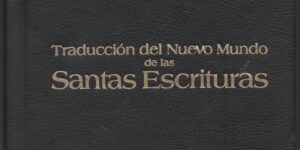
They have their own version of the Scriptures, called the “New World Translation of the Holy Hebrew and Greek Scriptures” and which corresponds to the translation launched by Knorr starting in 1950, which has been the subject of numerous criticisms from specialists for its rigged translation, criticisms that do not find a serious response within the Society. Some examples in this sense are the translations of Jn 1,1; Tt 2,13; 2Co 4,4; Mt 28,17; Jn 14,9-11; 1Tm 4.1; Lk 23,43.
It is also characterized by a vocabulary that is its own, and from which they change the traditional translation of a series of terms commonly used by Christians, altering in some cases the true meaning of the words. Some examples of this particular vocabulary are:
blessed for “happy,” Gospel for “Good News,” cross for “torture stake,” end of the world for “conclusion of the system of things,” Holy Spirit for “active force of God,” Old Testament for “Hebrew Scriptures,” New Testament for “Christian Greek Scriptures,” church for “congregation,” grace for “undeserved kindness,” bishop for “overseer,” Revelation for “Revelation,” worship God for “render.” sacred service
Another characteristic of this “translation” (actually we should call it the “free version”) is the counterintuitive effort it makes to cling to the transliteration “Jehovah” that it uses to refer to the divine Name. But the most serious thing about this issue is that this obsession even leads them to insert it into the New Testament 237 times, an insertion that, resisting all reason and fidelity to the biblical text, they justify by saying that Jesus and the Apostles would “use” the Hebrew text of the Old Testament. This statement does not find a single point of support in the Greek manuscripts of the New Testament and historical research tends to totally contradict it.
In this sense, it is very important to always keep in mind the ambiguity with which they defend their statements. When someone contradicts their statements, they demand that the contradiction be, in their opinion, “scientifically” proven; while in cases such as the name “Jehovah”, they justify themselves by saying lightly that the “form ‘Jehovah’” is “generally accepted in Spanish” (Cf. New World Translation of the Holy Scriptures -with references-, ed.1987, Introduction, p.6); a statement that does not support even a quick review of the Spanish versions of the Scriptures, both Catholic, Protestant and Orthodox.
As if these inaccuracies were not enough, they themselves clarify that in their version “no paraphrases of the Scriptures have been made. Rather, efforts have been made to make the translation as literal as possible” although they recognize that “”even something apparently insignificant such as the use or omission of a comma or an article… can sometimes alter the correct meaning of the original passage.” This last statement, which by the way is very accurate, turns particularly against them when one considers their way of translating some passages, such as Luke 23:43 for the discussion of the survival of the spiritual soul, or Jn 1:1 for the treatment of the divinity of Jesus, both points on which the Witnesses have beliefs markedly different from those of Christians.
They also appeal to a particular criterion in their literal translation, and that is the use of what they call the principle of “uniformity”, according to which a meaning is assigned to each main word and they stick to that meaning throughout the translation. This principle contradicts all the criteria of a scientific translation, is clearly erroneous in terms of translation, and creates serious difficulties of interpretation that disqualify them for dialogue with Christians.
B.2. God
They maintain a strict monotheism, but of a very material nature, which leads them, for example, to determine the precise place where God lives: “the constellation of the Pleiades is the seat of his eternal throne” (Rutherford in Reconciliation, p.12 – cited by Hebert in Jehovah’s Witnesses, p.164).
B.3. The name of “Jehovah”
According to them, this is the name that God himself has commissioned them to make known to modern times. But where does the term “Jehovah” come from?
The Hebrew language is originally a consonant language, that is, the meaning of words arose from the combinations of consonants. Correspondingly with this, in its written development Hebrew was originally a consonant language, that is, only the consonants were written, and the pronunciation of the words was transmitted by tradition. In this way we find that in Hebrew the Name of God was written: “YHWH” (what has been called “sacred tetragram”).
In the most primitive Jewish tradition, taking to the extreme the precept of not using the Name of God in vain, when they read the biblical text they avoided pronouncing it, and replaced it with the word “Lord”, which in Hebrew is said “Adonai”.
When the development of Hebrew began to write vowels (which were represented as dots below the consonants), and as a way to avoid pronouncing the Name of God, when the tetragram appeared in the biblical texts, the vowels of Adonai were placed in it so that the reader would remember to avoid pronouncing the sacred Name.
These details of the Hebrew language were unknown in the Renaissance when sacred texts began to be translated into different languages, so translators from the 15th century onwards came across what looked like the Hebrew word “Yaehowah”, which they translated as “Jehovah”. This appears in many translations that chose to use the Name of God, instead of retaining the traditional “Lord,” until the beginning of this century.
Only during the 20th century, with the development of modern linguistics and the study of biblical languages, was it possible to know that the true vocalization of the tetragram was “Yahweh”, as in fact it appears today in most translations that use the Name of God.
When Jehovah’s Witnesses began their preaching at the end of the last century, the word “Jehovah” certainly appeared in the most frequently used English translations. And when Judge Rutherford “reveals” that the name of the members of the Society is to be “Jehovah’s Witnesses,” he did not yet know that he was proposing a philological error as revealed by God. But today this has been clearly elucidated.
The most striking thing is that Jehovah’s Witnesses today confess that they are aware of the philological error implicit behind the word, but they dedicate long and erudite paragraphs in which they mix erudition with controversy and fundamentalism to justify their persistence in the use of it (In this regard, you can review: Rutherford, Let God Be True, c. II; Who is Jehovah? p. 20; The Truth that leads to Eternal Life, c. 3; Who is God?, p. 17; Reasoning from the Scriptures art. Jehovah, p.198; booklet The Divine Name that lasts forever, New York, 1984;
At this point there is a question that is never answered. If it is admitted that the term “Jehovah” has arisen as a consequence of the ignorance and error of the primitive translators, how can we expect that the Will of God is for this name to be made known? And what is worse… that whoever does not accept this name (this error we could say) is condemned.
B.4. The Trinity
Jehovah’s Witnesses radically deny Christian faith in the mystery of the Holy Trinity, they affirm that this doctrine comes from Satan: God cannot be the author of this doctrine because Christians to justify the effort of understanding appeal to the mystery, and “God – they say – is not the author of confusion.” They maintain that this concept has its origins in Babylonian and Egyptian theologies.
They also affirm that the main scriptural argument of Christians (let us keep in mind that although we do not all use the term “Trinity”, the concept is a common heritage of Christian confessions) to support the Trinitarian dogma is 1Jn 5,7 where in reality there is a confusion caused by a late addition by a copyist and which of course is excluded today in Catholic translations.
In their writings, they also consider other texts, such as Jn 10:30; 1Tm 3,16; Jn 1,1. It is noteworthy that when discussing the topic they do not refer to the command to baptize in Mt 28:19, since this text, along with that of the Baptism of Jesus, is one of the most used in the reflections of Christians.
But they also forget to consider that Russell began his preaching with the old version of the Protestant Bible, which incurred the error that was common to the editions of his time, and that the Society used it until the appearance of the New World version in 1950.
In conclusion: not only do they deny that the Trinity appears in Scripture, but at the same time they deny the Divinity of the Son and the Holy Spirit, that the Holy Spirit is personal, that both the Son and the Paraclete are coeternal with the Father, and therefore, both one and the other are inferior to God. Likewise, they deny any scriptural basis for any of these statements (Cf. Reasoning from the Scriptures, art. ‘Trinidad’, p.398ff.), ignoring the entire Christian tradition in this regard. In the writings of recent years, they have toned down the disdain for the Christian appeal to the “mystery” of the Trinity.
B.5. Christ
But where its distance from all Christian confessions is perhaps most clearly shown is in its persistent denial of the Divinity of Jesus Christ.
Jehovah’s Witnesses consider him only a privileged creature; In fact, they affirm that he is the transcorporalized archangel Michael (Cf. Reasoning from the Scriptures art. ‘Jesus Christ’, section ‘Are Jesus Christ and Michael the archangel the same person?’, p. 215). In this particular vision of the Person of Jesus of Nazareth, they affirm that he was a spiritual person, powerful although not all-powerful, he was before all other creatures, he was the first creation of Jehovah, after his creation God used him as his Partner, who worked with Him when creating all the rest of creation (Cf. Let God Be True, c. III ‘What do you say about the Messiah?’, pp. 31-32), but as is evident, for Jehovah’s Witnesses Jesus is not God.
In dealing with this issue, they are particularly concerned with justifying their translation of Jn 1:1 (see, for example, the corresponding note in their “New World Translation”), which is of singular importance due to its connection with Trinitarian doctrine, since in the verse the distinction of persons and the unity of nature are simultaneously affirmed. Other texts whose Catholic interpretation they are concerned about refuting are: Jn 20:28; Mt 1,23; Jn 5,18; Hb 1.6; Mt 14,33; Jn 10,30; used as arguments against the Divinity of Christ: Jn 17:3; Jn 20,17.
In general, they do not accept miracles as proof of the Divine work of Jesus, arguing that the prophets could also work similar miracles, not that there is an essential difference between the work of the prophets and that of Jesus of Nazareth. On the other hand, his comments on Mc 2:5-12 are not abundant; nor do they make reference to the interrogation in Caiaphas’ house narrated in Mt 26, 63-66, translated ambiguously in its “New World” version.
In this way, they discard a priori and without considering, the arguments that have been of greatest weight in the entire tradition of Christianity, to support the divinity of Jesus.
Jehovah’s Witnesses affirm that Jesus is the “firstborn”, thus accepting the terminology used in Col 1:16; Hb 1.6; the first begotten, but not in terms of nature, but as a creature: “he was the first son that Jehovah God gave birth to… he was the first of Jehovah God’s creations” (Let God Be True, p. 31).
Of course, they simultaneously deny the Divine Motherhood of Mary, considering it blasphemy to call Mary “Mother of God” (Let God Be True, c. III, p. 34), a title that they claim was taken by the Catholic clergy of pagan Babylon.
These statements have found some more moderate formulation in their latest publications. But in any case, Mary is for them only the woman chosen by God and highly favored to give birth to Jesus. Strangely, they maintain that she conceived Jesus virginally, which among Catholics is already considered proof of the Divinity of Christ, but, following Protestant tradition, they affirm that she later had other children.
Mary – always within the Jehovah’s Witness faith – was not conceived without original sin, nor did she assume heaven.
As expected, they affirm that it is not licit to appeal to Mary as an intercessor, nor that she was an object of special honor among the first Christians (in a way that shows their little concern for knowing the historical truth).
In reality, the special cult of Mary has – in the opinion of Jehovah’s Witnesses – a pagan origin; It would be related to devotions to mother goddesses (For these last points, refer to: Reasoning from the Scriptures, art. ‘María’, pp. 227ff.).
Starting with Russell, the Society has affirmed that Jesus was born around October 1, 2 B.C. (Cf. Studies in the Scriptures, II, 55, 60-61; Let God Be True, c. III, p. 35), a date that lacks any historical, scientific and biblical foundation.
According to the Witnesses, the Son was not incarnated, but rather his life was “transferred from his glorious place with God his Father, to the germ of a man” (Cf. Let God Be True, c. III, p. 35). As if this collection of originalities were not enough, they will also maintain that Jesus was not the Messiah at the moment of his conception, but rather “became so” at the moment of his baptism in the Jordan: “There in the Jordan, by means of holy spirit, Jesus was anointed by God to be the foretold great high priest, the king of the kingdom of God, and to preach…” (The Truth That Leads to Eternal Life, c.6, pp. 48-49). This would have happened – according to its chronology – in the autumn of the year 29.
B.6. The supernatural order, Adam, Eve and the devil
The Christological errors of the Witnesses are perhaps due to their erroneous conception of supernatural life (or vice versa?).
The question begins already in Eden, where Adam and Eve would have received the preternatural gifts (absence of fatigue, and eternal life), but not the presence of God in them (Grace), nor the beatific vision in heaven. In Jehovah’s Witness theology, what we Christians know as a vocation to a truly supernatural life is completely ignored.
Supported by a twisted interpretation of some biblical texts, they have imagined the following story (Cf. Let God Be True, c. V, pp. 54 ff. – the vocabulary of the synthesis, seeks to maintain fidelity to the original language of the text).
Lucifer enjoyed a very high position in the family of God, he was very beautiful, and he had a very important position: he was “superintendent of humanity”; His duty was to help men meet God’s requirements and educate them in a proper relationship with Him.
But this cherub desired the devotion and adoration of men for himself and rebelled against the theocratic order. The first sin was his, the lie he told Eve: “you will not die.” For this lie God sentenced him to death but postponed the sentence in order to allow him to establish a posterity.
Lucifer’s rebellion is indicated by the new name he will receive: Satan. The sin of Adam and Eve was the material act of eating the fruit, the consequence of this fall being the loss of eternal life on this earth.
The fall of Adam increased Satan’s ambition, going so far as to challenge God by telling him that he could not put men on the earth that he would not be able to cause to sin. “These words themselves are not found in the Bible, but the evidence (?) that he uttered them in substance is clear and unmistakable,” Judge Rutherford states in “Let God Be True,” c. V, p. 57. But since Abel, Jehovah has had witnesses on earth, the greatest of all of whom has been – in the opinion of the Society – Christ Jesus.
Jehovah’s Witness demonology is completed with the affirmation that until the flood, Satan and the other angels could clothe themselves in human flesh to separate men from God, but then this privilege was withdrawn from them. Together with the men who followed them, the demons then formed a diabolical organization visible (the evil men) and invisible (the demons), which corresponds inversely to the theocratic organization of the Watchtower. Satan would have become king of the world in 607 B.C. with the fall of the theocratic government of Jerusalem. It even seems that Christ died by his agents (Cf. Let God be true, c. V, p. 59).
His government lasted seven times, 2520 years, concluding in 1914 when he waged a war with Christ in heaven, as a result of which he was defeated and precipitated to earth, where he now causes incredible difficulties for which he uses religions, political organization and every other organization that is not, of course, the Society. They maintain that the battle of Armageddon will destroy his organization, and he and his demons will be bound for a thousand years and thrown into the abyss and will finally be annihilated (The summary of demonology has been taken from Hebert, G. Jehovah’s Witnesses, pp. 184-185).
As a result of this original sin, all men are born sinners, imperfect and condemned to death. Redemption is the rescue of man from this condemnation:
“The thing purchased with the ransom price is identified in Jehovah God’s declaration to the perfect Adam concerning what would be lost through sin and disobedience: ‘You will surely die’ (Gen 2:17). What was lost was perfect human life, with all earthly rights and hopes.” (Let God Be True, c. X, p. 113).
The Word (that is, Jesus) came to “redeem” us as a perfect man, similar to what Adam was before the fall, so he could have lived eternally on earth but he wanted to pay the ransom for humanity by giving up his perfect human life; This “perfect human life that Jesus gave up when he died is the thing of value that carries out the purchase of that which Adam lost for all his offspring due to his disobedience… “. That sacrifice, “was presented in heaven as a redemptive offering for sin, by the resurrected and glorified Christ, because he was resurrected as a spiritual and immortal creature, no longer being a human son of God” (Let God Be True, c.
But let no one be fooled, this redemption is not universal, it does not reach all men. Adam, for example, is not included. “Because he was a willful sinner, he was sentenced to death, and he died deservedly.” According to the Society, there are 3 kinds of sins (The classification of sins is from Hebert, G., Jehovah’s Witnesses, p. 186):
* Original sin, inherited and that can be erased (original originated). * Original sin, which leads to irrevocable destruction. This is the sin of Adam (original originating), which is why “Adam is not included among those rescued.” All those who consciously, deliberately, and habitually disobey God’s law incur this sin. The sacrifice of Jesus does not apply to these sins. * The sin that does not lead to death. They are sins of weakness, which are regretted after having been committed. God forgets these faults thanks to the sinner’s repentance and firm decision to follow the law.
Sin is not the transgression of the commandments of the Decalogue, these were abolished by Jesus: “…many are astonished when they are informed that the Law was abolished and terminated by Jehovah, and that no creature on earth is now under it, not even the Jews” (Let God be true, c. XVI, p. 180). For them, sin is not achieving the degree of justice that Jehovah has established “the power of the new covenant does not come from the abolished Ten Commandments, but is the spirit of God, which transforms Christians into a likeness that reflects God” (Let God Be True, p. 189).
To be saved, it is necessary for men to inform themselves “concerning the mercy of God through Christ Jesus and then to have faith in the provision He has made… and then to demonstrate that conviction by dedicating themselves to God and informing others concerning the rescue”; That is, the preaching of the doctrine of Jehovah’s Witnesses is necessary.
In short, for redemption to take effect, we must strive to overcome sinful tendencies and zealously participate in the works of preaching (Reasoning from the Scriptures, art. ‘Rescue’, pp. 325-326).
Now, this “rescue” as they call it, gives men the right to a perfect life, without end, on an equally perfect earth; only the 144,000 chosen will abandon their bodies to become spiritual creatures, being called to heavenly glory to constitute the body of Christ (Cf. Let God be true, c. XXIII, pp. 268 ff.).
In this soteriology it can hardly be classified as Christian, since in it there is neither adoptive filiation nor indwelling of God in us. That is to say, there is no what we Catholics call “sanctifying grace” that makes man righteous in the eyes of God, as well as an adopted son and heir of heaven, being elevated to a life superior to that which corresponds to us by nature. Furthermore, Christians affirm that all men are called to this double natural and supernatural happiness.
B.7. Death and Resurrection of Jesus
The Witnesses, under the guise of supposedly erudite and scientific language, maintain that Jesus died hanging from a “tree” nailed hand and foot; not crucified with outstretched arms.
To support this statement they try to rely on the meaning of the Greek and Latin terms xylón, staurós and crux. They do this ignoring the full meaning of these terms, the references of historians about the different forms of crosses, and the representations of early Christians in the catacombs. Encouraged by their need to differentiate themselves, they direct the force of their argument to affirm that the cross is a pagan symbol adopted by Christians from paganism.
This point of Witness doctrine actually appears quite recently; It is introduced by the book “Riches”, published by Rutherford in 1936; while the references from different authors, in the Society’s previous publications, used traditional crosses.
Much more serious is the Jehovah’s Witness doctrine about the Resurrection. Speaking of Jesus they say: “…his perfect human life, along with all its rights and hopes, was given up through death, but not because of any sin or in punishment. Jesus did not take it up again after his resurrection, because he was raised as a divine spiritual creature.” (Let God be true, c. X, p. 115).
That is, according to Jehovah’s Witnesses, Jesus was not truly resurrected, he did not have a true human body of flesh like ours. They maintain that on the occasion of his appearances, Jesus materialized bodies as (they say) the angels had done in times past.
Although it is difficult for them to admit it, these statements destroy the entire Christian faith which, as Saint Paul affirms in the 1 letter to the Corinthians chapter. 15 v.17, is based on the reality of the resurrection.
B.8. Synthesis of the Jehovah’s Witness faith
This synthesis has been taken verbatim from the pamphlet “Jehovah’s Witnesses in the Twentieth Century” (Watchtower Bible and Tract Society, Brooklyn, 1979), distributed on the occasion of the massive congresses organized by the Society in the eighties in Argentina.
The Bible is the Word of God, it is the truth and it is more reliable than tradition. The name of God is Jehovah. Christ is the Son of God and is inferior to Him. Christ was God’s first creation and died on a tree, not a cross. Christ’s human life was paid as a ransom for obedient human beings. A single sacrifice offered by Christ was sufficient. Christ was raised from the dead as an immortal spirit. The presence of Christ is in spirit. The Kingdom through Christ will rule the Earth in justice and peace. The Kingdom brings ideal living conditions to Earth. The Earth will never be destroyed or depopulated. God will destroy this system of things at the battle of Armageddon. The wicked will be destroyed forever. There is only one way to life. We are already in the “time of the end.” Human death is due to Adam’s sin. The human soul ceases to exist at the moment of death. The hope for the dead is the resurrection. Adamic death will cease. Man did not evolve: he was created. Only a small flock of 144,000 will go to heaven to rule with Christ. The new covenant was made with spiritual Israel. The congregation of Christ is built upon Himself. Prayers should be directed only to Jehovah through Christ. Images should not be used in worship. Spiritualism should be avoided. Satan is the invisible ruler of the world. The Christian does not participate in movements to unite faiths. The Christian must keep himself separate from the world. All human laws that do not conflict with the laws of God must be obeyed. Taking blood into the body through the mouth or veins violates God’s laws. Biblical laws regarding morality must be obeyed. The Sabbath was given only to the Jews and ended the Mosaic law. It is not proper to have a clerical class or special titles. Christ set the example that should be followed when serving God. Baptism through full immersion symbolizes dedication. Christians must bear public witness to biblical truth.
C. Changes in Group Doctrine
Jehovah’s Witnesses are well known today for some particularities of their doctrine, such as their denial of blood transfusions, or their affirmation that Jesus did not die on a cross. But what we often do not know is that the Society has not always supported these statements, but, on the contrary, most of them are “news” that contradict its previous practices. A clear example of this is the celebration of Christmas; While Russell celebrated it like every good Christian, today they despise it as a rite of pagan origin.
To have some news about this, we will try to see correlatively the “new things” that each president has introduced.
C.1. Russell
He affirmed that the second coming of Christ would occur invisibly in October 1874, inaugurating a period of forty years called the gathering period, during which the Lord would finish gathering his flock; the herald of this meeting was to be Russell himself.
This period of time is also, according to the founder of the Witnesses, the end of the “time of the Gentiles” that had been inaugurated with Nebuchadnezzar (in 606 BC) and which would essentially be the time of domination of the evil ones.
Russell believed that during the harvest period the destruction of these powers would be prepared, a destruction that should have ended in a spectacular and definitive way with the great battle of Armageddon, which, according to his predictions, would happen no later than 1914, giving rise to the beginning of the millennium, during which time the heirs of the Kingdom would reign with Christ in heaven, and a new earth would be established.
He distinguished three classes of men:
1- the consecrated saints, the only ones who would know heavenly joy; who have made a commitment to God that requires them to be like “living sacrifices”:
– the small flock, the famous 144,000, who would be faithful to the commitment made to God, they should receive the throne and the divine nature, and form the body of Christ.
– the great multitude, all those who, for not having been entirely faithful, would first be punished; They would become spiritual beings, but without the throne or the divine nature.
2- the brothers, who believe in Christ but have not accepted Russell’s call. They must make a choice in the recovery time, then they can obtain a perfect human life. This recovery would be done gradually during the millennium. At the head of this humanity would be found the righteous of the Old Testament, resurrected as perfect men. 3- wolves disguised as sheep; those who do not believe in Christ the Redeemer (as understood by the Witnesses); A second death, complete destruction, would await them.
The Armageddon announced by Russell should not be identified with the First World War. In an article from November 1, 1914, he said that September 20 had probably marked the end of the time of the Gentiles, but that the complete overturning of the nations would be done gradually, perhaps in the space of a year. In the 1916 reissue of “Studies in the Scriptures” (originally published between 1886 and 1904), he had to correct his considerations on the significance of the events of 1914, saying that from that date the Kingdom of God would begin to acquire authority and would be firmly established in a short time (note how the notion of immediacy has been lost).
C.2. Rutherford
The famous ‘Judge’ maintained the affirmation made by his predecessor, of an invisible presence of Christ in the world since 1874, based on his observation that from that date onwards inventions multiplied (this at the cost of fudging the dates, as he did with respect to the origin of the unions). As for the “gathering period” it will begin by delaying it: 1878-1918, the four-year shift is due to a period of preparation that corresponds to the public life of Jesus (?). In 1924 he stated that the collection began in 1874, but that in reality the collection period lasted 50 years. It wasn’t long before he claimed that harvesting had only begun in 1918.
Consequently, 1914 was no longer considered by Rutherford as the date of Armageddon but rather the beginning of the end of the world (!), which should have culminated with the collapse of the powers, three and a half years later, on Easter 1918, after glorification of the little flock.
So many mistakes explain why, starting in 1918, he stopped referring to specific dates, contenting himself with saying that the social and political order will end “in a few years” (an expression they still maintain today); He then attributed sensational but invisible events to the years 1914 and 1918, most importantly: in 1914 Christ would have ascended on his throne in heaven and would have unleashed the war against Satan, who would have been expelled; The kingdom of God was then inaugurated in heaven, Armageddon would not take long to arrive.
But it wasn’t just this, Rutherford also launched his own prophecy. In 1920, in the pamphlet “millions of people currently alive will never die” he announced that in 1925 the ancient patriarchs: Abraham, Isaac, Jacob and other righteous people would be resurrected to enjoy the perfect life of the new world; because that is the date of the beginning of the great Jewish jubilee.
He held this new announcement for a few years, until in 1929 he took personal possession of the house and land he had prepared for them in San Diego, California: Beth-Sarim (House of the Princes). Immediately after the death of the “Judge,” the house was sold.
This last attempt was enough for Rutherford to definitively abandon the announcement of dates, from then on he was content with only insisting on the imminence of the final crisis and universal reestablishment.
From its beginnings, the group’s adherents received various denominations: Bible students, Russellites, or simply Christians. On July 26, 1931, at the Congress in Columbus, Ohio, Rutherford presented and had approved a five-page resolution according to which they would henceforth be known by the name “Jehovah’s Witnesses”, a name that – so he maintained – would have been communicated to him by God in the fall of 1922, and which he supported in Is 43:10-12; 62.2; Rev 12,17.
D. Contradictions
The following is a synthetic list of some of the many contradictions that we can find in Jehovah’s Witness doctrine:
D.1. Rutherford:
* Religion was invented by the devil… but he appeals to religious freedom to spread his ideas and books. * He attacks the infallibility of the Pope… but claims total authority and infallibility for himself. * It proclaims that Jehovah’s Witnesses are not servants of any terrestrial organization… but subjects its members to the rigid control of the Society, which is ultimately a commercial organization. * He condemns “organized religions” but he himself uses the methods he reproaches.
D.2. General:
* At first they considered religion to be an invention of the devil… but today they consider themselves the “only true religion.” * They affirm that human governments are the work of Satan, which is why they cannot collaborate with them under any circumstances… but they praise the judicial courts of those governments when they approve their religious practices, pay taxes, make use of their social services, etc. * They consider that the existing religions are all bad because they are worldly organizations… while the Society has become a large business organization. * They reject all types of theological studies… but one of their training institutions is the “schools of Gilead”, a Jehovah’s Witness version of an institute for theological studies.
E. The Dates
At this end of the millennium, when a thousand fantasies are woven around dates and changes, dates deserve particular consideration since among Jehovah’s Witnesses they have their own relevance.
They are lovers not only of prophesying dates, but also of chronologies, and organizing history in periods of years according to their interpretation of different prophecies. This is a hallmark of its origin, let us not forget that Russell initially began by stating that he could establish the date of the second coming of Christ through a scientific study of Scripture.
E.1. The second coming of Christ
According to Russell’s teaching, it happened invisibly in October 1874 (Cf. Jehovah’s Witnesses in the Divine Purpose, p. 23; ‘Prophecy’ p. 72). Currently they affirm that Christ returned in October 1914 (Cf. The Truth That Leads to Eternal Life, p.93).
E.2. End of the world
Russell preached that the period or time of the end had begun in 1874 (Cf. Zion’s Watchtower, a.1, n.1, p.3, July 1, 1879), and that the complete reestablishment of the Kingdom of God would be accomplished by the end of 1914 (Cf. Jehovah’s Witnesses in the Divine Design, p. 57). Today they teach that the signs of the end have begun to be fulfilled since 1914 (Cf. The Truth that Leads to Eternal Life, c.11, p. 94).
E.3. Armageddon
Russell prophesied that this battle would take place in 1915 (Cf. Scripture Studies, 2nd series, p. 101). Today, the Witnesses say they hope for its realization. Knorr maintained in 1952 that “it is now at the door” (Cf. Let God Be True, c. XVII, p.200); At the end of the ’40s they announced that it would take place in 1975, saying that according to their chronology it corresponded with the end of the sixth day of creation, then they gave another date: 1984; In their latest publications they only describe it and it is not possible to find references to specific dates (Cf. Reasoning from the Scriptures, art. ‘Armageddon’. The dates of 1975 and 1984 were obtained from Elizaga, Julio, Las sects nos invade).
E.4. 1918
As announced in “The Finished Mystery”, published in 1917; In that year God would destroy the great churches, and their members by the millions; Christianity as a system would fall into oblivion to be succeeded by revolutionary republics. Christendom would be destroyed in a “brief but memorable period.” For now, that “brief period” exceeds 80 years.
E.5. The papacy
Its end was prophesied for a date close to the end of the Day of Wrath, which is supposed to have taken place in 1914 (Cf. Scripture Studies, 2nd series p.356).
E.6. The millennium
According to the aforementioned “Studies in the Scriptures”, p. 187, the millennium would have begun in 1874. Forty years ago, they affirmed that it would begin after Armageddon, “a war that all signs indicate will begin within our generation” (Cf. Let God Be True, p. 177). But a decade later they began to say, and to this day they teach, that it is yet to begin, after the final day comes (Cf. The Watchtower, 1967, p.235/25).
E.7. First Resurrection
Russell, in the 3rd series of his “Study…”, p. 305, states that the resurrection of the church was to occur in 1878, three and a half years after the second coming of Christ. Some time later, in 1952, the Society stated: “…They slept in the tomb until the first resurrection, which occurred at the coming of Christ Jesus to the temple of Jehovah in 1918” (Cf. Let God Be True, p. 128). And no one found out!
E.8. Resurrection of the Patriarchs
In “Millions Living Today Will Never Die,” p.88-89 / 90-97, Judge Rutherford stated that Abraham, Isaac, Jacob, and the faithful prophets would be resurrected in 1925. They later altered the prophecy slightly to say that this is a “reasonable promise,” and that they would be resurrected before Armageddon (Cf. Jehovah’s Witnesses in the Divine Purpose, p.254), or in a comparatively short time (Cf. Government, p. 276)… or not so short?
E. Dates Today
If this analysis of the dates seemed complicated to you, it may be much more difficult if you try to take the Watchtower publications and have a relatively coherent reference of the dates of the Jehovah’s Witness chronology today.
The Kingdom of God: would have been established in 1914. They try to prove this by:
a) the biblical chronology; b) the events after 1914.
In this biblical chronology the prophecy of Dn 4:1-17 occupies a prominent place. According to the Witnesses, the prophecy has a “greater fulfillment”: the time when Jehovah would give rulership over humanity to his Son. Luke 21:24 records the words of Jesus according to which Jerusalem would be trampled by the nations until its time was fulfilled; According to Daniel’s prophecy this would be for ‘seven times’. In prophetic time (this is what Jehovah’s Witnesses have established and no one knows why), a day is counted as a year, which would then mean 2520 years. Zedekiah (Zedekiah) is considered “the last king of the typical Kingdom of God,” who was removed from the throne of Jerusalem. According to them, the last vestige of Jewish sovereignty would have been the governor Gedaliah, who would have disappeared around the beginning of October 607 BC, 70 years before 537 BC, the year in which the Jews returned from captivity in Babylon. 2520 years from that date, we are at the beginning of October 1914.
The last days: after Christ was according to them enthroned in heaven, Satan and his angels were cast down to Earth. That is why from that moment on a separation process would be carried out, which is what has been currently taking place since 1914.
The great tribulation: will then take place in the time of this generation, before the last members of the generation that was alive in 1914 “have passed from the scene of this existence.”
As we have noted when referring to each point, in contemporary bibliography there are no references to specific dates of Armageddon, nor to the end of the papacy, of Christianity, of the “system of things”, nor to the date of the first resurrection, or of the resurrection of the princes of the Patriarchs.
Regarding these issues, the magazine The Watchtower in its issue of May 15, 1990 stated: Armageddon refers to “a situation of global reach, although in part its meaning is derived from Megiddo and what took place in that area”, without giving any specific reference regarding the place. This battle would take place “when a certain situation develops that will affect Jehovah’s Witnesses throughout the Earth,” but the date is further specified by saying: “The current generation will not pass away before Armageddon occurs!”
The paradoxical thing is that they themselves recognize that this is a statement that “has been proven many times from the Bible in this magazine”, which is true, this occurs in the field of Jehovah’s Witness bibliography at least from 1946 with the publication in English of “Let God Be True.”
G. Some “conflicting” issues
For some time, Jehovah’s Witnesses attracted public attention thanks to some unusual aspects of their religious practice. During the times of compulsory military service, it was common to find young people in the dungeons of military garrisons who preferred to remain prisoners rather than salute and swear the flag, who refused to carry weapons… because they were Jehovah’s Witnesses.
Nor is it strange that in the local news, or that in hospital waiting rooms or in a lawyer’s office we can find cases of parents who have refused to authorize a blood transfusion for their child for religious reasons.
Although these are not central aspects of the Jehovah’s Witness faith, given their significance and the curiosity they arouse, they deserve special attention:
Blood Transfusions
Primitive man recognized two primordial elements in which he supposed that this mysterious divine gift that is life was based: breath and blood.
Since life is a part of Divinity, primitive man also gave both elements a divine origin. This explains the precept of the book of Leviticus, cap. 7, vv. 10-11: “If any man of the house of Israel, or of the foreigners residing among them, eats any kind of blood, I will turn my face against him who eats blood and will destroy him from among his people. For the life of the flesh is in the blood, and I give it to you to make atonement on the altar for your lives…”
This is the reason and the precept that is at the origin of the Hebrew custom of not consuming foods that contain blood in their preparation, or meat that has not been properly bled. In this same sense it has also been interpreted by various Christian groups that tend to return to customs and customs typical of Judaism.
But to this religious interpretation of blood, Jehovah’s Witnesses have given a new dimension: the prohibition of receiving blood transfusions.
Stating that a transfusion is the same as eating blood, that alternative therapies for the use of blood in transfusions are not only similar but even better than the same blood, they lead their followers to reject this type of treatment for themselves and their relatives.
It is obvious that, even when for religious reasons one wants to resume the ancient custom of not eating blood as an act of recognition that life is a gift from God that only God is responsible for taking
The rejection of the cross
If there is a symbol that universally represents Christian confessions, it is the sign of the cross. All of them, even those who refuse to use it as ornamentation, affirm that Jesus of Nazareth died tormented on a cross made up of two pieces of wood joined transversally.
Beyond discussions, all Christian churches identify the preaching of the cross with that of the Gospel; to deny it would be to reject the words of Saint Paul in the first letter to the Corinthians, chap. 2, v. 3: “…I did not want to know among you except Jesus Christ, and him crucified.” And none of them will affirm that they worship the cross, but rather that they hold it as the symbol of our redemption.
But on this point the Society had to distinguish itself. Although they fight hard to be admitted as Christians (we have already clarified that they are not because they do not believe that Jesus is true God), they do not even admit the universal symbol of Christians.
They reject the cross, stating that it is a pagan symbol, and denying all historical evidence, they maintain that Jesus did not die on a cross formed by two pieces crossed transversely, but on a tree, with his hands joined above his head. As in the case of Christmas, they spend a lot of time “proving” that the introduction of the cross is a deception made on the occasion of the incorporation of pagans into Christianity in the 4th century, which induces the faithful to secretly worship those gods that the prophets execrated in the Old Testament.
Much could be written on this subject, books even, but everything that can be said in response has been wonderfully summarized by Saint Paul in the letter to the Galatians, chap. 6, v. 14: “God forbid that I should glory except in the cross of our Lord Jesus Christ…!” Or are you also going to tell me that Saint Paul was a pagan?
Respect for Patriotic Symbols
A point that has always been very delicate for Christians is the one that refers to war, love of the country and the right to self-defense.
The common Christian doctrine in this regard recognizes its foundation not only in the greatness and teachings of David, the warrior king, but also in the books of Maccabees and the New Testament. Christians have always found in the fourth Commandment – honor father and mother – the foundation of the demand for love and service to the Country, not as incompatible with the love of God, but as an expression of it.
But Jehovah’s Witnesses have not been able to see it that way. From the earliest times they had to face difficulties due to their rejection of national symbols and providing service to the country. They consider respect for the flag, oaths of loyalty to the country and the use of any symbol as acts of idolatry.
They start from the Old Testament texts that condemn gestures referring to foreign rulers and nations as idolatry. But in their fundamentalism they forget that in those times, pagan rulers were considered gods, and received a cult of adoration as such… today we know that our rulers are simple mortals, and even when they exhibit despotic power, they will never be divine, and consequently they are not objects of true worship; Consequently, in the times of the prophets, pagan banners were also elevated to the category of idols, very far from our flags, hymns and cockades, which are simple sensitive expressions of our nationality.
They also forget that far from condemning, the prophets praised, and the wisdom books sing the praise of those who legitimately armed themselves in the legitimate defense of the people.
But perhaps the Society reserves this praise, not for those who legitimately defend their country, but for those who defend the Society, which, as Rutherford proclaimed, seeks to be a theocracy, that is, a true state within the state.
Source: ARBIL Magazine
“ARBIL, Annotations of Thought and Criticism”, is edited by the Arbil Forum
The total or partial reproduction of these documents is available to people always under the criteria of good faith and citing their origin.
