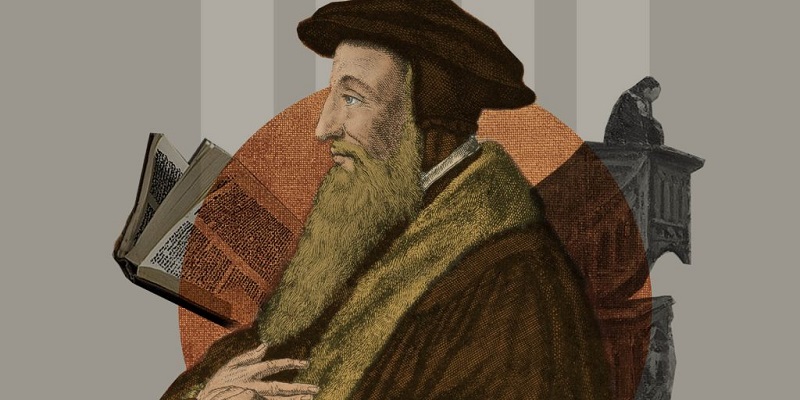
I already know that the title of this post is unfair, and not only that, it is a complete strawman fallacy, since that is not what César Vidal maintains in his article John Calvin and the Inquisition, but since he himself uses those resources, I thought: Why not me?
Sarcasm aside, what is also a fallacy and with all rigor, is the argument that César Vidal makes in said article, which is the first of a series of apologias in which he attempts to address “some myths spread about Protestantism”.
Where is the myth?
But what myth is the historian trying to reveal here? As he himself comments regarding his conversations with Catholics “The only thing they usually comment on is that the Catholic inquisition was not so serious because… Servetus was burned in Geneva by Calvin”.
I must say that during approximately 12 years in which I have been able to read and participate in debates between Catholics and Protestants (some more educated, others less) I have never heard that argument, as presented by Don César Vidal.
And anyone who presented a similar objection would simply be saying that the seriousness of one error is relative to the seriousness of another. Thus, if, for example, I killed a person today, I could argue that it is not so serious because someone else killed three, and she could argue that it is not so serious because someone else killed ten.
The times that I have found Catholics and Protestants debating these issues have been when some Protestant on duty arrives tearing his clothes and ranting because in the Holy Inquisition “millions and millions” of Christians were condemned to death. Ignoring that 99% of the time said person comes up with astronomically exaggerated (not to say downright ridiculous) figures, most of the time he or she is incapable of making any distinction based on the historical context of the moment and attempts to judge those who lived in past centuries from the perspective of the present.
It is there that Catholics usually refer to their Protestant interlocutors how at that time Protestants did not act very differently from Catholics, and hence the case of Servetus is usually mentioned, but not to justify the excess errors of our ancestors in faith, but so that they can understand that there are circumstances that must be taken into account when making a value judgment about those events. We must not forget the historical, sociological and cultural context of those countries during the 16th century, where Church and State were united, and there was little religious tolerance. Heresy was feared for endangering the civil order, which was inextricably linked to the religious order.[1].
Justo Gonzales, also a Protestant historian, has no qualms in acknowledging that “At the same time, and in various parts of Europe, both Catholics and Protestants were proceeding in a similar way against those they considered heretics.” [2]
But something that definitely cannot fail to draw attention in the article is that:
1) It is suggested that with respect to the field of freedom of conscience, Calvin was much more tolerant than Saint Thomas More, since the latter, unlike the reformer, “He expressed himself again and again against freedom of conscience”
2) Servetus burned in Calvin’s Geneva… “although not by order of Calvin but by the city government in which the reformer had no position”
But did Calvin have responsibility for the condemnation of Servetus? (It seems to be deduced from the words of Don César Vidal that it is not). He also alleges that Thomas More expressed himself again and again against freedom of conscience. Didn’t Calvin?
Calvin and the theocratic dictatorship
To understand how Calvin managed to establish a theocratic dictatorship where only what he wanted was allowed, we must understand how the civil and religious powers were organized in Geneva.
The great council or council of two hundred: highest civil authority with the power to make peace and war, decide alliances, establish and annul laws, and definitively judge civil cases.
The Council of the Sixties: purely diplomatic in nature.
The little advice or narrow advice: commune for whose election the great council was responsible.
Regarding the organization of the church there are the shepherds (as successors of the apostles), the doctors (professors of exegesis who ensured that the doctrine of the faithful was orthodox according to the doctrine of Calvin), the presbyters (elected by the council, they were to monitor the customs of the city), the deacons (inspired by chapter 6 of Acts, the apostles administered the assets of the church)[3].
It is in this context that Calvin formed a ministerial body called consistory, which was a true inquisitorial court with jurisdiction even more extensive than the Inquisition. It was made up of preachers and twelve elders, whose mission was to closely monitor the entire religious life of each of the citizens and punish faults. The penalties consisted of a reprimand, reprimand, excommunication, the obligation to publicly ask for forgiveness, and delivery to the council to punish the offender. Torture was used, and those who committed serious sins, such as blasphemers, adulterers, and stubborn opponents of the new faith, were handed over to the council. In each neighborhood of the city a watchman was assigned, who even received complaints from relatives and neighbors. The same deacons can be subjected to trial just for making some irreverent statement, criticizing Calvin, dancing, playing cards, or violating some other prohibitions, even ridiculous ones.
It is through this body and the resource of excommunication that Calvin, without holding any civil power, manages to subject all powers to his will.. The council is thus reduced to a purely executive and servile body, since anyone who opposed it risked not being admitted to the Lord’s Supper, which he denied to those whose moral conduct seemed reprehensible. The consequences of excommunication were enormous, whoever suffered it was left civilly dead, no one was allowed to speak to him, do business with him, and if he still did not capitulate, exile followed.
Of course, Calvin did not manage to impose this theocratic regime without a fight and overnight. In 1537 he presented the Instruction and Confession of Faith used in the Church of Geneva, made up of 23 articles which citizens had to swear twice a year under penalty of exile. The reaction of the Genevans was one of protest, to which Calvin and Farel went so far as to excommunicate the people. Due to the inflexibility of the reformer who does not give an inch in his demands, the protests continue and then by decision of the Great Council they are prohibited from preaching for having gone beyond their duties as preachers, ending up exiled.
However, with the reformer out of Geneva, supporters of the reform, even those who were opposed to him, began to fear advances on the part of the Catholics and asked that Calvin return. It is in this situation where he is forced to pray and only decides to return on the condition that an ecclesiastical discipline separate from civil jurisdiction be established. In this way the Ecclesiastical ordonnances accepted by the council they gradually become, in the hands of Calvin, the means of organizing public life, erecting a theocracy according to the ancient Jewish kingdom and the Platonic republic.[4].
It is already here with a strengthened and almost all powerful Calvin that the case of Servetus, although emblematic, is by no means the exception. The reformed countries are beginning to suffer the practical consequences of the principles they preached. The doctrines of Sola Scriptura and Private Judgment were beginning to dynamit the reform by dividing it into multiple sects and to avoid the dismemberment of their reform they began to be even more intolerant of dissidents than the Holy Inquisition ever dreamed of being.
As a brief summary, it is enough to mention that up to 1546 there were sixty-seven death sentences (thirty-four in 1545, in just three months, among witches and alleged spreaders of the plague), as many others sentenced to exile and nearly eight hundred imprisoned.[5]. Among other renowned victims of the Calvinist regime are Santiago Gruet, for denying the divinity of Christ and being accused of placing a poster that contained mockery about Calvin, he was arrested, tortured twice a day until he confessed and was finally beheaded in 1547.[6]. Raoul Monnet, who was accused of being a heretic and blasphemer for having composed a New Testament for the use of his disciples, and had caricatures of biblical characters recorded. He was condemned and beheaded on the hill of Champel[7]. Valentín Gentil, also sentenced to death but saved his life by recanting.
Among the most emblematic exiles are Jerome Bolsec, who opposed Calvin and his conception of predestination, and even a bookseller named Belot, who identified himself as an Anabaptist, and was imprisoned, tortured and finally banished on pain of being hanged if he returned, all for committing the “insolence” of distributing books and pamphlets without the reformer’s permission.[8].
One cannot fail to mention Sebastian Castellion, who writes From haereticis and Contra libellum Calvini. Still banished by Calvin, he opposes him and maintains that heretics should not be condemned to the death penalty. He is subsequently prosecuted and natural death saves him from probably suffering the fate of Servetus.
Background with Servetus
Long before Servetus’s arrival in Geneva, he had had an exchange of letters with Calvin in which each tried unsuccessfully to convince the other of his doctrines. To make matters worse, Servetus had the “audacity” to send Calvin a manuscript in which he denounced what he considered errors in his work Institutes of the Christian Religion (it is still paradoxical but very common at that time for one heresiarch to try to “correct” another). Of course this did not sit well with Calvin, who had managed to get the Council to recognize his work as the holy doctrine of God[9]. In this way he wrote to Farel saying “Servetus has just sent me with his letters a thick volume of his delusions. If I allowed him, I would come here, but I will not pledge my word to him, because if he does come, if my authority is of any use, I will not tolerate him leaving alive.”[10]
Thus, there was no shortage of reasons for Calvin, through Guillaume Trie, to send some pages of Servetus’s treatise into the hands of the Archbishop of Vienna; An example of how far Calvin can go, collaborating with the Inquisition that he detested, in order to achieve his objectives. However, Servetus inexplicably manages to escape to Geneva where he ends up arrested and at the mercy of the reformer.
This is where, knowing the facts, César Vidal’s attempts to excuse Calvin sound simply poor, alleging that Servetus’s conviction was “not by order of Calvin but by the city government in which the reformer had no position”, a city government that professed an almost dog-like submission, in a theocratic regime where the State was subject to the Church which ruled it with an iron glove.
That Calvin had reasons for wanting to see Servetus at the stake cannot be doubted, since he himself recognizes it in his letter to Farel. That the council was a puppet of Calvin is also indisputable. That not only did he not rectify but that he repeatedly opposed freedom of conscience is something that is obvious, and hence his confrontation with Sebastián Castellio who maintained exactly the opposite. “Bellianism” was baptized as the “heresy” with which the faithful disciple and successor of Calvin (Theodorus of Beza) refers to maintaining that heretics should not be punished with the death penalty.
Thus, Calvin not only does not rectify the condemnation of Servetus but he justifies it when he writesFidelis expositio errorum Michaelis Servetususi & brevis eorundem refutatio, a work in which he justifies the death penalty for heretics[11].
To justify the death of Servetus, Beza writes: “There are few Swiss or German cities where Anabaptists have not been killed according to law: here we have settled for exile. Bolsec blasphemed against the providence of God; Sebastian Castellion emblazoned the books of the Holy Scriptures; Valentine blasphemed against the divine essence. None of them are dead, two were banished, the third was acquitted with a fine honorable to God and the lordship. Where is the cruelty? Only Servetus was condemned to fire. And who was ever more deserving than that unfortunate, who for thirty years in so many ways blasphemed against the eternity of the Son of God, attributed the name Cancerberus to the Trinity of the three persons in a single divine essence, destroyed the baptism of children, accumulated most of all the stench that Satan ever vomited against the truth of God, seduced countless people and, to make matters worse, without ever wanting to repent and thus give rise to a truth by which he had so many times been convinced or give hope of conversion” [12]
Curiously, it is Beza, who to justify the death of Servetus, uses the resource that César Vidal attributes to us, when he alleges that the death of Servetus was not so serious because the other Protestants killed many Anabaptists…
Conclusion
Don César Vidal is completely free to raise his straw man and launch blows without rhyme or reason like a Don Quixote, thus trying to demolish his supposed myths spread about Protestantism, but from this humble blog, someone with less academic preparation asks him for two favors. First, do not distort the arguments of your opponents, and second, do not insult the intelligence of your readers.
Author: José Miguel Arráiz
____________________________________________________________________________________________________________
GRADES
[1] Regarding this, John Paul II writes in the apostolic letter Tertio Millennio Adveniente: “Another painful chapter of history to which the sons and daughters of the Church must return with a spirit of repentance is that of the acquiescence given, especially in certain centuries, to intolerance and even the use of violence in the service of truth.
It is true that an accurate historical judgment cannot prescind from careful study of the cultural conditioning of the times, as a result of which many people may have held in good faith that an authentic witness to the truth could include suppressing the opinions of others or at least paying no attention to them. Many factors frequently converged to create assumptions which justified intolerance and fostered an emotional climate from which only great spirits, truly free and filled with God, were in some way able to break free. Yet the consideration of mitigating factors does not exonerate the Church from the obligation to express profound regret for the weaknesses of so many of her sons and daughters who sullied her face, preventing her from fully mirroring the image of her crucified Lord, the supreme witness of patient love and of humble meekness. From these painful moments of the past a lesson can be drawn for the future, leading all Christians to adhere fully to the sublime principle stated by the Council: “The truth cannot impose itself except by virtue of its own truth, as it wins over the mind with both gentleness and power”.”
[2] Justo Gonzales, History of Christianity, Volume II, page. 62
[3] Guido Zagheni, The Modern Age, Church History Course III, Ediciones Palabra, Madrid 2005, page. 138.
[4] For more information consult Hermann Tuchle, New History of the Church, Christianity Editions, Volume III, 1987, p. 121
[5] Guido Zagheni, The Modern Age, Church History Course III, Ediciones Palabra, Madrid 2005, page. 139
[6] Hermann Tuchle, New History of the Church, Christianity Editions, Volume III, 1987, p. 122
[7] A reference to Monnet’s torture can be found in Paul Henry D.D. The Live and Times of John Calvin, the great reformer, Vol II, Whittaker and CO., Ave Maria Lane, 1849
[8] This episode is narrated by a colleague of Vidal himself on protestantedigital.com in the article An Anabaptist bookseller in Calvin’s Geneva. In other sources (Calvin strength and fragility, Bernard Cottret) it is detailed how Belot was tortured after being chained.
[9] Leónard E. G., Histoire generale du protestantisme I, Paris 1961, p. 301 s.
[10] Roland H. Bainton, Servetus, the persecuted heretic, Taurus Ediciones, Madrid, 1973, p. 152
[11] Cesar Cantú, Universal History Volume IV, Printing Press of Gaspar y Roig Editores, Madrid, 1866, Page 67
[12] Bernard Cottret, Calvin: strength and fragility, p. 197.
