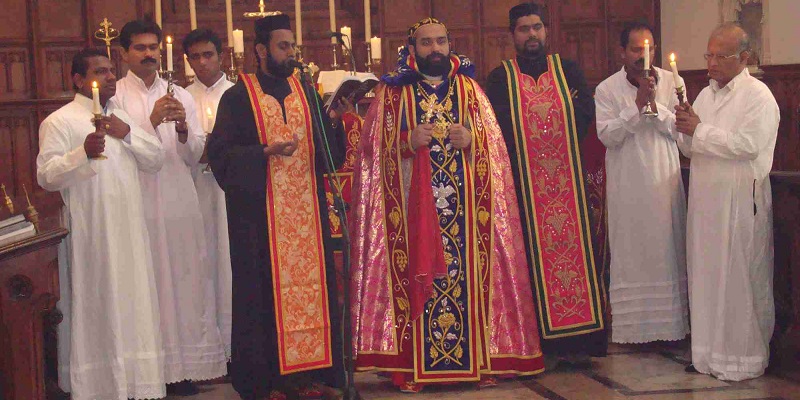
This article is courtesy of Revista Tierra Santa
The Syrian people are direct descendants of those ancient Aramaean populations which, in biblical times, were settled between the Tigris-Euphrates rivers and the Mediterranean coast. The Aramaeans did not form a unified State, but their language underwent a prodigious expansion. From the first millennium B.C., Aramaic became the “lingua franca” of the countries of the Fertile Crescent. It was the language of merchants and of the chanceries of the Assyrian and Persian empires. This linguistic flourishing lasted until the conquest of Alexander the Great, when Aramaic was supplanted by Greek as the language of culture. Let us not forget that Aramaic was the language commonly spoken in the Palestine of Jesus’ time. Its decline as a spoken language began with the Muslim invasion of the year 636. Aramaic was gradually replaced by Arabic. Today it is still spoken in small enclaves of the Middle East: in the mountainous area of Maaloula, Syria, and among the Christians of the mountains of Hakkari and Tur Abdin in Turkey. It is also used, together with Arabic, in the Syriac liturgy. “For us,” said the Syriac Orthodox patriarch Ignatius Zakka I in 1984, “it is a grace from Jesus Christ. We are therefore responsible for its preservation.”
The beginnings of the Syrian Church
It was in Antioch that the disciples of Jesus received the name “Christians.” In this city the apostles Peter and Paul resided. From there came the first missionaries who evangelized Asia and Europe. In cosmopolitan Antioch, the disciples of Jesus found the environment favorable to their expansion, so that by the middle of the fourth century the city had 100,000 faithful (John Chrysostom. In S. Ignatius PG 50,591).
Syria was also the field of the Christological controversies that gave rise to religious division in the East. Indeed, in the year 451 the ecumenical council of Chalcedon condemned Monophysitism – belief in a single nature in Christ – and proclaimed the official Catholic doctrine: two natures in Christ, the divine and the human, in one person. Most of the Syrian population did not accept the conciliar decisions, probably because of terminological disagreements rather than theological divergences, and separated from the Catholic Church. However, the constitution of the separated Church was not immediate. It was consummated after the second council of Constantinople, in the year 553, as a result of which the Byzantine imperial power exerted pressure against the insubordinate Monophysites. It was then that the charismatic figure of the Syrian monk Jacob Baradaeus appeared, raising the nationalist-religious banner. Secretly consecrated bishop by the patriarch of Alexandria in exile, Jacob set about organizing the Monophysite Church, also called Jacobite in his honor.
Not all Syria, however, allied itself with the new Church. The more educated and Hellenized society accepted the decisions of Chalcedon without difficulty, and for that reason received the name “Melkite” – from melek = king – that is, supporter of the Byzantine emperor.
The Muslim conquest of 636 did no more than consecrate this division. It does not seem that the conquest was received by the Syrian population as a liberation from the Byzantine yoke, as is ordinarily believed. The Syriac Orthodox patriarch Michael the Syrian wrote in this regard: “They (the Muslims) killed many people… All that can be said of the evils Syria had to suffer cannot be counted because of their number, since the Tayyaye (the Arabs) were the great scourge of divine wrath” (Chronique, ed. Chabot, t.I, Paris 1901,421).
From that date onward the Syrian Church withdrew more and more into itself in order to preserve its identity, gathering closely around its bishops, who were granted legal and civil prerogatives by the Islamic regime. At the same time, the missionary drive of the Church and the number of faithful diminished.
Changes of the patriarchal see, a reflection of this Church’s history
One of the surest means of knowing the vicissitudes faced by the Syrian Church over the course of history is to enumerate the changes of the patriarchal see of Antioch. From that see it moved to Aleppo, Raqqa, Edessa and Qinnasrin-Chalcis, before settling at an uncertain date in the Great Monastery of Teleda, north of Aleppo. It remained there until the year 1034, when it was transferred to Amida-Malatya. In 1293 the patriarchal see was fixed in the monastery of Deir Zaafaran, 4 km from Mardin. It remained there until 1920, when Turkish soldiery occupied the monastery manu militari. The patriarch then established himself in Mosul, then under British rule. A new transfer took place in 1932 to Homs, under the French mandate, and finally, in 1959, to Damascus, where he resides today.
The most crucial years were those of the First World War. In 1915 the Christians of Tur Abdin, about 200,000, were attacked by bands of Kurds fanatized by the proclamation of the Holy War. One third perished in the massacre. Among those who remained alive, one part took refuge in Syria and Lebanon, the other in Iraq.
Since then the center of gravity of the Syrian Church shifted from the Turkish regions of Tur Abdin, Mardin and Nisibis to the neighboring countries. In Tur Abdin 15,000 faithful remained, a number that decreases year after year.
At present the most active part of the Syrian communities is emigrating to the West, far from Turkish-Kurdish suffocation, far from the Iraqi dictatorship and from Lebanese instability.
Far from their traditional homes, the Syrian Christian people are worn down by contact with the Western way of life. There is a danger that the members of this martyr Church may lose their religious-cultural roots and become diluted in the amorphous society of the West.
Patriarch of Antioch and of all the East
The Syrian Church, like all the Eastern Churches, has a patriarchal structure. Its supreme head bears the title “Patriarch of Antioch and of all the East.” He considers himself the direct and legitimate heir of the primitive apostolic Church of Antioch, governed by the first bishop-martyr, St. Ignatius. Hence the patriarchs place the name Ignatius before their own, as a reference to apostolic continuity. They receive the honorific style “His Holiness,” a title also received by the Coptic patriarch of Alexandria.
In the fifth century the Patriarchate of Antioch comprised the provinces of Isauria, Cilicia I (with Tarsus as capital), Cilicia II, Osrhoene (Edessa), Mesopotamia, Syria I (Antioch), Syria II (Apamea), Phoenicia I (Tyre), Phoenicia II (Damascus), Arabia (Bosra) and Euphratesia (Hierapolis-Menbej).
The bishops are chosen from among the monks. Both are celibate, unlike the rural clergy. For the formation of the clergy, Patriarch Ignatius Zakka opened a patriarchal seminary in the Christian village of Seidnaya, north of Damascus. “Saint Ephrem” – that is its name – has capacity for 63 seminarians and is equipped with a chapel, a library and 10 rooms for professors. Around it a monastery of religious sisters and an orphanage have been built.
The Jacobite Church is present in the Holy Land in the monastery of Saint Mark, or House of Mary, mother of John Mark, a sanctuary erected over the house to which St. Peter went after being freed from prison by an angel (Acts 12:3-17). Since 1471 it has been the see of an archbishop-patriarchal vicar. The monks of this monastery – there are four of them – care for the so-called tomb of Joseph of Arimathea, a dark chapel situated behind the Tomb of the Lord, within the basilica of the Holy Sepulchre. The patriarchal vicar, Mar Swerios Murad, has jurisdiction over the 2,100 Syriac Orthodox of the Holy Land and Jordan. Of them, 150 live in Jerusalem, 900 in Bethlehem and about 1000 in Jordan.
The Church of Jerusalem keeps a special memory of its holy bishop Yuhanna al-Karkari, crucified in 1587 by Muslims at the entrance of the Church of Deir el-´Adas, situated next to the Via Dolorosa. As a result of this martyrdom, a persecution broke out that almost annihilated the Syrian Church. Since then its presence in the Holy City has been reduced to a testimonial minority.
The Syriac Orthodox Church, the closest to the Catholic Church
The Jacobite Church has a long theological tradition, represented by such well-known writers as St. Ephrem, proclaimed in 1920 a Doctor of the universal Church, a prolific author of theological, exegetical and liturgical treatises. Severus of Antioch and Philoxenus of Mabbug, sixth century, others such as Jacob of Edessa, seventh century, and other well-known theologians and writers of this sister Church. In the twelfth century Michael the Syrian stands out; he wrote a precious Chronicle that extends from the creation of the world to his own time. The last Father of this Church is Bar Hebraeus, polyglot, canonist and physician, author of a theological summa. He marks the end of Syrian culture.
The Jacobite Church experienced in its territory an extraordinary monastic flowering in the first centuries. There flourished a host of monks practicing the most varied forms of Christian asceticism: stylites, voluntary recluses, hypaethral monks, etc., whose archaeological remains have come down to us. At present monastic activity is very reduced. In Tur Abdin four monasteries remain: Deir Zaafaran, with a single monk; Mar Gabriel, with six monks and a dozen religious sisters; Mar Matta, with about ten monks; and Mar Yacub of Salah, inhabited by religious sisters. The celebrated monasteries of Mar Abraham and Abel near Midyat, Mar Eugen near Nineveh and Mar Malke on Mount Izala continue to be pilgrimage centers, but are empty of monks.
They are guarded by Christian families. The monastery of Mar Matta in Iraq, not far from Mosul, still stands.
Fifteen years ago the Jacobite bishopric of Aleppo bought the land on which the Great Monastery of Teleda stood, north of Aleppo, founded around the year 341 and abandoned in the twelfth century. The reconstruction of the monastery has met with the opposition of the Muslims of the region, and the project has remained at a standstill. Better fortune attended the foundation of the monastery of St. Ephrem in Glane-Losser, Holland, the first Syrian monastery in Europe, inaugurated in 1984. It occupies the site of an old Catholic convent ceded by the Marist Brothers.
The Jacobite Church is, among the non-united Eastern Churches, the closest to the Catholic Church. The Syriac Orthodox are not heretics, since they are not divided by questions of faith (heresy) but of precedence (schism). The common declaration signed by Pope John Paul II and the Jacobite patriarch Ignatius Zakka I in Rome on June 23, 1984, recognized that both parties profess the same faith in Christ and attributed the divergences in Christological terminology to cultural differences. In fact, relations between the two Churches are excellent today. The Syriac Orthodox Patriarch declared in a lecture given in Damascus on March 10, 1985: “We may use the Catholic churches, halls and centers by prior agreement” for the activities of our faithful, and added: “Catholic priests are permitted to administer the sacraments to our faithful in the absence of a priest of our rite… just as the Syriac Orthodox priest may administer the sacraments to Catholic faithful under identical conditions.”
The Syriac Catholic Church
The Catholics of the Syrian rite are, in origin, Jacobites who entered into union with Rome from the seventeenth century onward, preserving their language, their rite and their own ecclesiastical legislation. They constitute a separate Church with its own hierarchy under the authority of a patriarch.
It is known that in past centuries there were several attempts at union, especially during the crusades. The Popes sent Dominican and Franciscan missionaries in the thirteenth and fourteenth centuries in order to seal the union of the two Churches. The results were partial. Let us recall the attempt at union proposed at the council of Lyon in 1245 and the ephemeral union of the year 1444 as a result of the council of Florence of 1439.
It was in the seventeenth century that the unionist will concluded with the formation of the Syriac Catholic Church. Indeed, in the middle of that century the Capuchin and Jesuit missionaries succeeded in bringing the majority of the Jacobites of Aleppo into union with Rome, so that in the year 1656 the city’s first Syriac Catholic bishop, Andrew Akijan, was consecrated; later, in 1662, he would be recognized by the Turkish Sublime Porte as Catholic patriarch of Antioch. The Syriac Orthodox, in order to halt this movement of conversions, appealed to the Turkish secular arm, harshly persecuting the Syriac Catholics throughout the eighteenth century. The violence against them was so great that the small Syriac Catholic Church was on the point of disappearing, for it remained without a patriarch from 1706 to 1782.
On this latter date Michael Jarwe, Syriac Orthodox archbishop of Aleppo, became Catholic and years later, in 1774, was appointed – surprisingly! – Patriarch of the Syriac Catholic Church. The first step of the new patriarch was to go to the Jacobite patriarchal see of Deir Zaafaran to take possession of his new office, but without renouncing the first. In Deir Zaafaran he convinced one archbishop and two Syriac Orthodox bishops to become Catholic. Afterwards he had himself recognized as patriarch of all the Syrians and asked Rome for confirmation of his office. While this was arriving, the Jacobites reacted and elected a new patriarch of their party, who was immediately confirmed by the Sublime Porte. Faced with this unexpected change, Patriarch Jarwe fled hastily to Baghdad and from there to the Lebanese mountain, settling in 1801 in the monastery of Sharfe, north of Beirut, famous for its Library, where more than 3000 Syriac and Arabic manuscripts are preserved.
In 1830 the Turkish government approved the civil and religious separation between the two sister Churches, but it was in 1843 that the Syriac Catholic patriarch was recognized as civil head of his community by the Turkish Sultan. Patriarch Peter Jarwe transferred the residence from Sharfe to Aleppo in 1831 and, as a result of a riot by the Muslims of that city against the Christians in 1851, changed the patriarchal see to Mardin, where an important Jacobite community resided. At the beginning of this century the see moved again to Sharfe, where it currently resides.
The title of the religious Head of the Syriac Catholics, today Ignatius Hayek, is “Patriarch of Antioch, the city of God, and of all the East,” with jurisdiction over all the faithful of the Syriac Catholic rite in the Middle East and in the diaspora.
In Jerusalem the Syriac Catholics are represented by a patriarchal vicar established in 1890. Since 1973 he has had his residence on Chaldeans Street, number 6. It has a modern complex consisting of the Church of St. Thomas, a hospice with 26 rooms for pilgrims and a youth center. The Church has 315 faithful residing in Jerusalem, Jaffa, Lod and Haifa, in addition to 117 in Bethlehem, where it has a church, an adjoining school and a hospice with 30 rooms. To these must be added the 274 faithful of Amman and Zarqa in Jordan, that is, a total of 700 souls.
Author: Fr. Ignacio Peña
