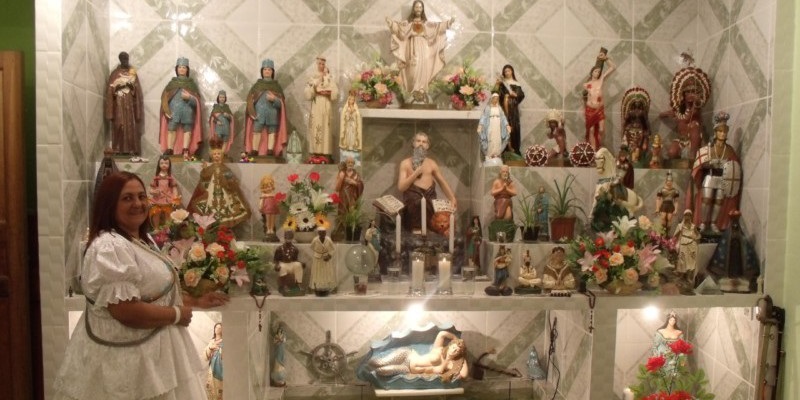
Umbanda has its roots in Afro-Brazilian cults. These cults arose with the arrival of the slaves who, because of the difficulties of keeping their customs alive and through contact with different cultures, assimilated elements of African, Amerindian, and Christian origin, forming a syncretistic phenomenon. In the case of Umbanda, elements of Spiritist origin must also be added, since its founder, Captain José Pesoa, devoted himself to Kardecist Spiritism.
Beliefs
As in the other Afro-Brazilian cults, Umbanda holds belief in a supreme being and in a series of intermediate entities that they call orixás. These orixás are ancient African divinities or divinized forces of nature (e.g., lightning, the waters, etc.), and they are the ones identified with Christian figures:


Ogum Orixá or God of War Saint George
Xangô Orixá or God of Lightning Saint Jerome
Iemanjá Orixá or Goddess of the Waters Virgin Mary
Ibeji Orixá or God of Twins Saints Cosmas and Damian


Oxalá The most important of the orixás Our Lord Jesus Christ
They also have another entity, intermediate between the orixás and human beings, known as Exu, which they identify with the Christian figure of the devil.
In their cults, they maintain that these orixás incorporate themselves into, or possess, the faithful in the midst of the liturgy. This phenomenon, far from being a true possession, is produced by a technique of induction into trance, in which the faithful person dissociates his personality, releasing the unconscious.
They also develop various divinatory practices and, because of the elements of Spiritist origin, believe in reincarnation, the law of Karma, fluids, etc.
It should be noted that, since these cults are autocephalous, within Umbanda one can find not only great cultic differences, but also doctrinal differences from one terreiro (the name for the place where worship is carried out) to another.
Proselytizing strategies
Proselytism, both in Umbanda and in the other Afro-Brazilian cults, takes place mainly through two channels. The first is personalized, through an invitation from a member to participate in ceremonies for the solution of various problems. The second channel, which favors the approach of many people, comes from the advertising that these groups usually place in classified ads, taking advantage of superstitious beliefs and promising the solution of work-related and sentimental problems, divination of the future, cancellation of supposed curses, etc., through magic or invocation of the orixás.
Some considerations
Umbanda and the other Afro-Brazilian cults are cosmic religious conceptions that develop a cultic action directed toward the forces of nature. They cannot be considered Christian, since although they use the figure of Christ, he is not considered the Son of God and Redeemer, but only the most important of the orixás. The apparently Christian elements are only elements mixed syncretistically with others of diverse origins.
Their beliefs in reincarnation and the law of Karma, which denies the Christian concept of redemption, the supposed consultations with the dead and presumed possessions, and practices of a magical and divinatory kind are incompatible with the Christian faith.
* Some biblical references for clarification: Exodus 22:18; Leviticus 19:31 and 20:27; Deuteronomy 18:9-12; 1 Samuel 28:5-25; Galatians 5:20; Acts 8:9-12; 13:6-12; 16:16-18 and 19:11-20.
* Some references from the Catechism: Christ, true God, 151ff. and 461; Christ the Redeemer, 52ff., 436, 668-679, 823ff., 1085, 1987 and 1999; Superstition, 2100ff.; Divination, 2115; Reincarnation, 1013.
Author: Lic. José María Baamonde
Source: S.P.E.S. Foundation
Bibliography for further study
– Afro-Brazilian Cults, Ed. Paulinas.
– Occultism, Magic and Sorcery, Ed. CCS.
– Macumba and Witchcraft, Ed. Paulinas.
– Healings, Possessions and Exorcisms, Ed. Fundación Spes.
