
Mr. Editor of El HERALDO
August 9, 2005
Now, with the abundance of so many religious preachers who call themselves Christians but not Catholics, it is common for them to question us Catholics on topics such as the one I had to address with one of them in this way:
The non-Catholic Christian brother told me that he “did not believe in saints,” only in God and in his Son Jesus Christ. In this regard I asked him:
How do you know the life and teachings of Jesus Christ, in whom you say you believe? He answered me: “through the Bible,” and for that purpose he showed me the Gospels in it, whose titles were “Gospel according to Saint Matthew, St. Mark, St. Luke, St. John…”
I replied: then, if you do not believe in saints, but only in Jesus Christ, how is it that you are basing your belief on writings of saints such as those you have just shown me? Does it not seem to you that you are contradicting yourself?
 He told me, among other words: “It is that this is the Word of God and was written by those persons who were with Christ; that is why I believe it…”
I asked him again: do you believe only what is in the Bible? The preacher told me that this was so, that he believed only “what is found in the Bible.”
I commented: your attitude still seems incongruous to me, for the following reason:
The Bible does not state that the writings (Gospels) you show me, those of St. Matthew, St. Mark, St. Luke and St. John, are precisely theirs. These writings are anonymous. Their authorship was defined by the Catholic Church, based on Tradition, and this was officially determined in councils as ancient as that of Carthage (fourth century). The editor of your Bible relied on that judgment in order to note that information in it, where it says: “according to Saint…” How, then, do you accept an ecclesiastical judgment and not a biblical one?
I went on, pointing out to him that:
The title “Saint,” referring to the evangelists in the editor’s text of your Valera Bible, is not in the original Greek text and comes — to the greater confusion of your thesis that the Bible is the only rule of faith — also from a judgment of Catholicism and not from the Bible. I also added something more:
Why does the evangelical Christian accept sanctity in those first-century persons, and the name of those who possess that quality, and then no longer have any record of more saints in the same terms, citing them by name in the centuries from the second down to the present twenty-first? Did your Church become frozen in this particular matter of forming saints and recording them from the remote first century of the Christian era until today?
The dialogue with the preacher ended with his withdrawal, without answering me, in my view, anything objective about what was discussed here.
Mr. Editor of El HERALDO
August 9, 2005
I commented in another contribution to this appreciated section that:
A non-Catholic Christian preacher questioned me, saying that it was not biblical to invoke the saints, since, according to him, these persons are dead. He affirmed that, however upright their lives and virtues may have been, they can do nothing for us, since the only Mediator for human beings is Our Lord Jesus Christ.
I replied to the preacher that:
Many non-Catholics have an incorrect idea of what they “believe” to be Catholic doctrine regarding the invocation of the saints. To that effect, I commented:
 Catholics believe, as the Bible says, that the one Mediator between God and men is Jesus Christ. This is a truth that is not opposed to another truth, which I explained more or less as follows: non-Catholic Christians are not troubled by asking their brothers in the faith to pray for them in some petition. I know this, because I have seen it in their churches and personally.
The preacher told me that this is so, but among living people, not dead ones.
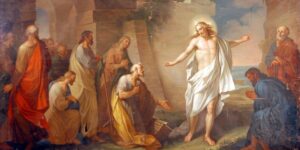
I invited him to consider that the Bible teaches us that God is a God of the living and not of the dead; Jesus affirmed this in Lk 20:38. St. John in the Apocalypse sees “the dead” acting as living persons and even praying for their brothers in the faith (Rev 6:9). When Jesus is transfigured on Mount Tabor, he shows his apostles Moses alive and speaking with Him, even though Moses had been dead for many years. When Yahweh makes himself present in the burning bush before Moses, he identifies himself as “I AM the God of Abraham, of Isaac and of Jacob…,” he does not say “I was,” as would be the case if, for the Most High, those patriarchs were dead. For God they were alive, even though physically those important biblical figures had died many years before.
If this happened in the Old Covenant, more imperfect than the New in Christ with the People of God, all the more should it be manifested in the New, inaugurated with the blood of Our Lord Jesus Christ. Heb 1:1-3.
Therefore, Catholics, trusting in this Word of God, invoke the saints who were begotten by faith in Christ from the first century of the Christian era, and the others of the following centuries until the return of Jesus Christ at the end of time. Our Church has many of them officially registered (canonized). These, and the rest who are not canonized and who are legions, she venerates and remembers especially on the feast of All Saints (November 1).
When a Catholic prays to the Most High, he does so through our one Mediator: Our Lord Jesus Christ; and if he invokes his friends in heaven, the saints, it is no longer a single prayer that is presented through Christ to God the Father, but several: in this case, that of the Catholic faithful and that of his holy brothers of the Church Triumphant in heaven.
If every Christian, Catholic or not, trusts that his brothers in the faith who still journey on this earth can pray for one another effectively, how much more will our friends in heaven do so! This is the reality that we proclaim to believe and practice when we profess in the Creed: “I believe in the communion of saints.”
Author: José Leopoldo Fierro
Source: Luxdomini.com
