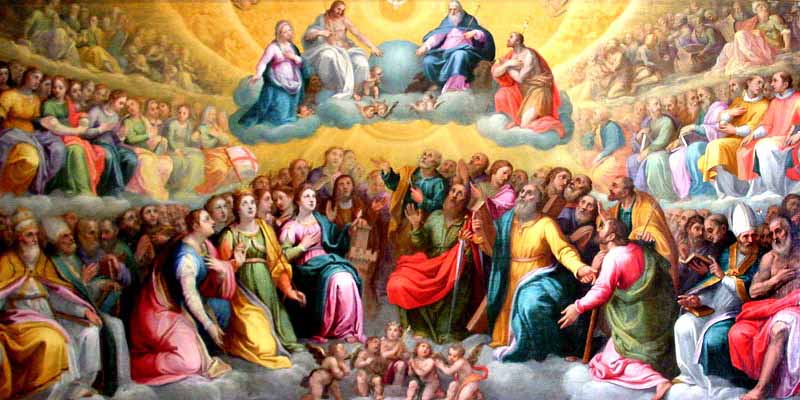
There are three states in the Church:
1- The pilgrim Church on earth: this is us until the day of our death.
2- The suffering Church (in purgatory): these are the deceased who have not yet gone to heaven. We pray for them on All Souls’ Day, November 2.
3- The Church triumphant, already glorified in heaven: these are the saints whom we celebrate on November 1.
“Until the Lord shall come in His majesty, and all the angels with Him, and death being destroyed, all things are subject to Him, some of His disciples are pilgrims on earth. Others have died and are being purified, while still others are in glory, contemplating ‘in full light, God Himself triune and one, exactly as He is.'” (LG #49)
The Catechism of the Catholic Church says, quoting L.G. #49: “Since all the faithful form one body, the good of each is communicated to the others… We must therefore believe that there exists a communion of goods in the Church. But the most important member is Christ, since he is the head… Therefore, the riches of Christ are communicated to all the members, through the sacraments”.
“The union of the wayfarers with the brethren who have fallen asleep in the peace of Christ is in no way interrupted. On the contrary, according to the constant faith of the Church, this union is reinforced by an exchange of spiritual goods”.
What does this quotation from Lumen Gentium mean?
1. The saints intercede for us:
Because they are more closely united to Christ, they establish the whole Church more firmly in holiness… they do not cease to intercede with the Father for us. Through Jesus Christ they present the merits they acquired on earth through their lives of holiness, virtue, good works and suffering. Thus their fraternal concern greatly helps our weakness. (LG #49)
2. The communion of saints:
We venerate the memory of those in heaven not only as our models, but above all so that the union of the whole Church in the Spirit may be strengthened by the practice of fraternal love.
Saint Bernard the Abbot says in one of his sermons (Office for All Saints’ Day):
What good do our praises, our glorification, this very solemnity that we celebrate, do for the saints?
What good are earthly honors or our praises to them, if they receive from the heavenly Father the honors that the Son truly promised them?
The saints have no need of our honors; nevertheless, the veneration of their memory redounds to our benefit. It awakens in us two desires:
1. To enjoy their company, so desirable, and to become fellow citizens with the blessed, the saints, patriarchs, martyrs, apostles, confessors and virgins; in short, to be associated with them and rejoice together in the communion of all the saints.
2. That, as to them, Christ, who is our life, may also be manifested to us, and that we too may be manifested with Him, clothed in glory.
3. Communion with the dead:
“Fully conscious of this communion of the whole Mystical Body of Jesus Christ, the Church in its pilgrim members, from the very earliest days of the Christian religion, has honored with great respect the memory of the dead; and because it is a holy and wholesome thought to pray for the dead that they may be loosed from their sins, she offers her suffrages for them (2 Macc 12:45)” (LG 50).
Our prayer for them is capable not only of helping them, but also of making their intercession for us effective.
CONCLUSION:
“We believe in the communion of all the faithful of Christ, those who are pilgrims on earth, the dead who are being purified, and the blessed in heaven, all together forming one Church; and we believe that in this communion the merciful love of God and his saints is always attentive to our prayers” (SPF 30).
_____________________________________________________________________________________________
THE COMMUNION OF SAINTS
ANGELUS Meditation by the Pope on the Solemnity of All Saints, November 1, 1997.
Dear Brothers and Sisters,
1. The first two days of November constitute for the Christian people an intense moment of faith and prayer, which highlights in a singular way the “eschatological” orientation strongly recalled by the Second Vatican Council (cf. Lumen gentium, ch. VII). Indeed, in celebrating all the saints and commemorating all the faithful departed, the pilgrim Church on earth lives and expresses in the liturgy the spiritual bond that unites her to the heavenly Church.
Today we honor the saints of every age, while already offering prayers of suffrage for our beloved deceased as we visit cemeteries. How consoling it is to think that our loved ones who have died are in the company of Mary, the Apostles, the martyrs, the confessors of the faith, the virgins and all the saints of paradise!
2. Today’s solemnity thus helps us to deepen a fundamental truth of the Christian faith, which we profess in the “Creed”: the “communion of saints”. In this regard, the Second Vatican Council states: “All who belong to Christ, having his Spirit, form one Church and cleave together in him (cf. Eph 4:16). Therefore the union of the members of the pilgrim Church with the brethren who have fallen asleep in the peace of Christ is in no way interrupted. On the contrary, according to the constant faith of the Church, it is reinforced by an exchange of spiritual goods (…). Their brotherly concern greatly helps our weakness” (Lumen gentium, 49).
This admirable communion is realized in the highest and most intense way in the divine liturgy and, above all, in the celebration of the Eucharistic sacrifice: in it “we are most closely united to the worship of the Church in heaven: gathered in communion, we venerate the memory, first of all, of the glorious ever-Virgin Mary, Mother of Jesus Christ our God and Lord; of blessed Joseph, her spouse; of the blessed Apostles and Martyrs, and of all the saints” (ibid., 50).
3. In the glorious assembly of the saints, God wished to reserve the first place for the Mother of the Incarnate Word. Throughout the centuries and in eternity Mary remains at the summit of the communion of saints, as the singular protectress of the bond of the universal Church with Christ, her Lord. For anyone who wants to follow Jesus on the path of the Gospel, the Virgin is the sure and experienced guide, the solicitous and attentive Mother to whom one can entrust every desire and difficulty.
Let us ask the Queen of all saints together to help us respond with generous fidelity to God, who calls us to be holy as He is holy (cf. Lev 19:2; Mt 5:48).
(©L’Osservatore Romano – November 7, 1997)
Author: Fr. Jordi Rivero
Source: Corazones.org
