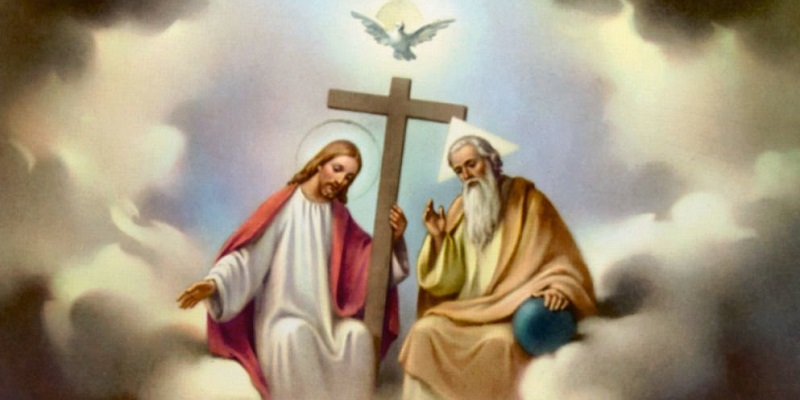
One of the most profound and important truths of the Christian faith is contained in the dogma of the Most Holy Trinity. The Trinitarian Faith teaches the existence of one single God, in three distinct Persons: Father, Son, and Holy Spirit. One same divine nature, but three distinct Persons.
At present the number of Protestant denominations that reject the Trinitarian dogma is increasing considerably, most of which have adopted some of the ancient Christological heresies.
How Do We Understand the Trinity?
Theologians specify that the words “nature” and “person” are not taken here in the ordinary sense of the terms, but according to philosophical language, which is more precise. The nature or essence of beings is that which makes things be what they are; the principle that enables them to act as such (for example, the nature of man is to be a rational animal composed of soul and body). The person, on the other hand, is the subject who acts, and in each man there is a single nature and a single person. In God, however, it is not so: one single Nature sustains a Trinity of Persons.
For this reason, it is impossible for the human intelligence to comprehend the mystery of the Most Holy Trinity. The rational effort of the theologians (among whom we have St. Thomas Aquinas) has tried to illustrate it in the following manner:
Since the three divine Persons are not distinguished by their Nature, nor by their perfections, nor by their external works, they are distinguished solely by their origin.
They are not distinguished by their nature, because they have one nature in common, the divine Nature. Thus they are not three gods, but one single God.
They are not distinguished by their perfections, because these are identified with the divine Nature. Thus none of the three Persons is wiser or more powerful, but all have infinite wisdom and power; nor is one prior to the others, but all are equally eternal.
They are not distinguished by their external works, since, the three having the same Omnipotence, what one works with respect to the creature, the other two work as well.
They are distinguished solely by their origin, because the Father proceeds from no person; the Son is begotten by the Father; and the Holy Spirit proceeds from the Father and from the Son, as from a single principle. This is what prevents one Person from being confused with the others.
Ricardo Sada Fernández[1], in his study of the Trinity, explains this in a very didactic way:
First, let us consider God the Father. With His infinite wisdom, in knowing Himself, He forms a thought of Himself. We ourselves often do something similar when we think about ourselves and form a concept of our own self — that is, “what we are to ourselves.” Yet there is a very great difference between our own self-knowledge and God’s knowledge of Himself. Our self-knowledge is imperfect and incomplete — “no one is a good judge in his own case.” And even if we knew ourselves perfectly — that is, if our concept of our own self were a perfectly clear reproduction of ourselves — it would remain merely a thought that would not go beyond our interior, with no independent existence and no life of its own. The thought would cease to exist, even in my mind, as soon as I turned my attention to something else.
In the case of God, things are very different. His thought about Himself is utterly perfect: it encompasses completely every single aspect of His infinity. But a perfectly perfect thought, to be truly such, must have its own existence — for if it could cease to be, that very perfection would be lacking. His thought is so infinitely complete and perfect that He has reproduced it with an existence of its own. The image that God sees of Himself, the silent Word with which He eternally expresses Himself, must have a distinct, independent existence. This living Thought in which God perfectly expresses Himself is what we call God the Son. God the Father is God knowing Himself; God the Son is the expression of the knowledge that God has of Himself. For this reason, the Second Person of the Most Holy Trinity is called the Son, precisely because He is generated for all eternity, begotten in the divine mind of the Father.
Moreover, since that generation is intellectual, He is called “Verbum,” that is, “Word.” God the Son is the “interior Word” that God the Father pronounces when His infinite wisdom knows His infinite essence.
Now, God the Father — God knowing Himself — and God the Son — God’s knowledge of Himself — contemplate the nature they both possess in common. In beholding it — we are speaking, of course, in a human manner of speaking — they contemplate in that nature beauty and goodness in an infinite degree. And since beauty and goodness produce love, the divine Will moves both Persons to an act of infinite love, of the One toward the Other. Since God’s love of Himself, like God’s knowledge of Himself, is of the same divine nature, it must be a living love. This infinitely perfect, infinitely intense love that flows eternally from the Father and the Son is what we call the Holy Spirit, “who proceeds from the Father and the Son.” He is the Third Person of the Most Holy Trinity. The Holy Spirit is “Subsistent Love,” “Love made Person.”
Foreshadowings of the Trinity: from the Old to the New Testament
“Then God said, ‘Let us make man in our image, after our likeness.’”[2]
Just as Divine Revelation has been progressive, so too has the manner in which God has gradually revealed Himself to men.
The Christian Tradition has seen the texts where God speaks in the plural[3] as a dialogue between the Divine Persons. Note that it says: “Let us make…” and not “I will make”.
Certainly this text does not say explicitly to whom God was speaking, but it is deduced that it is among the Divine Persons, since, whoever it was that God was speaking to, he took part in the work of creation (for He would not have said “let us make” if the one He was speaking to were merely an observer, just as you would not say to anyone “let us eat” merely so that they might watch you eat).
Man is created in the image of the One who creates, a fact that becomes evident when God speaks of making the human being “in our image and likeness”, and when it says “in the image of God he created him”.
The interpretation that in that text God was speaking to angels presents multiple difficulties. In the first place, because Scripture declares that God made everything alone and without any help (and this excludes the angels).
“Thus says the LORD, your Redeemer, who formed you from the womb: I am the LORD, who made all things, who stretched out the heavens alone, who spread out the earth — Who was with me?”[4]
“My hand laid the foundation of the earth, and my right hand spread out the heavens; when I call to them, they stand forth together.”[5]
“You have forgotten the LORD, your Maker, who stretched out the heavens and laid the foundations of the earth.”[6]
It follows that the one to whom God was speaking was also Yahweh and God, which the Gospel of John confirms when it says:
“In the beginning was the Word, and the Word was with God, and the Word was God. He was in the beginning with God; all things were made through him, and without him was not anything made that was made.”[7]
This text, which also refers to the moment of creation, is somewhat more explicit, and two things can already be noted:
1) Whoever it was that God was speaking to, one of them was His Word (logos), through which “all things were made” and without which “nothing that exists was made”.
2) The Word (logos) was not created either, for if everything that can be labeled as “made” was made through the Word, it would be contradictory to think of the Word itself as a “product” of itself.
From all of the foregoing it can be concluded that the one who is called the Word, took part in the work of creation and is therefore also Yahweh.
Throughout history this explanation has been given by numerous Fathers of the early Church. St. Irenaeus, bishop and disciple of St. Polycarp, who in turn was a disciple of the Apostle St. John, explains in the second century:
“That the Word, that is, the Son, has always been with the Father, we have demonstrated in many ways. And that His Wisdom also, that is, the Spirit, was with Him before the creation.”[8]
“It is not the angels, then, who have made us or formed us. Nor is it possible that they could make an image of God; nor would any other be capable of doing so, except the Word of God; nor could any power accomplish it other than the Father of all. God had no need of anyone in order to carry out what He Himself had predetermined to make, as if He did not have His own hands. For the Word and Wisdom, the Son and the Spirit, are always with Him, through whom and in whom He made all things freely and spontaneously. It is to them that the Father addresses Himself when He says: Let us make man in our image and likeness.”[9]
Tertullian maintains the same idea:
“If the plurality in the Trinity scandalizes you, as if it were not bound together in the simplicity of union, I ask you: how is it possible that a being who is purely and absolutely one and singular speaks in the plural: “Let us make man in our image and after our likeness”? Should He not rather have said: “I make man in my image and likeness,” since He is a unique and singular being?
Nevertheless, in the passage that follows we read: “Behold, the man has become as one of us.” Either God deceives us or mocks us by speaking in the plural, if He is one and singular; or was He perhaps addressing the angels, as the Jews interpret it, because they do not recognize the Son? Or was it perhaps because He was at once Father, Son, and Spirit that He spoke in the plural, considering Himself multiple?
Certainly, the reason is that He had at His side a second person, His Son and His Word, and a third person, the Spirit in the Word. That is why He deliberately employed the plural: “Let us make… our image… one of us.” For with whom was He creating man? In whose likeness was He creating him? He was speaking, on the one hand, with the Son, who was one day to clothe Himself in human flesh; on the other, with the Spirit, who was one day to sanctify man — as though He were speaking with so many ministers and witnesses.”[10]
St. Justin Martyr, an apologist of the second century, gives us a similar explanation:
“… in saying these words: Let us make man in our image and likeness… And lest you twist the words just quoted and say what your teachers say — that God said “let us make” addressing Himself, just as we, when we are about to do something, say “let us do it”; or that He spoke to the elements, that is, to the earth and the other things of which we know man is composed, and to them said “let us make” — I will now cite to you other words of the same Moses, by which, beyond any possible dispute, we must recognize that God conversed with someone who was numerically distinct and likewise rational. Here they are:
And God said: Behold, Adam has become as one of us, to know good and evil. Now, in saying “as one of us,” He indicates the number of those conversing with one another, and that they are at least two.
For I cannot hold as true what is dogmatized by what among you is called heresy, nor are its teachers capable of demonstrating that God spoke to angels or that the human body is the work of angels. Rather, this offspring, truly emitted from the Father, was with Him before all creatures, and with him the Father converses, as the Word manifested to us through the mouth of Solomon, telling us that this very one whom Solomon calls wisdom was begotten by God as beginning and offspring before all creatures.”[11]
St. Augustine in his work City of God explains:
“It might also be understood of the angels, that expression, when God created man, in which He says: Let us make man; for He did not say “I will make”; but because He adds: in our image and likeness, it is not lawful to believe that man was created in the image of the angels, or that the image of the angels and that of God is one and the same; and therefore the plurality of the Trinity is rightly understood there.”[12]
In the texts of Scripture where it is said that God is “one,” the Hebrew word echad is used, which can designate a composite unity — as in Genesis 2:24, where man and woman become “one flesh” — and not yachid, which means “only.” This word, although it means “one,” is compatible with the idea of unity and at the same time of the plurality of “one formed by several” (one single God in three divine Persons). The idea of the plurality of the Persons in God does not contradict His oneness.
The Holy Fathers of the Church have seen in the Trisagion a praise to the One and Triune God, in which the angels praise and glorify saying “Holy, Holy, Holy”. Three times Holy, because the divine Persons are Three; once Lord, because there is one single God.
“The cherubim and seraphim with unwearied voices praise and say: Holy, Holy, Holy is the Lord God of Sabaoth (Isaiah 6:3). They do not say it only once, lest you believe in a single person; they do not say it twice, lest you exclude the Spirit; they do not say “holies,” lest you imagine a plurality; but they repeat it three times and say the same word, so that even in the hymn you may understand the distinction of the Trinity and the unity of the Godhead. When they say this, they praise God. Nor do we find anything more precious with which to praise God than to call Him holy.”[13]
“When the seraphim glorify God saying three times: Holy, Holy, Holy, Lord God of hosts (Isaiah 6:3), they glorify the Father, the Son, and the Holy Spirit. Wherefore, just as we are baptized in the name of the Father, and of the Son, and also in the name of the Holy Spirit, we are made children of God, not children of gods. For the Lord God of hosts is the Father, and the Son, and the Holy Spirit. One alone is the Godhead, one single God in Three Persons.”[14]
“When [Isaiah] saw this awesome revelation, which was an indication of the divine economy through Christ — by which the whole universe was to be filled with divine praise, to learn the mystery of the Trinity, and to receive catechesis, profession, and baptism in the name of the Father, and of the Son, and of the Holy Spirit — to make this known, the seraphim cried aloud this canticle: Holy, Holy, Holy the Lord, of whose praise the heavens and the earth are full (Isaiah 6:3).”[15]
Already in the New Testament, Trinitarian doxologies (prayers of praise and glorification to the Trinity) begin to appear.
“The grace of the Lord Jesus Christ and the love of God and the fellowship of the Holy Spirit be with you all.”[16]
“And such were some of you. But you were washed, you were sanctified, you were justified in the name of the Lord Jesus Christ and in the Spirit of our God.”[17]
The first Christians did not hesitate to greet one another in their letters with a triple invocation in which the Father, the Son, and the Holy Spirit were united.
Another fundamental characteristic in the faith of the first Christians was the certainty that the charisms given to the Church proceeded from the Trinity, and there existed in them the absolute conviction that their life of faith, built up by the divine charisms, was nourished by the three divine Persons:
“Now there are varieties of gifts, but the same Spirit; and there are varieties of service, but the same Lord; and there are varieties of working, but it is the same God who inspires them all in every one.”[18]
We cannot conclude without mentioning the Trinitarian formula of Baptism:
“Go therefore and make disciples of all nations, baptizing them in the name of the Father and of the Son and of the Holy Spirit.”[19]
In the preceding text we have the risen Christ sending His disciples to baptize all peoples “in the name of the Father and of the Son and of the Holy Spirit”. It would not be coherent to think that Christ would use a baptismal formula associating God with two mere creatures; hence the baptismal formula places the Father, the Son, and the Holy Spirit on the same level, as the Three Persons of the Trinity.
The Divinity of Christ
The evidences of the divinity of Christ that can be found in Scripture are not few. Christ, the second Person of the Trinity, is also God and consubstantial with God the Father.
Perhaps one of the most explicit texts is found in the Gospel of John, where the Apostle, referring to the Word made flesh (Christ), declares Him God:
“In the beginning was the Word, and the Word was with God, and the Word was God. He was in the beginning with God; all things were made through him, and without him was not anything made that was made.”[20]
Christ is also called “God with us,” “Mighty God,” and even simply “God.”
“All this took place to fulfil what the Lord had spoken by the prophet: Behold, a virgin shall conceive and bear a son, and his name shall be called Emmanuel (which means, God with us).”[21]
“For to us a child is born, to us a son is given; and the government will be upon his shoulder, and his name will be called ‘Wonderful Counselor, Mighty God, Everlasting Father, Prince of Peace.’”[22]
“But of the Son he says, ‘Thy throne, O God, is for ever and ever, the righteous scepter is the scepter of thy kingdom.’”[23]
“And again, when he brings the first-born into the world, he says, ‘Let all God’s angels worship him.’”[24]
“…him who is true. We are in him who is true, in his Son Jesus Christ. This is the true God and eternal life.”[25]
“For in him the whole fulness of deity dwells bodily, and you have come to fulness of life in him, who is the head of all rule and authority.”[26]
Christ, as the second Person of the Trinity, shares the glory of the Father:
“And now, Father, glorify thou me in thy own presence with the glory which I had with thee before the world was made.”[27]
The Catholic Faith rejects the heretical doctrine which teaches that Christ is a lesser created god, distinct from and subordinate to God the Father. This doctrine, known as Arianism and adopted today by many sects (such as the Jehovah’s Witnesses), sees the figure of Christ in a way similar to how the Greeks in pagan culture saw Hercules with respect to Zeus.
Thomas himself, who after doubting recognized Christ as Lord and God, did not do so thinking that He was a “god” distinct and separate from the Father:
“Then he said to Thomas, ‘Put your finger here, and see my hands; and put out your hand, and place it in my side; do not be faithless, but believing.’ Thomas answered him, ‘My Lord and my God!’”[28]
This explicit acceptance of the divinity of Christ in front of the whole Apostolic College did not cause any kind of rejection — and, had Christ not been God, it would have been an act of crass idolatry.
There are also those who have attempted to see in St. Thomas’s words an expression of mere astonishment in the style of “Oh my God!” — even though the Greek text leaves no room for doubt, for those words refer unequivocally to Jesus Christ. It is Christ whom Thomas addresses in that sentence as his Lord and his God.
However, this does not mean that the divinity of Christ was necessarily fully understood by the Apostles from the beginning. The Apostle Philip himself, despite his time in Christ’s company, had at first not become aware of it.
“If you had known me, you would have known my Father also; henceforth you know him and have seen him.’ Philip said to him, ‘Lord, show us the Father, and we shall be satisfied.’ Jesus said to him, ‘Have I been with you so long, and yet you do not know me, Philip? He who has seen me has seen the Father. How can you say, “Show us the Father”? Do you not believe that I am in the Father and the Father in me? The words that I say to you I do not speak on my own authority; but the Father who dwells in me does his works. Believe me that I am in the Father and the Father in me; or else believe me for the sake of the works themselves.’”[29]
“I and the Father are one.”[30]
The equality of the Father and the Son as to their divine nature is expressed in the Gospel, to the point that it is commanded to honour the Son as the Father is honoured. If Jesus Christ were not also God, this would be an act of idolatry:
“The Father judges no one, but has given all judgment to the Son, that all may honour the Son, even as they honour the Father. He who does not honour the Son does not honour the Father who sent him. Truly, truly, I say to you, he who hears my word and believes him who sent me, has eternal life; he does not come into judgment, but has passed from death to life.”[31]
St. Augustine, starting from this text of Scripture, explains with crystal clarity the divinity of the Son and His equality with the Father as to their nature.
“…there is not in the Trinity that difference which these men wish to establish, for in the Trinity the nature is identical, as is also the power. This is what the Son said: That all may honour the Son as they honour the Father; and let those who wish to live piously adore the Lord their God and serve Him alone, which was commanded by the divine law to the fathers of old. Nor can it be otherwise, for we must serve our one Lord God with the reverence that is owed to God… I say that this can in no way be verified unless the whole Trinity is our same Lord God.”[32]
The Titles of Divinity
Christ as true God bears titles that only God possesses. Like the Father and the Holy Spirit, He is the First and the Last, the Alpha and the Omega and the End of all things.
“Thus says the LORD, the King of Israel and his Redeemer, the LORD of hosts: ‘I am the first and I am the last; besides me there is no god.’”[33]
“I am the Alpha and the Omega, says the Lord God, who is and who was and who is to come, the Almighty.”[34]
“When I saw him, I fell at his feet as though dead. But he laid his right hand upon me, saying, ‘Fear not, I am the first and the last, and the living one; I died, and behold I am alive for evermore, and I have the keys of Death and Hades.’”[35]
“And to the angel of the church in Smyrna write: The words of ‘the first and the last,’ who died and came to life.”[36]
“I am the Alpha and the Omega, the first and the last, the beginning and the end… I Jesus have sent my angel to you with this testimony for the churches. I am the root and the offspring of David, the bright morning star.”[37]
The three preceding texts are particularly clear, because it is Jesus who speaks and who uses those titles.
Christ, like the Father, is God of God, King of Kings and Lord of Lords:
“for the LORD your God is God of gods and Lord of lords, the great, the mighty, and the terrible God, who is not partial and takes no bribe.”[38]
“O give thanks to the God of gods, for his steadfast love endures for ever. O give thanks to the Lord of lords, for his steadfast love endures for ever.”[39]
“They will make war on the Lamb, and the Lamb will conquer them, for he is Lord of lords and King of kings, and those with him are called and chosen and faithful.”[40]
“On his robe and on his thigh he has a name inscribed, King of kings and Lord of lords.”[41]
Objections Against the Divinity of Christ
Argument #1 — Christ says “The Father is greater than I”
“If you loved me, you would have rejoiced, because I go to the Father; for the Father is greater than I” (Jn 14:28).[42]
This text was in its day one of the most used by the Arians to deny the equality of Christ with the Father, and it is one of the most used today at the hands of the Jehovah’s Witnesses.
The difficulty lies in a misunderstanding of the Trinitarian doctrine. It teaches that Christ, although He is a single Person, has two natures (the human and the divine). This means that although before the Incarnation Christ was only God, after it He became truly man, without ceasing to be God.
Since Jesus Christ is one person but with two natures, there can be applied to Him the properties that correspond both to His human nature and to His divine nature (communicatio idiomatum). In this sense there are found in the New Testament texts where a subordination of Christ with respect to the Father is suggested, while in others a perfect equality between the two is suggested.
St. Augustine explains in this regard:
“Those who say that the Son is inferior to the Father support their opinion on the words of the Lord when He says: The Father is greater than I. But the truth shows that in this sense the Son is also inferior to Himself. And how should He not be inferior to Himself, if He emptied Himself, taking the form of a servant? Nevertheless, in clothing Himself with the nature of a servant He did not lose the nature of God, in which He is equal to the Father. If, then, He took the form of a servant without losing His divine form — in His form of a servant and in His form of God He is always the only-begotten Son of the Father, in His divine form equal to the Father, and in His form of a servant, mediator between God and men, the man Christ Jesus — who does not see that in His form of God He is superior to Himself and in His form of a servant inferior to Himself?”[43]
However, there are other texts in the New Testament that speak of the perfect equality of the Son and the Father:
“This was why the Jews sought all the more to kill him, because he not only broke the sabbath but also called God his own Father, making himself equal with God. Jesus said to them, ‘Truly, truly, I say to you, the Son can do nothing of his own accord, but only what he sees the Father doing; for whatever he does, that the Son does likewise.
“For the Father loves the Son, and shows him all that he himself is doing; and greater works than these will he show him, that you may marvel. For as the Father raises the dead and gives them life, so also the Son gives life to whom he will. The Father judges no one, but has given all judgment to the Son, that all may honour the Son, even as they honour the Father. He who does not honour the Son does not honour the Father who sent him.”[44]
In this text the following can be observed:
1) The Jews sought to kill Christ because He made Himself equal to God (v. 18)
2) Christ gives them to understand that He is not a God separate from the Father, for He does nothing on His own initiative (v. 19)
3) Then we have an explicit declaration of omnipotence, where Jesus declares that whatever the Father does, the Son can likewise do (verse 19)
4) Finally we see a declaration of the equality between the Father and the Son, declaring the Father’s will that all should honour the Son as they honour the Father (no more, no less).
An excellent explanation again comes to us from the pen of St. Augustine:
“The human eye cannot in any way see the divinity, and those who contemplate it are not men, but more than men. Therefore, with full right the words blessed and only powerful are to be understood of the Triune God, manifesting the coming of our Lord at the opportune time (1 Timothy 6:15). The expression: the only one who possesses immortality (1 Timothy 6:16) offers the same sense as that other: The only one who works wonders (Psalm 71:18).
I should like to know how my adversaries interpret it, for if they apply it to the Father alone, how will the Son’s affirmation be true when He says: All that the Father does, the Son does likewise? Is there, perchance, anything more wondrous among wonders than to raise and give life to the dead?
For the Son Himself says: As the Father raises the dead and gives them life, so the Son gives life to whom He wills (John 5:19-21). How will the Father alone work wonders, if these words cannot be understood of the Father alone, or of the Son alone, but of the one and true God? — that is, the Father, the Son and the Holy Spirit.”[45]
In his reply to the Arians’ sermon he explains:
“For the works of the Father and of the Son are the same, but without the Son being the same as the Father; rather, because no work belongs to the Son that the Father does not do through him, and no work belongs to the Father that he does not do at the same time through the Son.
For all that the Father does, the Son does likewise. The works of the Son are not some and those of the Father others, but the same; nor does the Son do them in a different way, but likewise. But since the Son does not do other similar works, but the same ones the Father does, what is it to do them likewise but to do them with identical ease and identical power?
For if, in truth, the two do the same works, but one with greater ease and power than the other, then certainly the Son does not do them likewise. But since he does the same works and likewise, the works of the Son are not in truth distinct from those of the Father, nor diverse the power of those who work. Nor, certainly, without the Holy Spirit, for he cannot be separated from the other two in works that are to be done by both.
Thus, in one same admirable and divine manner, the three do the works of all of them, and the three those of each one. For heaven and earth and every creature are the work of the three. For of the Son it was said: All things were made through him (John 1:3). But who will dare to remove from any of these works the Holy Spirit, who is characterized by granting graces to the saints, of whom it is written: But all these things one and the same Spirit works, distributing to each one as he wills?
Finally, Christ being Lord of all and God blessed above all for ever (Romans 9:5), what work among all of them could be denied to the Holy Spirit, who formed Christ himself in the womb of a virgin?
For when the Virgin asked the angel who announced to her her future childbearing: How shall this be, since I know not man? (Luke 1:34), she received this answer: The Holy Spirit shall come upon thee (Luke 1:35). But those works are called the works of each one which are shown to belong to one person.
Thus, to be born of a virgin belongs only to the Son; the voice from the cloud: Thou art my beloved Son, belongs only to the Father (Matthew 3:17; 17:5); only the Holy Spirit appeared in the bodily form of a dove. Nevertheless, the whole Trinity made that flesh of the Son alone, that voice of the Father alone, that form of the Holy Spirit alone. Not because each of them is incapable without the others of accomplishing what is to be done, but because the operation cannot be separated; where not only the nature is equal, but also undivided. For, being three, each of them is God, and yet they are not three gods.
For the Father is God, and the Son is God, and the Holy Spirit is God; and the Son is not the same as the Father, nor is the Holy Spirit the same as the Father or the Son; rather, the Father is always Father, and the Son is always Son, and the Spirit of both is never of only one of them, either of the Father or of the Son, but is always the Spirit of the two.
Nevertheless, the whole Trinity is one single God. For who will deny that neither the Father nor the Holy Spirit, but only the Son, walked upon the waters?
Only the Son has flesh, in virtue of which He could set His feet upon the waters and walk on them. But let it by no means be thought that He did this without the Father, since of all His works it is said: But the Father, who abides in me, does his works.
Nor without the Holy Spirit, for the casting out of demons was likewise a work of the Son. It is true that the tongue of that flesh, by which He commanded the demons to depart, belonged to the Son alone; nevertheless, He Himself says: I cast out demons in the Holy Spirit.
Likewise, who but the Son alone rose again? For only he who had flesh could die. And yet, to this work by which the Son rose again the Father was not a stranger, since of Him it is written: “He who raised Jesus from the dead” (Romans 8:11). Did not the Son also raise Himself? Where will that fit which He said: “Destroy this temple, and in three days I will raise it up” (John 2:19)?
He also affirms that He has power to lay down His soul and to take it up again (John 10:18). And who will be so deranged as to think that the Holy Spirit did not cooperate in the resurrection of Christ the man, when He acted so that Christ the man himself might exist?”[46]
Argument #2 — Christ is Not Omniscient
“But of that day and hour no one knows, not even the angels of heaven, nor the Son, but the Father only.”[47]
A text very frequently used by the Arians in their attempt to demonstrate that Christ, not knowing the day and hour of the end of the world, is inferior to God and is not God.
There are, however, other texts that indicate Christ’s omniscience with respect to His divine nature:
“…that their hearts may be encouraged as they are knit together in love, to have all the riches of assured understanding and the knowledge of God’s mystery, of Christ, in whom are hid all the treasures of wisdom and knowledge.”[48]
“Now we know that you know all things, and need none to question you; by this we believe that you came from God.”[49]
“He said to him the third time, ‘Simon, son of John, do you love me?’ Peter was grieved because he said to him the third time, ‘Do you love me?’ And he said to him, ‘Lord, you know everything; you know that I love you.’ Jesus said to him, ‘Feed my sheep.’”[50]
Saint Hilary of Poitiers offers an explanation that is somewhat lengthy but excellent.
“58. But the heretics interpret as a denial of His divine nature the statement: The Father is greater than I (John 14:28); or likewise: Of that day and hour no one knows, neither the angels in heaven, nor the Son, but the Father only (Mark 13:32; Matthew 24:36).
Therefore the ignorance of the day and the hour serves them as a basis for denying that He is the Only-begotten God; in such a way that the God born of God would not possess that perfection of nature proper to God, since, being necessarily subject to this ignorance, an external force would be stronger than He, and that force would keep Him in the frailty of His ignorance as one who is powerless against it.
Still more: the madness of the heretics would compel us to this impious interpretation, as though they had the right to impose the confession that this is how it must be understood; and they adduce as their reason that this is what the Lord Himself has said, and it might seem highly irreverent that the testimony He bears of Himself should be altered by our differing interpretation.
59. And first of all, before speaking of the meaning and the reason for these words, it must be considered, by the judgment of common sense, whether it can be believed that He who is the principle of all things in what they are and will be is ignorant of anything whatsoever.
For if all things exist through Christ and in Christ, and exist through Him in such a way that all things have their being in Him (Colossians 1:16), how shall that which is not foreign to Him, nor ceases to exist through Him, fail to enter into His knowledge as well — given that He so often, by virtue of His nature which can be ignorant of nothing, comprehends even that which neither exists in Him nor comes to be through Him?
And that which has its reason for being solely from Him, and receives only in Him the development toward what it is and will be — how shall it remain outside the knowledge proper to His nature, by and in which is contained all that is to come to pass?
For the Lord Jesus is not ignorant of human thoughts — not only those stirred by some present occasion, but also those that will be moved on account of future desires; as the Evangelist attests: for Jesus knew from the beginning who they were that did not believe, and who it was that would betray Him (John 6:64).
Can it be considered that the power of His nature, which encompasses knowledge of things that do not yet exist and is not ignorant of the anxieties that still-tranquil souls will yet endure, was ignorant of that which exists through Him and in Him?
And can He who is powerful in things foreign to Himself be powerless in His own — He of whom we recall it is written: All things were created through Him and in Him, and He is before all things (Colossians 1:16–17); or: For in Him all the fullness was pleased to dwell, and through Him to reconcile all things to Himself (Colossians 1:19–20)?
Since in Him dwells all fullness, all things are reconciled through Him and in Him, and that day is the hope of our reconciliation — shall He be ignorant of when that day will be, when its establishment is in Him and its mystery exists through Him?
For that day is the day of His coming, of which the Apostle says: When Christ, your life, appears, then you also will appear with Him in glory (Colossians 3:4).
No one is ignorant of that which exists through Him and within Him. Christ is to come — and shall He be ignorant of the day of His coming? It is His day, as the same Apostle says: for the day of the Lord will come like a thief in the night (1 Thessalonians 5:2) — and is it to be believed that He does not know it?
Human beings plan what they have to do; they know it beforehand as far as they are able, and the knowledge of what they are to do accompanies the will to carry it out; and shall He who was born as God be ignorant of what exists through Him and in Him?
Through Him the times exist, and the day is in Him, for through Him future things are determined and in His hand is the disposing of His coming. And shall He live in such ignorance as not to know what exists for Him, owing to the dull nature of His mind?
Shall He be like the wild beasts and savage animals which, with their life devoid of all forethought, are ignorant of the very things they do when, moved by some impulse of their irrational instinct, they are carried anywhere in a random and uncertain course?
60. How can it be believed that the Lord of glory, by being ignorant of the day of His coming, possesses a disintegrated and imperfect nature — which, on the one hand, must needs come, and on the other, does not know the time of its coming? Thus it would be better to attribute to God the ignorance that deprives Him of the power to know…
62. But Paul, the teacher of the gentiles, does not tolerate among us this confusion of impious error by which it is believed that the Only-begotten God was ignorant of anything. For he says: Rooted in love, may they be brought to the riches of full understanding, to the knowledge of the mystery of God, Christ, in whom are hidden all the treasures of wisdom and knowledge (Colossians 2:2–3).
The God Christ is a mystery, and in Him are hidden all the treasures of wisdom and knowledge. But this cannot be said simultaneously of a part and of the whole, because the part does not signify the whole and the whole cannot be interpreted as a part.
But if the Son is ignorant of the day, then all the treasures of knowledge are no longer in Him. But if all the treasures of knowledge are in Him, He is not ignorant of the day, for He possesses within Himself the entire treasure of knowledge. Yet we must bear in mind that these treasures of knowledge are hidden in Him — but they do not cease to exist by being hidden, for they are in Him because He is God, but they are concealed because He is mystery.
But for us the mystery of God, Christ — in whom are hidden all the treasures of knowledge — is neither hidden nor unknown. And since He is mystery, let us see whether He is ignorant in those things which He does not know.
But if elsewhere the confession of ignorance cannot be interpreted as unknowing, neither does He now ignore what He does not know. For since His ignorance — given that all the treasures of knowledge are hidden in Him — is a saving dispensation rather than ignorance, the reason for His ignoring can be explained without understanding it as a not-knowing.
63. For every time God says that He does not know something, He certainly professes ignorance, but He is not confined by it.
For not knowing has nothing to do with the weakness of ignorance, but is owing either to the fact that the time for speaking has not yet come, or that the opportune moment for acting has not yet arrived.
God speaks thus to Abraham: The outcry of Sodom and Gomorrah has filled up the measure, and their sins are very great. Therefore I will go down and see whether, according to their outcry, they have reached the limit; and if not, I will know (Genesis 18:20–21). We have, therefore, a God who does not know and yet is not ignorant; for if He knows that the sins are very great and nevertheless goes down to see whether they have filled up the measure — or, if they have not, to know it — we see that He is not ignorant because He does not know, but that He then knows because the time for acting has come.
God’s knowing, therefore, is not a transition from ignorance, but the fullness of time. One must still wait for Him to know. But we cannot think of Him as not knowing, and yet still waiting to know; therefore it is necessary that His not knowing while knowing, or His knowing while appearing ignorant, should be explained by nothing other than the design of speaking and of acting.
64. We cannot doubt, therefore, that God’s knowledge is a matter of time rather than of change in Him; for when it is said that God knows, it concerns the time of making knowledge manifest rather than the moment at which it was acquired.
This same truth is taught us by what was said to Abraham: Do not lay your hand on the boy, and do nothing to him, for now I have known that you fear the Lord your God, and have not spared your beloved son for my sake (Genesis 22:12).
So then, God now knows. That He now knows implies a prior ignorance — but this does not accord with the being of God. Nor is it possible that He was previously ignorant of Abraham’s fidelity, of whom it was said: Abraham believed God, and it was reckoned to him as righteousness (Genesis 15:6).
That He now knows signifies the moment in which Abraham received this testimony, not that God began to know at that moment. Abraham, through the holocaust of his son, had shown the love he bore toward God. God knows it at the moment He speaks of it. But since it must not be thought that He did not know it beforehand, we must consider that He is said to have known it then because He speaks of it.
And from among the many passages contained in the Old Testament concerning the knowledge of God, we have presented these only by way of example, so that it may be understood that God’s not knowing is not due to ignorance but to time.
65. In the Gospels we find many things which the Lord ignores while knowing them. He does not know those who work iniquity and glory in the many miracles done in His name, when He says: And then I will swear that I do not know you. Depart from me, all you who work iniquity (Matthew 7:23).
He affirms even under oath that He does not know those whom, nonetheless, He does not fail to recognize as workers of iniquity. He does not know them, therefore, not on account of His ignorance, but because, owing to the iniquity of their deeds, they are unworthy of His knowledge; and He confirms the truth of what He says even by the bond of an oath. He possesses not-ignoring in the power of His nature, and maintains not-knowing in the mystery of His will…
66. …When He who perfectly knows thoughts and deeds asks, as though in ignorance, about thoughts and deeds — as when He asks the woman why she had touched the hem of His garment, or the Apostles why they were arguing, or those who wept where the tomb of Lazarus was — one must not think He truly did not know, but that this is a manner of speaking. For it makes no sense that He who, while absent, knows that Lazarus has died and been buried, should not know the location of the tomb; or that He who sees thoughts should not have known the faith of the woman; or that He who has no need to ask about anything should have been ignorant of the Apostles’ dispute. For one who knows all things, to say on occasion that He does not know what He ignores is a hidden dispensation.
Thus, in the case of Abraham He conceals His knowledge for a time; or in the case of the foolish virgins and the workers of iniquity, He says He does not know them because they are unworthy; or in the mystery of the Son of Man, if He asks as though ignorant, it is on account of His human condition.
He who adapts Himself to the reality of His corporeal birth in all that pertains to the limitations of our weak nature — not because He who is God is, by nature, weak, but because the God born as man has taken upon Himself the weaknesses of men. And He has taken them not in such a way that the immutable nature was transformed into a weak nature, but in such a way that the mystery of the assumption has taken place within the immutable nature; for He who was God is man, and He who is man has not ceased to be God.
In acting and presenting Himself as one who has been born as man, the Word — who remains God — makes very frequent use of the mode of speech proper to His human being, and often the mode of speaking as God is the same as that of men, for He says He does not know what it is not yet time to reveal, or what is not worthy to be known.
Consequently, we must understand why the Lord has declared that He does not know the day. If it is believed that He is absolutely ignorant of it, the Apostle contradicts this assertion: In whom are hidden all the treasures of wisdom and knowledge (Colossians 2:3).”[51]
It is the same solution that the Church teaches to this day: what Christ, in His human knowledge, declares He does not know, He likewise declares He has no mission to reveal (cf. Catechism of the Catholic Church, n. 474).
On the Divinity of the Holy Spirit
Just as Scripture identifies the divine Person of the Son with Yahweh, so too does it identify the Person of the Holy Spirit.
It is not uncommon to find in Old Testament texts where God speaks that He is identified as the Holy Spirit in the New Testament:
“And I heard the voice of the Lord saying, ‘Whom shall I send, and who will go for us?’ Then I said, ‘Here I am! Send me.’ And he said, ‘Go, and say to this people: Hear and hear, but do not understand; see and see, but do not perceive. Make the heart of this people fat, and their ears heavy, and shut their eyes; lest they see with their eyes, and hear with their ears, and understand with their hearts, and turn and be healed.’”[52]
The foregoing text is cited by Saint Paul, who attributes God’s words to the Holy Spirit:
“As they disagreed among themselves, they departed, after Paul had made one statement: ‘The Holy Spirit was right in saying to your fathers through Isaiah the prophet: Go to this people, and say, You shall indeed hear but never understand, and you shall indeed see but never perceive. For this people’s heart has grown dull, and their ears are heavy of hearing, and their eyes they have closed; lest they should perceive with their eyes, and hear with their ears, and understand with their heart, and turn for me to heal them.’”[53]
The same is the case with this text from the Old Testament:
“For he is our God, and we are the people of his pasture, and the sheep of his hand. O that today you would hearken to his voice! Harden not your hearts, as at Meribah, as on the day at Massah in the wilderness, when your fathers tested me, and put me to the proof, though they had seen my work. For forty years I loathed that generation and said, ‘They are a people who err in heart, and they do not regard my ways.’ Therefore I swore in my anger that they should not enter my rest.”[54]
In the Epistle to the Hebrews this text — in which God speaks — is cited, and His words are once again attributed to the Holy Spirit:
“Therefore, as the Holy Spirit says, ‘Today, when you hear his voice, do not harden your hearts as in the rebellion, on the day of testing in the wilderness, where your fathers put me to the test and saw my works for forty years. Therefore I was provoked with that generation, and said, They always go astray in their hearts; they have not known my ways. As I swore in my wrath, They shall never enter my rest.’”[55]
Scripture identifies the Holy Spirit as a personal being — in contrast to the heretical belief of sects such as the Jehovah’s Witnesses, who regard the Holy Spirit as an impersonal force, or as “the power of God upon the earth”.
An impersonal force cannot be grieved, unlike the Third Person of the Trinity.
“And do not grieve the Holy Spirit of God, in whom you were sealed for the day of redemption.”[56]
One can also sin against the Holy Spirit:
“Therefore I tell you, every sin and blasphemy will be forgiven men, but the blasphemy against the Spirit will not be forgiven. And whoever says a word against the Son of man will be forgiven; but whoever speaks against the Holy Spirit will not be forgiven, either in this age or in the age to come.”[57]
The Holy Spirit can be resisted:
“You stiff-necked people, uncircumcised in heart and ears, you always resist the Holy Spirit. As your fathers did, so do you.”[58]
The Holy Spirit consoles:
“So the church throughout all Judea and Galilee and Samaria had peace and was built up; and walking in the fear of the Lord and in the comfort of the Holy Spirit it was multiplied.”[59]
The Holy Spirit is sent by the Father and teaches:
“But the Counselor, the Holy Spirit, whom the Father will send in my name, he will teach you all things, and bring to your remembrance all that I have said to you.”[60]
Chapter 16 of the Gospel of John clearly distinguishes the three Divine Persons. Christ announces that He will go to the Father and that, from there, He will send the Holy Spirit:
“Nevertheless I tell you the truth: it is to your advantage that I go away, for if I do not go away, the Counselor will not come to you; but if I go, I will send him to you. And when he comes, he will convince the world of sin and of righteousness and of judgment: of sin, because they do not believe in me; of righteousness, because I go to the Father, and you will see me no more; of judgment, because the ruler of this world is judged. I have yet many things to say to you, but you cannot bear them now. When the Spirit of truth comes, he will guide you into all the truth; for he will not speak on his own authority, but whatever he hears he will speak, and he will declare to you the things that are to come.”[61]
The Holy Spirit is also God, which is why Saint Paul can rightly say:
“Do you not know that you are God’s temple and that God’s Spirit dwells in you? If any one destroys God’s temple, God will destroy him. For God’s temple is holy, and that temple you are.”[62]
Saint Cyril of Alexandria explains it in the following manner:
“To those filled with such ignorance I propose that they answer this question: How can we be temples of God — we who, as Paul says, have the Holy Spirit dwelling in us — if the Spirit were not God by essence?
If He were a creature and a work of God, then for what reason does God destroy us if we have destroyed the temple of God, by profaning our body in which the Holy Spirit dwells — He who is of the same and single essence as God the Father and the Only-begotten Son?
Were it not so, what the Saviour said would not be true: If anyone loves me, he will keep my word, and my Father will love him, and we will come to him and make our home with him — for we must bear in mind that the Spirit dwells in us, and that through Him we believe we have with us the Father and the Son, as John himself says in one of his letters: By this we know that we abide in him and he in us, because he has given us of his own Spirit.”[63]
It is fitting also to cite Saint Basil of Caesarea, who explains how the names proper to the Father and the Son are common to the Holy Spirit:
“He is called ‘Spirit,’ as in: God is Spirit and: Christ the Lord is the Spirit of our face. He is ‘Holy,’ as the Father is holy and the Son is holy. Indeed, for the creature, holiness was introduced from without, whereas for the Spirit, holiness is fullness of nature. For this reason He is not ‘sanctified’ but ‘sanctifier.’
He is ‘Good’, as the Father is good and the Son is good, the One begotten of the Good, and possessing goodness as His essence. He is ‘Upright’, as the Lord God is upright, because He is Himself truth and justice, swerving or yielding in no direction, by reason of the immutability of His knowledge.
He is ‘Counselor’, as the Only-begotten, according to what He Himself says: I will ask my Father, and he will give you another Counselor. Thus the names proper to the Father and the Son are common to the Holy Spirit, who receives these appellations by reason of His affinity of nature. From where else, indeed, could they come to Him?
He is called moreover Spirit of Governance, Spirit of Truth, Spirit of Wisdom. The Spirit that made me was a divine Spirit. And Bezalel — it says — God filled with the divine Spirit of wisdom, of understanding, and of knowledge. Such, then, are the names — great beyond measure, yet assuredly without exaggeration, concerning the glory.”[64]
Notes
- Ricardo Sada Fernández, El misterio de la Santísima Trinidad, available at https://encuentra.com/el_misterio_de_la_santisima_trinidad_13961/ ↩
- Genesis 1:26 ↩
- Genesis 11:5-9; Isaiah 6:8 ↩
- Isaiah 44:24 ↩
- Isaiah 48:13 ↩
- Isaiah 51:13 ↩
- John 1:1-3 ↩
- Irenaeus of Lyon, Against Heresies IV,20,3 | Carlos Ignacio González, S.J., Ireneo de Lyon, Contra los herejes, Conferencia del Episcopado Mexicano, México 2000 ↩
- Irenaeus of Lyon, Against Heresies IV,20,1 ↩
- Tertullian, Against Praxeas, 12 | Johannes Quasten, Patrología I, Biblioteca de Autores Cristianos 206, Fifth Edition, Madrid 1995, p. 622 ↩
- Justin Martyr, Dialogue with Trypho, 62,1-4 | Daniel Ruiz Bueno, Padres Apologetas Griegos, Biblioteca de Autores Cristianos 116, Third Edition, Madrid 1996, pp. 411-412 ↩
- Augustine of Hippo, La Ciudad de Dios, XVI,6,1 | Biblioteca de la Iglesia Reformada, http://www.iglesiareformada.com/Agustin_Ciudad_16.html ↩
- Ambrose, The Holy Spirit, III, 109-111 | Biblioteca Patrística Ciudad Nueva, Madrid 1986ss, 41, 225-226 | Guillermo Pons, La Trinidad en los Padres de la Iglesia, Editorial Ciudad Nueva, Madrid 1999, p. 56 ↩
- Pseudo-Athanasius, De la encarnación y contra los arrianos, 10: Migne, Patrología Griega, 161 vols., París 1875ss, 26,1000 ↩
- Theodore of Mopsuestia, Catechetical Homily, 16,36 | Jesús Solano, Textos Eucarísticos Primitivos Tomo II, Biblioteca de Autores Cristianos 118, Third Edition, Madrid 1997, p. 102 ↩
- 2 Corinthians 13:14 ↩
- 1 Corinthians 6:11 ↩
- 1 Corinthians 12:4-6 ↩
- Matthew 28:19 ↩
- John 1:1-3 ↩
- Matthew 1:22-23 ↩
- Isaiah 9:6 ↩
- Hebrews 1:8 ↩
- Hebrews 1:6 ↩
- 1 John 5:20 ↩
- Colossians 2:9-10 ↩
- Jn 17:5 ↩
- Jn 20:27-28 ↩
- John 14:7-11 ↩
- Jn 10:30 ↩
- John 5:22-24 ↩
- Augustine of Hippo, Answer to the Arian Sermon, XXIV, 27 | Obras completas de San Agustín, Tomo XXXVIII, Biblioteca de Autores Cristianos 512, Madrid 1990, p. 329 ↩
- Isaiah 44:6 ↩
- Revelation 1:8 ↩
- Revelation 1:17-18 ↩
- Revelation 2:8 ↩
- Revelation 22:13-16 ↩
- Deuteronomy 10:17 ↩
- Psalm 136:2-3 ↩
- Revelation 17:14 ↩
- Revelation 19:16 ↩
- John 14:28 ↩
- Augustine of Hippo, La Trinidad, I,7,14 | Obras completas de San Agustín, Tomo V, Biblioteca de Autores Cristianos 39, Madrid 1985, p. 142 ↩
- John 5:18-23 ↩
- Augustine of Hippo, La Trinidad, I,6,11 | Obras completas de San Agustín, Tomo V, Biblioteca de Autores Cristianos 39, Madrid 1985, p. 137-138 ↩
- Augustine of Hippo, Answer to the Arian Sermon, XV | Obras completas de San Agustín, Tomo XXXVIII, Biblioteca de Autores Cristianos 512, Madrid 1990, p. 305-308 ↩
- Mt 24:36 ↩
- Col 2:2-3 ↩
- Jn 16:30 ↩
- Jn 21:17 ↩
- Hilary of Poitiers, La Trinidad (The Trinity), IX, 58-67. San Hilario de Poitiers, La Trinidad, Biblioteca de Autores Cristianos 481, bilingual edition prepared by Luis Ladaria, Madrid 1986, p. 492-502. ↩
- Is 6:8-10 ↩
- Acts 28:25-27 ↩
- Ps 95:7-11 ↩
- Heb 3:7-11 ↩
- Eph 4:30 ↩
- Mt 12:31-32 ↩
- Acts 7:51 ↩
- Acts 9:31 ↩
- Jn 14:26 ↩
- Jn 16:7-13 ↩
- 1 Cor 3:16-17 ↩
- Cyril of Alexandria, Comentario al Evangelio de S. Juan (Commentary on the Gospel of St. John), 1,13: Migne Patrología Griega, 161 vols., Paris 1875ff., 73,157. Guillermo Pons, El Espíritu Santo en los Padres de la Iglesia, Editorial Ciudad Nueva, Madrid 1998, p. 24. ↩
- Basil of Caesarea, El Espíritu Santo (On the Holy Spirit), 19,48. Biblioteca de Patrística 32, Ciudad Nueva, Madrid 1986ff., p. 188-189. Guillermo Pons, El Espíritu Santo en los Padres de la Iglesia, Editorial Ciudad Nueva, Madrid 1998, p. 23-24. ↩
