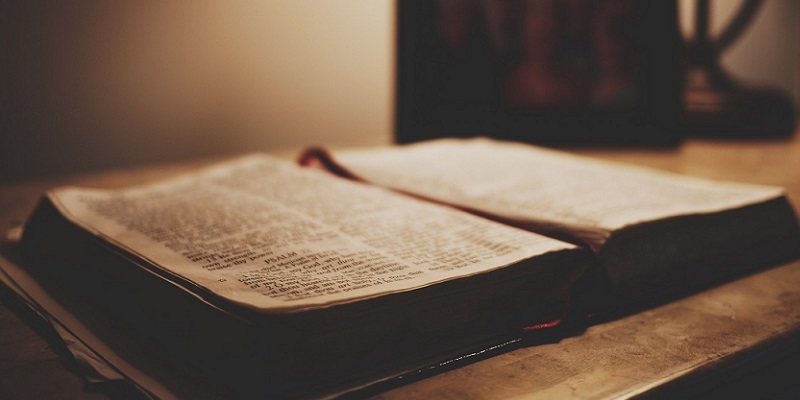
A brief excerpt from the book “Rome Sweet Home”
This is a brief excerpt taken from the book “Rome Sweet Home,” in which the Presbyterian minister Scott Hahn recounts the testimony of his conversion to the Catholic Church. (We highly recommend the book).
_________________________________________________________________________________
“In my Church History class, one of my best students (a former Catholic) presented a paper on the Council of Trent, and when he finished he asked me an embarrassing question that I had never heard before. He said:
— Professor Hahn, you have taught us that the doctrine of Sola Fides is not biblical, and that this battle cry of the Reformation has no foundation when set against Paul’s interpretation. As you well know, the other battle cry of the Protestant Reformation was Sola Scriptura: that the Bible is our only authority, rather than the Pope, the Councils, or Tradition. Professor: Where does the Bible teach that Scripture is our only authority?
I stared at him and began to break out in a cold sweat.
In the seminary I had a reputation for being a Socratic wasp, always putting others on the spot with uncomfortable questions; but this one had never occurred to me.
I answered what any professor caught off guard would have answered: “What a silly question!” But as soon as those words left my mouth I felt defeated, for I had promised myself that as a teacher I would never use that expression.
The student did not back down. He knew it was not a silly question, so looking me straight in the eye, he challenged me:
— Well then, at least give me a silly answer.
I said to him:
— Let us go first to Matthew 5:17 and then look at 2 Tim 3:16-17: “All scripture, inspired of God, is profitable to teach, to reprove, to correct, to instruct in justice, that the man of God may be perfect, furnished to every good work.” And then we can also look at what Jesus says about Tradition in Matthew 15.
His reply was cutting:
— But Professor, Jesus was not condemning all tradition in Matthew 15, only the corrupt traditions. When 2 Tim 3:16 mentions “all scripture” it does not say “only scripture” is profitable. Prayer, evangelization, and many other things are also essential. And what about 2 Thess 2:15?
— Oh, yes… Thessalonians… —I murmured weakly—, what does it say there?
— Paul says to the Thessalonians: “Therefore, brethren, stand fast; and hold the traditions which you have learned, whether by word, or by our epistle.”
I dodged the issue:
— You know what, John? We are getting off topic. Let us move on a bit and we will talk more about this next week.
I can assure you he was not satisfied. And neither was I.
As I drove home that night, I looked up at the stars and murmured: “Lord, what is happening? Where does Scripture teach Sola Scriptura? There were two pillars on which the Protestants based their revolution against Rome. One had already fallen, and the other was tottering. I felt afraid.
I studied all week without reaching any conclusion. I even called several friends, but made no progress. Finally I spoke with two of the best theologians in America, and also with some of my former professors. All those I consulted were surprised that I would ask them such a question, and were even more disturbed when I was not satisfied with their answers. I said to one professor:
— Perhaps I am suffering from amnesia, but I have forgotten the simple reasons why we Protestants believe that the Bible is our only authority.
— Scott, what a silly question.
— Well, give me a silly answer.
— Scott —he replied—, in reality you cannot explain the doctrine of Sola Scriptura from Scripture. The Bible does not explicitly teach that it is the only authority for Christians. In other words, Scott, Sola Scriptura is essentially the historical belief of the Reformers, over against the Catholic claim that authority rests in Scripture and also in the Church and Tradition. For us, therefore, this is only a theological presupposition, our starting point, rather than a demonstrated conclusion.
He then offered me the same texts of Scripture that I had pointed out to my student, and I gave him the same sharp answers.
— What more could we add? —I said.
— Scott, look at what the Catholic Church teaches. It is obvious that Tradition is mistaken.
— Obviously it is mistaken —I agreed—. But where is the concept of Tradition condemned? And on the other hand, what did Paul mean when he asked the Thessalonians to hold fast to Tradition, both written and oral? —I went on passionately—. Is it not ironic? We insist that Christians may believe only what the Bible teaches, yet the Bible itself does not teach that it is our only authority.
I asked another theologian:
— What is for you the pillar and foundation of truth?
— The Bible, of course.
— Then why does the Bible say in 1 Tim 3:15 that the Church is the pillar and ground of the truth?
— You upset me, Scott!
— I am the one who feels upset!
— But Scott, which Church…?
— How many candidates are there for the post…? I mean: How many churches claim to be the pillar and ground of the truth?
— Does this mean you are converting to Catholicism?
— I hope not….
Author: Scott Hahn
