
It is well known that many evangelical religions and religious movements venerate the Sacred Scriptures with commendable reverence and love. From them, I believe, many Catholics can learn much, for one reason or another, they do not put into practice those words of the last Universal Council of the Church, namely the Second Vatican Council, when it teaches us that “such is the force and power of the word of God that it can serve the Church as her support and vigor, and the children of the Church as strength for their faith, food for the soul, and a pure and lasting fount of spiritual life… Easy access to Sacred Scripture should be provided for all the Christian faithful” (DV 21 and 22).
Now, it is also known to everyone that these brothers of ours generally reject everything that is not contained explicitly or at least implicitly in the Sacred Scriptures.
 That is to say, we agree with these brothers of ours in love and veneration for the Sacred Scriptures, but we differ when they say that only what is found in the Sacred Scriptures is worthy of being taken as God’s certain message for our salvation. The Catholic affirms that the written Word of God is contained, yes, exclusively in the Sacred Scriptures, but that the Word of God is not only what was put in writing in the Scriptures; rather, the Word of God exceeds the Scriptures. The proof is that Jesus, the great revealer of the Father, “did and said many other things which are not written in this book,” and which, obviously, we may consider to be the Word of God, although not written but oral. This Word of God transmitted by Jesus and the Apostles orally and literally is technically called Tradition, written here deliberately with a capital letter, to distinguish it from what we usually understand by “traditions,” that is, customs of more or less unknown origin which are repeated from generation to generation, and whose only authority is “this is how it is done,” and that is enough. Such “traditions,” when they are religious in character, can be good or bad, can change or remain, can increase or decrease, can disappear.
The Tradition (with a capital letter) of the Church has its origin in Jesus Christ and the Apostles and is handed on from generation to generation through the preaching and celebration of the mysteries of salvation, under the guidance of the Holy Spirit. The word “tradition,” as is known, comes from the Latin “tradere,” which means “to hand over” or “to hand on.” In this sense the Sacred Scriptures are part of the Tradition that we have received from our ancestors in the faith; that is, the Bible is a message that has been “handed on” from generation to generation, under the guidance of the Holy Spirit.
But, as we have said, the Christians so-called “evangelicals” deny that we should listen to any other “Tradition” than this written Tradition, that is, the Bible. The Catholic Church, on the other hand, maintains that that Sacred Tradition (or “handed-on teaching of salvation”) which we must maintain and preserve is broader than Sacred Scripture, and, let us say it from the beginning, it does not oppose or contradict it, since it is one and the same Tradition which is “handed on” under two different forms: written and oral. I believe there is no better way to say it than as Saint Paul himself said it: “brothers, stand firm and hold to the traditions which you were taught, whether by word of mouth or by letter from us” (2 Thess. 2:15). Some translations of this passage, incidentally, render the word of the original text “paradoseis” as “doctrines,” which is perfectly lawful if it is not a tendentious translation: it must not be forgotten that the word “paradosis” unequivocally means “tradition” (apart from the meaning of “betrayal,” “arrest,” which does not apply here), from the verbal root “para-didomi,” and that it is the same word Jesus uses when he says to the Pharisees: “Thus you have made void the word of God for the sake of your tradition (paradosis).”
 As can be seen, the word “tradition” can be taken as a synonym for the doctrine of Jesus and the apostles and also as a synonym for the doctrines of the Pharisees or of their ancestors. In a word, the term “tradition” can be used in a positive sense and also in a more pejorative sense; therefore there is no reason to be scandalized when the Church speaks of Tradition, as Saint Paul spoke. (In 2 Thess. 3:6 the Greek term “paradosin” is also used, which, again, in some Spanish versions is translated as “doctrines”: “…according to the doctrines which they received from us” —Reina-Valera—; what we said about 2:13 also applies here: yes, we can translate “paradosin” as “doctrine,” but let us not lose sight of the fact that the original text says: “…according to the tradition which they received from us”; we could add that the text of Mt. 15:3 and 6, where in the original we have the same word as in 2 Thess. 3:6, that is, “paradosin,” is translated by almost all Spanish versions —even the Reina-Valera— as “traditions.” We ask ourselves: why not translate “paradosin” here as “doctrines,” as 2 Thess. 3:6 is translated, which refers to a similar reality—teachings, traditions, doctrines? Certainly the suspicion of partiality in the translation is not entirely unfounded: it would seem that when the term “paradosin” appears to indicate the teaching of Jesus or of the Apostles it is translated as “doctrines,” while when it refers to the human teachings and precepts of the Jews it is translated as “traditions.” We repeat once again that, although the translator may choose the synonyms he considers convenient, nevertheless in this case it seems to me that the saying “traduttore traditore” is fulfilled, since it can lead simple readers to think that “tradition” is a kind of “bad word” that alludes to human traditions, contrary to the doctrine of Jesus, when in fact in the original text it is the same word, which takes on its positive or negative value according to the “content” of the said tradition. However, it is not so much to questions of exegesis that I wished to draw the reader’s attention, but rather to questions of the history of Christian doctrine in its first steps, just after the Holy Spirit was received at Pentecost.
It is an obvious fact, and one recorded in the Sacred Scriptures, that “there are also many other things which Jesus did; were every one of them to be written, I suppose that the world itself could not contain the books that would be written” (Jn 21:25). Jesus spent the years of his public life preaching and doing good, which later the Apostles of the Lord also did; and they are considered by all Christian churches as sources of Revelation, that is, the public Revelation of the mystery of Jesus Christ culminates with the death of the last of the Apostles, who was John.
No one can say, based on any biblical text, that the authors of the New Testament texts wanted to limit the teaching of Jesus or of the Apostles to what they were writing. Or, put another way, neither Matthew, nor Mark, nor Luke, nor John, nor Peter, nor Paul, nor James, nor Jude, nor anyone else who may have been among the authors of the New Testament ever thought of putting in writing everything that Jesus taught, for that would have been endless, as John says (21:25). Nor had Jesus commanded them to write anything. Not even all the Apostles wrote something, but only five, some of whom wrote barely two or three pages (see the letter of Jude, or of James; from Peter we have two letters).
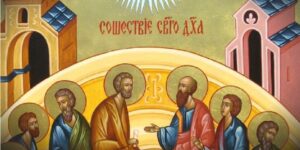 Jesus, however, gave his Apostles the commandment to go into all the world announcing the Gospel to all creation, “teaching them to observe all that I have commanded you” (Mt. 28:20). The Apostles, and also the other disciples of the Lord, once they had received the Consoling Spirit, fulfilled what the Lord had ordered them and preached day and night, even at the price of their blood, what they had “seen and heard” concerning Jesus. Now, as is clear, the Apostles did this by preaching, that is, by orally handing on the mystery of Salvation, since, as we said, only some of the Apostles, after a long time of preaching, and without intending to summarize in their writings that “all” which Jesus had commanded them (see above the quotation from Mt. 28:20), wrote something of what they preached (let us note that many New Testament writings are circumstantial letters). By this we mean that:
It never occurred to any of the Apostles to limit the teachings of Jesus to what they were writing at that moment;
The Christian community at the beginning was not founded on the writings of the New Testament, but on the oral teaching of the Apostles and disciples of the Lord;
Thousands of Christians of the primitive Church never read any New Testament text.
Could we conclude from this that the community of the first Christians did not know the Word of God? Of course not. It knew it, and knew it very well; but for them (and for many particular churches for centuries) the Word of God was handed on orally, at least in almost its entirety.
I have heard it said here and there that, when the time came, God caused the evangelical teachings to be put in writing so that they would not be distorted by the passing of the years; today we must remain with what was written, which undoubtedly contains no error; everything else is dangerous, unreliable.
Regarding this, let us say that such an assertion still remains to be proved: it is not based on any commandment—at least any that we know—of the Lord, nor on any decision of a Council of the Church (such as, for example, the Council of Jerusalem in Acts 15, where the Church decides questions that were arising and on which Jesus apparently had left no clear rule of conduct). That is, the assertion that “God, seeing that some doctrines ran the risk of going astray, gives us the writings of the New Testament” may sound very good to someone, but unless we know God’s thoughts directly, we cannot defend it with any historical or biblical datum; it is a hypothesis. I could say, as a hypothesis, that no, that this was not God’s thought, that this was not the reason why the writings of the New Testament appeared, and who could tell me that I am wrong?
On this point we could adduce other aspects, but that is not what most concerns us now.
We take it as established, then, that Jesus and the Apostles said and did much more than what is written, and that in the life of the apostles important events occurred that were not put in writing (or can anyone think that the work of the Twelve is limited to the little that the book of the Acts of the Apostles relates, almost exclusively, about Peter and Paul?). And we also take it as established that if anyone thinks that the only thing important for us is what was written, that thought is neither biblical—it is nowhere in the Bible, not even hinted at; rather the opposite—nor is it historical—no one ever thought that way until the last centuries of our era.
Now, suppose that in the Christian community at the beginning an event occurred that was not put in writing, and let us immediately give an example to make the question more practical and understandable: let us say that the Mother of the Lord, known and loved by all the Apostles, who had been with Jesus throughout his life, when the day determined by God arrived, died, and that when her tomb was visited by some people, let us say for the rites proper to Jewish funerals, they found that her body was no longer there. This fact, which Catholics take as a “handed-on teaching,” a “Tradition” with a capital letter (the Assumption of the Virgin), we take here purely and exclusively as a supposition, since, as we have seen, things certainly happened that were not put in writing.
In this supposed case, and in all the other cases that certainly occurred, that is, in the thousands of events that took place during the life of Jesus and of the Apostles, and in the very extensive teaching of Jesus and the Apostles that was not put in writing (which “the world itself could not contain the books that would be written,” Jn 21:25), what was the Church, that is, the community of believers, supposed to do? Forget? Why should it forget, if its mission was precisely to transmit everything that they had seen and heard? At what moment in the history of the Church was the decision made to “forget” the events that the sacred authors had not left in writing?
What should a believer of the twentieth century do when reading 2 Thess. 2:13-15?
“…so then, brothers, stand firm and hold to the traditions which you were taught by us, either by word of mouth or by letter.”
On what principle must I now say that what was taught “by word of mouth” must be forgotten and that we must keep only what was handed on “by letter”?
Did Saint Paul not realize how “dangerous” it was to say that oral traditions had to be obeyed…?
* * *
 Catholics, for their part, continue to maintain that both doctrines must be preserved, the one handed on by letter and the one handed on orally by the pastors of the Church; “both” doctrines, which are one and the same doctrine communicated through different channels, but which complement, perfect, and mutually explain one another. So it was in the beginning, and they do not see why now the teaching should be limited to what was written. If God taught it so, for example through one of the Apostles, then it would have to be accepted gladly. But, as we said, there is no reason that permits us reasonably to think that now we must cease paying attention to oral Tradition.
In what does this Tradition consist? In the whole evangelical message of salvation which the Church preached, beginning with the Apostles, throughout the centuries through her pastors, who must preach to all creation, “teaching them to observe all that I have commanded you; and behold, I am with you always, to the end of the world,” even after the Apostles of the Lord had already disappeared, as for example in the twentieth century… Today also Jesus is with those upon whom the Apostles laid hands, bishops, presbyters, and deacons (1 Tim. 5:22; Titus 1:7; Phil. 1:1), who have the obligation to preach in the name of Jesus, in such a way that “he who hears you hears me, and he who rejects you rejects me, and rejects him who sent me” (Lk. 10:16). But that is another topic, which we shall gladly treat, God willing, in another writing.
Dear evangelical brother who has read me to this point: I thank you for your interest and patience, which speak well of your commitment to the truth that will make both you and me free. I ask you to reflect on these things, because they are important matters, matters of eternal life. I would greatly appreciate it if you would send me a few lines in response to these questions I have raised, or about some other topic you are studying more deeply, or some translation you would like to corroborate, etc. Thanks be to God I can read (or at least try to!) the original texts in Hebrew and Greek, and I can help you. I have one single interest: to do you good.
An embrace to all in Christ Jesus.
Author: Fr. Juan Carlos Sack
Taken from Apologetica.org
