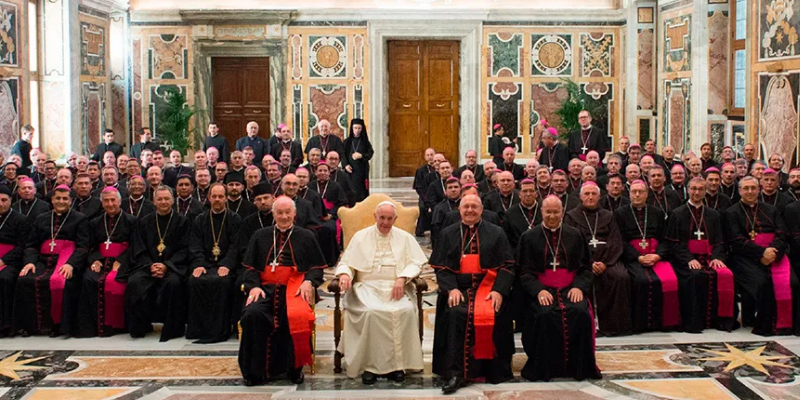
We Catholics obey the magisterium because it is the authentic interpretation of the Word of God, entrusted by Jesus Christ to the Pope and to the bishops in communion with him. Jesus said: “He that heareth you, heareth me” (Lk 10:16). All the teachings of the magisterium are important and worthy of being received with obedience.
It is true that the teachings of the Church are arranged in a hierarchy that helps us better understand the meaning of each one. The Pope and the bishops do not exercise the same degree of authority in every teaching. But this must not become a pretext for disdaining any of their teachings. Pope Pius XII (Humani generis, 12-14) warns of this danger:
There are some who, deliberately and as a habit, disregard everything that the Roman Pontiffs have set forth in their Encyclicals concerning the character and constitution of the Church; and this they do in order to make prevail a vague notion which they profess and claim to have drawn from the ancient Fathers, especially the Greek ones. And since the Supreme Pontiffs, so they say, do not wish to settle anything in the questions disputed among theologians, one must return to the primitive sources, and the constitutions and decrees of the Magisterium are to be explained by the writings of the ancients. Such assertions, perhaps clothed in an elegant style, are nonetheless not free of fallacy. For it is true that the Roman Pontiffs generally leave theologians free in the questions disputed —in differing senses— among the most reputable doctors; but history teaches that many questions which were once open to free discussion can no longer be debated. Nor can it be maintained that the teachings of the encyclicals do not of themselves demand our assent, on the pretext that in them the Roman Pontiffs do not exercise the supreme authority of their Magisterium. For these are teachings of the ordinary Magisterium, to which those words likewise apply: ‘He that heareth you, heareth me’ (Lk 10:16); and most of the time, what is proposed and inculcated in the Encyclicals already belongs —for other reasons— to the patrimony of Catholic doctrine. And if the Supreme Pontiffs, in their constitutions, deliberately hand down a judgment on a matter hitherto disputed, it is evident that, according to the mind and will of those same Pontiffs, that question can no longer be regarded as a matter of free discussion among theologians.
We call “doctrine” every truth taught by the Church as necessary to be believed. Every doctrine falls into one of the following categories:
1-It is divine revelation (e.g.: the Real Eucharistic Presence)
2-It is a theological conclusion drawn from revealed truth (e.g.: the canonization of a saint)
3-It is part of the natural law (e.g.: the sinfulness of contraceptives). See also: Humanae Vitae and Infallibility
Doctrines “of faith”
The truths that the Church teaches as “of faith” are those about which there is certainty that they are infallible (with no possibility of error) because they are safeguarded by the promises of Christ: ‘He that heareth you, heareth me’ (Lk 10:16). The promise of Christ cannot fail. These truths require of Catholics the assent of faith. That is, the supernatural virtue of faith, because we have faith in Christ and in his promise to teach through the Church. These truths bind Catholics under pain of breaking our communion with the true faith.
How can we know whether a teaching is “of faith”?
-It is “of faith” if it is found in the first three levels of the magisterium:
First level of magisterium: An infallible definition by the Pope.
“The Roman Pontiff, Head of the College of Bishops, enjoys this infallibility by virtue of his ministry when, as supreme Pastor and Teacher of all the faithful, the one who strengthens his brethren in the faith, he sets forth by a definitive act the doctrine on questions of faith and morals…” -Catechism 891
1) “as supreme Pastor and Teacher of all the faithful, the one who strengthens his brethren in the faith”. (If he speaks as a private person, or if he addresses only one group and not the universal Church, he does not enjoy infallibility).
2) “he sets forth by a definitive act the doctrine”. (When the Pope clearly states that the doctrine is definitive, cannot change, and is infallible)
3) “on questions of faith and morals”
The special and explicit exercise of Papal infallibility is called an ex-cathedra pronouncement. When the Supreme Pontiff speaks from his chair (cathedra) of authority, as the visible head of all Christians, his teachings do not depend on the consent of the Church and are irreformable.
Although most of the Pope’s infallible proclamations have been made in collegiality (in consultation with the bishops), this is not a requirement. The Pope can define a dogma even without the bishops. Second Vatican Council (Lumen Gentium, 25): “his definitions, of themselves and not by the consent of the Church, are irreformable, since they were pronounced under the assistance of the Holy Spirit promised to him in Saint Peter, and thus they need no approval from others, nor do they admit any appeal to another tribunal. For in such cases the Roman Pontiff does not issue a judgment as a private person, but rather, in his capacity as supreme teacher of the universal Church, in whom the charism of the infallibility of the Church herself resides in a singular way, he sets forth or defends the doctrine of the Catholic faith.”
Second level: The teaching of the episcopal magisterium in communion with the Pope.
This occurs:
1- When the bishops teach definitive truths of faith and morals in communion with the Pope.
2- in a special way, when they gather in Council.
“The infallibility promised to the Church resides also in the body of bishops when it exercises the supreme magisterium together with the successor of Peter, above all in an ecumenical council. When the Church proposes through her supreme Magisterium that something is to be accepted ‘as revealed by God to be believed’ and as a teaching of Christ, ‘its definitions must be received with the obedience of faith’. This infallibility extends to the whole deposit of divine Revelation.” -Catechism 891.
Lumen Gentium 25: “Although the individual prelates do not by themselves possess the prerogative of infallibility, nevertheless, if all of them —even while scattered throughout the world, yet keeping the bond of communion among themselves and with the Successor of Peter— agree on one and the same judgment as authentic teachers who set forth a doctrine on matters of faith and morals as definitive, in that case they infallibly declare the doctrine of Christ.”
A solemn definition does not require a special formula. One knows that it is an infallible teaching because the magisterial document itself clearly makes known that the teaching is definitive. An example is the Council of Trent (DS 1520), which “strictly forbids anyone to believe, preach, or teach otherwise than what has been established and explained in the present decree”. It is therefore an infallible decree.
The councils have used the formula: “If anyone says…. Let him be anathema”. (“Si quis dixerit. . . anathema sit.”). But that formula by itself is not decisive of infallibility, since it has also been used in disciplinary matters.
To know whether the Church intends to teach infallibly at this second level, one must observe the language and the intention. If it makes clear that it is a definitive truth, then it is infallible.
Third level: The ordinary magisterium of the Pope, when he expressly renders a definitive judgment on a matter of faith or morals that was previously debated.
In that case, what the Pope teaches is safeguarded by the promises of Christ in Lk 10:16, and it is therefore infallible because his promise cannot fail. These definitive judgments may be given in an encyclical or another type of pontifical document.
Fourth Level – pronouncements that are not infallible. They do not require the assent of faith but they do require a religious submission of the will and the intellect (Cf. Canon 752 of the new Code of Canon Law).
“This religious submission of the will and the intellect must be given in a particular way to the authentic magisterium of the Roman Pontiff, even when he does not speak ex cathedra; in such a way that his supreme magisterium is acknowledged with reverence and that one sincerely adheres to the judgment he expresses, according to the mind and will he himself has made manifest, which is discerned chiefly either from the nature of the document, or from the frequency with which he repeats the same doctrine, or likewise from the manner of expression employed.” -Lumen Gentium, 25; Cf: Canon 752
The teachings that are not definitive do not fall under the virtue of faith. Rather, they are matter that Lumen Gentium 25 and canon law call “religious submission of the will and the intellect”.
What does this submission require?
It forbids that these teachings be publicly contradicted.
It also requires assent of the mind, although it does not require the assent of faith.
How can we give mental assent without absolute certainty? We do so out of trust in the source. The truth is that we all give assent daily in secular matters about which we cannot have absolute certainty. For example, when we take a flight, we entrust our life to the pilot without the certainty that he is a good pilot. When we go to a restaurant, we trust that they are not going to poison us…. Our belief that we are not being deceived in such cases takes into account that there is a small probability of error, yet we risk our life out of trust in the enterprise. We could not live without this kind of assent. In a court of law the aim is to find the truth and prove it beyond reasonable doubt. Nothing more is demanded, nor can more be asked.
Our assent to the fourth-level teachings of the magisterium is not of faith; it does not carry the absolute certainty of the first three levels, but it is indeed an assent that trusts in the guidance of the Holy Spirit over the Church. The chances of error in this kind of assent are even far smaller than in the case of the airplane or the restaurant. Moreover, if we err by assenting to some teaching of the Church that is not of faith, when we stand before the Divine Judge, he will commend us. But if we err by breaking with the Church, thinking that we know more than she does, we fall into serious risk of being charged, at the very least, with pride.
Some object that, by obeying the authorities of the Church, injustices were committed in the past. Answer: One must distinguish between the teachings of the magisterium and the temporal authority of the Church in matters of governance or in judgments about persons exercised in the past, which is not the domain of the magisterium.
The Pope frequently teaches with the help of the Congregations of the Roman Curia. The declarations published by these Congregations do not aim to teach new doctrines but to reaffirm or synthesize the doctrine of the Catholic faith defined or taught in earlier documents of the Church’s Magisterium, indicating its correct interpretation in the face of present-day doctrinal errors and ambiguities. A doctrinal document of a Congregation of the Curia is formally promulgated when it is expressly approved by the Supreme Pontiff, and it therefore has a universal magisterial nature because it carries the authority of the Pope himself.
Author: Fr. Jordi Rivero
