
This article aims to clarify some of the questions that have frequently arisen from the use of the “Gospel of Thomas” in recent film productions.
Real Events?
In the plot of a certain 1999 film there appears the discovery of a gospel earlier than those accepted in the Bible, written in Western Aramaic—the language of Jesus—and the Catholic Church is the villain that tries to conceal this discovery in order to protect itself from collapse.
The theme of certain truths and documents hidden by the Catholic Church is nothing new, and it has been a rich vein of fantasy widely exploited in recent literature and film.
The business of the Aramaic gospel is fanciful, which is perfectly valid within the limits of a certain poetic license; but the stance against the supposed representatives of the Catholic Church at the end of the movie is justified by means of a distortion concerning what is known as the “Gospel of Thomas.”
Claiming to ground the film in real events, it concludes with a written statement that reads more or less:
In 1945 there was discovered at Nag Hammadi, Egypt, “The Secret Words of Jesus,”
known as the Gospel of Thomas.
The Vatican immediately declared the writing heretical.
That writing does in fact exist, and it contains the words attributed to Jesus that are repeated in the film as part of the imaginary Aramaic gospel:
| “Break a piece of wood and there am I; lift up a stone and there you shall find me” NHC2 46,26-28. |
The corresponding original Coptic text may be consulted.
But the Catholic Church never saw this writing as a threat; on the contrary, scholars from all over the world, Catholic and otherwise, set about the task of studying this fascinating discovery.
From its content it was quickly identified as belonging to a movement that had its heyday during the second and third centuries A.D., called Gnosticism.
This movement, located geographically above all in Egypt, was a blend of philosophical currents of Greek and Jewish origin, with a strong mystery-religion flavor, full of supposed secret revelations, and highly selective.
At a certain point, the Gnostics adopted the Jesus of the Christians as their protagonist.
That is to say, a non-Christian movement appropriated the Jesus of Christianity and made him a Gnostic.
Strictly speaking, Gnosticism does not even rise to the level of heresy, since it did not arise within the Church.
But the Christians of the second and third centuries, with exponents such as Origen and Athanasius of Alexandria, had to defend themselves against this movement, which distorted the figure of Jesus by casting him as “the chief Gnostic.”
Abundant writings survive from this period, in which one can already see Christianity fighting hard at the very moments of its birth.
The recent discovery of the “Gospel of Thomas” meant, for the Catholic Church and for researchers throughout the world, a marvelous opportunity to confirm what was already known and to gain further elements of judgment for studying that era.
What did the Nag Hammadi discovery consist of?
| In 1945 some peasants discovered at Nag Hammadi, Egypt, papyrus codices that were later dated to around the fourth century A.D. |
|
 Photograph of Nag Hammadi codices
The most astonishing content was found in the second of the twelve codices discovered: on folios 33 to 52—twenty pages in all—there was a text in the Coptic language (ancient Egyptian), in perfect condition, with the following closing words:
| Retouched photograph of the original |
|
| In digital characters |
|
| Pronunciation |
EUANGUÉLION |
| Meaning |
GOSPEL |
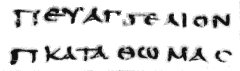

Anyone who reads Spanish can, with a little effort, identify some of the letters.
I refer the reader to a photograph of folio 52 of the second codex (the end of Thomas):

photograph of folio 52 of the second codex (end of Thomas).
|
Note of March 9, 2000: I recommend the booklet: NAG HAMMADI / The Gospel according to Thomas: Gnostic Texts from the Origins of Christianity, KUNTZMANN – DUBOIS, in the collection “Documentos en torno a la Biblia,” No. 16, Ed. Verbo Divino. |
Where is the Gospel of Thomas currently kept?
It is kept in the Coptic Museum of Old Cairo, in Egypt.
It is, and always has been, the property of the Egyptian people and government, not of the Vatican nor of any religious group.
Although, to be precise, what is found there is:
the 12 papyrus codices in the Sahidic Coptic language discovered at Nag Hammadi in 1945, the second of which contains, on folios 33 to 52, a complete collection of sayings introduced with the phrase “Jesus said” or “He said,” and which concludes with the words “Gospel according to Thomas.”
A chart of the contents of the most important codices may be consulted with my friend Michael Grondin, and here is a complete translation into Spanish. Yet another one in Spanish can be found at http://www.metalog.org/files/tomas.html.
I say “to be precise” because, as is answered in other sections,
- it is not a gospel (see the formation of the Gospels)
- it is not an original, but a copy of earlier copies that were already circulating, just as happens with the fragments we preserve of the true Gospels.
What is a gospel?
Two things above all are understood by this term:
a) Etymologically it means “Good News,” and it refers specifically to the proclamation that Jesus has died and risen for the salvation of all. An example of this meaning is found in the voice of St. Paul: 1 Cor 15:1-4 and Rom 1:1-6.
b) As a literary genre (a certain type of writing), it refers to the writings that developed in some early Christian communities for the purpose of proclaiming the Good News of Jesus in a systematic way, explaining it above all through the narration of His deeds and words.
How many gospels are there?
There are four, and they appear in the following order in the Bible:
1.- The Gospel according to St. Matthew
2.- The Gospel according to St. Mark
3.- The Gospel according to St. Luke
4.- The Gospel according to St. John
Are there gospels other than the four found in the Bible?
Strictly speaking, no.
There exist, on the other hand, many writings from the first centuries of Christianity (and others from much later centuries) that call themselves gospels. These “gospels,” together with many other writings, have been classified in the history of the Church as apocryphal books.
How were the Gospels formed?
This is one of the most fascinating questions when one makes the effort to understand the Bible and, in our case, why Thomas is not included in it.
Someone might answer:
“Like the whole Bible, God wrote them.”
Or else:
“They were written by each of their respective authors, as their names indicate: Matthew, Mark, Luke, and John.”
Someone might go deeper and reply:
“They were written by each of the four evangelists, but inspired by God.”
And someone else might take the question into greater detail:
“God’s inspiration of the human authors does not consist in dictation, nor in revelations by way of dreams, ecstasies, or situations indicating that the evangelist wrote down word for word what God told him. Inspiration consists in this: that God, without the human authors realizing it, yet immersed as they were in a community of faith, was assembling and weaving together the whole of the Sacred Scriptures, accompanying believers throughout their history.”
Most true.
Nevertheless, the question is much deeper, and it deserves a careful study of the only aspect to which we have access: the human one, since the divine will always remain beyond our comprehension.
Let us begin with the origin of Christianity.
1) What did the first followers of that carpenter from Galilee believe in?
In the Gospels?
No, because they did not yet exist. The first written gospel appeared some decades after there were already Christians.
Did they believe in the Bible, then?
Up to a point, yes. The Scriptures then in existence, which we Christians today call the “Old Testament” and which form the first part of what we now call the Bible, served to be read in public.
But it should be noted that ordinary people did not read the Bible, for two simple reasons:
a) Almost no one knew how to read.
b) Written documents (codices, papyri, parchments) were very costly because they were copied by hand, and they were therefore reserved for public use, since only a common fund could cover such expenses. Printed Bibles as we know them today date from Gutenberg (1400-1468) onward.
Did they believe in the Ten Commandments, in forgiveness, in love of neighbor?
In all of this, yes, of course. But no moral code, however good and accepted it may be, is the essence of Christianity, nor is living it enough.
What did the first Christians believe in, then?
In JESUS CHRIST as God made man, who died and rose again so that all of us might attain the salvation we did not deserve.
Neither the commandments, nor the Church, nor any writing, nor any custom is more important than faith in this Risen Jesus.
2) After Jesus was no longer physically present on earth, how could Christians know that they were following the true Jesus and his teachings?
Answer: the Church.
“Church” comes from the Greek “Ekklesía,” which means Assembly.
It refers, then, to the community of believers, headed by the apostles, which went on living its faith from the memories and teachings about that Jesus whom many of the new members no longer knew personally.
Whoever reads the book of the Acts of the Apostles will realize how extremely zealous the first Christians were, not only in proclaiming the Good News of Jesus, but in keeping what they believed free from distortions and deviant interpretations, which abounded from the very beginning.
The examples of this struggle to preserve the faith, already reflected from the birth of the Church, are countless. The following passages may be consulted:
On “other” gospels (in the sense of different doctrines):
– 2 Cor 11:4
– Gal 1:6-7
On unnecessary obligations:
– Acts 15:1ff
Thus it is the Church, with Peter and the apostles at its head, that watches jealously over transmitting the faith in Jesus Christ and making it grow faithfully and without distortions.
3) How did the Christian communities hand on faith in Jesus from generation to generation?
Here is the most interesting part of all.
The principal way of proclaiming Jesus to someone who does not know him, or of going deeper with someone who has already had a first contact, is by oral transmission.
That is, through spoken words, pronounced with tongue, lips, pharynx, teeth, and palate.
Understanding this situation is harder for us than it seems, because we are very accustomed to having access to newspapers, books, magazines, and publications of every kind.
Nothing of the sort in those days.
We easily have paper and pencil at hand to write anything down, and in recent years even print has become non-essential, with computing and electronic correspondence.
It seems so natural to us that everyone should know how to read.
But it was not so in those days.
Only those who did it as a trade wrote (hence the word “scribe”).
And the only things written down were those worth the investment of tanning animal hide, making ink, and hiring someone who knew how to write.
It is no surprise that the most abundant and ancient writings are sales contracts and money receipts.
Now then, returning to the Christian communities: as they grew with new members coming from everywhere and with all kinds of customs and beliefs, it became ever more necessary not to rely on memory and oral transmission.
It was no longer enough for someone who had personally known one of those who had had physical contact with Jesus to relate what he had been told. This had its limits.
And since each community built up its own store of memories of the words and deeds of Jesus according to its own situation, not all the Churches preserved and handed on exactly the same things, although in the essentials they had to agree.
And at some given moment, someone in the community wisely systematized the Good News about Jesus that had already been handed down for years, putting it into writing.
And thus this writing, whose content was already being transmitted orally and was very much alive in the memory of the community, became a sacred patrimony that served to transmit the Good News more faithfully: thus the Gospels were born.
The different geographical origins explain the differences among the four Gospels: in Rome fierce persecutions were endured, and so the community forcefully handed on the encouraging words of Jesus: “If any man will follow me, let him take up his cross and follow me” (Mk 8:34; 10:21).
The Gospel according to St. Mark, which reflects the life of the community of Rome, therefore abounds in encouragement in the face of suffering.
The Gospel according to St. Luke, on the other hand, addressed to non-Jews, has a language that is more accessible and more pleasant to read, besides selecting among the words of Jesus those that speak of the “true treasure in heaven” (Lk 18:22; 12:15; 12:33), since among the members of the communities where this gospel arose there were many rich people.
4) Summary.
The Gospels arose in the Christian communities when what had already been handed down for years was put into writing: the Good News of the Risen Jesus.
With this explanation, the following table of priorities of faith becomes clear:
Indeed, first comes Jesus, then those who follow him, and afterwards the human-divine Word that nourishes this following.
Why is the Gospel of Thomas not included in the Bible?
Because, unlike the canonical Gospels (those which are indeed considered inspired by God), it did not arise from a Christian community.
Most probably it circulated as a Gnostic writing, for its style closely resembles that movement in its arcane, esoteric character, full of mystery-laden phrases.
And even if it had arisen in a Christian community, what determined that some books were accepted as canonical and others were not was the consensus among the Churches (by “Churches” understand the various Christian communities belonging to the one Church of Jesus Christ).
The oldest testimony to a canon of sacred books is what is known as the “Muratorian Fragment,” which dates from the second century and includes a list of the writings circulating as inspired in the Church.
On the other hand, there are specialists who assert that Sahidic Coptic, the language in which the Nag Hammadi codices are written, was never spoken among ordinary people.
Since Gnosticism was rather elitist, they practically invented their own language: a mixture of Egyptian with Greek words and characters.
The matter is not so simple, for it is not known whether what we preserve today corresponds to a Coptic original, or whether it is rather a translation of a Greek original, as certain fragments discovered in 1896-1905 in another Egyptian town called Oxyrhynchus seem to show.
In any case, whoever reads the 114 “sayings of Jesus” contained in this work, grouped without any apparent logical order, some of them identical to those of the canonical Gospels, will realize the great abyss that lies between the “Gospel of Thomas” and the four that have been used in the Church for two thousand years.
What has the Nag Hammadi discovery contributed to biblical studies?
(I suggest the average reader skip this section)
Above all, it has confirmed a hypothesis that already existed:
That there circulated, as a literary genre of their own, collections of sayings of Jesus.
From 1838 onward this hypothesis served as a basis for explaining the origin of many gospel passages found in Matthew and in Luke, but not in Mark. This hypothetical collection of sayings of Jesus that served as a source for Matthew and Luke was called “Q” (from the German “Quelle,” source).
Thus this work found in Codex II of Nag Hammadi, known as the Gospel of Thomas, is parallel in style to “Q,” but not to the canonical Gospels.
About this article.
The author of this essay, a Catholic priest of the diocese of Tijuana, had his first contact with the “Gospel of Thomas” in 1986, owing to a research assignment on words of Jesus outside the Gospels.
I am grateful for the guidance of several specialists: Msgr. Isidro Puente, who became well known through his doctoral thesis defense on a translation of his of a Coptic text into Latin back in the 1970s; Fr. Florentino Durazo, a specialist in Patristics; and Mr. Michael Grondin, an enthusiastic scholar of the Nag Hammadi codices, who was kind enough to provide me with his version of the Coptic text of the “gospel of Thomas,” complete, in editable format.
Mr. Grondin maintains a superb reference site for students of the second Nag Hammadi codex at http://gospel-thomas.net/ .
Deeper academic study has led your humble servant to love the Word of God all the more, counting among his greatest fortunes the ability to read it in the original languages.
I see in this matter an opportunity to spread questions which, for most people, are rather dry, but which can help toward a better understanding of the Bible and the Church.
©1999-2005 Juan García Ruvalcaba. I encourage anyone who finds this material useful to reproduce it in whole or in part and by any means. I appeal only to the most elementary ethics, asking that whoever does so
a) cite this source (http://www.giscala.com/tomas/).
b) not profit from it.
| c) if possible, notify me at |  |
Ad Maiorem Dei Gloriam
Juan García Ruvalcaba
Notes.
1)
|
The characters that appear in this photo, taken from a film, are not the Aramaic of the time of Jesus. They correspond to the Hebrew of the time of Hezekiah, who reigned in Jerusalem from 727 to 698 B.C. Next to each letter I placed its corresponding transliteration. If it really means anything at all, the only coherent thing I have found is the word “yashud” (which devastates), which is also found in Psalm 91:6. |
 |
2) NHC2 46,26-28:
Read: “Nag Hammadi, Codex 2, folio 46, lines 26 to 28.”
Although the collection is divided into 114 “sayings of Jesus,” and for that reason this numbering by “sayings” (or logia) quickly came into use for locating a given text, it is considered less scientific.
If we keep to this simpler way of citing, we would say GosThom 77 (Gospel of Thomas, saying 77).
3) Divine omnipresence and pantheism
Divine omnipresence, that is, the fact that God is everywhere, is a Christian postulate. Also part of the Christian spiritual tradition is a certain form of contact with the Creator through His creatures.
A separate discussion, as regards human perception, is the non-incompatibility between the concept of omnipresence and the need for visible places of worship.
Distinct from divine omnipresence, and contrary to the Christian faith, is “pantheism”; that is, the assertion that everything is God, since it strips Him of His transcendent, personal, superior character and, above all, of His being distinct from His creation.
Return to “break a piece of wood…”
4) At that time, studying first-year Theology as a seminarian, it was logion (saying) 82 that drew my attention, on account of a written assignment I had to hand in for the course of theological introduction:
“Whoever is near me, is near the fire;
whoever is far from me,
is far from the Kingdom.” (GosThom 82).
A German biblical scholar named Joachim Jeremias, in his book Unknown Sayings of Jesus (Ed. Sígueme), pp. 72ff., considers that this logion, attested also by several Christian authors of the second to fourth centuries, truly goes back to Jesus Christ, even though it is not recorded in the Gospels.
Here there used to be a note of February 8, 2000, followed by several comments supplementing the article. Today, June 20, 2001, I pruned the article, above all removing almost everything that might seem polemical. I left only three readers’ comments.
“…we have been active in parishes and Church groups, but we honestly did not know of the existence of the ‘gospel’ mentioned in the film.”
One of the cleverest devices of the production was to make use of a valuable document, yet one unknown even to people of average culture. In fact, the Catholic priests who have seen this film do, in most cases, remember that an apocryphal gospel of Thomas exists; but since it is a rather secondary topic in the cycle of theological studies, a special interest would be required to be familiar, I do not say with this writing, but with the apocrypha in general.
I have downloaded the gospels of Thomas from the internet, since I very much liked the film and its plot; I am now getting ready to read them. Your comment seemed very coherent to me, but I will hear the other bell on this and will tell you my conclusions in a coming e-mail, since on this there is much to say and to think, according to the viewpoints of whoever reads them.
I await your conclusions.
Although two opposing bells seem to me insufficient for forming a personal conclusion. It would take quite a few bell towers, and abundant hours of generous study with a truly critical mind, without sacrificing the intellect to the poor expedient of finding one’s own opinion in a democratic average of everyone else’s.
“…But tell me: is it possible that at some point some apostle other than the 4 could have kept something like a diary of his life with Jesus and written it down, and that in time it was lost?”
Jorge Rojas
The possibility that something closer to Jesus than the Gospels we possess was written does exist, though it is small.
In fact, an Italian biblical scholar (I do not recall his name) stated some five years ago that, contrary to what is commonly thought, the oldest gospel is not Mark’s but John’s.
His hypothesis is that the evangelist John wrote down the events of Jesus’ life almost directly, and not several years later. He sets out several reasons that would take long to mention (exact names of places with detailed descriptions, mention of what hour it was, etc.), although he did not meet with much acceptance in the scholarly world.
On the other hand, the idea has long been entertained that there probably existed what is called an “Aramaic proto-gospel of Matthew,” which was lost, and which served as the basis for the present Greek Matthew. This hypothesis is based on a mention made by a certain Papias.
And it is an almost certain fact, as I mention above, that there must have existed a writing containing sayings of Jesus (similar in style to the “Gospel of Thomas”) which served as a source for the Gospels of Matthew and Luke. That writing, known as “Q,” is a mere hypothesis, found nowhere, but whose traces we detect in Lk and Mt.
But returning to your question, as to whether it is possible that some apostle other than the four wrote something like a biography or a logbook of Jesus’ activities, I can only tell you that we are moving in the realm of the possible. There are no grounds either to affirm it or to deny it.
The reasons that make it unlikely, however, are:
1.- The art of writing was reserved to a few, and none of Jesus’ disciples seems to have been a scribe: the leading ones were fishermen. The written forms of the Gospels surely saw the light through the hiring of someone suitable. And incidentally, the communities were poor, which is why the oldest manuscripts are of papyrus, a cheaper material than parchment, and generally in very poor handwriting, which indicates that the scribes hired were not exactly the most professional.
2.- There is no testimony indicating that anyone wrote anything down immediately.
Nevertheless, there is something very interesting.
The idea is gaining ever more ground among scholars that Jesus spoke in such a way—like an exceptional orator—that his short, intense sentences were designed to be memorized and repeated quickly, which facilitated their later being put into writing.
Note of February 26, 2000.
The end of the matter; all has been said
Qoheleth 12:13
Today, Saturday, February 26, 2000, this page having unexpectedly reached one thousand visits (not bad for something homemade), and with much still left to comment on the great number of topics that may spring from readers’ curiosity, I declare myself tired and repeat with the book of Qoheleth, at the end of its exhausting reflection:
Of making many books there is no end,
and much study is an affliction of the flesh.
The end of the matter! All has been said!
Fear God, and keep his commandments,
for this is all man.
Qoheleth 12:12b-13b
This space will remain here indefinitely.
For my part, I am redirecting the energies that have been invested in this toward the services I was beginning to neglect, for the poor are already crying out to heaven demanding justice.
I commend myself to your prayers.
God bless you all.
Source: www.giscala.com
