Where Did “Punishment-Phobia” Come From?
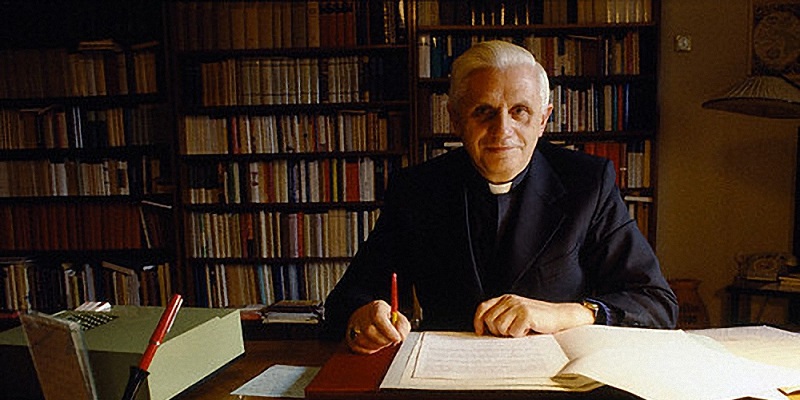
In the preceding chapters I have been treating the topic of punishment — specifically how the idea that God never punishes gradually infiltrated Catholic preaching and teaching to the point of being frequently heard in homilies, talks, and Catholic media. Pope Benedict XVI gave a very lucid diagnosis of where this error originated, and I cite him to show that those who hold the opposing position are not evil people, but very good ones who have nonetheless fallen into a confusion:
“The Archbishop of Dublin told me something very interesting. He said that ecclesiastical penal law functioned until the late 1950s and that it was then applied for the last time. After the Council, it was simply not applied anymore. The prevailing sense was that the Church must be a Church of love — she could not put anyone in prison.“
“In those days, even among very good people, a peculiar blurring of thought took place. Today we have to learn from that.” (Benedict XVI, Light of the World, Herder, 2010, pp. 16–17)
In this way, both the idea of a God who can punish if He so chooses and the image of a Church that punishes with medicinal penalties those who deserve it have been eroded. Simply put, speaking of divine punishment is not politically correct today.
Is It Merely a Problem of Semantics?
So, to close this line of reflection, I want to address the problem of terminology in greater detail, since some people have suggested that the debate between Alejandro Bermúdez and myself is merely a matter of language — that we are saying the same thing in different words.
And is it not better, they ask, to teach only that God “corrects” without using the word “punishment,” thereby avoiding the risk that some people will have an erroneous image of God as a vindicative God? The answer is no, and for good reason. If we stop using the word “punishment” and replace it systematically with “correction,” we end up emptying the concept of its full theological meaning, because — as I have explained — punishment is not only a correction; it also has a vindicative or retributive dimension that is inseparable from divine justice.
In my view, this is not merely a terminological problem but a misunderstanding of Catholic doctrine — one that manifests itself in an inability to understand divine justice in the light of divine mercy. But before addressing that, let us briefly revisit the meaning of the word “punishment.”
Clarifying Once More the Meaning of the Word “Punishment”
In my first commentary I said that terminological questions are of secondary importance compared to questions of substance or content, and that everyone has the right to choose their own terminology, provided that it does not contradict the faith. I stand by this. But what I cannot agree to is that, under the guise of terminological preference, the full theological content of the concept is quietly abandoned.
1) While punishment may have a corrective character, as is the case with temporal punishment, it also has a vindicative or retributive character: it is a real evil inflicted by divine justice as retribution for sin. To reduce it only to “correction” and deny its vindicative dimension is to contradict Scripture, Tradition, and the Magisterium.
2) The People of God have always understood divine punishment in this sense, grasping at the same time its corrective character and its character of expiation and retribution for sin. This is the understanding found in Scripture, in the Fathers of the Church, in the Councils, and in the ordinary Magisterium of the Church.
3) It is an error to assume that there has been a “development” of Christian doctrine changing the Church’s position on this point. The ordinary and extraordinary Magisterium has consistently and unambiguously taught throughout history that God can and does punish — both temporally and eternally.
Relevant Clarifications
Finally, I wish to clarify an unpleasant matter. I have learned through social media that Alejandro Bermúdez has understood me to be accusing him and our brother Frank Morera of being “heretics” or of being opposed to Catholic doctrine. I take this opportunity to clarify that this is not true. I have pointed out that they are mistaken on this point and that, given their prominence in the media, their error affects a greater number of people. But to be a heretic requires certain conditions that Alejandro surely knows as well as I do, and it is not my place to make that kind of judgment. This problem far transcends the specific error that two Catholic communicators may commit. It is an error found even in the preaching of priests — and not far from home: the very day I was writing this, my own sister heard a priest preach at Holy Mass that God does not punish.
My exhortation is that we teach Catholic doctrine exactly as Scripture, the Magisterium, and Tradition have always taught it — without yielding to the temptation of political correctness, or clinging to a fashionable idea that, as Benedict XVI has said, though found among very good people, is nothing other than a “peculiar obscuring of thought” that has “lost awareness of the fact that punishment can be an act of love.”
