
“And he shewed me a river of water of life, clear as crystal, proceeding from the throne of God and of the Lamb.” Apocalypse 22:1
Jesus Saves! Is It Enough to Accept Christ as Our Only Savior?
If there is one truth on which all of us Christians agree, it is this: Jesus Christ is our only Savior. For as St. Peter says: “There is no other name under heaven given to men, whereby we must be saved.” Acts 4:12.
If it is important to know that Jesus saves, it is no less important to know HOW JESUS SAVES. Indeed, suppose that the airplane you are traveling in is on fire. This airplane carries parachutes so that you can save your life, but if you jump without a parachute, or refuse to use it, you are not saved.
Yahweh saved Noah and his family from the flood, but He saved them by means of the ark that He commanded them to build.
The same happens with Jesus: He is our only Savior, but if I do not use the means He gives me to be saved, I am not saved.
Read the passage of the ten virgins in Matthew 25:1ff. All ten knew that Jesus was their Lord and Savior. All ten expected that Jesus would let them into the Kingdom; they all knew the same thing, they all believed the same thing, but only five were saved: the wise ones. Only they did what Jesus wanted: to keep the lamp of the soul burning (Read: John 11:9-10). And when the Lord came, only they entered the Kingdom. Afterwards the five foolish ones arrived; they recognized Jesus as their Lord and so they call him: “Lord, Lord, open to us,” but He answered them: “I know you not.” Why? Because they knew that Jesus, their Lord, saved, but they did not do what Jesus, their Lord and Savior, commanded.
The same happens with Jesus: He is our only Savior, but if I do not use the means He gives me to be saved, I am not saved.
How Does Jesus Save Us? How Does He Communicate Life to Us?

Jesus saves us by communicating His very own life to us. He Himself said: “I am come that they may have life, and may have it more abundantly.” That life, being divine and entirely gratuitous, we call the life of grace or supernatural life. When I live in grace, the lamp of my soul is lit, the light of Christ shines in me; when I live in mortal sin, my lamp is out, I live in darkness.
This supernatural life is communicated to me through the seven sacraments.
The Pope teaches us: “When we receive the sacraments we receive the life of Jesus, we live the divine life, we become like Jesus. It is Christ Himself who, with His power, through the Holy Spirit, works that likeness in us.” John Paul II to the children, 01/22/84.
The Church Teaches Us
“Adhering to the teaching of the Holy Scriptures, to the apostolic traditions, and to the consensus of the Fathers,” we profess that “the sacraments of the new law were all instituted by Jesus Christ our Lord.” CCC n. 1114 ff.
The purpose of the sacraments is to sanctify men, to build up the body of Christ, and, finally, to give worship to God; because they are signs they also instruct. They not only presuppose faith, but by words and objects they also nourish, strengthen, and express it; that is why they are called “sacraments of faith.” They do indeed impart grace, but, in addition, the very act of celebrating them most effectively disposes the faithful to receive this grace in a fruitful manner, to worship God duly, and to practice charity.
It is therefore of the highest importance that the faithful should easily understand the sacramental signs, and should frequent with great eagerness those sacraments which were instituted to nourish the Christian life. Sacrosanctum Concilium, n. 59. Study the CCC (Catechism of the Church) 1122 ff.
Why 7 Sacraments?
Because 7 are the stages of life. There is a great likeness between the stages of natural life and the stages of supernatural life. Read: Catechism of the Catholic Church (CCC n. 1210).
1. In natural life one must be born.
In supernatural life one must be born of water and the Spirit. Read: John 3:5. Our mother the Church begets us through Baptism.
2. In natural life one must grow and bear fruit.
In supernatural life, Confirmation brings to full development and makes fruitful that life received in Baptism. Read: John 15:16.
3. In order to live we need to feed ourselves.
In the Eucharist, Christ, the Bread of Life, nourishes us with His body and His blood. Read: Luke 22:19.
4. In natural life we fall sick and need medicine to recover our health.
In supernatural life Jesus Christ, physician of souls (Read: Matthew 9:12), offers us the sacrament of Reconciliation to heal the wounds of sin. Read: CCC n. 1421.
5. In natural life we seek to form a home.
In supernatural life Christ wants spouses to love each other as He loves His Church (Read: Ephesians 5:25): for this He instituted Matrimony.
6. In natural life we need an authority to order social life.
In supernatural life the Kingdom of Christ in this world requires an authority, shepherds who feed the sheep of Christ; for this Christ instituted the Priesthood.
7. Natural life reaches its sunset and we die.
The Anointing of the Sick conforms us to the death and resurrection of Christ. Read: CCC n. 1523.
Is Baptism Alone Enough? Who Invented the Rainbow?

Indeed, Christ said: “Unless a man be born again of water and the Holy Ghost, he cannot enter into the kingdom of God.” John 3:5. But Jesus Christ never said: “It is enough merely to be born of water and the Spirit to enter the Kingdom of God.” And of course! How could it be enough? He who is true Life — how could He give us life by halves? If natural life has seven stages, why would Christ make supernatural life less perfect? Some Christians object: “I do not see the seven sacraments in the Bible; to me they are an invention of the Catholic Church.”
Of course you do not see them! In the same way that you do not see the seven colors of the rainbow if you do not have a prism. We do see them, because we have a prism, which is the Church. The prism does not invent the colors of light; it simply separates and distinguishes them so that your eye can perceive them with clarity and sharpness. The same with the Church: she does not invent the sacraments; she simply helps us distinguish clearly what the Bible teaches.
Without the prism I could not distinguish the seven colors in a ray of light. Without the Church I cannot perceive the seven sacraments contained in the light of the Divine Word.
The Sacraments in the Bible, Seven Proofs of the Faith.
Baptism.
“And Jesus coming, spoke to them, saying: All power is given to me in heaven and in earth. Going therefore, teach ye all nations: baptizing them in the name of the Father, and of the Son, and of the Holy Ghost.” Matthew 28:18-19.
Confirmation.
“Now when the apostles, who were in Jerusalem, had heard that Samaria had received the word of God, they sent unto them Peter and John. Who, when they were come, prayed for them, that they might receive the Holy Ghost. For he was not as yet come upon any of them; but they were only baptized in the name of the Lord Jesus. Then they laid their hands upon them, and they received the Holy Ghost.” Acts 8:14-17.
Eucharist.
“And taking bread, he gave thanks, and brake; and gave to them, saying: ‘This is my body, which is given for you. Do this for a commemoration of me.’ In like manner the chalice also… saying: ‘This is the chalice, the new testament in my blood, which shall be shed for you.’” Luke 22:19-20.
Confession.
“When he had said this, he breathed on them; and he said to them: ‘Receive ye the Holy Ghost. Whose sins you shall forgive, they are forgiven them; and whose sins you shall retain, they are retained.’” John 20:22-23.
Anointing of the Sick.
“Is any man sick among you? Let him bring in the priests of the church, and let them pray over him, anointing him with oil in the name of the Lord.” James 5:14.
Priesthood:
“And when they had ordained to them priests in every church, and had prayed with fasting, they commended them to the Lord.” Acts 14:23.
Matrimony.
“But to them that are married, not I but the Lord commandeth, that the wife depart not from her husband. And if she depart, that she remain unmarried, or be reconciled to her husband. And let not the husband put away his wife.” 1 Corinthians 7:10-11.
Conclusion.
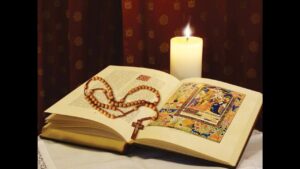
The 7 Sacraments are indeed in the Bible; the fact that you do not see them or ignore them does not mean they do not exist.
Eucharist. Many do not obey Christ, who says: “Do this for a commemoration of me.” Others obey but do not believe Christ, who says: “This is my body.” We, with St. Thomas Aquinas, confess: “Sight, taste and touch are deceived, but I believe what comes from Your mouth.”
Matrimony. Jesus Christ commanded: “What therefore God hath joined together, let no man put asunder.” Read: Matthew 19:6. The churches of Protestant origin authorize divorce. How can we listen to those who do not obey Christ?
Confession. James commands: “Confess therefore your sins one to another.” Read: James 5:16. But some say: “I do not confess to any man who is a sinner like me; I confess only to God.” What good is it to know much Bible if afterwards they do not obey what the Bible commands?
Baptism. There are those who say that children should not be baptized, because they have no sin. But the Bible teaches that we are all born with sin. Read: Psalm 50 (51), v. 7.
James says: “Is any man sick among you? Let him bring in the priests (“elders” in Greek) of the Church.” Read: James 5:14. Whom do they call, if they do not believe in the sacrament of the Priesthood? The elderly of the nursing home? Which Church? Do they not say that the Church is invisible? As you can see, the strength of the sects lies in the ignorance and inaction of Catholics. Fulfill your duty to evangelize by acquiring and distributing FE Y EVANGELIO (Faith and Gospel).
Source: Catolico.com
Prayer
Lord Jesus, You are my only Savior, and that is why I accept the means You give me to be saved. I want to be reborn to life through Baptism, to be strengthened with Your power through Confirmation, to feed on You in the Eucharist, to embrace You in Confession, and to obey You in the Priesthood. Amen.
Christian brother:
If you accept what the Bible says, why do you not accept the seven sacraments when I am proving it to you with the Bible? Why, when you give me a verse, must I accept what you tell me, and when I give you a verse, you do not accept what I say? I will tell you why: because you do not believe in the Bible, but in what you understand of the Bible. (The Protestant principle of private judgment.) This is like believing that the sea is only the water that fits in the hollow of my hand.
Confused Catholic:
The Church of Christ offers you seven sacraments. There is none that offers you more; all offer you less. Why? Because the Catholic Church, like Christ Himself, is imitated by all but surpassed by none.
Apathetic Catholic:
What good is it to know that there are seven sacraments if you live as though they did not exist?
