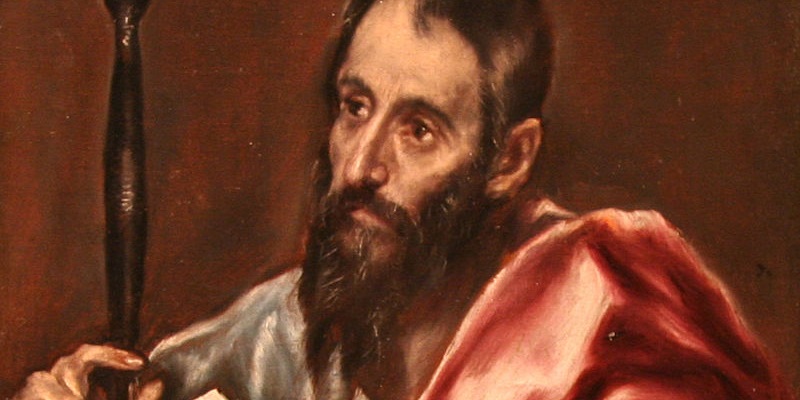
In order to invalidate celibacy, some evangelical Christians claim that Paul was married, and to support their position they say that he was a member of the Sanhedrin and that being married was a requirement for belonging to it.
To ground this argument they rely on Acts 26:10
“Which I also did at Jerusalem, and many of the saints did I shut up in prison, having received authority of the chief priests: and when they were put to death, I brought the sentence” Acts 26:10
Our evangelical brethren “freely interpret” this to mean that here Saint Paul says that he voted in the Sanhedrin. Is this true? To analyze this I have wanted to make this little study.
Analyzing the arguments
Let us begin by reading 1 Cor 7:1-8, where Saint Paul is asked about marriage and he explains his position on marriage and celibacy:
“Now concerning the things whereof you wrote to me: It is good for a man not to touch a woman. But for fear of fornication, let every man have his own wife, and let every woman have her own husband. Let the husband render the debt to his wife, and the wife also in like manner to the husband. The wife hath not power of her own body, but the husband. And in like manner the husband also hath not power of his own body, but the wife. Defraud not one another, except, perhaps, by consent, for a time, that you may give yourselves to prayer; and return together again, lest Satan tempt you for your incontinency. But I speak this by indulgence, not by commandment.” 1 Corinthians 7:1-8
And Saint Paul, after explaining what a marriage should be, says:
“For I would that all men were even as myself”
But was he not speaking just before about marriage, saying that the husband belongs to the wife and the wife to the husband?
What did he mean by “I would that all men were even as myself”?
In the verses that follow we find the answer:
“but every one hath his proper gift from God; one after this manner, and another after that. But I say to the unmarried and to the widows that it is good for them if they so continue, even as I”
If it is true that Paul was a widower, why did he not say “to the unmarried women and to the widowers I say that it is good for them to continue even as I”?
As for the argument that the members of the Sanhedrin were married, some say that this regulation was not in force until after Paul’s time (Longenecker, The Ministry and Message of Paul, Grand Rapids, Zondervan, 1971, pp. 23-24)
There is no record that Paul was a member of the Sanhedrin; otherwise the NT would say that he was expelled from it as a blasphemer or an apostate.
Now let us analyze Acts 26:10
“Which I also did at Jerusalem, and many of the saints did I shut up in prison, having received authority of the chief priests: and when they were put to death, I brought the sentence” Acts 26:10
Here Paul says that he had authority given to him by “the chief priests”, that is, the Sanhedrin charged Paul with persecuting the Christians (this does not prove that Paul was a member of the Sanhedrin; the only thing it proves is that he was “sent” to persecute the Christians), and then he says that after they were dead he cast his vote. Did the Sanhedrin really vote for or against a dead person? It sounds illogical…
Besides, would a member of the Sanhedrin personally take charge of persecuting the Christians, of traveling long distances until he found them? The role of a member of the Sanhedrin was inside the Sanhedrin, not outside of it; his duties were to interpret, to judge, to expel a member. They met as a kind of Tribunal in order to legislate.
The Sanhedrin was made up of 71 members, among whom was also the high priest (Acts 23:1-5), and it was originally composed of Sadducees and Pharisees. It seems there was a third component of the Sanhedrin: the elders, men of standing to whom a certain authority was acknowledged, even though they were not leaders by religious vocation (Mk 15:1; Acts 4:5; 8:27-28; 23:14; 24:1; 25:15)
In Acts 7:58 we find Paul witnessing the death of Stephen, and in this passage he is not shown as a member of the Sanhedrin:
“And casting him forth without the city, they stoned him; and the witnesses laid down their garments at the feet of a young man, whose name was Saul”
Here Paul is seen as a passive accomplice in the death of Stephen, and they call him a “young man”…
It is known that Paul was a Pharisee
“And Paul looking upon the council, said: Men, brethren, I have conversed with all good conscience before God until this present day. And the high priest Ananias commanded them that stood by him to strike him on the mouth. Then Paul said to him: God shall strike thee, thou whited wall. For sittest thou to judge me according to the law, and contrary to the law commandest me to be struck? And they that stood by said: Dost thou revile the high priest of God? And Paul said: I knew not, brethren, that he is the high priest. For it is written: ‘Thou shalt not speak evil of the prince of thy people’. And Paul knowing that the one part were Sadducees, and the other Pharisees, cried out in the council: Men, brethren, I am a Pharisee, the son of Pharisees. Concerning the hope and resurrection of the dead I am now called in question” Acts 23:1-6
Why did Paul not cry out “Brethren, I am a member of the Sanhedrin”?
And finally, the Biblioteca Judaica says that Paul was a Pharisee but does NOT say that he was a member of the Sanhedrin.
Conclusion
There is no record that Paul was a member of the Sanhedrin; there is not the slightest proof apart from suppositions, whereas what there is indeed biblical evidence for is Paul’s desire that all men be celibate as he was. He could not have been saying that he wished all men to be widowers, but rather that those who were in the state of celibacy should remain celibate in order to serve the kingdom of God without division.
“For I would that all men were even as myself: but every one hath his proper gift from God; one after this manner, and another after that. But I say to the unmarried, and to the widows: It is good for them if they so continue, even as I.” 1 Corinthians 7:7-8
But I would have you to be without solicitude. He that is without a wife, is solicitous for the things that belong to the Lord, how he may please God. But he that is with a wife, is solicitous for the things of the world, how he may please his wife: and he is divided. And the unmarried woman and the virgin thinketh on the things of the Lord, that she may be holy both in body and in spirit. But she that is married thinketh on the things of the world, how she may please her husband. And this I speak for your profit: not to cast a snare upon you; but for that which is decent, and which may give you power to attend upon the Lord, without impediment. 1 Corinthians 7:32-35
Author: Beatriz Aparicio
