–And with this one, that already makes five.
–In the biblical tradition, seven is a perfect number.
The exact diagnosis of a disease is the key to achieving its cure. Archbishop Lefebvre saw Rome as afflicted with “spiritual AIDS” (Tissier 597). For my part, as I already said in the first article of this series (126), Lefebvrism is a spiritual disease that has two principal causes: 1st, the condemnatory discernment of the present Church and of her Popes; and 2nd, the conviction that the Priestly Society of Saint Pius X is the providential means necessary to save the Church, keeping her in doctrinal and liturgical orthodoxy. I shall now confirm this diagnosis by recalling, in a synthesis, the historical development of Lefebvrism.
1970. Archbishop Lefebvre founds the Priestly Society of Saint Pius X “above all to make priests and, consequently, to open seminaries.” So he declares in an important conference from the beginning of 1987, in which he gives a historical summary of the SSPX. I shall return to it shortly. Indeed, shortly after the Second Vatican Council, and even during its celebration, the life of the Church was disturbed by very strong turbulence. It seemed that all the devils had been let loose; countless “errors and horrors” were occurring,which I have already described (129), the most spectacular being perhaps the abrupt ruin of the Seminaries. There were diocesan Seminaries that went from 1,000 to 10 seminarians, or to zero.
There is nothing strange, then, in the fact that Archbishop Lefebvre founded the SSPX in 1971 in Fribourg, Switzerland, with a five-year approval from the local Bishop, Bishop Charrière, and that he immediately established his Seminary, which soon moved to Écône. There an excellent Seminary was formed, perfectly adjusted to the tradition and to the norms of the Church. If I remember correctly, at one point there were more French seminarians in the SSPX than in all the French Seminaries put together. A very great grace of God. But… Écône remains closed to the “new Mass” and to the “conciliar Church.” Tensions with the Holy See keep growing.
1974. Archbishop Lefebvre finally makes at Écône a solemn declaration of his rejection of the “conciliar Church” (21-XI-1974). “We adhere with all our heart, with all our soul, to Catholic Rome… to eternal Rome, mistress of wisdom and of truth. We refuse, on the other hand—as we have always refused—to follow the Rome of neo-modernist and neo-Protestant tendency, which manifested itself clearly in the Second Vatican Council, and after the Council, in all the reforms that issued from it.”
“No authority, not even the highest Hierarchy, can oblige us to abandon or diminish our Catholic Faith, clearly expressed and professed by the Magisterium of the Church for nineteen centuries… This reform, having issued from liberalism, from modernism, is entirely poisoned; it comes out of heresy and ends in heresy, even though not all its acts are formally heretical… The only attitude of fidelity to the Church and to Catholic doctrine, for our salvation, is the categorical refusal to accept the Reform”… Tissier adds: “No sooner does Archbishop Lefebvre finish reading his declaration than the seminarians applaud, conscious of living a decisive moment” (Tissier 506).
These are years in which Archbishop Lefebvre accentuates more and more his public battle against the Council, the new Mass, and in general against the “conciliar Church.” Some of his works are particularly aggressive: La messe de Luther (1975), J’accuse le concile (1976), Le coup de maître de Satan, Écône face à la persécution (1975), etc.
1975. The absolute rejection of the new Mass is the principal cause of the suppression of the SSPX. Once the five-year term of temporary approval had elapsed, Bishop Mamie, successor of Bishop Charrière, does not renew the SSPX’s permission—that is, he suppresses it, in an act confirmed by the Holy See, under Paul VI. Archbishop Lefebvre files an appeal to the Apostolic Signatura, but it is not admitted for consideration. Breaking then with the canonical order of the Church,Archbishop Lefebvre decides that the SSPX and its Seminary must continue their existence, considering that upon it depends the historical continuity of the Catholic Church herself.
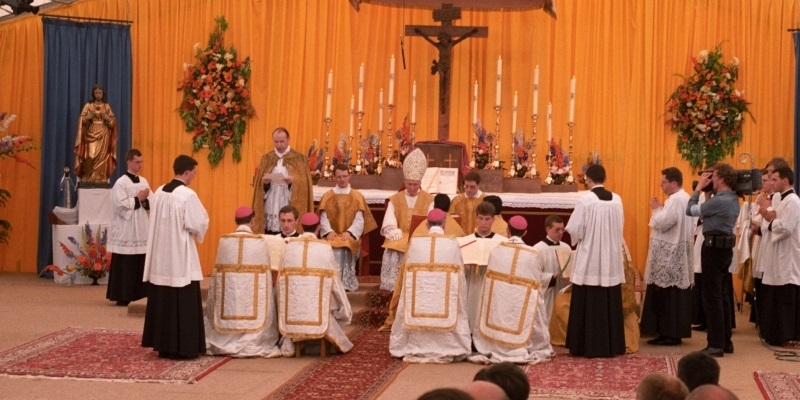
1976. Archbishop Lefebvre is suspended a divinis, and from then on he can no longer celebrate Mass and the sacraments licitly. Having received an admonition from the Holy See not to proceed with the ordination of the first group of seminarians formed at Écône, he disobeys the command, carries out the ordinations, and is suspended a divinis (22-VII-1976). Archbishop Lefebvre, who considers from the outset that the suspension is null, a month later (29-VIII)celebrates the Mass of Saint Pius V in a sports arena in Lille before 7,000 faithful and numerous media, and proclaims in the homily before some 400 journalists:
“The Revolution [of 1789] has made martyrs, but it has done nothing in comparison with the Second Vatican Council: priests apostate from their priesthood! The marriage between the Church and the Revolution that the triumphant liberal Catholics have wanted, who say: ‘with Vatican II our theses have been accepted,’ is an adulterous marriage. And from this adulterous union nothing can be born but bastards. The new rite of the Mass is a bastard rite, the sacraments [of the renewed rituals] are bastard sacraments, the priests who come out of the seminaries are bastard priests: they no longer know that they are constituted to go up to the altar to offer the sacrifice of Our Lord Jesus Christ” (Tissier 516-517).
1987. The years pass and the SSPX’s confrontation with the Church gradually reaches a peak phase. In the book “They Have Uncrowned Him” (1987) Archbishop Lefebvre fights hard against Vatican II, and especially against the decree on religious liberty (Dignitatis humanæ). This work, divided into four parts and 34 chapters, gathers a collection of conferences and writings of Archbishop Lefebvre. I point out the title of some chapters: The Brigandage of Vatican II (part IV, 24),A Suicidal Liberalism: The Post-Conciliar Reforms (32), etc.
In the third part, The Liberal Conspiracy of Satan against the Church and the Papacy, Archbishop Lefebvre recalls certain secret documents obtained by Gregory XVI and Pius IX. In them are described the satanic plans that, between the years 1820 and 1846, the Alta Vendita lodge of the Carbonari had already drawn up with the express aim of destroying the Church from within. “The pope, whoever he may be, will never come to the secret societies: it is the secret societies that must take the first step toward the Church” in order to conquer her… “We do not want to win the popes to our cause, to make them neophytes of our principles, propagators of our ideas. That would be a ridiculous dream… What we must strive for and await, as the Jews await the Messiah, is a pope according to our needs”… The plan designed is to infiltrate its spirit into the Church, above all in seminaries and convents, until the Masonic and liberal principles become predominant. “If you wish to establish the reign of the elect upon the throne of the harlot of Babylon, let the clergy march under your banner, believing always that they follow the banner of the apostolic keys.”
A terrible diabolical plan, Archbishop Lefebvre comments: “a pope seduced by liberal ideas, a pope who uses the keys of Saint Peter in the service of the counter-Church. Now then, is this not precisely what we are living through today, ever since Vatican II and since the new Code of Canon Law?With this false ecumenism and this false religious liberty promulgated at Vatican II and applied by the popes with cold perseverance, in spite of all the ruins they have provoked for more than twenty years! Without the infallibility of the Magisterium of the Church having been compromised, even perhaps without a heresy properly so called ever having been sustained, we are witnessing the systematic self-demolition of the Church. Self-demolition is a word of Paul VI, who implicitly denounced the true culprit, for who can ‘self-demolish’ the Church but the one whose mission is to keep her on the firm rock?… And what acid so effective for dissolving the rock as the liberal spirit that penetrates even the successor of Peter!… This plan is of diabolical inspiration and of diabolical realization! Not only have the enemies of the Church revealed it, but the popes too have unveiled and predicted it.”
The Priestly Society of Saint Pius X and Rome is an important and lengthy conference that Archbishop Lefebvre delivers months before ordaining four Bishops for the SSPX (Fideliter no. 55, I-II-1987). From it I highlight some of the more significant texts.
The Mass Published by Paul VI. In 1975 the SSPX, as we already saw, is suppressed because it rejects the Mass renewed by Paul VI. It is Bishop Mamie who decides it and communicates it: “‘It is inadmissible. Therefore we suppress you.’ He then exhibits the Ordo [Missae] of Msgr. Bugnini, invented, previously nonexistent. The obligation of the new Mass was imposed by the Vatican offices and by the bishops in France. In this way, unfortunately, the ancient Mass was abandoned by communities such as the Abbey of Fontgombault, under the pretext that it was necessary to obey the bishops. All of this was imposed by force, by obligation. There was an absolute determination to compel us to abandon this liturgy and, by the same token, to close our seminary.
“Faced with such imposture and illegality in which everything had been done, and above all faced with the spirit in which that persecution had been orchestrated, a modernist, progressive, and Masonic spirit, we believed that it was a duty to continue. It is not possible to accept something that has been done illegally, in an evil spirit, against Tradition and against the Church, in order to destroy her.”
“If our priests were to abandon the true liturgy, the true Holy Sacrifice of the Mass, the true sacraments, then it would not be worth continuing. It would be to commit suicide!… It would make our seminaries disappear. They could not accept the new liturgy; it would be to introduce the poison of the conciliar spirit into the community.” And he goes on to say:
Three Errors. “There are three fundamental errors which, of Masonic origin, are publicly professed by the modernists who occupy the Church. The substitution of the Decalogue by the Rights of Man [in reference to religious liberty]… This false ecumenism which in fact establishes equality among the religions… And the denial of the social kingship of Our Lord Jesus Christ through the secularization of States. The Pope has willed and has practically achieved the secularization of Societies, and thus the suppression of the reign of Our Lord over the Nations.”
“The situation is, therefore, extremely grave, because everything indicates that the realization of the Masonic ideal has been accomplished by Rome herself, by the Pope and the cardinals. This is what the Freemasons have always desired, and they have achieved it not by themselves but through the very men of the Church.”
Null Excommunications. For all of which, the ecclesial sanctions applied to Archbishop Lefebvre and to the SSPX are null. “It is this liberal Rome that has condemned us. But in so condemning Tradition, the Truth. We have rejected this condemnation because we consider it null and inspired by the modernist spirit. What we do and continue to do is to work for the maintenance of Tradition. We have thus found ourselves in a situation of apparent legal disobedience, but we have continued ordaining priests, giving priests to the faithful for the salvation of their souls”…
The Conciliar Church with the Revolution. “Louis Veuillot used to say: ‘Two powers live and are in struggle in the world: Revelation and Revolution. We have chosen to keep Revelation, whereas the new conciliar Church has chosen the Revolution’”—that of 1789.
1988. The schismatic ordinations of four Bishops of the SSPX (18-VI-1988) were already considered and described by me in another article (126), where I recalled the grave prior admonitions of the Holy See, the norms of canon law, the pressing letter of the Pope, etc. On several occasions, before proceeding with the ordinations of Bishops, Archbishop Lefebvre made a good number of consultations with persons of his greatest confidence (Tissier 566-576). The counsels he received were very diverse.
Not a few are those who advise the episcopal consecrations. But there are also quite a few—such as Fr. José Bisig, his second assistant, and the future ordained Bishops Fr. Tissier and Fr. Williamson—who judge that an act should not be carried out which would practically amount to denying the Primacy of the Pope (Tissier 568-569). And in this situation of disparate counsels, it is Archbishop Lefebvre personally who takes the decision to ordain. Fr. Bisig immediately leaves the SSPX, travels to Rome with a group of priests and seminarians, is received by the Pope, and shortly afterward they begin the Priestly Fraternity of Saint Peter. Tissier and Williamson, on the other hand, accept episcopal ordination: “Monseigneur has graces to decide, and we have grace to follow him” (591). In this and other circumstances one verifies that the personal leadership of Archbishop Lefebvre was very strong.
Moreover, this decision had for some time already been almost made in the mind of Archbishop Lefebvre. A year earlier, gathered at Fátima with his closest collaborators (22-VIII-1987), he tells them: “We cannot follow these people; it is apostasy, they do not believe in the divinity of Our Lord Jesus Christ, who must reign. Why should we wait any longer? Let us proceed to the consecration” of Bishops.
It must be acknowledged that, seeing the Church as Archbishop Lefebvre saw her, it was logical that he should ordain Bishops, even though in doing so he incurred a “schismatic act” (John Paul II, Ecclesia Dei, 2-VII-1988). Those schismatic episcopal ordinations were a grave duty of conscience (note well) if one believes, as Archbishop Lefebvre did, that at that time the Pope [the future Blessed John Paul II] was the Antichrist. What would any of us have done had we found ourselves in a similar situation?… The Antichrist has occupied the See of Peter: what must we do?… Evidently: ordain Bishops without his permission, and if necessary against his express command. We would have believed ourselves moved by God to create Catholic Bishops “so that the Church may continue.” From a frightful diagnosis about the Church proceeds a frightful schismatic act. Archbishop Lefebvre expresses it with all precision in his Letter to the Future Bishops (29-VIII-1987):
“Very dear friends, the See of Peter and the posts of authority in Rome being occupied by antichrists, the destruction of the Kingdom of Our Lord is being brought about at an accelerated pace… I find myself obliged, therefore, by divine Providence to transmit the grace of the episcopate that I have received, so that the Church and the Catholic priesthood may continue to subsist” (Tissier 578).
The sermon of Archbishop Lefebvre at the episcopal ordinations of 1988 also gives us some important keys for better understanding Lefebvrism. I have found the full text in English and in Spanish, but strangely not in French.
“You know well, dear brethren, how Leo XIII, in a prophetic vision that he had, said that one day the See of Peter would be the seat of iniquity. He said it in one of his exorcisms, in the ‘exorcism of Leo XIII.’ Is it today? Tomorrow? I do not know. In any case it has been announced. The iniquity may be quite simply error. Error is an iniquity: no longer to profess the Faith of always, no longer to profess the Catholic Faith, is a grave error; if there is a great iniquity, it is precisely that one! I really believe I can say that there has never been a greater iniquity in the Church than the day of Assisi,” etc.
“And not only has Pope Leo XIII prophesied these things, but Our Lady. Recently, the priest who is in charge of the Priory of Bogotá [of the SSPX] in Colombia brought me a book that deals with the apparitions of Our Lady of Good Success, who has a church, a great church in Ecuador, in Quito, the capital of Ecuador. These apparitions to a religious took place in a convent in Quito shortly after the Council of Trent… This miraculous Virgin is honored there with great devotion by the faithful of Ecuador, and she prophesied for the twentieth century. She said to this religious clearly: ‘During the nineteenth century and the greater part of the twentieth century, errors will spread ever more forcefully in the Holy Church, and will lead the Church to a situation of total catastrophe, of catastrophe! Morals will become corrupted and the Faith will disappear.’ Our impression is that we cannot but observe it.
“I beg pardon for continuing the account of this apparition, but in it there is spoken of a prelate who will oppose himself totally to this wave of apostasy and impiety and will preserve the priesthood by preparing good priests. Make the application yourselves if you wish; I do not want to make it. I myself was left stupefied reading these lines, I cannot deny it. It is inscribed, printed, recorded in the archives of this apparition.”
Let us see, finally, what the present situation of the SSPX is. To understand it better, it is helpful to recall that for many years Archbishop Lefebvre had as his most important interlocutor at the Holy See Cardinal Ratzinger. The latter, shortly after being made Pope, Benedict XVI, carries out two acts of great importance:
–1st. Through the motu proprio Summorum Pontificum (7-VII-2007), the Pope reaffirms in the Catholic Church the Mass published by Paul VI (1970) as the ordinary form of the Eucharistic Liturgy, and establishes as the extraordinary form the ancient Mass, prior to the Second Vatican Council, in the edition authorized by John XXIII (1962), which had never been properly abrogated.
The consequences that this motu proprio has for the liceity of the Masses celebrated by priests of the SSPX are specified in a letter (23-V-2008) that Msgr. Camille Perl, Vice-President of the Pontifical Commission Ecclesia Dei, writes to Mr. Brian Mershon, answering several concrete questions that the latter had put to the Commission.
“The priests of the Society of Saint Pius X are validly ordained, but suspended, that is: forbidden to exercise their priestly functions because they are not properly incardinated in a diocese or religious institute in full communion with the Holy See… This means that the Masses offered by the priests of the Society of Saint Pius X are valid, but illicit, i.e., contrary to Canon Law”…
The SSPX has thus been celebrating Holy Mass illicitly for decades. This is explained by the fact that the Society has always considered that both the excommunications and the suspensions a divinis were and are radically null.
–2nd. Benedict XVI lifts the excommunication of the four Bishops of the SSPX by means of a decree of the Congregation of Bishops (21-I-2009).
This act is presented by the SSPX as a great victory. Bishop Fellay, its Superior General, communicates in a circular letter that
“the excommunication of the bishops consecrated by H.E. Archbishop Marcel Lefebvre on 30 June 1988, which had been declared by the Sacred Congregation of Bishops by a decree of 1 July 1988, and which we have always rejected, has been withdrawn by another decree of the same Congregation, dated 21 January 2009 by mandate of Pope Benedict XVI… Thanks to this gesture, Catholics the world over attached to Tradition will no longer be unjustly stigmatized and condemned for having kept the faith of their fathers. Catholic Tradition is no longer excommunicated… We accept and make our own all the councils up to Vatican II. But we cannot but have reservations regarding the Second Vatican Council… We await the prompt rehabilitation of Archbishop Marcel Lefebvre” (Menzingen, 24-I-2009).
On the other side, the remission of the excommunication “has provoked, for many reasons, within and outside the Catholic Church, a discussion of a vehemence such as had not been seen for a long time.” So says the Pope in the document that follows.
Benedict XVI finds himself obliged, then, to write a letter to explain his act of benevolence (10-III-2009). In it the Pope corrects both the false triumphalism of the Lefebvrists and the bitter and harsh rejection on the part of some Catholics, especially Central Europeans. In this letter, then, he declares the true meaning of his benign gesture.
The Church, the Pope writes, had to react in 1988 against the episcopal ordinations carried out in the SSPX “with the harshest sanction, excommunication, in order to call the persons thus sanctioned to repentance and to the return to unity. Unfortunately, twenty years after the ordination, this objective has still not been attained.
“The remission of the excommunication tends to the same end served by the sanction: to invite the four Bishops once more to return. This gesture was possible after the interested parties had recognized in principle the Pope and his authority as Pastor, albeit with reservations concerning obedience to his doctrinal authority and to that of the Council…
“Until the questions concerning doctrine are clarified, the Society has no canonical status in the Church, and its ministers, although they have been freed from the ecclesiastical sanction, do not legitimately exercise any ministry in the Church…
“Certainly, for a long time now, and again on this particular occasion, we have heard from representatives of that community many things out of tune: pride and presumption, fixations on one-sided positions, etc. For love of the truth, I must add that I have also received a series of impressive testimonies of gratitude, in which I perceived an opening of hearts…
“And must we not admit that in the ecclesial sphere too there has been some going out of tune? At times one has the impression that our society has need of a group at least toward which to have no tolerance whatsoever; against which it may calmly lash out with hatred. And if someone tries to draw near to it—in this case the Pope—he too loses the right to tolerance and may likewise be treated with hatred, without fear or reservation.”
Let us collaborate wholeheartedly with the Pope in his effort to bring the SSPX back to the full unity of the Church. 1st. Let us collaborate chiefly through prayer: let us pray, pray, pray. 2nd. Let us collaborate through the witness of the truth. And you will excuse me for making reference to this blog Reforma o apostasía. We favor the full unity of the SSPX with the Catholic Church
–by denouncing the doctrinal, liturgical, and disciplinary infidelities that today injure the Catholic Church, and by affirming the Catholic truths, especially those most silenced or denied; in this way the continuity of the apostolic Magisterium is reaffirmed, whereas the rupture with Catholic Tradition prevails in so many ecclesial spheres [see in this blog (1-125)]; and we also collaborate
–by describing and rejecting the errors of the Lefebvrists, for in this way they are helped to dissociate themselves from those errors, a necessary condition for them to be able to “repent and return to the unity” of the Church, to which Benedict XVI, and all of us who are fully united to him in Catholic communion, so earnestly and kindly call them [see in this blog (126-129) and perhaps another article, God willing].
Author: Fr. José María Iraburu
