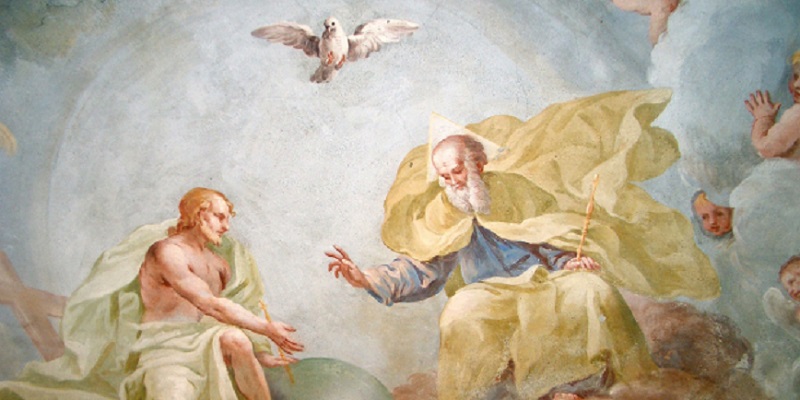
Reflections on the central mystery of Christianity.
The confession of one God in three persons, Father, Son and Holy Spirit, is what is most specific to Christianity and the original point of the Christian conception of God: it is precisely this Trinitarian vision of God that distinguishes Christianity from other monotheistic religions such as Judaism or Islam. The so-called Most Holy Trinity is considered by the Church to be “the central mystery of Christian faith and life,” a mystery considered “inaccessible to reason alone.” These difficulties in understanding the mystery have often led to skeptical opinions even among some Christians of good faith, for whom this Trinitarian confession of a God with one nature but three distinct persons would be a speculation proper to monks and theologians, foreign to the world and without any practical consequences. What is really hidden behind the Trinitarian confession? Is it possible that it still has something to say to the person of the twenty-first century?
The Trinitarian affirmation of God appears in practically all the traditions of the New Testament. We find it in Saint Mark, in the account of Jesus’ baptism, and it also appears in Saint Matthew (where the baptismal command of Mt 28:19 is particularly relevant), in Saint Luke and in Saint John; moreover, Trinitarian affirmations can be found in numerous texts of Saint Paul. The Trinitarian witness is firmly rooted in the early Christian community, which synthesized in this formula the result of a new reflection on God based on the experiences lived alongside Jesus of Nazareth. The disciples had heard Jesus’ teachings and had witnessed his deeds, many of them wondrous. Jesus’ words and actions had revealed to them that the One and Almighty God is, above all, a God of love who is like a father to all. They had likewise witnessed that there existed a relationship of special sonship between Jesus and this God the Father. After the bitter hours of Jesus’ arrest, trial and crucifixion, they witnessed his resurrection, which was a real fact for the disciples; this again raised the question of Jesus’ true identity, and from then on he became Christ. Finally, when the Risen One ceased to show himself to the disciples, they also experienced an interior force that impelled them to spread their faith, realizing that, in a different way, Jesus the Christ remained present among them and gave them a strength they had previously lacked. All these realities witnessed by the first disciples gave rise to a new vision of God, in which he is at once Father, Son and Spirit.
 The Old Testament certainly already spoke of God as Father. The concept of the Spirit of God also appears repeatedly in the Bible from its first pages: in the Bible, spirit is the vital principle of man, and the Spirit of God is the divine force or power that creates, preserves, directs and guides everything. The followers of Jesus knew these ideas and, acting upon them, their experience of Jesus of Nazareth revealed to them the existence in God of three distinct faces: Father, Son and Spirit:
a.- God “Father.” New Testament exegetes are unanimous in affirming that the invocation of God as Father (abba, in Aramaic), besides being a trait proper to Jesus, belongs to what has come to be called the ipsissima verba of Jesus, the words undoubtedly spoken by him. It is Jesus himself, and he alone, who reveals God to us as Father and teaches us to pray by saying “Our Father.” With the term Father, God is designated as a being with a concrete personal face, who has a name and can be called by his name. There is no doubt, in short, that this appeal to God as Father is not a theoretical speculation but is directly connected with Jesus’ teaching.
b.- God “Son.” Those who followed Jesus observed that he “taught as one who had authority,” that he had power over demons, that he healed the sick, that he forgave sinners, that he stood above the Sabbath, that he questioned the norms concerning ritual purity and the temple, that he allowed himself to correct the commands of the Law, that he invoked God in a particular and intimate way as his Father. All this already pointed to Jesus being invested with a special authority that identified him as one sent by God, superior to Moses and the prophets. For this reason, even before his death, people wondered about his identity, a question that received various answers. After his death, God raised Jesus, and he appeared to his disciples. This exceptional event opened the eyes of his followers, who then understood that Jesus was not only the expected Messiah (the Christ), but that his relationship with God was so special, intimate and unrepeatable that Jesus could truly be called Son of God. After the Resurrection, Jesus becomes the decisive person, and no title will seem excessive to the primitive community. With the title Son of God, the particular union of Jesus with God was expressed, a union that allowed him to invoke God as Father; it was meant to indicate to what extent Jesus of Nazareth belongs to God, to what extent he stands at God’s side before the community and before the world, subject only to the Father, constituted as God’s definitive and unique representative before men.
c.- God “Spirit.” Primitive Christianity faced the problem of how to express, once the Risen One ceased to be visibly present to the disciples, that Christ Jesus continued to be truly near the believer. The answer to this question was that God and Jesus Christ are near the believer and the community in the Spirit. It is not merely that they remained in the memory of believers, but that the presence of Christ in the community existed in a real way in the form of Spirit. The Holy Spirit is, in the words of a well-known theologian, Spirit of God, God himself as force and power of grace that conquers the interior, the heart of man, that subdues the whole man and becomes intimately present to him, giving from himself effective witness to the human spirit. The first disciples experienced within themselves the force of God and of Christ in the form of Spirit, and that force impelled them to spread the new message throughout the world.
As the centuries passed, and surely with the purpose of countering certain incorrect interpretations, the different councils developed and explained the doctrine of the Trinity using concepts proper to their time that today may seem complicated and far removed from ours. However, we cannot forget, as has been explained, that perhaps things were simpler at the time and that, at its origin, the first Christian community, in its Trinitarian confession of God, did nothing other than narrate simply, in the light of everything that happened with Jesus of Nazareth, that they had discovered three distinct faces in the one God who had revealed himself to them in an unrepeatable and surprising way.
Author: Fernando Renau
Taken from Apologetica.org
