Those were the days when one could praise the ecumenical practice of the Holy See, where «charity in truth» prevailed and practice matched what the magisterial documents said.
It was not long ago (in 2012) that the President of the Pontifical Council for Promoting Christian Unity, Cardinal Koch, declared with regard to the Centenary of the Reformation: «we cannot celebrate a sin», «the events that divide Christians cannot be called a feast day». At that time he was of the very firm opinion that «the separation of the Protestant churches from the Church is not an expression of success, but the failure of the Reformation», and for that reason, in November of the same year, he repeated that «there is nothing to celebrate with regard to the Protestant Reformation». Even when he wanted to point to a «disobedient» group, he did not hesitate to compare them with Luther.
Four years later (2016), Pope Francis gave way. At that moment it was said that it would not be celebrated, but that the Protestant Reformation would be «commemorated». And yes, much insistence was placed on the fact that nothing was being celebrated, but that it was a «remembering together» in search of unity and reconciliation. Some were satisfied; others, not so much.
Then the excesses began to come in a cascade. Luther was declared a «Witness to the Gospel» by the Pontifical Council for Promoting Christian Unity, presided over by the same Cardinal Koch who had previously shown himself so measured. Almost immediately the cardinal finished capitulating by publishing a laudatory article about the «reformer» in L’Osservatore Romano, for which he was personally congratulated by Pope Francis. In that article he said that Luther «had in mind the renewal of all Christendom in the spirit of the Gospel» and «would have found in the Second Vatican Council his council»: just imagine Luther signing Lumen Gentium!
The signal had been clearly understood: to praise Luther effusively seemed to be the sure path for aligning oneself with the politically correct trend then in vogue in the Church and thus ensuring at least a pat on the back.
Today the situation is totally out of control. The Jesuit journal La Civiltà Cattolica, which according to its own director Antonio Spadaro is reviewed directly by the Holy See, publishes an article asking whether Luther «was truly heretical»:
«Today, five hundred years later, historical research and recent studies lead us to ask ourselves: “Luther: Heretic”, really? (…) Honesty and love for the truth must support research and guide our eyes before the urgent need for a rereading of the past, free from clichés and vulgarities handed down uncritically; free also from positions and prejudices that have arisen over the centuries at the expense of the truth».
«Five centuries after the Reformation, it is possible to turn to Luther with a new gaze in order to grasp him in his truth and context. The Wittenberg Theses are not a challenge or a rebellion against authority, but the proposal for a renewal of the proclamation of the Gospel, in the sincere desire for a “reform” in the Church. The question of power was perhaps the claim, both of the Church of Rome and of Luther, to embody the truth and to be its dispensers. Nevertheless, despite everything, one cannot deny the role Luther had as a witness to the faith.»
Recently the general secretary of the Italian Episcopal Conference, Archbishop Nunzio Galantino, also stated at a conference at the Pontifical Lateran University in Rome that the Protestant Reformation «has been, is and will be in the future an event of the Spirit»
Now, well acclimatized, people say without shame or hesitation that they are going to «celebrate»—not commemorate—the «Reformation». That is exactly what they have just done in the Cathedral of Mallorca, in a solemn ecumenical service presided over by the Protestant bishop Margot Kässmann, the Anglican bishop David Hamid, and the cathedral canon Joan Bestard, on behalf of the bishop of Mallorca.
We urgently need true ecumenism

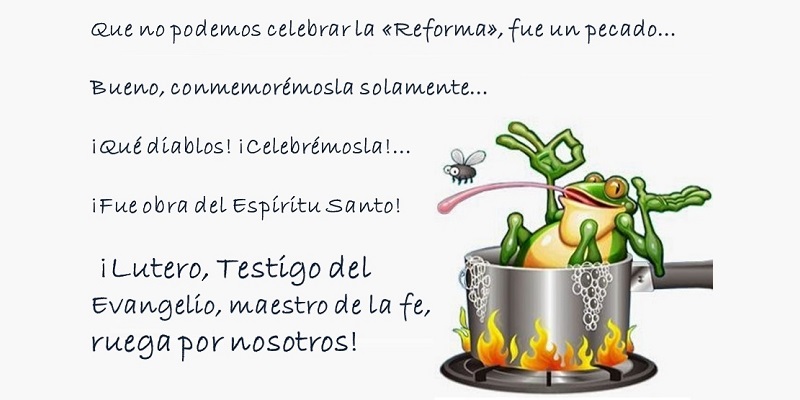
I do not know whether it is just my impression, but it seems that we have ended up being cooked like the frog that is first placed in warm water so it can acclimatize, and then the temperature is gradually raised.
I have always recognized that ecumenism is a movement inspired by the Holy Spirit that seeks to restore the unity of Christians. But, as so many previous Popes have said in the past: unity cannot be sought at the expense of truth.
That is precisely what is incomprehensible about the practice of ecumenism today by a large part of the Catholic hierarchy. While La Civiltà Cattolica criticizes the genuine ecumenism between Catholics and Protestants who cooperate on pro-life and pro-family issues, calling it «ecumenism of hate», it wants Catholics to wonder whether the solemn condemnations issued by an Ecumenical Council against the German heresiarch were really justified.
Let this be clearly understood: if Luther was right and his doctrines were not heretical, then we have absolutely nothing to do in the Catholic Church. There would be no need for the Magisterium, because it would have to be replaced by the free interpretation of the Bible. There would be no need for the celebration of the Eucharist, which Luther described as a sacrilegious abomination. The Pope would not have to «waste» time on canonizations, because they would be idolatry. There is no need to recall what other Catholic teachings we would have to throw into the trash. Wanting to draw closer to Protestants by vindicating Luther—and worse still, his doctrines—is a betrayal of the truth and of the Church of Jesus Christ.
In my opinion, one of the great failures of this pontificate is precisely this: wanting to be on good terms with Protestants by reinterpreting history. Because even if we rewrite it, Protestants will still believe today what they believe, and it will still be incompatible with the Catholic faith.
“In effect, this unity bestowed by the Holy Spirit does not merely consist in the gathering of people as a collection of individuals. It is a unity constituted by the bonds of the profession of faith, the sacraments and hierarchical communion. The faithful are one because, in the Spirit, they are in communion with the Son and, in him, share in his communion with the Father: «Our fellowship is with the Father and with his Son Jesus Christ» (1 Jn 1:3). For the Catholic Church, then, the communion of Christians is none other than the manifestation in them of the grace by which God makes them sharers in his own communion, which is his eternal life. Christ’s words «that they may be one» are thus his prayer to the Father that the Father’s plan may be fully accomplished, in such a way that everyone may clearly see «what is the plan of the mystery hidden for ages in God who created all things» (Eph 3:9). To believe in Christ means to desire unity; to desire unity means to desire the Church; to desire the Church means to desire the communion of grace which corresponds to the Father’s plan from all eternity. Such is the meaning of Christ’s prayer: «Ut unum sint».” John Paul II, Ut unum sint 9
“It should be repeated that, on the part of the church and her members, dialogue, whatever form it takes—and these forms can be and are very diverse since the very concept of dialogue has an analogical value—can never begin from an attitude of indifference to the truth. On the contrary, it must begin from a presentation of the truth, offered in a calm way, with respect for the intelligence and consciences of others. The dialogue of reconciliation can never replace or attenuate the proclamation of the truth of the Gospel, the precise goal of which is conversion from sin and communion with Christ and the church. It must be at the service of the transmission and realization of that truth through the means left by Christ to the church for the pastoral activity of reconciliation, namely catechesis and penance.” Reconciliatio Et Paenitentia, 25
